

Use BACnet at the supervisory and BMS layer for multi-vendor interoperability, and Modbus at the field device layer for meters, variable frequency drives, and OEM-packaged equipment. The hybrid architecture reduces equipment budget inflation compared with forcing BACnet on every field device, while preserving the object-level semantics that building operators and commissioning agents depend on at the head end.
Three architectures cover the majority of Canadian projects:
- BACnet-first greenfield: BACnet/IP or BACnet Secure Connect (B/SC) at the supervisory layer, BACnet MS/TP on the field bus for native BACnet controllers (AHUs, VAVs, FCUs), with Modbus RTU or Modbus TCP only where OEM equipment ships no BACnet option.
- Modbus-first legacy retrofit: Existing Modbus RTU field devices retained; a hardware gateway or multi-protocol controller translates to BACnet objects for the head-end BMS, avoiding full device replacement.
- Hybrid with gateway normalization: A middleware platform such as the Niagara Framework (Tridium) or HMS Anybus-style gateways normalizes both stacks into a unified point namespace, hiding protocol differences from operations staff and the BMS front end.
For Canadian projects in Alberta and Ontario, commissioning coordination with the Authority Having Jurisdiction (AHJ) is required wherever networked controls affect life-safety systems, including fire alarm integration and emergency power. Document point ownership in tender and O&M deliverables from day one.
Table of Contents
- How do BACnet and Modbus compare across key decision dimensions?
- What are BACnet and Modbus, and where does each protocol belong?
- What are the core technical differences between BACnet and Modbus?
- How do the transport variants work: BACnet/IP, MS/TP, B/SC, Modbus TCP, and RTU?
- How do you connect BACnet and Modbus in real systems?
- What are the security requirements for BACnet and Modbus in Canadian projects?
- What performance and scalability should you plan for?
- How do you decide between BACnet, Modbus, or a hybrid approach?
- Migration, commissioning, and Canadian field notes
- Key Takeaways
- The case for treating protocol selection as a systems engineering decision
- Futuregenconsulting brings MEP and BAS integration expertise to Canadian projects
- Standards, tools, and further reading for engineers
How do BACnet and Modbus compare across key decision dimensions?
BACnet and Modbus differ across nearly every engineering decision dimension. The table below gives a side-by-side reference for the most common project criteria.
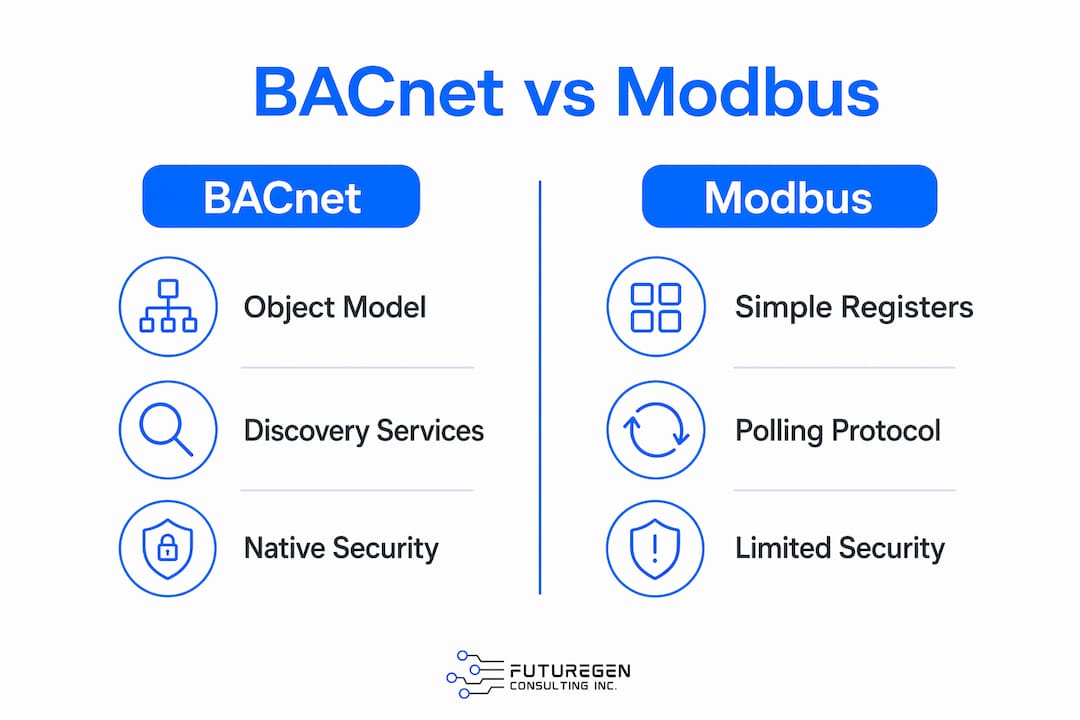
| Dimension | BACnet | Modbus |
|---|---|---|
| Typical use case / domain | Supervisory BMS, multi-vendor building automation (HVAC, lighting, access, fire) | Field devices: meters, VFDs, PLCs, OEM packaged skids |
| Data model | Object-oriented (Analog Input, Binary Output, Trend Log, Notification Class) | Flat register/coil map (Holding Registers, Input Registers, Coils, Discrete Inputs) |
| Transport / physical layer | BACnet/IP (UDP 47808), BACnet MS/TP (RS-485), BACnet/SC (TLS/WebSocket) | Modbus TCP (TCP 502), Modbus RTU (RS-485), Modbus ASCII (serial) |
| Discovery and interoperability | Native Who-Is/I-Am broadcast discovery; ASHRAE Standard 135 conformance testing | No native discovery; register maps are vendor-specific documentation |
| Scalability / device counts | Hundreds of devices per BACnet/IP internetwork; MS/TP limited to ~127 nodes per trunk | Modbus RTU: up to 247 addresses per trunk; Modbus TCP: limited by master polling capacity |
| Latency and determinism | COV subscriptions reduce polling; MS/TP token-passing adds deterministic latency | RTU serial trunks: 8–15 s full scan at 19,200 baud with ~30 slaves; TCP faster but still poll-driven |
| Security and mitigations | BACnet/SC: TLS 1.3, mutual authentication; BACnet/IP: no native security, mitigate with OT VLANs | No native security in standard Modbus; Modbus/TCP Security (port 802) rarely implemented; mitigate with VLANs and firewalls |
| Ease of integration / tooling | Broad vendor support; Niagara Framework, PICS documents, conformance testing | Simple PDU; widely supported; requires manual register map interpretation |
| Commissioning needs | BBMD/FDR configuration for inter-subnet discovery; unique Device Instance assignment | Register map validation; byte-order and scaling verification; writable-point failure-mode testing |
| Typical cost / timeline drivers | Higher device cost for native BACnet field hardware; faster BMS commissioning | Lower field device cost; gateway adds cost and schedule; mapping labor intensive |
Single-sentence conclusions per dimension:
- Best for multi-vendor BMS supervisory layer: BACnet/IP or BACnet/SC.
- Best for meters, VFDs, and packaged skids: Modbus RTU or Modbus TCP.
- Best hybrid action path: Deploy a dedicated gateway or Niagara normalization layer to bridge both stacks rather than forcing one protocol across all tiers.
What are BACnet and Modbus, and where does each protocol belong?
BACnet: ASHRAE Standard 135 and the object model
BACnet is the global data communications protocol standard for building automation and control networks, developed and maintained by ASHRAE’s Standing Standard Project Committee 135 (SSPC 135). It was first published as ANSI/ASHRAE Standard 135 in 1995 and became an ISO standard (ISO 16484-5) in 2004. The protocol defines an abstract, object-oriented representation of information exchanged between devices, which means every data point carries metadata: object name, units, description, and status flags. Native services include device and object discovery (Who-Is/I-Am, Who-Has), Change of Value (COV) subscriptions, alarm and event notification, trend logging, and scheduling.
Typical BACnet domains in Canadian commercial buildings include:
- BMS head-end workstations and supervisory controllers
- Air handling units (AHUs), variable air volume (VAV) boxes, and fan coil units (FCUs)
- Lighting control panels and access control head ends
- Fire alarm integration gateways (where the AHJ permits BACnet/IP interconnection)
Modbus: the de facto industrial standard since 1979
Modbus originated as a serial communication protocol published by Modicon in 1979 and remains the industry’s serial de facto standard for field-level automation devices. Its data model is a flat map of four primary data types: Holding Registers (read/write 16-bit words), Input Registers (read-only 16-bit words), Coils (single-bit read/write), and Discrete Inputs (single-bit read-only). Communication follows a strict client/server (master/slave) request-response model with no broadcast discovery. Every integration depends on the vendor’s register map documentation.
Typical Modbus domains include:
- Revenue-grade and sub-meters
- Variable frequency drives and soft starters
- Packaged chillers, boilers, and rooftop units with OEM controllers
- PLC-level I/O modules and process instruments
Key integration terms engineers use daily:
Unit ID — the Modbus device address (1–247 on RTU; also used in TCP MBAP header).
Object_Identifier — the BACnet unique identifier combining object type and instance number within a device.
COV (Change of Value) — a BACnet subscription service that pushes updates only when a value changes, reducing polling traffic.
Holding Register — Modbus register type FC03/FC16, 16-bit read/write, the most common data container.
Coil — single-bit read/write Modbus data type, used for discrete outputs.
Function Code — the one-byte field in a Modbus PDU that specifies the action (e.g., FC03 = Read Holding Registers, FC16 = Write Multiple Registers).
What are the core technical differences between BACnet and Modbus?
Data model and metadata
BACnet’s object model is the most consequential difference for integrators. Each BACnet object (Analog Input, Analog Output, Binary Input, Binary Output, Multi-State Input, Trend Log, Notification Class) carries properties including Present_Value, Units, Description, and Status_Flags. That metadata travels with the data, which reduces the manual mapping effort required during commissioning. Modbus exposes raw 16-bit register values with no embedded units or naming. Every scaling factor, engineering unit, and point description must be sourced from the vendor’s register map and entered manually into the BMS or gateway configuration.

Addressing and namespace
BACnet uses a two-level addressing scheme: a Device Instance (a 22-bit integer, globally unique across the BACnet internetwork) and an Object_Identifier (object type plus instance number within that device). Conflicts arise when contractors commission multiple devices with duplicate Device Instances, a common field problem that requires a documented instance assignment plan before commissioning begins. Modbus addressing is simpler: a Unit ID (1–247 for RTU) plus a register offset. Conflicts are less common but register map discrepancies between firmware versions are a frequent source of incorrect readings.
Discovery and services
BACnet’s Who-Is/I-Am mechanism allows a BMS to broadcast a discovery request and receive responses from all BACnet devices on the internetwork, including across subnets when BBMD or Foreign Device Registration (FDR) is configured. Modbus has no equivalent. Every Modbus device must be known in advance, its Unit ID pre-assigned, and its register map loaded into the master or gateway configuration before any communication can occur. This documentation-driven integration model means that missing or incorrect register maps directly delay commissioning.
Mapping pitfalls: byte order and scaling
Modbus transmits 16-bit words, but 32-bit floating-point values and 32-bit integers require two consecutive registers. The byte and word order of those register pairs varies by vendor and is not specified in the Modbus application protocol. A 32-bit float stored as Big-Endian Word, Little-Endian Byte will produce a plausible but completely incorrect value if the gateway is configured for standard Big-Endian. This is one of the most common commissioning failures on Modbus integrations.
Statistic callout: A Modbus RTU trunk running at a typical baud rate with several slaves and registers per slave can require a full scan time of multiple seconds. At incorrect byte-order settings, every 32-bit value in that scan returns a wrong number that still falls within a plausible engineering range, making the error difficult to detect without a reference instrument.
How do the transport variants work: BACnet/IP, MS/TP, B/SC, Modbus TCP, and RTU?
Each protocol family runs over multiple physical and network transports, and the choice of transport directly affects network design, firewall rules, and commissioning procedures.
| Transport | Protocol | Port / Medium | Key operational notes |
|---|---|---|---|
| BACnet/IP | BACnet | UDP 47808 | Broadcast-based Who-Is; requires BBMD for inter-subnet discovery; works over standard Ethernet/IP infrastructure |
| BACnet MS/TP | BACnet | RS-485 serial | Token-passing bus; up to 127 nodes per trunk; deterministic but slower than IP; common for VAVs and FCUs |
| BACnet/SC | BACnet | TLS/WebSocket (hub-and-spoke) | TLS 1.3 and mutual authentication; requires certificate management; changes topology from broadcast to hub-and-spoke |
| Modbus TCP | Modbus | TCP 502 | Removes serial bottleneck; high transaction rates for dense polls; firewall port 502 from corporate networks |
| Modbus RTU | Modbus | RS-485 serial | Most common field-device transport; 8–15 s scan at 19,200 baud with ~30 slaves; half-duplex; termination and biasing critical |
| Modbus ASCII | Modbus | RS-485 | Older, less efficient encoding; used in legacy instrumentation only |
BACnet/IP broadcast behavior and BBMD
BACnet/IP relies on UDP broadcasts for Who-Is discovery. Routers block UDP broadcasts by default, so any BACnet/IP deployment spanning multiple subnets requires a BACnet Broadcast Management Device (BBMD) on each subnet, or Foreign Device Registration (FDR) for devices that cannot host a BBMD. Failure to configure BBMD correctly is one of the most common reasons a BMS cannot discover controllers after a network change. In Alberta projects where building IT and OT networks are on separate VLANs, confirm BBMD placement and inter-VLAN routing rules with the network engineer before commissioning.
Modbus TCP and firewall rules
Modbus TCP uses TCP port 502 with no authentication. Any device that can reach port 502 on a Modbus TCP server can read or write registers. Firewall rules blocking port 502 from corporate and guest networks are a minimum requirement, not an option.
How do you connect BACnet and Modbus in real systems?
Integration patterns
Three patterns cover most Canadian projects. First, a native multi-protocol controller handles both stacks internally: the controller polls Modbus RTU devices on one port and presents their data as BACnet objects on the IP network. This works well for small device counts, typically up to 5–10 Modbus devices, where a separate gateway is not justified. Second, a dedicated hardware gateway (products in the HMS Anybus family are a widely cited example) sits between the Modbus field bus and the BACnet network, translating registers to objects with configurable byte-swap, scaling, and point-type mapping. Typical hardware gateways handle 50–200 Modbus devices and 5,000–10,000 data points; beyond those counts, software middleware becomes preferable. Third, a middleware platform such as the Niagara Framework normalizes both protocols under a unified point namespace, hiding protocol differences from the BMS front end and from operations staff.
Mapping example: Modbus register pair to BACnet Analog Input
| Step | Modbus side | BACnet side | Notes |
|---|---|---|---|
| 1. Identify register | Unit ID 5, Holding Registers | — | 32-bit float, two registers |
| 2. Confirm byte order | Big-Endian Word, Little-Endian Byte | — | Verify empirically with reference instrument |
| 3. Apply scaling | Raw float scaled | — | Per vendor register map |
| 4. Map to BACnet object | — | Analog Input, Instance 1 | Object name: “Chiller-1 Entering Water Temp” |
| 5. Set units property | — | Units: degrees-Celsius | Carried in BACnet object metadata |
| 6. Set COV increment | — | COV_Increment | Reduces unnecessary BACnet traffic |
Gateway sizing and selection criteria
When procuring a gateway, verify: maximum Modbus device count and total point count against the project schedule, polling capacity in points per second, writable-point support and behavior on communication loss (fail-safe or hold-last-value), RS-485 isolation and termination options, and supported byte-order configurations. For projects with writable points, test failover behavior explicitly during commissioning. A gateway that holds the last commanded value on communication loss behaves very differently from one that drives outputs to a safe default.
Pro Tip: Confirm byte-order settings empirically during commissioning by comparing the gateway’s displayed value against a calibrated reference instrument or the device’s local display. Do not rely solely on the vendor register map, as firmware revisions sometimes change default byte order without updating documentation.
What are the security requirements for BACnet and Modbus in Canadian projects?
Native security posture
BACnet Secure Connect (B/SC) is the only BACnet transport with native cryptographic security. It wraps BACnet messages in TLS 1.3 with X.509 mutual authentication, changing the network topology from broadcast to a hub-and-spoke WebSocket architecture. B/SC requires compatible firmware on every BACnet node and a certificate management process covering issuance, renewal, and revocation. BACnet/IP and BACnet MS/TP have no native security.
Modbus has no native security in its standard form. The Modbus Organization has published a Modbus Security protocol that uses TLS encapsulation and X.509v3 certificates on port 802, but most device vendors do not implement it. Treat standard Modbus as a plaintext protocol and compensate entirely at the network layer.
Practical mitigations for Canadian projects
- Segment all BACnet/IP and Modbus TCP devices on a dedicated OT VLAN, isolated from corporate and guest networks.
- Apply access control lists to restrict inter-VLAN routing; block TCP port 502 from all non-OT subnets.
- For BACnet/IP, restrict UDP 47808 to the OT VLAN and configure BBMD only where inter-subnet discovery is required.
- Conduct quarterly firewall rule audits to confirm that OT segmentation has not been bypassed by network changes.
- For B/SC deployments, establish a certificate lifecycle process: track expiry dates, automate renewal alerts, and test mutual authentication during commissioning with a packet capture confirming the TLS handshake completes.
Canadian project note: Where networked building controls interface with life-safety systems (fire alarm, emergency power, or sprinkler monitoring), the AHJ may require review of the network architecture as part of the permit and inspection process under the applicable edition of the National Building Code of Canada (NBC) and provincial amendments. Coordinate with the AHJ and the project’s electrical engineer of record before finalizing OT network segmentation design.
Pro Tip: During B/SC commissioning, run a packet capture on the WebSocket connection between a BACnet node and the hub. Confirm the TLS handshake completes with mutual certificate exchange before signing off on the network configuration. A one-sided handshake (server-only auth) means the node firmware does not support full B/SC mutual authentication.
What performance and scalability should you plan for?
Polling behavior and scan times
Modbus is entirely poll-driven. The master queries each device sequentially, and the total scan time grows linearly with device count and register density. A Modbus RTU trunk at 19,200 baud with approximately 30 slaves and 50 registers per slave produces a full scan time of roughly 8–15 seconds. Modbus TCP removes the serial bottleneck but still generates high transaction rates for dense poll sets, which can saturate a gateway’s processing capacity before the network itself becomes the constraint.
BACnet COV subscriptions invert this model: the controller sends a notification only when a value changes by more than the configured COV increment. For stable points (setpoints, equipment status), COV dramatically reduces traffic. For rapidly changing analog values, COV can generate more traffic than polling if the increment is set too small.
Scalability planning
For Modbus RTU trunks, keep device counts below 30 per trunk when polling intervals under 30 seconds are required. For Modbus TCP, the gateway’s polling capacity in transactions per second is the binding constraint, not the network. For BACnet/IP, the practical limit per internetwork is in the hundreds of devices; MS/TP trunks are limited to 127 nodes, with 32 or fewer recommended for reliable token-passing performance.
Tuning actions to improve performance:
- Reduce poll sets to only the points required for control and alarming; exclude diagnostic registers from routine scans.
- Increase poll intervals for non-critical monitoring points (energy sub-meters, ambient sensors) to 60 seconds or longer.
- Enable COV subscriptions on BACnet controllers for all stable setpoint and status objects.
- Choose middleware that supports point-level throttling so high-frequency control points and low-priority monitoring points can be polled at different rates.
- Segment large Modbus device populations across multiple gateway instances rather than loading a single gateway beyond its rated point count.
How do you decide between BACnet, Modbus, or a hybrid approach?
Work through the following decision steps in sequence before finalizing the protocol strategy for any project.
- Identify native device protocols. Survey every field device in the design. Confirm whether each ships BACnet, Modbus, or both natively. OEM-packaged equipment (chillers, boilers, rooftop units) frequently ships Modbus-only regardless of project specification.
- Confirm head-end requirements. Does the owner’s BMS or the specified supervisory controller require BACnet objects? Most enterprise BMS platforms (including Niagara-based systems) can consume both, but the owner’s IT and facilities team may mandate BACnet for long-term maintainability.
- Count writable points. Writable Modbus points (FC16 writes) require explicit gateway configuration and failure-mode testing. A high writable-point count increases commissioning hours and gateway complexity; factor this into the schedule.
- Assess network topology constraints. Multi-subnet buildings require BBMD planning for BACnet/IP. Serial RS-485 trunks require physical topology planning (daisy-chain, termination, maximum cable length). Confirm whether the IT team will permit OT devices on the IP network or require a separate OT infrastructure.
- Score the following checklist items:
- Multi-vendor interoperability required at supervisory layer → BACnet/IP or B/SC.
- Field devices are Modbus-only OEM equipment → retain Modbus, add gateway.
- Security policy requires encrypted control traffic → BACnet/SC; plan certificate management.
- Commissioning hours budget is constrained → native BACnet field devices reduce mapping labor.
- Future extensibility and BMS portability are owner priorities → BACnet object model reduces long-term lock-in.
- Canadian permit and AHJ review required for life-safety integration → document protocol boundaries in the design submission.
- Apply the decision flow:
- Does the head end require BACnet objects? If yes, proceed with BACnet at the supervisory layer.
- Are more than 10 field devices Modbus-only? If yes, specify a dedicated gateway rather than relying on controller-native Modbus ports.
- Does the IT security policy require encrypted BACnet traffic? If yes, specify B/SC-compatible firmware and plan certificate infrastructure.
For building automation systems in Alberta, the hybrid architecture resolves the majority of these decision points without requiring full protocol replacement at the field layer.
Migration, commissioning, and Canadian field notes
Migration timeline and milestones
A medium-sized commercial building integration project typically follows four phases:
- Survey and device inventory (1–2 weeks): document every field device, its native protocol, firmware version, and register map or PICS document. Identify gaps where register maps are unavailable.
- Mapping and gateway design (1–2 weeks): produce the point list, assign BACnet Device Instances, configure gateway templates, and validate byte-order settings in a lab or staging environment.
- Staged commissioning (2–4 weeks): commission one system at a time (e.g., HVAC controls first, then metering, then access), validate each point against a reference instrument, and test writable-point failure modes.
- Handover and training (1 week): deliver as-built point lists, gateway configurations, and O&M documentation; train facilities staff on alarm acknowledgment and BMS navigation.
Commissioning reality check: The survey and mapping phases are consistently underestimated. On projects where register maps are missing or incorrect for even a subset of Modbus devices, the mapping phase alone can extend by one to two weeks. Budget accordingly, and require vendors to submit register maps with submittals, not at commissioning.
Commissioning checklist
- Assign unique BACnet Device Instance numbers across the entire internetwork before any controller is powered on site.
- Configure BBMD on each subnet and verify inter-subnet Who-Is/I-Am discovery with a BACnet browser before connecting the BMS.
- Validate every Modbus register against a reference instrument or the device’s local display, paying particular attention to 32-bit float registers.
- Test every writable point: command a value from the BMS, confirm the field device responds, then simulate a communication loss and confirm the gateway’s failure mode matches the design intent.
- For B/SC nodes, capture the TLS handshake and confirm mutual certificate authentication.
- Document point ownership (which system is the authoritative writer for each writable point) in the O&M deliverables.
Canadian field notes
For HVAC design and control integration in Alberta, coordinate with the AHJ on any networked controller that interfaces with a fire alarm system, emergency power system, or sprinkler monitoring panel. The National Building Code of Canada and Alberta’s provincial amendments govern life-safety system interconnections, and the electrical permit process may require the engineer of record to document the protocol boundary between the BAS and the life-safety system. Require as-built drawings that include gateway configurations, point lists, and network diagrams as a contract deliverable, not an optional closeout item.
Key Takeaways
The most effective architecture for Canadian commercial buildings uses BACnet/IP or BACnet/SC at the supervisory layer and Modbus at the field layer, bridged by a dedicated gateway or Niagara normalization, which preserves interoperability without inflating field device costs.
| Point | Details |
|---|---|
| Use a hybrid architecture | BACnet at the supervisory layer, Modbus at the field layer, bridged by a gateway or Niagara normalization. |
| Biggest integration risk | Incorrect byte order on 32-bit Modbus registers produces plausible but wrong values; verify empirically against a reference instrument. |
| Security priority | Segment all Modbus TCP devices on an OT VLAN and block TCP port 502 from corporate networks; use BACnet/SC with TLS 1.3 where encrypted control traffic is required. |
| Commissioning must-do | Assign unique BACnet Device Instances before site commissioning and configure BBMD for every inter-subnet BACnet/IP deployment. |
| Futuregenconsulting | Futuregenconsulting provides MEP and BAS integration design, gateway sizing, commissioning support, and engineer-stamped as-built deliverables for Canadian projects. |
The case for treating protocol selection as a systems engineering decision
Protocol selection in building automation is rarely a pure technical question. The more consequential decisions are organizational: who owns the point list, who manages gateway firmware, and who is responsible when a Modbus register map changes after a chiller controls upgrade.
The conventional framing of BACnet vs Modbus as a binary choice misses the actual engineering problem. Most buildings already have both protocols in service, often without a documented integration strategy. The real risk is not choosing the wrong protocol. It is commissioning a gateway without a verified point list, deploying Modbus TCP devices without OT VLAN segmentation, or handing over a building with undocumented writable-point ownership. Those gaps create warranty disputes, O&M failures, and security exposures that persist for the life of the building.
BACnet/SC addresses the long-standing security gap in BACnet/IP, but it introduces certificate management complexity that most facilities teams are not equipped to handle without support from the engineering team. Specifying B/SC without a certificate lifecycle plan is not a security improvement; it is a deferred problem. The same logic applies to Niagara normalization: the platform is powerful, but its value depends entirely on the quality of the point mapping and the discipline of the commissioning process.
For Alberta projects, the coordination requirement with the AHJ on life-safety system interconnections is not a formality. It is a substantive engineering review that affects network architecture, documentation requirements, and permit timelines. Building that coordination into the project schedule from the design phase, rather than discovering it at commissioning, is the single most effective way to avoid schedule overruns on BAS integration work.
Futuregenconsulting brings MEP and BAS integration expertise to Canadian projects
Protocol integration decisions belong inside the MEP engineering scope, not as an afterthought during controls procurement. Futuregenconsulting delivers MEP engineering services for commercial and residential projects across Ontario and Alberta, including BAS protocol strategy, gateway sizing, point list development, and engineer-stamped as-built drawings that satisfy AHJ and permit requirements.

For projects involving BACnet/IP, BACnet/SC, Modbus TCP, or hybrid gateway architectures, Futuregenconsulting provides staged support covering design, commissioning oversight, and final O&M documentation; see the Package Room Setup Checklist for Multifamily Properties for useful coordination guidance. Whether you are specifying a new HVAC control system for a greenfield Alberta building or retrofitting legacy Modbus field devices into a BACnet head end, the engineering team at Futuregenconsulting can scope the integration, size the gateway infrastructure, and deliver permit-ready documentation. Contact Futuregenconsulting to discuss your project requirements.
Standards, tools, and further reading for engineers
| Category | Resource | Type |
|---|---|---|
| Standards | ASHRAE Standard 135 (BACnet) | Normative standard |
| Standards | Modbus application protocol | De facto specification |
| Standards | Modbus Specifications and Implementation Guides | Normative + implementation |
| Integration guides | Multi-Protocol BAS Integration Strategy (ControlsHub) | Practical how-to |
| Integration guides | BACnet vs Modbus for HVAC Systems (ControlsHub) | Practical how-to |
| Integration guides | BACnet vs Modbus Comparison (CertifBus) | Practical how-to |
| Gateway docs | Modbus to BACnet Protocol Conversion Guide (Chipkin) | Gateway / commissioning reference |
| Gateway docs | Modbus TCP Toolkit (Modbus Organization) | Diagnostic tools and sample code |
| BACnet background | BACnet Committee — About BACnet Standard | Standards body reference |
| Canadian firm resources | MEP Engineering Services (Futuregenconsulting) | Canadian MEP integration guidance |
Notes on resource types: ASHRAE Standard 135 and the Modbus Application Protocol Specification are normative documents that govern conformance and interoperability. The ControlsHub, CertifBus, and Chipkin guides are practical how-tos useful for commissioning planning and gateway configuration. The Modbus TCP Toolkit from the Modbus Organization provides diagnostic tools for validating Modbus TCP implementations during commissioning. For Canadian project coordination, the Futuregenconsulting MEP engineering page covers the full scope of protocol integration within an MEP design engagement.
This article provides general technical guidance for engineering professionals. Engineers of record should verify all protocol, code, and regulatory requirements against the applicable edition of the National Building Code of Canada, provincial amendments, and the relevant ASHRAE and Modbus standards for their specific project and jurisdiction.