

Construction document control is the structured process that maintains one current revision per document, enforces controlled distribution, and preserves an auditable trail from design through closeout, consistent with CAN/CGSB/CSA-ISO 19650 principles and NRC research. Done correctly, it produces a single source of truth, prevents outdated drawings from reaching the field, and gives every party evidence of who received what and when. The sections below cover the system’s components, the steps required to implement it, and the criteria that matter when evaluating supporting technology.
TL;DR:
- Set project information and asset requirements before choosing a platform, then define the repository, handover formats, naming rules, and permissions at kickoff.
- Each register entry needs a unique ID, suitability status, revision, classification, originator, and date; use the same codes in filenames, title blocks, and records.
- Require formal, documented review for permit, life safety, and construction release documents, while routing low risk internal records through a lighter approval process.
- Pilot transmittal evidence, an RFI from issue through linked response, and a handover export against asset requirements before committing to a platform.
Table of Contents
- What belongs under construction document control
- Why uncontrolled documents cost more than they appear to
- Core components of a working document-control system
- Naming conventions and the metadata fields that keep registers accurate
- How approvals, RFIs and submittals move through the system
- [Implementation checklist from information requirements to handover — teams can find practical project handover templates that actually get used helpful in structuring the process.](#implementation-checklist-from-information-requirements-to-handover-teams-can-find-practical-project-handover-templates-that-actually-get-usedhttpsblogkeptsolutionsblogproject-handover-documentation-helpful-in-structuring-the-process)
- Choosing technology to support document control
- Applying document control to MEP deliverables
- What the standards get right, and where teams still stumble
- An engineering partner for implementing MEP document controls
- FAQ
- Sources
What belongs under construction document control
Construction document control is not limited to architectural drawings. NRC research identifies drawings, analysis calculations, bills of material and specifications as the categories that most commonly require metadata, integration and retrieval support, and the discipline extends across the full project record.
A properly scoped system governs:
- Drawings, specifications, schedules and engineering calculations across all disciplines.
- Models and model-derived data, including coordination views and object-level information.
- RFIs, submittals and the change information tied to approved variations.
- Meeting records, site observations and inspection evidence.
- Approvals, testing records and as-built documentation prepared at closeout.
The organizing concept behind most mature systems is the Common Data Environment, or CDE. A CDE is a workflow, not automatically a single piece of software, and Canadian marketplace guidance notes it can be implemented with one solution or several, provided the arrangement preserves controlled collaboration, information security, and auditability. Teams sometimes assume a CDE requires a specific platform purchase; the standard’s intent is the behavior it enforces, not the brand running it.
Within that workflow, every document carries an explicit status, often called suitability: work in progress, shared, issued for construction, or accepted. The Canadian ISO 19650 annex treats this status as a required attribute, not an informal label, because a drawing marked “latest” without a defined state leaves no way to confirm whether it has cleared review. Alongside status, the annex calls for revision or version, classification, and a unique identifier attached to every information container. These metadata fields form the backbone of the metadata set discussed later in this article, and skipping any one of them tends to reintroduce the ambiguity the system was built to remove.
Why uncontrolled documents cost more than they appear to
Weak document control rarely announces itself as a single failure. It shows up as rework ordered against a superseded drawing, a submittal approved twice because two reviewers worked from different copies, or a claim that cannot be defended because no one can prove which revision reached the site.
Procurement notices for construction management platforms warn that buying software before defining governance commonly produces multiple competing sources of truth rather than solving the problem. Teams that purchase a tool first and decide the workflow afterward often end up running the new platform alongside the email threads and spreadsheets it was meant to replace.
The same procurement guidance points to a specific pattern worth watching for: project information splits across contractor systems, inboxes and informal tracking logs, with no single party responsible for reconciling them. When that happens, a foreman working from a local copy saved weeks earlier can install equipment against a layout the engineer revised and reissued, and the superseded version is never formally retired. NRC’s CADD standards work addresses exactly this failure mode, emphasizing consistent file management, standardized title blocks and updated as-built drawings so that the register and the title block never disagree.
None of this requires a large project to go wrong. A small renovation with a mechanical contractor can still suffer a wrong-revision installation if the latest issue sits in an inbox rather than a controlled register. The fix is procedural, not a function of project size: a defined authoritative repository, one current revision per document, and a transmittal record that proves distribution.
Core components of a working document-control system
A document-control system earns its keep through a set of components that work together rather than any single feature. Treat each one as a design requirement, whether it is implemented through enterprise software, a disciplined file structure, or a combination of both.
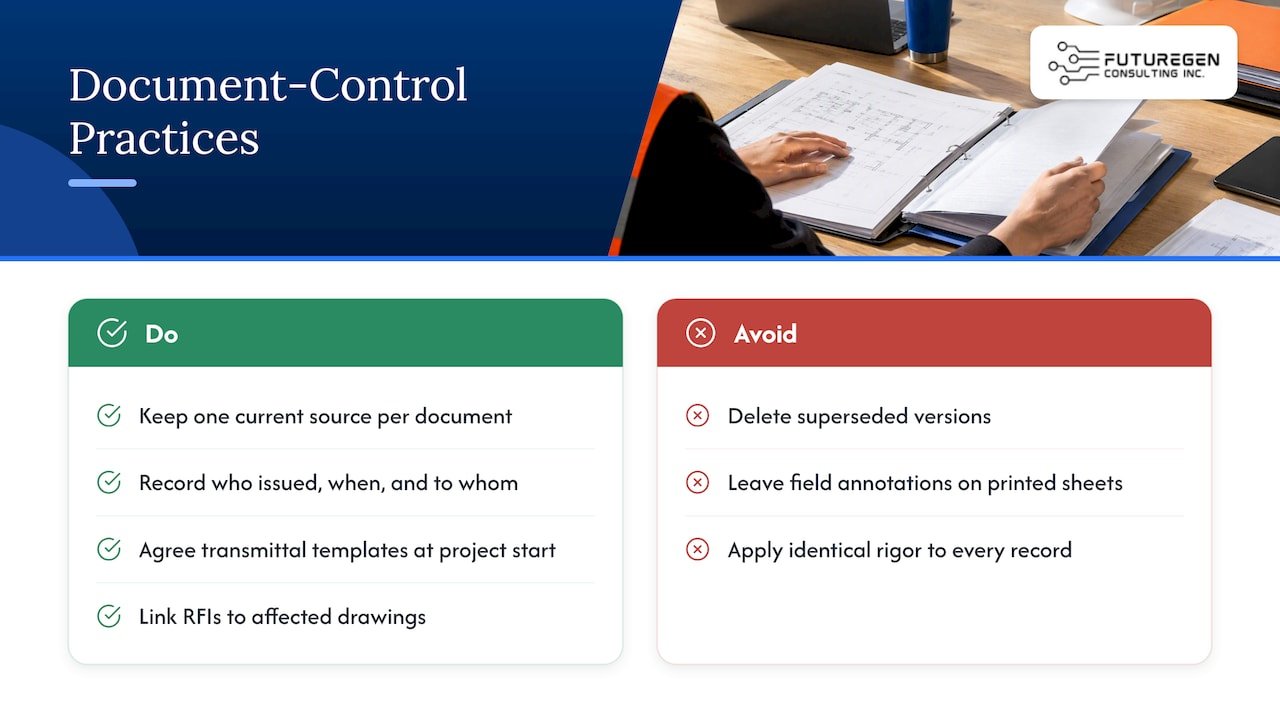
Authoritative repository and document register. Every project needs one place recognized as the current source, holding one current revision per document with superseded versions clearly retired rather than deleted or silently overwritten. The register is the index that tells anyone on the project which revision is live without opening the file itself.
Revision control and audit trail. The system must record who issued a revision, when, and to whom it was distributed. Canadian marketplace research on document-control platforms notes that buyers should expect revision history and an audit trail as baseline capabilities, not premium add-ons, because the trail is what turns a dispute over “who knew what” into a documented fact.
Transmittals and controlled distribution. A transmittal is the formal record that a specific revision went to a specific recipient on a specific date. Without it, a contractor’s claim of never having received an updated drawing cannot be disproven, and an engineer’s claim of having issued it cannot be proven either. Transmittal templates should be agreed at project start, not improvised mid-construction.
Approval gates with documented acceptance criteria. Permit drawings, life-safety submissions and structural calculations warrant a defined review sequence with named approvers and recorded acceptance criteria. Lower-risk records, such as internal meeting notes, do not need the same weight, and applying identical rigor to both tends to slow the system down without reducing risk where it matters.
RFI and submittal linkage. Requests for information and submittal reviews should reference the specific drawing or model element they relate to, not stand as isolated correspondence. Linking an RFI response back to the drawing it clarifies, and to the transmittal that reissued the drawing afterward, keeps the full decision chain visible later.
Markups and field annotations. Field teams need a way to redline drawings and have those annotations feed back into the controlled set, rather than existing only on a printed sheet in a site trailer.
Search, reporting, and integration with model data. As projects grow, the ability to search by discipline, status, or linked RFI becomes the difference between finding the right document in seconds or losing an afternoon to it. Integration with BIM model objects, where models are part of project deliverables, lets a document reference the specific component it describes rather than a general area of the building.
Together these components answer the same question from different angles: can anyone on the project confirm, at any moment, which revision is current, who has seen it, and what decision led to it. A system missing even one component usually fails quietly until the gap surfaces during a dispute or a failed inspection.
Naming conventions and the metadata fields that keep registers accurate
Consistent naming is what lets a register, a title block, and a file name agree with each other instead of drifting apart over the life of a project. Canadian open data guidance on information management recommends settling the convention before production begins and assigning a unique ID to each container rather than relying on the filename alone, since filenames get renamed, copied, and altered in ways a register field does not.
A workable project naming scheme typically assigns these fields, in a fixed order, separated by a consistent delimiter:
- Project or originator code, identifying which organization produced the document.
- Discipline code, such as mechanical, electrical, or structural.
- Volume or system identifier, narrowing the document to a specific building system.
- Level or location code, tying the document to a floor, zone, or area.
- Document type, distinguishing a drawing from a calculation or a schedule.
- Sequence number, giving each document in that category a unique position.
Pro Tip: Agree on the exact field order and delimiter in writing before the first drawing set is issued; retrofitting a naming convention onto existing files takes more time than defining it up front.
Beyond the filename, every document needs a minimum metadata set attached in the register itself: a unique ID, status or suitability, revision or version, classification, originator, and date. The Canadian ISO 19650 annex specifies that decisions about project code length, originator codes, location codes, and classification should be made at project inception, precisely so that every subsequent document follows the same pattern without renegotiation.
Two practical constraints are worth planning for early. Long naming strings can exceed file-system path-length limits on some platforms, so keep codes short and avoid redundant information already captured elsewhere in the register. On bilingual or multi-jurisdictional projects, decide whether discipline and document-type codes follow English or French abbreviations, and apply that choice uniformly rather than mixing conventions across drawing sets.
How approvals, RFIs and submittals move through the system
Document control only functions when roles are clear. In ISO 19650 terminology, an appointing party sets requirements, a lead appointed party coordinates delivery, information production teams generate the documents, and a document controller administers the register, transmittals, and status changes. On smaller projects, one person may hold several of these roles, but the responsibilities themselves do not disappear.
A typical approval sequence runs through defined stages:
- A document is submitted by the production team at a stated suitability, such as “shared.”
- A reviewer checks it against the project’s acceptance criteria.
- Comments are returned and incorporated, with the revision number incremented.
- The document is accepted or authorized, changing its suitability to “issued for construction” or equivalent.
- A transmittal records the distribution of the authorized revision to every relevant party.
RFIs follow a parallel lifecycle: an RFI is raised against a specific drawing or model element, routed to the party able to answer it, resolved with a written response, and then linked back to the drawing or specification it affects. When the resolution changes a drawing, that change should travel through the same transmittal process as any other revision, so the RFI response and the reissued document stay connected in the record rather than existing as separate threads.
Not every document warrants the same scrutiny. ISO 19650 guidance supports applying controls proportionally: permit drawings, life-safety submissions, and construction-release documents justify a formal multistep review, while low-risk internal records can move through a lighter process. Applying the same rigor everywhere slows the project without reducing the risk that actually matters, and applying none anywhere creates the gaps described earlier.
Implementation checklist from information requirements to handover — teams can find practical project handover templates that actually get used helpful in structuring the process.
Rolling out document control works best as a sequence rather than a single rollout event. The steps below follow the order most projects need, though the depth of each step should scale to the project’s size and risk profile.
- Define Project Information Requirements and Asset Information Requirements. Before selecting any tool, agree what information the project needs to produce (PIR) and what the owner needs for the completed asset (AIR). These requirements drive every downstream decision, from naming conventions to handover format.
- Decide the authoritative repository and the scope of the CDE. Name the single source of truth and specify handover formats up front, including whether model exchanges will use IFC, COBie, or BCF, so the end format is never a surprise at closeout.
- Document naming, metadata and coding choices in a project CDE manual. Record the agreed field order, delimiters, status definitions, and classification codes in a single reference document that every party receives at project start.
- Configure workflows, transmittal templates and permissions. Map the RFI and submittal flows to the roles defined earlier, and set permissions so that only authorized reviewers can change a document’s suitability status.
- Pilot the system, validate search and export, then roll out with role-based training. Run a small set of real documents through the full cycle, confirm the register and search function as intended, and train each role on only the functions relevant to their work.
- Close out with an accepted, searchable final set. Deliver final drawings, equipment and asset data, commissioning records, and operation and maintenance information in the format the AIR specified, confirming nothing was substituted along the way.
Teams managing as-built drawings and closeout documentation often find step six is where gaps surface first, since a register that was loosely managed during construction rarely becomes complete or searchable on its own at handover. Building the discipline in from step one avoids that scramble.
Choosing technology to support document control
The procurement principle worth holding onto is simple: define governance and requirements first, then test candidate technology against them, rather than choosing a platform and adapting the project’s workflow to fit it. Canadian procurement notices for construction management software specifically caution against selecting a tool before specifying the authoritative repository, document types, review gates, and handover deliverables.
With requirements defined, test candidate platforms against a consistent feature checklist:
- Centralized storage with clear ownership of the authoritative copy.
- Revision history that records every change and who made it.
- Permission controls matched to the roles defined in the project workflow.
- Transmittal generation with delivery confirmation.
- RFI and submittal tracking linked to specific drawings or model elements.
- Mobile and field access for site-based markups and annotations.
- Search across metadata fields, not just file names.
- Reporting on outstanding RFIs, pending approvals, and distribution status.
- Integration with model data where BIM is part of the deliverable set.
- Export and retention options that match the project’s handover format.
- A complete audit trail covering every status change.
Beyond features, Canadian marketplace guidance recommends validating data residency, contract terms, offline or mobile behavior, and implementation effort directly with the vendor during procurement, since listed ratings and feature sets change over time and a feature appearing on a product page is not the same as confirming it works for the project’s specific contract requirements.
Pro Tip: During a pilot, test transmittal delivery evidence, the RFI lifecycle from issue to linked response, and a handover export against the AIR to confirm the format matches what was specified.
Applying document control to MEP deliverables
Mechanical, electrical, and plumbing scopes generate a specific kind of document friction: a drawing, the calculation that justifies it, and the equipment data sheet describing the installed unit can each carry a different revision history, and coordination errors often trace back to one of the three lagging behind the others. A shared metadata scheme and a single register that links drawing, calculation, and equipment record reduce that gap considerably.
Supporting PIR and AIR definition for MEP scope, piloting the approval workflow against real coordination drawings, and validating the handover export before it reaches the owner are the kind of groundwork that benefits from outside technical review. Our MEP coordination process and checklist and our electrical coordination checklist are built around that same linkage between drawings, calculations, and field coordination.
What the standards get right, and where teams still stumble
The ISO 19650 framework is often treated as a BIM requirement reserved for large, model-heavy projects, and that reading undersells it. The standard’s real value is procedural: define the information requirement, name an authoritative source, record status explicitly, and keep an audit trail. A renovation involving a few trades needs that discipline just as much as a high-rise, even without a model in sight.
Where conventional advice tends to go wrong is treating document control as a software purchase decision. A platform does not create a single source of truth; a defined workflow does, and the platform either supports it or gets worked around. Teams that buy first and define governance afterward are the ones who end up running multiple systems in parallel.
If a project can prioritize only one thing, prioritize the register and the status field. A simple, consistently maintained register with explicit suitability states prevents more rework than any feature list, and it costs nothing to start on the next project kickoff.
— Sanjay
An engineering partner for implementing MEP document controls
Defining PIR and AIR, piloting a transmittal workflow, and preparing a handover set that actually matches the agreed format takes time most project teams are stretched thin to provide, particularly on the mechanical and electrical scope where drawings, calculations, and equipment data all need to line up. A scoped engineering review can confirm that MEP documentation meets Canadian code requirements and the project’s own information requirements before problems reach the field.

Our relevant services include:
- Construction review services that review MEP drawings and documentation against site conditions and applicable codes.
If your project needs a scoped construction review or help preparing an MEP document-handover package, see current services on our services page.
FAQ
What is the primary purpose of document control?
The primary purpose is to maintain one current, authoritative revision of every project document while recording who distributed it, to whom, and when. This prevents work from proceeding against outdated information and gives the project a defensible audit trail if a dispute arises.
What are the four types of documents in construction document control?
Document control typically organizes records around status: documents can have statuses such as work in progress, shared for coordination, issued for construction, or accepted as final. The Canadian ISO 19650 annex treats these suitability states as required metadata rather than informal labels.
How much does a document controller get paid?
Compensation for a document controller varies by region, employer, and project size, and no single figure applies across the industry. Project teams should treat salary research as a hiring question separate from the document-control process itself.
What are the main types of construction documents?
Construction documents include drawings, specifications, schedules, engineering calculations, models, RFIs, submittals, meeting records, inspection evidence, approvals, and as-built records. NRC research identifies drawings, calculations, bills of material and specifications as categories most in need of structured metadata and retrieval support.