
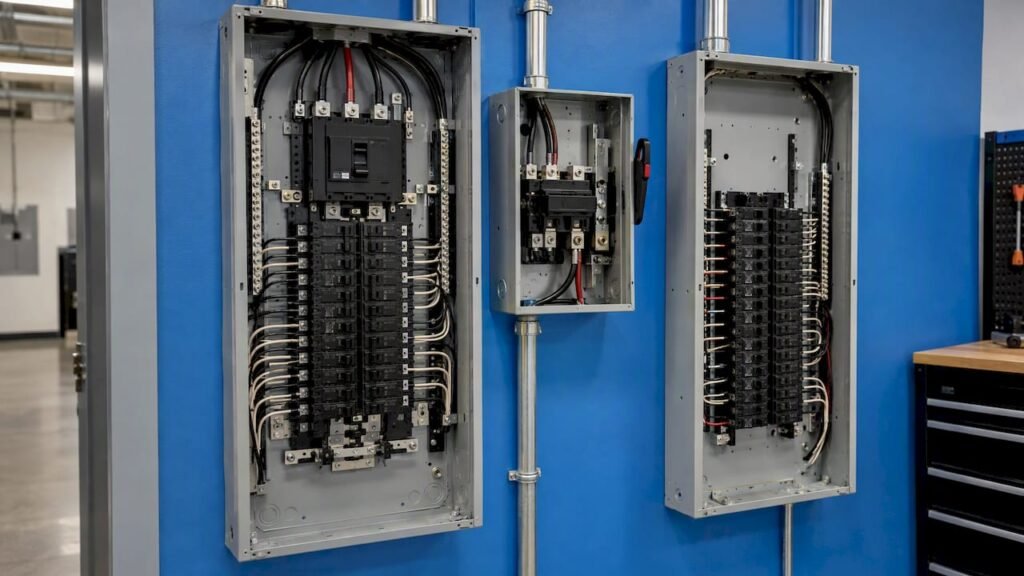
A main lug only (MLO) panel has no main overcurrent device: the incoming conductors land directly on the lugs of the busbars. A main breaker panel, often written “MCB” in this context, adds a main circuit breaker between those conductors and the busbars, so that one device protects and isolates the whole panel. In Ontario, the choice is rarely about the enclosure alone. It depends on where the service disconnecting means is located, how the panel is fed, what the utility requires at the meter, and how much capacity the building will need later.
This article sets out the technical distinction, the Ontario regulatory context, the situations in which each panel type is normally specified, and the coordination issues that make the decision an engineering matter on commercial, multi-unit and mixed-use projects.
TL;DR
- An MLO panel has no main breaker and normally depends on an upstream device for overcurrent protection and isolation. A main breaker panel contains that device.
- Both types contain many branch-circuit breakers. The real design question is where the service disconnecting means sits and whether it is accessible.
- Ontario installations are inspected by the Electrical Safety Authority (ESA) against the Ontario Electrical Safety Code (OESC), and the utility, such as Hydro One, sets metering and access requirements that can drive the choice.
- Bus rating and main breaker rating limit how much solar PV, EV charging and storage can be added later, so these loads belong in the initial design.
- Settle the single-line diagram and utility interface before ordering equipment.
Table of Contents
- What the terms mean
- The question that actually decides it: where is the disconnect?
- Ontario regulatory context
- Utility requirements at the meter
- Comparing the two panel types
- When each type is normally specified
- Capacity planning: PV, EV charging and storage
- Service upgrades and renovations
- Larger commercial installations
- Layout and serviceability
- Our perspective
- Engineering support for panel and service design
- Decision checklist before ordering a panel
- FAQ
- Sources
What the terms mean
Main lug only (MLO) panelboards
In an MLO panelboard, the feeder or service conductors terminate on main lugs connected directly to the bus. The enclosure carries branch breakers, but nothing within it limits the total current drawn through the lugs other than the capacity of the bus and the device ahead of it. For that reason, an MLO panel is typically used as a subpanel or distribution panel downstream of a feeder breaker, a fused switch or a main breaker panel. Manufacturers also publish MLO panelboard ratings for larger commercial equipment, with lug sizes and bus ratings that extend well beyond residential sizes.
Main breaker (MCB) panelboards
A main breaker panel includes a breaker at the top of the bus, rated to match or protect the panel. Operating it de-energizes every branch circuit in that panel. Where the panel serves as service equipment, the main breaker commonly acts as the service disconnecting means, which is why this type is the usual choice for a dwelling or small building served directly from the utility.
A note on the abbreviation “MCB”
Outside North America, “MCB” usually means a miniature circuit breaker, a single branch-circuit device. In Canadian electrical practice, the comparison readers are making is between a panel with a main circuit breaker and a panel with main lugs only. This article uses “main breaker panel” for the first and “MLO panel” for the second to avoid confusion with the branch breakers that both types contain.
The question that actually decides it: where is the disconnect?
An MLO panel can hold dozens of branch-circuit breakers, so it is not accurate to say that it lacks breakers. What it lacks is a single main device. Consequently, the design question is whether the building has a service disconnecting means elsewhere, and whether that device is accessible, labelled and appropriately rated for the panel it feeds.
ESA’s description of a service inspection shows how the whole path is considered together. According to ESA’s inspection guidance, a service inspection can include the meter base, panelboard, ground electrode, trenching, service conductors and the main disconnect means, such as fuses or breakers, and no part of the installation should be concealed before it is inspected. The panelboard is evaluated as one element of a chain, not as a stand-alone product.
This has a practical consequence. An MLO panel is acceptable where the supply arrangement provides the required disconnecting means and overcurrent protection upstream, for example a main disconnect switch at the service entrance feeding an MLO distribution panel inside the building. An MLO panel installed with no suitable upstream device, or with a device that is remote, inaccessible or mismatched to the bus, is a deficiency that the inspector will identify and the contractor will correct at the project’s expense.

Ontario regulatory context
The Ontario Electrical Safety Code
The OESC is an Ontario regulation that sets safety standards for the installation and maintenance of electrical equipment. ESA’s FAQ on the 2024 edition identifies it as the 28th edition. The Code is largely prescriptive, which means that the panel type is selected as part of a compliant service and distribution design, not by terminology or by the shortest product description. Designers should confirm the edition in force for the project, and any amendments, with ESA before finalizing drawings. For a general orientation to how the Code is organized, see our overview, Demystifying the Ontario Electrical Safety Code.
Disconnection and safe isolation
A clearly identified, accessible disconnect is also a maintenance requirement. ESA’s guidance on energized equipment refers to OESC Rule 2-304, which requires disconnection before repairs or alterations, with precautions such as locks and warning signs. ESA recommends lockout and tagout, verification of the absence of voltage and documented procedures for personal protective equipment.
This is relevant to the panel choice. A main breaker panel allows the entire panel to be isolated at the panel itself. An MLO panel requires that the upstream device be identified, labelled and, for maintenance purposes, lockable and reachable by the people who work on the board. In a multi-tenant building where the upstream device is in a locked electrical room on another floor, the maintenance consequences of that arrangement should be considered during design, not after occupancy.
Utility requirements at the meter
The utility’s requirements are separate from the Code and can influence the arrangement. In Hydro One territory, Hydro One’s retail metering guide divides services into secondary metered (below 750 V) and primary metered (above 750 V) categories, and describes services below 750 V with a size under 200 A as self-contained metering installations. Hydro One also states that metering installations must be accessible to it at all times, safely reachable and free of obstructions, and, where applicable, installed indoors in a dedicated electrical room. Other Ontario local distribution companies publish their own standards, so the applicable utility document should be obtained at the start of the project.
These requirements can determine whether the main disconnect is integrated with a panel or installed as a separate switch ahead of it. They also bear on ownership: for single-position metering, Hydro One states that the customer owns and maintains the meter-mounting device, the breaker if one is installed, and the associated conduits, subject to the applicable arrangement.
A further coordination point concerns grounding. ESA Bulletin 10-17-8 addresses whether the system grounding conductor may enter a combination panelboard through the branch circuit section, and permits certain routing only where the barrier of the main breaker compartment is not altered. Details of this kind are resolved at the one-line stage, not at rough-in.
Comparing the two panel types
| Criterion | MLO panel | Main breaker panel |
|---|---|---|
| Main overcurrent device | None in the panel; provided upstream | Included in the panel |
| Typical role | Subpanel or distribution panel downstream of a feeder device | Service entrance panel or panel that needs its own main |
| Isolation of the whole panel | At the upstream device | At the panel itself |
| Equipment cost at purchase | Generally lower, since no main device is supplied | Generally higher, since a main breaker is included |
| Separate upstream device required | Yes, correctly rated and accessible | Not for the panel’s own protection, though the service arrangement still governs |
| Typical sizes | From residential subpanels to large commercial boards | Common in residential and small commercial services |
| Main risk if misapplied | No suitable protection or isolation ahead of the bus | Bus and main rating limit future capacity |
The cost row requires care. A lower purchase price for an MLO panel is not a saving if the project needs an additional disconnect switch, enclosure and conduit run to provide what a main breaker would have provided. Equipment cost should be compared at the level of the complete service and distribution assembly, which is the basis on which our electrical construction cost estimation is prepared.
When each type is normally specified
Typical applications for MLO panels
- A subpanel serving a defined area or tenant, fed by a correctly sized feeder breaker in the main distribution equipment.
- A distribution panel downstream of a main disconnect switch in a commercial or industrial building.
- Floor-by-floor or suite-by-suite panels in multi-unit buildings, where the feeder device at the main distribution centre provides protection and isolation.
- Equipment rooms and process areas where a feeder breaker or fused switch nearby serves as the local means of isolation.
Typical applications for main breaker panels
- The service entrance panel of a house, townhouse or small commercial unit where no separate service switch is installed.
- A panel at a remote location that needs its own overcurrent protection and local isolation, for example a panel in a detached building.
- A panel where the feeder protection upstream is sized for the cable and not for the bus, so that the panel needs its own device to match its rating.
- Panels where maintenance staff are expected to isolate the board without leaving the room.
These are general patterns, not rules. The actual requirements depend on the OESC, the utility, and the single-line diagram for the building, and a particular project can legitimately differ from the patterns above.
Capacity planning: PV, EV charging and storage
Panel selection also constrains what can be added later. The relevant example is in Natural Resources Canada’s photovoltaic-ready guidelines, which show that the busbar rating and the main breaker rating both affect the connection capacity available for PV. In the guidelines’ example, a 100 A panel with a 100 A main allows a 25 A PV breaker at 240 V, equivalent to 4.8 kW of PV, while a 125 A panel with a 100 A main allows a 50 A PV breaker and 9.6 kW. These figures are framed around the cited Canadian Electrical Code rule and residential distribution panels, and they should not be applied to every service configuration without engineering review.

The lesson extends beyond solar. A panel that looks adequate for the present calculated load can become a limit once EV chargers, battery storage or electric heating are added. A lower initial equipment cost can therefore produce redesign risk later. These assumptions should be identified in the initial load and distribution study. Projects that expect charging equipment should also review EV charger load management and the EV charger infrastructure design process before the panel schedule is fixed.
Service upgrades and renovations
On renovation projects the panel type is often tied to a service upgrade. Hydro One’s service-upgrade guidance states that a request is needed for changes such as upgrading service amperage, installing central metering, changing the meter location or adding a service, and that scheduling in advance avoids safety issues and project delays. It also directs projects to contact ESA before changing the electrical service so that the work can be inspected against the OESC.
Swapping an old fused panel for a new one, converting a building to central metering, or adding a second service for an additional suite all trigger some combination of these steps. Our guide to electrical service upgrades in Ontario covers the sequence in more detail, and ESA plan review explains when drawings are reviewed before construction. After a successful service inspection, ESA states that it authorizes the utility to energize the service, and that the connection authorization is valid for up to six months, so the inspection should be scheduled close to the energization date.
Larger commercial installations
On larger projects, the panel decision cannot be separated from protection coordination and short-circuit design. Public-sector electrical specifications in Canada, such as a Fisheries and Oceans Canada specification, require protective devices to be sized and set to the required values and may require time-current coordination studies. NRCan’s work on protection coordination planning with distributed generation describes breaker and fuse coordination as central to planning the protection of a distribution system.
In practice, this means the available fault current at the panel, the interrupting ratings of the devices, and the selectivity between the upstream feeder device and the panel’s own branch breakers all enter the choice. Whether a study is required depends on the service size, the available fault current, the equipment ratings, any distributed generation and the project specification. Our power system studies service addresses this scope for Ontario projects.
Layout and serviceability
Panels are rarely installed in isolation. Electrical rooms and closets also house low-voltage equipment, and a layout that keeps power and communications serviceable avoids rework. For builders planning that part of the room, structured wiring panel layouts illustrate how clearances and access can be organized so that each system remains reachable. The power panel itself must still respect the working clearances and access conditions set by the OESC and the utility.
Our perspective
We are asked about this choice more often than its apparent simplicity would suggest, and the question is almost always posed too narrowly. A client asks whether an MLO panel will save money, when the useful question is what the complete service path looks like from the utility connection to the last branch circuit. When we prepare power distribution designs, we begin with the single-line diagram, the utility’s metering requirements and a realistic load schedule that includes the future PV, EV charging and storage the owner may add.
Our experience across new builds and renovations in Ontario, over more than 30 years, is that most panel problems are coordination problems. The equipment was acceptable on its own, but the disconnect was in the wrong place, the metering room did not meet the utility’s access conditions, or the bus could not accommodate the next load. Resolving these points before procurement is considerably less expensive than resolving them during an ESA inspection. Where a project is large enough to warrant it, we add a short-circuit and coordination review so that the main devices and the panel ratings are justified, not assumed.
— Sanjay
Engineering support for panel and service design
FutureGen Consulting Inc. prepares permit-ready, engineer-stamped electrical drawings for residential and commercial projects in Ontario, including power distribution design, service and panel selection, EV charger infrastructure, solar power system design and emergency power. If a project needs the panel arrangement confirmed before equipment is ordered, our power distribution design team can review the single-line diagram, the utility interface and the future load assumptions. Developers, contractors, architects and property managers can start from our electrical services page or contact us through the main site.
Decision checklist before ordering a panel
- Obtain the utility’s metering and service requirements for the project location and confirm the metering arrangement.
- Identify the service disconnecting means and confirm that it is accessible, labelled and lockable.
- Prepare a load schedule that includes PV, EV charging, storage and any planned electrification.
- Confirm the bus rating and main device rating against the load and the PV interconnection limits.
- For feeders to MLO panels, confirm that the upstream device is correctly rated for the panel and the conductors.
- For larger services, determine whether a short-circuit and coordination study is required.
- Confirm the applicable OESC edition and the ESA notification and inspection steps.
- Compare equipment cost at the level of the complete assembly, not the panel alone.
FAQ
Can an MLO panel be the main panel in a house?
An MLO panel can serve in that role only where a separate service disconnecting means with the required overcurrent protection is provided ahead of it. In most houses, the service entrance panel is a main breaker panel, since it combines the panel and the disconnect in one enclosure. The arrangement should be confirmed against the OESC and with ESA before work begins.
Does an MLO panel have breakers?
Yes. It contains branch-circuit breakers for the individual circuits it serves. What it does not contain is a main breaker that protects the whole panel and isolates it as a unit. That protection and isolation come from a device upstream.
Is a main breaker panel always better than an MLO panel?
No. Each is suited to a different role. A main breaker panel is the normal choice at the service entrance or at a remote panel that needs its own protection, while an MLO panel is a standard and economical choice for a subpanel or distribution panel fed from a properly rated upstream device. The better option is the one that fits the complete design.
Do I need to notify anyone before changing a panel in Ontario?
Changes to service amperage, meter location or panel type can require a service-upgrade request to the utility and contact with ESA so that the work can be inspected. Hydro One’s guidance describes these steps for its customers. A licensed electrical contractor and, on larger projects, a professional engineer should confirm the requirements for the specific property.
Sources
- ESA: Notifications and Inspections
- ESA: 2024 Ontario Electrical Safety Code (OESC) FAQs
- ESA: Don’t Work On Energized Equipment
- ESA: Bulletin 10-17-8
- Hydro One: Service upgrades
- Hydro One: Retail Metering Guide
- NRCan: Photovoltaic Ready Guidelines
- NRCan: Protection Coordination Planning with Distributed Generation
- Fisheries and Oceans Canada: Electrical specification