

An open-transition automatic transfer switch (ATS) is a break-before-make device: it disconnects the load from one source before connecting to the other, so the load sees a brief interruption. A closed-transition ATS is make-before-break: it connects to the second source before releasing the first, so the load stays energized, but the two sources are briefly paralleled. That single difference drives cost, utility approval, fault-current duty and the type of load each switch suits. This article sets out how each type operates, where Canadian codes and utilities place limits, and how developers, property managers and contractors can select the correct type early in design.
TL;DR
- Open transition (break-before-make) is the most common type and suits loads that can tolerate a short interruption, typically 50 milliseconds or less in the switch itself.
- Closed transition (make-before-break) avoids interruption during planned transfers, such as generator testing, by paralleling both sources for no more than about 100 milliseconds.
- Closed transition adds cost, requires synchronization and, where it parallels with the utility, requires the utility’s written approval and review.
- An open-transition design operated without paralleling generally avoids the utility’s closed-transition review process, which can shorten the permit and commissioning path.
- The choice should be made at schematic design, together with the generator, short-circuit and coordination studies.
Table of Contents
- How each transition type operates
- Side-by-side comparison
- What the transition type means for the load
- Canadian code and utility requirements
- Design coordination that depends on the choice
- Our perspective
- Engineering support for your transfer scheme
- FAQ
- Sources
How each transition type operates
Open transition: break-before-make
In an open-transition switch, the contacts to the first source open before the contacts to the second source close. According to the manufacturer’s ATS fundamentals guide, the switch breaks its connection to one source before connecting to the other, and the downstream load is therefore without supply for a short period.
The interruption is brief. ABB Technical Note 178 describes the open transfer as the most common type in the North American market, built as a two-position switch with no stable off position, with a contact transfer time usually under 50 milliseconds. The same note places the interruption in a standard open transition at up to 50 milliseconds, or 3 cycles. Another white paper on transition modes reports that, for one manufacturer’s switches, the sequence completes in about 30 to 50 milliseconds depending on the size of the ATS.
The interruption is short, but it is not zero, and it has an electrical consequence. The same white paper notes that the momentary disconnection and reconnection can cause large inrush currents when active or inductive loads, such as motors and transformers, are connected downstream.
This is the reason many switches are built with an in-phase monitor. Eaton’s Transfer Switch 101 white paper states that open in-phase transitions are typically completed in 150 milliseconds or less so that inrush current does not exceed the normal starting current of inductive loads, and that some switches default to a delayed transition if synchronization does not occur within that window.
Closed transition: make-before-break
A closed-transition switch closes onto the alternate source just before it opens on the source that is online. The Canadian technical FAQ on transition modes describes the sequence as briefly paralleling the sources under monitored parameters, taking less than 100 milliseconds, and avoiding interruptions during planned transfers such as routine testing. In that design the normal and emergency contacts sit on separate operators that switch asynchronously.
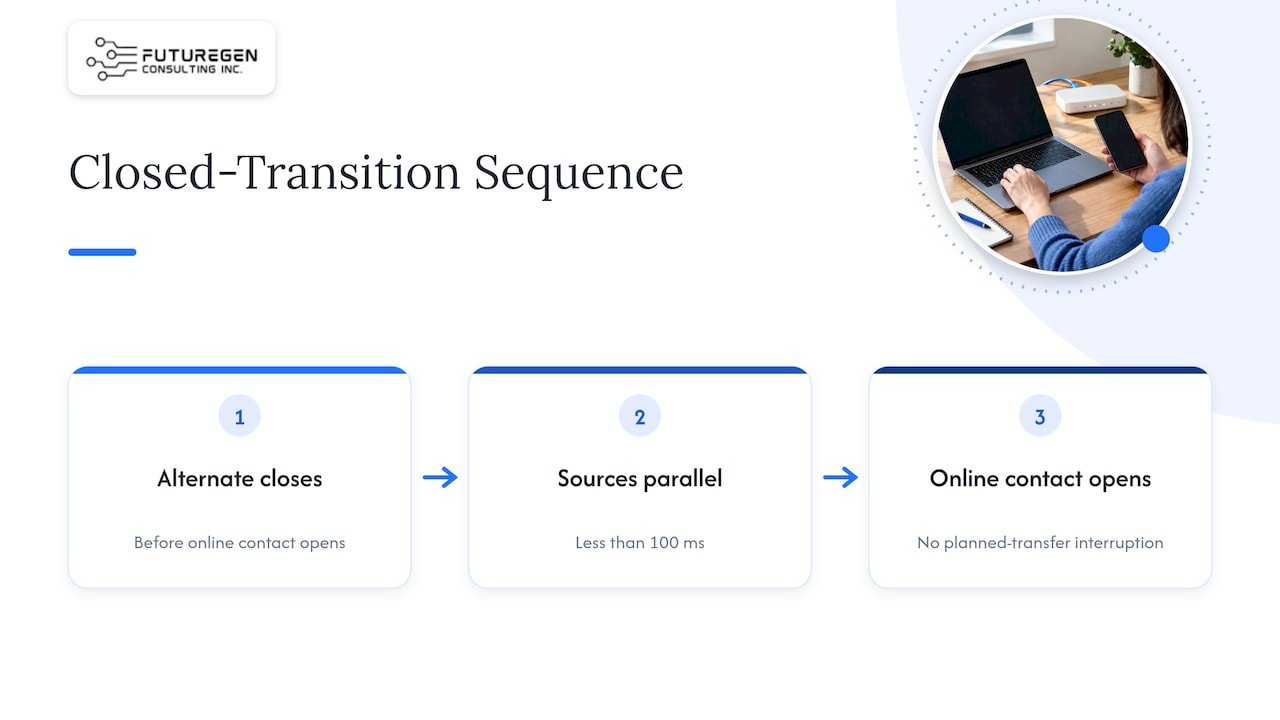
Because the two sources are connected together, they must be synchronized. Eaton’s white paper states that closed-transition switches usually transfer automatically as soon as both sources are closely matched in phase, voltage and frequency. A Canadian consulting application guide from the same manufacturer notes that its closed-transition model parallels for 100 milliseconds or less, and that the controller provides undervoltage, underfrequency, overvoltage and overfrequency protection on all phases, with a synchronization timer that monitors phase angles to anticipate when they will fall within 8 electrical degrees.
Many closed-transition designs use passive synchronizing. As a generator manufacturer’s selection paper explains, a sync-check device (also called a permissive relay or phase band monitor) senses the phase relationship between the two live sources and permits interconnection only when they are in step. The control has no direct influence on generator frequency, so it relies on load changes or frequency differences to bring the phase angles together.
Side-by-side comparison
| Criterion | Open transition | Closed transition |
|---|---|---|
| Switching sequence | Break-before-make | Make-before-break |
| Load interruption | Brief, up to about 50 ms in the switch (ABB) | None during a planned transfer |
| Sources paralleled | No | Yes, usually no more than 100 ms |
| Synchronization | Required for in-phase transfer between live sources | Required for every transfer |
| Fault-current duty | Standard | Higher during the paralleling period |
| Utility involvement | Generally limited when operated without paralleling | Written approval and review where the generator parallels with the utility |
| Typical use | Standby power for buildings that tolerate a brief outage | Facilities that test generators under load without interrupting critical loads |
What the transition type means for the load
Where open transition is appropriate
The generator manufacturer’s paper describes open-transition switches as the most commonly used type, applied in all kinds of installations, and by design neither requiring nor permitting generator paralleling with the utility. Its typical applications include basic standby systems for small businesses, hotels, small manufacturing plants and commercial buildings that can tolerate brief interruptions during monthly testing and when retransferring to the utility after an outage.
The Schneider Electric white paper adds that open-transition switches offer straightforward operation and long service life where the load can tolerate a momentary interruption. For many residential towers, mid-rise offices and retail buildings with life safety loads already designed to restart on transfer, this is the practical default.
Where closed transition earns its cost
Closed transition becomes relevant when even a momentary loss of power is unacceptable during a planned transfer. The Canadian transition-mode FAQ identifies facilities that must test generators regularly without interrupting critical loads as the clearest case. Eaton’s white paper lists additional advantages: critical loads continue to operate during loaded generator testing, peak shaving can reduce energy costs, and depending on the application it may remove the need for a downstream UPS.
The same paper lists the trade-offs the design team has to plan for: higher equipment cost, protective relays required by some utilities, the need for an automatic controller because manual operation is not possible, and higher fault current from the paralleling period, which may call for a higher withstand and close-on rating (WCR). ABB’s note likewise states that closed transitions can produce higher fault currents. This is why a short-circuit study belongs in the scope before the switch is specified, and why power system studies are part of closed-transition design.
Load criticality decides, not preference
The manufacturer’s fundamentals guide frames the selection as a function of the load: the functions the load performs, and their importance to safety or security, determine which transition is required. A practical way to apply this is to list each load on the transfer switch and ask three questions:
- Does the equipment restart safely after a loss of supply of up to several cycles?
- Will motors, transformers or large inductive loads create inrush current at reclosure that the system cannot absorb?
- Is a planned transfer needed during normal operation, such as loaded generator testing or return to utility without a break?
If the answer to the first question is yes and to the third is no, open transition is usually sufficient. If a critical process cannot restart or cannot tolerate an interruption during planned transfers, closed transition deserves evaluation.
Canadian code and utility requirements
Code framework
Electrical design in Canada follows the Canadian Electrical Code (CEC), Part I, adopted provincially. In Ontario it is administered through the Ontario Electrical Safety Code and the Electrical Safety Authority. The reproduced 2021 CEC Section 46 on emergency power supplies includes the following requirements relevant to transfer equipment:
- Rule 46-206 requires that automatic transfer equipment be accessible only to authorized persons.
- Rule 46-202 sets generator capacity and automatic-start requirements, with reference to CSA C282.
- Rule 46-208 requires overcurrent coordination.
- Rule 46-108 requires emergency wiring to be kept independent of other wiring, with stated exceptions.
An ATS serving emergency loads in a building therefore sits inside a wider design: generator sizing, coordination, wiring separation and access. For a fuller treatment, see our guide to emergency versus standby power in Canadian buildings and the Ontario emergency generator requirements.
Preventing backfeed
Both transition types must prevent unintended interconnection between sources. NS Power’s electrical plan submittal document states that where a standby generator is connected to a service, feeder or branch circuit, an approved transfer switch must be installed so that no operation of the switch causes an inadvertent interconnection that could feed standby power back into the utility system, as required by CEC Rules 14-612 and 6-106. A closed-transition switch intentionally parallels, so it cannot rely on this reasoning alone: the paralleling must be a controlled, approved function.
Equipment standard
Transfer switch equipment in Canada is covered by the harmonized CSA C22.2 No. 178.1 standard. The CSA listing for the 2012 edition describes it as covering transfer switch equipment rated up to 600 volts in non-hazardous locations, including automatic, manual, closed-transition, hybrid, fire-pump, bypass/isolating and service-equipment types. The current edition is C22.2 No. 178.1:22, which the utility documents below reference.
Utility requirements for closed transition
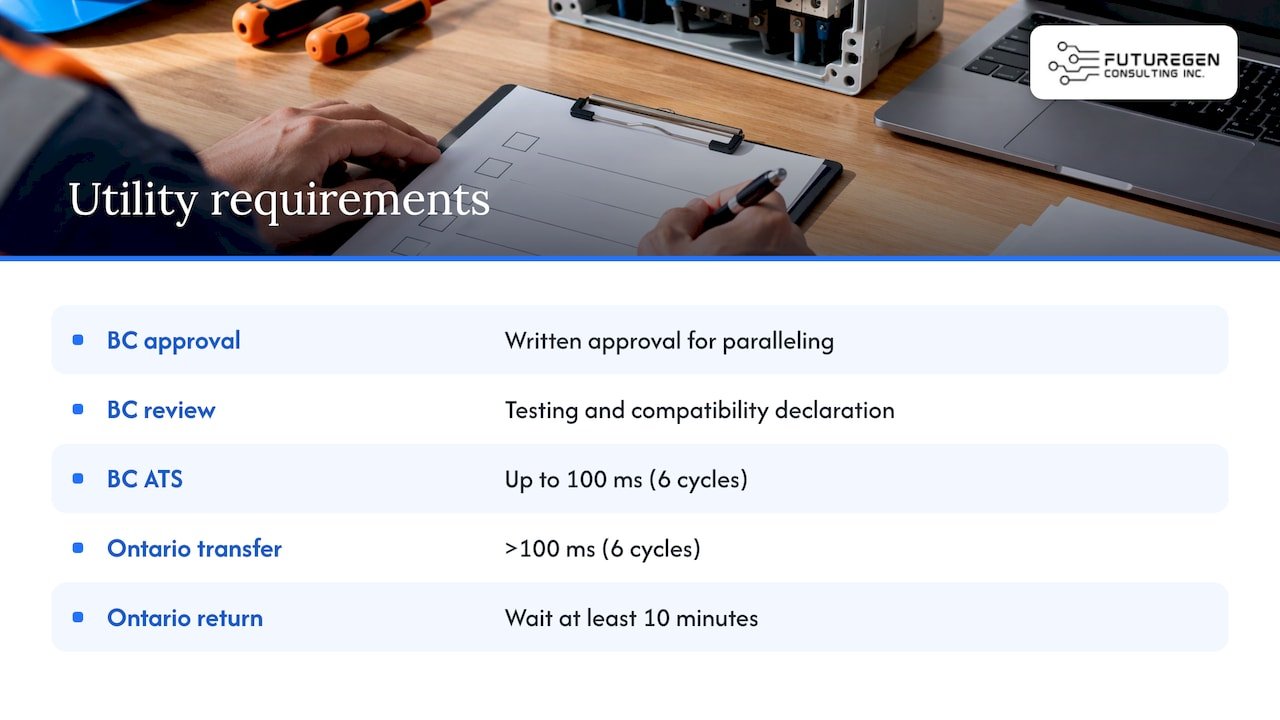
Utility rules for paralleling are where closed transition most affects schedule. BC Hydro’s closed-transition technical requirements (March 2024) state that, per CEC Part I Section 84, a customer may operate a generator in parallel with its distribution system only with written approval. They also require that related equipment comply with the applicable CSA standards, including CSA C22.3 No. 9, C22.2 No. 178.1, C22.2 No. 178.3 and C22.2 No. 31. The document defines a certified momentary closed-transition ATS as a factory-built single unit, certified to CSA C22.2 No. 178, that parallels for up to 100 ms (6 cycles).
The utility’s closed-transition fact sheet (October 2023) adds that a generator must not run in parallel until the review process is complete, including site acceptance testing and a declaration of compatibility. It also notes that standby generation operated in open-transfer mode, without paralleling, does not require the utility to review the site information.
These documents come from British Columbia, and Ontario and Alberta utilities set their own terms, so the local distribution utility’s current interconnection requirements must be confirmed at the start of design. Ontario practice is illustrated by Hydro Ottawa’s technical guideline ECG0002 (2025, Rev 2) for customer-owned emergency generation. It specifies a double-throw open-transition switch, either 3-pole with a solid neutral or 4-pole, compliant with C22.2 No. 178.1:22, with an open-transition transfer time greater than 100 milliseconds (6 cycles) between generator and utility. It also requires the retransfer scheme to wait a minimum of 10 minutes after utility restoration before returning the load. Requirements that differ this much between utilities are the reason to confirm the local rules before specifying equipment.
Bypass and isolation on life safety loads
Transfer equipment that serves life safety loads also carries maintenance requirements. According to IAEI Magazine (October 2025), Clause 9.5 of CSA C282 requires a means to isolate and bypass automatic transfer switches that supply life safety equipment in institutional (Group B) and residential (Group C) occupancies, with interruption during the procedure not exceeding 15 seconds, or 10 seconds in a health care facility. The same article explains that this requirement is not intended for a switch used solely with a fire pump, since CEC Rule 32-308 directs fire pump transfer switches to Annex E of C22.2 No. 178.1.
This matters for the transition choice because the closed-transition controller must be automatic, and a bypass arrangement has to be coordinated with it. Where the building also relies on evacuation management systems for life safety, the supply to those systems should be identified on the load schedule so the transfer arrangement is reviewed against them.
Design coordination that depends on the choice
Selecting the transition type touches several other deliverables:
- Generator sizing and loading. The generator manufacturer’s paper states that fast closed-transition switches must transfer sequentially, with each switch load limited to less than 25 percent of the generator set’s standby rating, to prevent disruptive transients.
- Short-circuit and coordination study. The paralleling interval raises available fault current, so interrupting and withstand ratings are verified against the study.
- Protection settings. Voltage and frequency windows and synchronization limits are set in the controller and, where required, in utility-specified relays.
- Commissioning and testing. Closed-transition systems need site acceptance testing before parallel operation, and routine loaded testing is planned through generator load bank testing procedures.
- Permit documentation. Single-line diagrams, sequences of operation and equipment certification to the applicable CSA standard accompany the stamped drawings.
For the overall distribution design that surrounds the switch, our power distribution design guide covers the upstream and downstream considerations.
Our perspective
We approach this decision as a design question rather than an equipment preference. Most Ontario buildings we see, including residential developments, offices and retail properties, are served well by open-transition switching, provided the load schedule is reviewed for inrush current and restart behavior. That review is where a transfer scheme succeeds or fails, and it costs far less at design stage than after the generator is on site.
Closed transition is a sound choice when the operating requirement calls for it: loaded testing without interruption, or critical processes that cannot lose supply during a planned transfer. In those cases we treat the utility interconnection process, the fault-current study and the commissioning plan as part of the same engineering package, so that the permit submission, the equipment specification and the utility application agree with one another.
Our experience on both new construction and renovation projects lets us align the transfer scheme with the code framework, the local utility and the owner’s testing procedures from the first drawing. The outcome we design for is a stamped, permit-ready package that reduces the questions raised at review.
Sanjay
Engineering support for your transfer scheme
FutureGen Consulting Inc. provides emergency power design for residential and commercial projects in Ontario, including generator and transfer equipment selection, single-line diagrams, power system studies and permit-ready, engineer-stamped drawings. Developers, contractors, architects and property managers can review the full scope of services on our services page and request an engagement for a specific project.

If the project involves paralleling with the utility, the sooner the transition type is settled, the sooner the study scope, equipment lead times and utility application can be planned together.
FAQ
Is an open-transition ATS safe for sensitive electronics?
An open-transition switch interrupts supply for a short period, up to about 50 milliseconds in the switch itself according to ABB’s technical note. Equipment with adequate ride-through, or with a UPS, generally tolerates this. Where equipment cannot, the load schedule should be reviewed to decide between UPS support and closed transition.
Does a closed-transition ATS need utility approval in Canada?
Where the generator parallels with the utility, utilities require approval. BC Hydro, for example, requires written approval under CEC Part I Section 84, and its process includes site acceptance testing. Open-transfer operation without paralleling does not require that review. Confirm the rules of the local utility in Ontario or Alberta at the start of design.
How long does a closed transition last?
The paralleling overlap is usually no more than 100 milliseconds, as stated by ABB, Eaton and the Canadian manufacturer FAQ. BC Hydro defines a certified momentary closed-transition ATS as one that parallels for up to 100 ms (6 cycles).
Can a closed-transition switch be operated manually?
No. Eaton’s white paper notes that closed transition requires an automatic controller and manual operation is not possible. This matters when planning the bypass and isolation arrangement for life safety loads.
Which Canadian standard covers transfer switches?
CSA C22.2 No. 178.1 covers transfer switch equipment, including automatic and closed-transition types. Utility documents in Ontario and British Columbia reference the 2022 edition, and installation is governed by the Canadian Electrical Code, Part I.
Sources
- Automatic transfer switches (ATS) fundamentals
- ABB Technical Note 178: Automatic transfer switch technology and drives
- Transfer switch transition white paper (Schneider Electric, 2018)
- Transfer Switch 101 (Eaton, 2015)
- What are the different ASCO ATS transition modes? (Schneider Electric Canada)
- Transfer Switches consulting application guide (Eaton Canada)
- Guidelines for ATS selection (Cummins Power Generation, 2008)
- Canadian Electrical Code, Part I, 2021 edition (reproduced)
- Closed Transition Transfer of Power Generators Technical Interconnection Requirements (BC Hydro, March 2024)
- Closed transition transfer fact sheet (BC Hydro, October 2023)
- CSA C22.2 No. 178.1-12 listing
- ECG0002 Technical Guideline (Hydro Ottawa, 2025)
- Submittal of Electrical Plans for Inspection Department Acceptance (NS Power)
- Requirements of the Canadian Electrical Code, Part I (IAEI Magazine, October 2025)