

In Canada, no single federal statute says “commission an arc flash study.” The requirement comes from the workplace safety duties of the employer, applied through CSA Z462, the Canadian standard for workplace electrical safety. Under that standard, an arc flash risk assessment is completed before anyone works on energized equipment inside the arc flash boundary, the results are documented on equipment labels and in a report, and the assessment is reviewed at intervals of no more than five years or sooner when the electrical system changes. For owners, developers and property managers in Ontario, the practical consequence is that the study is an engineering deliverable that should be planned together with the power distribution design, not purchased later as an afterthought.
FutureGen Consulting Inc. is an Ontario engineering firm with more than 30 years of experience in electrical and mechanical design, and its power system studies and arc flash analysis service is built around the same engineering model that the distribution design uses.
TL;DR
- The duty to assess arc flash risk rests with the employer, and CSA Z462 is the standard that sets out how the assessment is carried out and documented in Canada.
- The study is a software model of the real distribution system, calculated by the IEEE 1584-2018 method, and it yields incident energy, arc flash boundary and PPE guidance for each piece of equipment.
- Labels must show the available incident energy or required PPE level and the date of the evaluation, and they should be dated to the study they came from.
- Review the study at least every five years and whenever the system changes: new transformers, switchgear, protective device settings, utility service or major renovations.
- Keep the report, the labels, the single-line diagrams and worker training records together, because they are the evidence of due diligence.
Table of Contents
- What an arc flash study is and why the requirement exists
- Which rules apply in Canada and Ontario
- When a study is required
- What the study must contain
- Arc flash label requirements
- Review and update intervals
- Records and follow-up the owner should keep
- What to ask for in a proposal
- How the study fits into an Ontario project schedule
- Promo: engineering support for studies and design
- Perspective
- FAQ
- Sources
What an arc flash study is and why the requirement exists
An arc flash is an electrical explosion caused by a fault that passes current through air between conductors, or between a conductor and ground. The danger to a worker is the thermal energy released at the point where the work is done, measured as incident energy in calories per square centimetre (cal/cm²). An arc flash study is the engineering calculation that predicts that energy at each location in the electrical system, so that the employer can decide who may work there, under what conditions and in what protective clothing.
The study is not a general hazard walk-through. It requires a model of the facility’s actual electrical distribution system: utility source data, transformers, cable lengths and sizes, switchgear, panelboards, motor contributions and the settings of every protective device that would clear a fault. The clearing time of those devices drives the result, which is why two panels with identical fault currents can carry very different incident energies.
The calculation method is IEEE 1584-2018, the standard that defines how to determine the arc flash hazard distance and the incident energy to which workers could be exposed when working on or near electrical equipment. Because this edition revised the calculation approach compared with earlier editions, a study prepared on an older method should be reviewed by an engineer rather than assumed to remain valid.
Which rules apply in Canada and Ontario
Three layers of rules interact, and a project team benefits from keeping them separate.
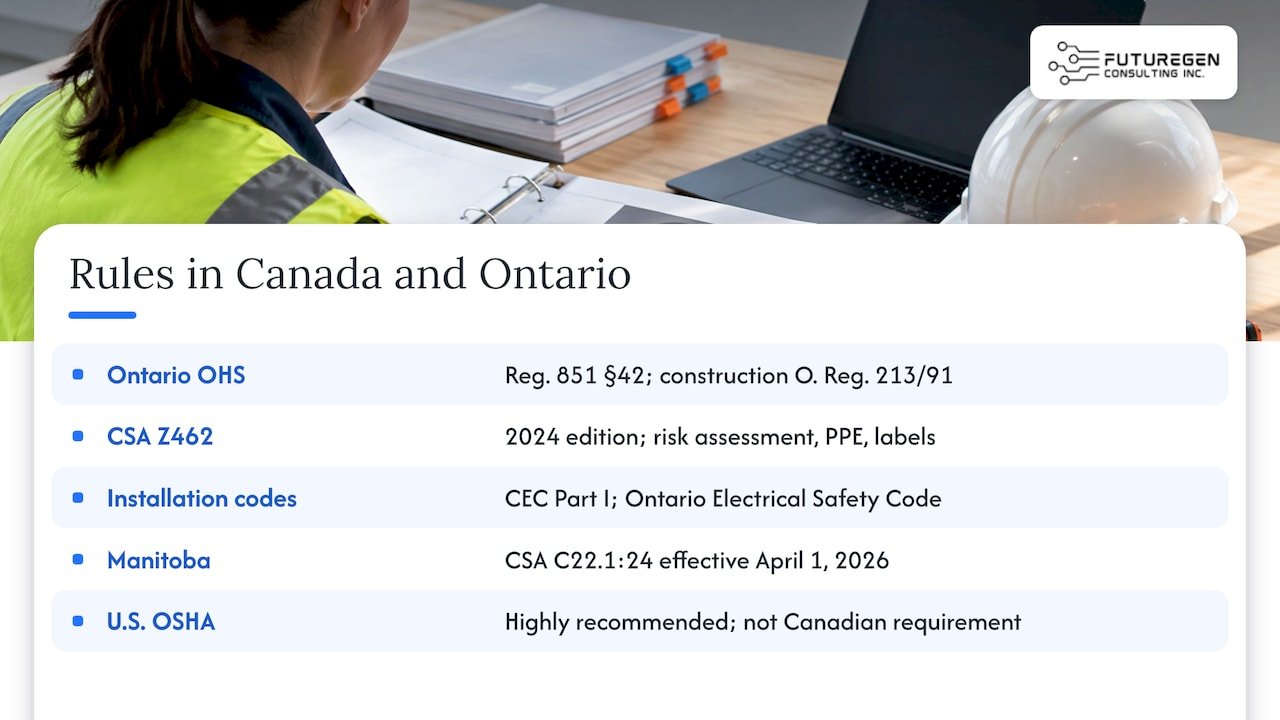
Occupational health and safety law. Workplace safety is provincial for most employers. In Ontario, Regulation 851 for industrial establishments requires, in section 42, that power to electrical installations, equipment or conductors be disconnected, locked out of service and tagged before work on or near live exposed parts, with written procedures that the employer establishes and implements. Construction projects are governed by the separate construction regulation, O. Reg. 213/91. These instruments establish the duty to protect workers; the arc flash study is the engineering tool that shows what protection a given task needs.
CSA Z462. This standard, which is the Canadian counterpart of the American NFPA 70E, provides the method for the arc flash risk assessment, the incident energy and PPE category approaches, the labeling concept and the energized work permit. The current edition is CSA Z462-24, and the standard is widely used in Ontario as the benchmark for what a competent employer does. Whether a regulator cites it directly or an inspector or insurer treats it as the accepted practice, designing to it is the defensible route.
The electrical installation codes. The Canadian Electrical Code, Part I (CSA C22.1), is adopted by each province, and in Ontario it is enforced through the Ontario Electrical Safety Code under the Electrical Safety Authority. These codes govern how equipment is installed and marked, and they are the reason an arc flash study often begins with the design drawings. Our guide to the Ontario Electrical Safety Code explains how the code and the permit process fit together. Other provinces update their adoption on their own schedules; Manitoba, for example, adopted the 26th edition of the code (CSA C22.1:24) through M.R. 30/2026, effective April 1, 2026, so a project outside Ontario should confirm the edition in force locally.
For comparison, the United States regulator OSHA states in its publication on protecting employees from electric-arc flash hazards that an arc flash study is highly recommended for all employers whose workers may be exposed to electrical hazards. That is an American document and is not a Canadian requirement, but it describes the same logic: identify the hazard, its likelihood and severity, and the measures that reduce it.
When a study is required
The trigger in CSA Z462 is the work, not the building type. Before an employer allows energized work within the arc flash boundary, an arc flash risk assessment must exist for the equipment concerned. In practice that places a study on most commercial, institutional and industrial facilities with equipment that is examined, adjusted, serviced or maintained while energized: switchgear, distribution panels, motor control centres, disconnects and transformer secondaries.
The following situations commonly call for a study:
- New construction with substantial electrical distribution. The study should be completed from the final design, so that protective device selections are confirmed before equipment is ordered and labels are ready at energization.
- Renovation or tenant fit-out that changes the distribution. New panels, feeders or transformers alter fault current and clearing times.
- Existing facilities with no study, or one prepared years ago. A report that predates equipment changes no longer describes the building.
- Added generation or storage. Emergency generators, solar and battery systems change fault current sources. Our emergency power design and solar design work addresses these systems at the design stage.
- Change of utility service. A utility transformer replacement or a change in available fault current changes every downstream result.
A residential developer building a multi-unit building usually does not employ workers who open energized equipment in the finished suites, but the common electrical rooms, main switchgear and any service contractors working there fall within the same logic. The owner or property manager who will operate the building inherits the obligation, so it is better to hand over a completed study than a request to commission one.
What the study must contain
A complete study is more than a set of labels. A property manager or developer reviewing a proposal should expect these elements.
Data collection and a system model
The engineer gathers the single-line diagram, utility short-circuit data, transformer ratings and impedances, conductor types and lengths, and the make, model and settings of each overcurrent protective device. A field verification of nameplates and settings corrects the drawings, which are frequently out of date. The model is then built in power systems software.
Short circuit and protective device coordination
Arc flash results depend on the available fault current, so a short circuit study comes first. A coordination study follows, because it shows how quickly each device operates and whether a faster setting can lower incident energy without causing nuisance trips upstream. Reviewing these together is far more useful than receiving labels in isolation. Our power system studies combine them for that reason.
Incident energy, boundary and PPE
The University of Toronto’s Electrical Safety Program, which applies CSA Z462, describes the arc flash boundary as the approach limit at which incident energy equals 1.2 cal/cm² (5 J/cm²), the level associated with the onset of a second-degree burn. The same program notes that for systems of 600 V and less, a default flash protection boundary of 4 feet applies where the system does not exceed 50 kA bolted fault current with a 6-cycle clearing time, or any combination not exceeding 300 kA cycles. The study replaces default assumptions with calculated values for each location.
PPE is then chosen in one of two ways. Under the incident energy method, arc-rated clothing is selected with a rating at or above the calculated energy. Under the PPE category method, the task and equipment are matched to the tables in the standard, which classify protection into categories 1 to 4. The tables only apply when the equipment and task fall within their stated conditions, so where they do not, the calculated method governs.
Recommendations
A useful report goes beyond numbers. It identifies the locations with the highest incident energy and sets out options to reduce it: maintenance-mode settings, zone-selective interlocking, current-limiting fuses, remote racking or an arc flash relay. Reduction at the source is preferable to relying on heavier PPE, and the recommendations belong in the design stage wherever possible.
Arc flash label requirements
Labels are the visible output of the study, and they are what an inspector or contractor will actually see. The University of Toronto program, applying CSA Z462, requires that equipment be field-marked with a label stating the available incident energy or the required PPE level together with the date of the evaluation. The label format follows a signal word panel (DANGER, WARNING or CAUTION) with a message panel beneath it. A detailed label can add the arc flash boundary, incident energy, PPE requirement, shock hazard voltage and an equipment designation.
A practical label specification for an Ontario project therefore includes:
| Label item | Why it matters |
|---|---|
| Equipment designation | Ties the label to the line in the study report |
| Nominal voltage | Identifies the shock hazard along with the arc hazard |
| Incident energy and working distance | Shows the exposure the PPE must withstand |
| Arc flash boundary | Tells others where the hazard begins |
| PPE category or minimum arc rating | Allows the correct clothing to be chosen quickly |
| Study date | Shows when the evaluation was done and when review is due |
Separately, the Canadian Electrical Code requires field-applied warning markings on certain equipment, with a specific arc flash warning rule in Section 2 of the 2024 edition. The wording of labels should follow the language requirements of the province. An installation labelled to the code and a study label that carries calculated values serve different purposes, and both are normally present on the same switchboard.
Labels should be updated after a new study, after protective device settings change in a way that affects results, when the five-year review period lapses, and when a label is damaged or hard to read. A label that no longer matches the system is worse than none, because workers rely on it.
Review and update intervals
CSA Z462 asks for a review of the incident energy analysis at intervals not exceeding five years, and for an update when changes occur that could affect the results. The University of Toronto program states the same two rules: update after a major modification or renovation, and review at intervals not exceeding five years, taking into account the overcurrent protective device design, its opening time and the condition of maintenance.
Five years is a ceiling. The events that should prompt an earlier review include:
- replacement or addition of a transformer, switchgear or motor control centre;
- a change in utility fault current or service configuration;
- protective relay, breaker or fuse setting changes;
- new feeders, large connected-load changes or a building expansion;
- addition of generation or battery storage;
- discovery that earlier study data were wrong.
In Alberta, where the client also operates, the Government of Alberta’s Hazard Assessment and Control handbook (October 2023) states that hazard assessments must be reviewed periodically even when nothing has changed, and recommends recording the last revision date on each assessment. A building owner with properties in both provinces can use one review calendar that satisfies the stricter reading.
Records and follow-up the owner should keep
A study that sits in a drawer does not protect anyone, and it will not help an employer who must demonstrate due diligence. The Canadian Centre for Occupational Health and Safety advises that employers document due-diligence activities in writing, including risk assessments, evidence that control measures were implemented, worker training records, inspection reports with corrective actions, and equipment maintenance records. Federal guidance on hazard prevention programs adds that a record of the preventive measures put in place is needed for the later steps in the prevention process. Federal workplaces are a narrow category, but the record-keeping logic applies equally to provincially regulated employers.
A sensible file for each building contains:
- the final study report with its input data and the software model;
- current single-line diagrams matching the model;
- a label schedule listing every labeled location and its date;
- the lockout and tagging procedures required by Regulation 851, section 42;
- worker training and qualification records;
- a log of changes to the electrical system with the date on which each triggered a review.
The change log is the item most often missing. Without it, nobody notices that a tenant’s new transformer has made the last study obsolete.
What to ask for in a proposal
Because the study influences safe work practices for years, the scope of the proposal matters more than the lowest fee. Confirm that:
- the work is performed and reviewed by a licensed professional engineer in Ontario, with experience in power system studies;
- it uses IEEE 1584-2018 and the current CSA Z462 edition;
- site verification of equipment and settings is included, rather than reliance on old drawings;
- short circuit and coordination studies are part of the deliverable;
- labels, a label schedule and mitigation recommendations are included;
- the report is delivered in a form that can be updated when the system changes.
For new construction, ask that the study be tied to the electrical design set, so that protective device choices can be revised on the drawings and not only noted in a report. This is the main reason owners come to an engineering firm that designs the distribution system as well as studying it. Our power distribution design work and the studies share one model, and design changes flow through to the results.
How the study fits into an Ontario project schedule
For a new building, the sequence normally runs as follows. The design engineer issues the single-line diagram and the protective device specifications during design development. After shop drawings and equipment submittals confirm actual breaker and relay models, the study is finalized from those data. Labels are printed and applied before energization, and the report is handed over with the operations and maintenance documents. For an existing building, a site visit and data collection come first, then modelling, then the report and label installation.
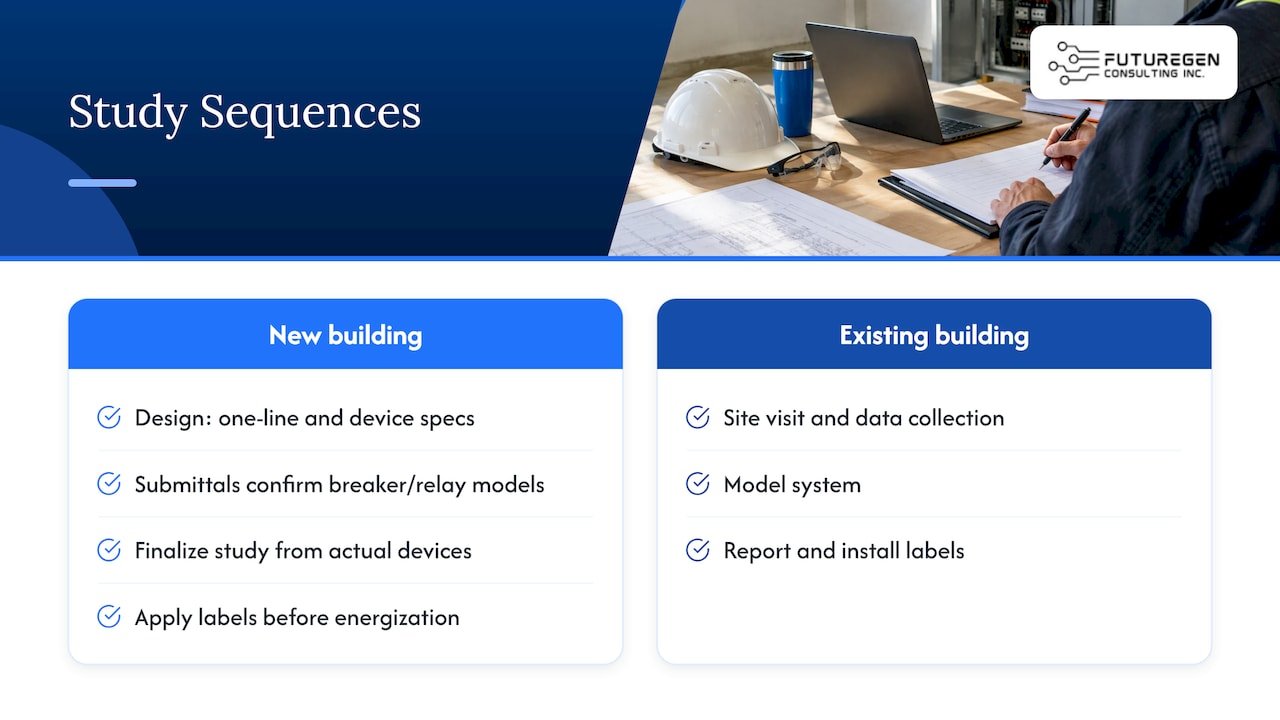
Planning the study in this order avoids the two common failures: equipment ordered with protective devices that produce unnecessarily high incident energy, and labels applied that do not match the devices actually installed. Both are expensive to correct after the walls are closed.
Promo: engineering support for studies and design
FutureGen Consulting Inc. provides power system studies as part of its electrical engineering services in Ontario and Alberta, alongside power distribution design, emergency and temporary power design, EV charger infrastructure design, solar power design and construction review. Projects are delivered with permit-ready, engineer-stamped drawings and building code compliance in view. To discuss the scope of a study for a new building, a renovation or an existing facility, visit the FutureGen Consulting services page.

Owners who also need related work can review the arc-fault and ground-fault protection guidance, which covers the protection devices that interact with the study results.
Perspective
Most of the arc flash problems we see described in the industry start in the same place: the study was treated as a document to be bought, not as part of the electrical design. When the engineer who designs the distribution system also models it, a high incident energy result is a design decision that can still be changed, by a different breaker, a different setting or a different arrangement of the equipment, before it becomes a label that tells workers to wear heavier clothing.
Our position is that the study belongs with the design and with the permit drawings, and that the owner should receive a report that can be updated as the building changes. With more than 30 years of experience in electrical and mechanical systems across new builds and renovations, we prepare engineer-stamped drawings and studies so that code compliance and safe maintenance are planned from the start.
For a developer, that means fewer surprises at energization. For a property manager, it means a file that is ready when a contractor asks for the arc flash label data.
Sanjay
FAQ
Is an arc flash study mandatory in Ontario?
The Ontario regulations set the employer’s duty to protect workers and to control electrical hazards, including lockout under Regulation 851, section 42. CSA Z462 is the recognized standard for how the arc flash risk assessment is done, and it calls for the assessment before energized work within the arc flash boundary. In practice, an employer with energized work needs a current study to meet that duty.
How often should an arc flash study be updated?
CSA Z462 sets a review at intervals not exceeding five years, and an update whenever changes could affect the results. Changes include new transformers or switchgear, altered protective device settings, a different utility service and major renovations. The five years is a maximum, so a significant change brings the review forward.
What must an arc flash label show?
Under the University of Toronto’s program, applying CSA Z462, the label states the available incident energy or the required PPE level and the date of the evaluation. A detailed label also shows the arc flash boundary, shock hazard voltage and equipment designation. Labels carry a signal word such as DANGER or WARNING.
Who performs the study?
The study should be prepared by a qualified engineer with experience in power system studies, using a model of the facility’s actual distribution system. In Ontario, a licensed professional engineer should review and stamp it. The employer remains responsible for acting on the results.
Do residential developments need an arc flash study?
The study applies to equipment that workers may service while energized. Multi-unit residential buildings usually have main switchgear, electrical rooms and common equipment of this kind. A design engineer can confirm the scope during the electrical design.
Sources
- IEEE SA: IEEE 1584-2018
- OSHA: Protecting Employees from Electric-Arc Flash Hazards
- Ontario Regulation 851, Industrial Establishments
- Manitoba Electrical Code, M.R. 30/2026
- University of Toronto Electrical Safety Program
- Government of Alberta: Hazard Assessment and Control handbook
- CCOHS: Due diligence
- Canada.ca: Hazard prevention program guide