

A construction change order is a written amendment to an existing contract that formally modifies the scope of work, the contract price, or the project schedule. When a change arises on your project, the immediate priorities become clear:
- Document the change in writing before any work proceeds.
- Log the potential impact against the baseline schedule.
- Preserve contemporaneous evidence: daily reports, photographs, correspondence, and site diaries.
- Submit a priced quotation or a formal rejection within the timelines your contract specifies.
Standard forms such as the AIA G701 Change Order and the Canadian Construction Documents Committee (CCDC) contract procedures provide the recognized frameworks for executing these steps. In Ontario, the Construction Act adds a layer of prompt payment and adjudication obligations that directly affect how change-order payments flow and how disputes are resolved. Futuregenconsulting, an Ontario MEP engineering firm with over 30 years of project experience, applies these frameworks on every residential and commercial project it supports.
Table of Contents
- What are construction change orders, and how do related terms differ?
- Why do change orders happen on construction projects?
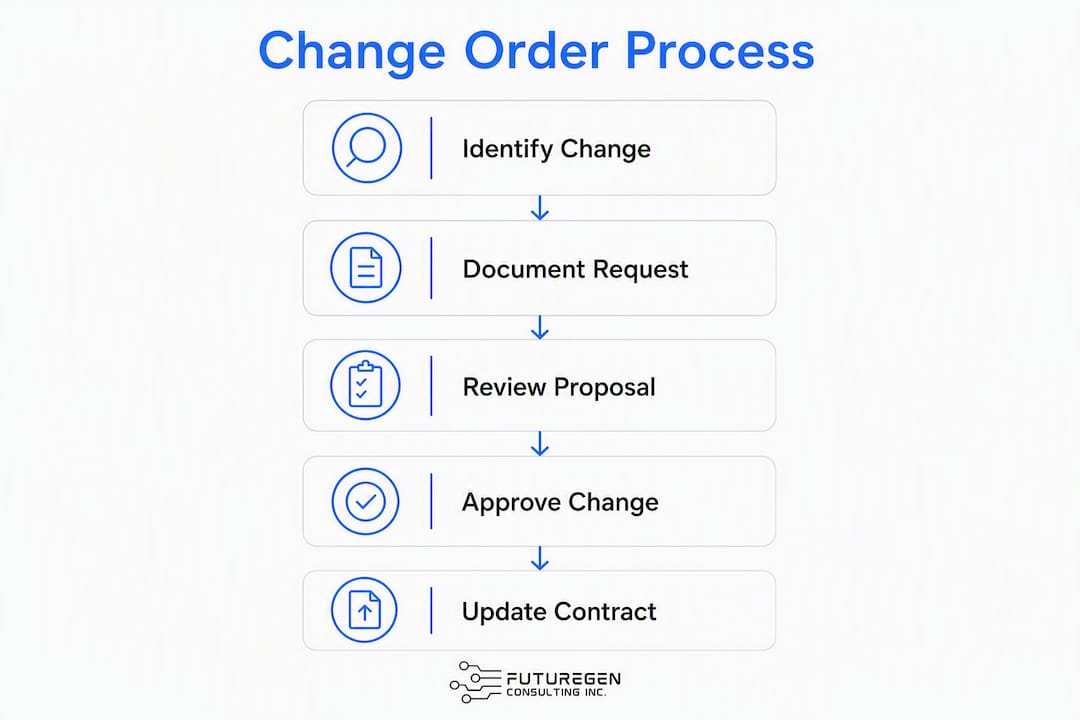
- How does the change-order process work from start to finish?
- What should every change order document include?
- Who pays for change orders, and how are costs calculated?
- How do change orders affect the project schedule?
- How should you maintain records and distinguish RFIs from change-order requests?
- Which forms and templates apply to Canadian construction projects?
- What are change directives, and when should you accept or resist them?
- How do you avoid change-order disputes and common legal pitfalls?
- Ontario-specific insights and a practical checklist for Canadian projects
- Key Takeaways
- The part of change-order management that most project teams underestimate
- Futuregenconsulting’s change-order review and pricing support for Ontario projects
- Authoritative sources for further reading on Canadian change-order practice
What are construction change orders, and how do related terms differ?
Understanding the precise meaning of each document type prevents costly procedural errors. The terms below are distinct instruments, and using the wrong one can affect payment rights and legal enforceability.
- Change Order (CO): — A fully executed written amendment, signed by the owner, the consultant or contract administrator, and the contractor, that adjusts the contract price, the completion date, or the scope of work. No work under the change should begin until all parties have signed, unless a change directive has been issued.
The AIA G701 Change Order form is the most widely referenced template in North American practice. CCDC contracts, which govern the majority of Canadian private-sector construction, follow an analogous procedure: the consultant issues a contemplated change notice, the contractor responds with a quotation, and the parties execute a change order upon agreement. Ontario’s OPSS.PROV 100 (GC 3.10) governs changes in the work and additional work on Ministry of Transportation of Ontario (MTO) projects, prescribing the contract administrator’s authority to prepare and issue change orders and the process for interim payment when pricing is unresolved.
Written documentation is not a formality in Ontario construction practice. Adjudicators under the Construction Act rely heavily on contemporaneous written records when determining entitlement and valuation. A verbal direction, however clear at the time, rarely survives a payment dispute without a supporting paper trail.
Why do change orders happen on construction projects?
Change orders arise from a predictable set of causes. Recognizing them early allows project teams to prepare contractual controls and documentation before a dispute develops.
- Owner-directed design changes: The owner modifies the program, finishes, or layout after the contract is executed. These are the most straightforward changes to price because scope is clearly owner-initiated.
- Unforeseen site conditions: Subsurface conditions, concealed structural elements, or undisclosed environmental contamination that differ materially from what the contract documents represented. These are among the most contested changes because entitlement depends on what the contract documents actually said.
- Errors and omissions in design documents: Conflicts between drawings and specifications, missing details, or coordination gaps between disciplines (structural, mechanical, electrical) that require field resolution. When a change order involving MEP systems arises from a design coordination gap, revised engineer-stamped drawings are typically required before the work proceeds.
- Regulatory and code changes: Mid-project revisions to the Ontario Building Code, the Ontario Electrical Safety Code, or fire code requirements that affect the permitted design. A permit amendment can trigger scope changes across multiple trades simultaneously.
- Material shortages and substitutions: Supply chain disruptions that require approved substitutions, which may carry different installation requirements, costs, or lead times.
- Latent conditions: Conditions that existed but were not discoverable through reasonable pre-contract investigation, such as asbestos in a renovation or undocumented underground utilities.
- Scope clarification requests: Ambiguities in the contract documents that, once resolved, require additional or different work than originally tendered.
Undocumented incremental changes are particularly dangerous. Each individual adjustment may appear minor, but the cumulative effect on cost and schedule can be significant. When these changes are not formally documented, the contractor loses the ability to claim their full impact, and the owner loses visibility into the true cost of the project.

How does the change-order process work from start to finish?
A disciplined, sequential process reduces disputes and accelerates approvals. The MCAC/MCAB Change Order Protocol recommends that contractors submit quotations promptly (targeting seven days) and that owners respond within defined windows (targeting 14 days), with a 21-calendar-day target for completing the full change-order cycle where possible.
- Identify the change. The contractor, consultant, or owner identifies a condition or instruction that falls outside the original contract scope.
- Issue written notification. The party identifying the change notifies the contract administrator in writing. Most contracts require notice within a specified period of becoming aware of the change; missing this window can forfeit entitlement.
- Prepare a cost and schedule impact estimate. The contractor prepares a detailed quotation covering direct costs, overhead and profit, and schedule impact. Subcontractor quotations are assembled and reviewed at this stage.
- Submit the formal change proposal. The contractor submits the priced quotation to the contract administrator, with supporting documentation including a schedule impact analysis tied to the baseline critical path.
- Review and approve, or issue a change directive. The contract administrator reviews the quotation. If pricing is agreed, a change order is executed. If pricing is disputed or time-sensitive, the contract administrator may issue a change directive to proceed on a reimbursable basis.
- Execute the work. Work proceeds under the authorized instrument (signed change order or change directive), with contemporaneous records maintained throughout.
- Update contract records and close out. The contract sum, substantial completion date, and schedule are updated. The change order is logged in the project change-order register, and as-built documentation is revised accordingly.
Responsibility at each step:
| Step | Primary Responsible Party | Supporting Party |
|---|---|---|
| Identify change | Contractor or Owner | Consultant |
| Issue written notice | Notifying party | Contract Administrator |
| Prepare cost/schedule estimate | Contractor | Subcontractors |
| Review and approve | Contract Administrator | Owner |
| Issue change directive (if needed) | Contract Administrator | Owner |
| Execute work | Contractor | Subcontractors |
| Update records and closeout | Contract Administrator | Contractor |
What should every change order document include?
A change order that omits critical fields is difficult to enforce and nearly impossible to audit. Industry guidance identifies six core items every change order must contain: project and contact information, change dates, a detailed description of the work, an updated schedule, the cost of the change, and the revised contract value. The following checklist expands on these for Canadian practice:
- Project identification: Project name, address, contract number, and change order number.
- Initiating party and date of initiation: Who identified the change and when.
- Description of changed work: Specific, precise language describing exactly what work is added, deleted, or modified. Reference the original drawing numbers, specification sections, and revision dates. Vague descriptions (“additional electrical work as directed”) create disputes; precise descriptions (“supply and install one 100A, 120/208V, 3-phase panelboard at grid line C-4 per revised drawing E-102 Rev. 3”) do not.
- Cost breakdown: Direct labor (by trade, hours, and rate), materials (itemized with quantities and unit prices), equipment, subcontractor costs, overhead, and profit. Separate direct costs from impact or consequential costs, and state clearly which costs are included and which are reserved for later claim.
- Schedule impact: The number of calendar days of extension requested, the specific baseline schedule activities affected, and a brief critical-path narrative explaining why the change affects the completion date.
- Revised contract sum and completion date: The updated totals after this change order.
- Assumptions and exclusions: Any conditions under which the pricing is valid, and any costs explicitly excluded from this change order (particularly impact costs that require further quantification).
- Signature blocks: Owner, contract administrator, and contractor, with authority designations and dates.
Pro Tip: Always reference the baseline schedule activity IDs in the schedule impact section. An adjudicator or arbitrator reviewing a time extension claim will look for a direct link between the change and a specific critical-path activity. Without that link, the extension claim is difficult to substantiate.
Who pays for change orders, and how are costs calculated?
Pricing a change order correctly requires separating three distinct cost categories and selecting the appropriate pricing method for the circumstances.
Pricing methods
- Lump sum: The contractor proposes a fixed price for the defined scope. Appropriate when the scope is well-defined and risks are quantifiable. This is the preferred method under most CCDC and MCAC protocols.
- Unit price adjustment: The change is priced by applying pre-agreed unit rates (from the contract’s schedule of unit prices) to measured quantities. Common on civil and infrastructure projects.
- Time and material / force account: The contractor is reimbursed for actual labor, materials, and equipment at agreed rates, plus overhead and profit. Used when scope cannot be defined in advance, typically under a change directive.
Cost categories
Direct costs cover field labor (including foreman time), materials incorporated into the work, and equipment directly used on the changed work. Indirect costs include head office overhead, site supervision dilution, and general conditions attributable to the change. Impact costs, sometimes called consequential costs, are the productivity losses, acceleration costs, and disruption effects that result from the change but are not captured in direct cost alone. The OCA Change Order Protocol specifically identifies impact costs as frequently missed and recommends that contractors address them early using baseline schedules and ongoing productivity tracking.
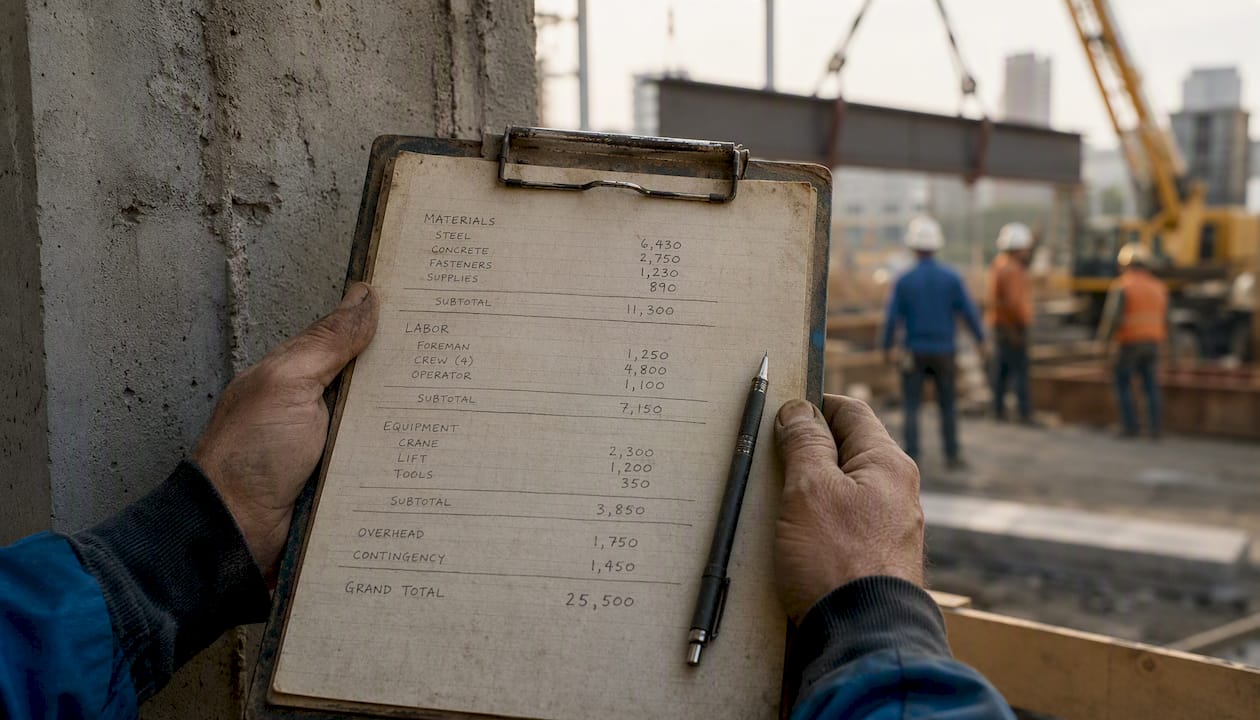
Contractors are entitled to overhead and profit on change order work. The MCAC/MCAB protocol provides guidance on reasonable markup levels, and the OCA protocol similarly supports the inclusion of overhead and profit as standard components of a fair and reasonable change order price. When work proceeds under a change directive, interim invoicing for reimbursable expenses is commonly permitted until final pricing is agreed.
Practical steps for pricing
- Tie every cost element back to a specific baseline schedule activity.
- Maintain daily productivity logs during the execution of changed work.
- State in the quotation that the price covers direct costs only and that the right to claim cumulative impact costs is expressly reserved.
- Include clear assumptions about access, sequencing, and concurrent work conditions.
Proceeding without a signed change order significantly increases non-payment risk. Construction law practitioners recommend treating verbal authorization as a temporary work directive only, and pursuing a written, signed instrument before finalizing payment expectations.
How do change orders affect the project schedule?
A change order that adds cost without addressing schedule impact is an incomplete document. Time extensions require the same level of substantiation as cost claims, and the burden of proof rests with the party claiming the extension.
- Link the change to the baseline critical path. Identify which baseline schedule activities are directly affected by the changed work. If the affected activities are on the critical path, the change has a direct impact on the completion date. If they are on a near-critical path, the float consumption may still be claimable.
- Produce a time-impact analysis. A time-impact analysis (TIA) inserts the changed work into the baseline schedule as a fragnet and demonstrates the delay by comparing the updated completion date to the original. This is the most defensible method for substantiating a time extension in Canadian construction disputes.
- Document lost productivity and access restrictions. If the change disrupted ongoing work (e.g., a design change that required rework in a completed area, or a change directive that altered the sequence of trades), document the specific productivity loss with daily reports, labor records, and correspondence.
- Submit the extension claim with required supporting documents. The claim should include the TIA, the baseline schedule snapshot, daily reports covering the affected period, and a narrative explaining the causal link between the change and the delay.
- Negotiate with the contract administrator. Present the TIA at the earliest opportunity. Delays in submitting time extension claims can result in the claim being denied on procedural grounds, independent of its merits.
Pro Tip: Preserve a locked, dated snapshot of the baseline schedule at contract execution. Courts and adjudicators have consistently treated the baseline schedule as the reference point for delay analysis. A schedule that has been continuously updated without preserving the original baseline is far less useful in a dispute.
How should you maintain records and distinguish RFIs from change-order requests?
Disciplined recordkeeping is the single most effective risk management tool available to construction project teams. Adjudicators rely on contemporaneous written documentation when determining entitlement and valuation, and a well-maintained project log can resolve a dispute that would otherwise require months of litigation.
Core logs every project should maintain:
- Change-order register: Sequential list of all change orders and change directives, with status (pending, approved, rejected), cost, schedule impact, and execution date.
- RFI log: All RFIs issued and received, with response dates and disposition. RFIs that result in scope changes should be cross-referenced to the corresponding change-order request.
- Daily reports: Site superintendent’s daily records of labor, equipment, weather, visitors, instructions received, and work completed. These are the primary contemporaneous record in any dispute.
- Material receipts and delivery records: Proof of quantities and costs for force-account and time-and-material work.
- Correspondence index: All written communications, including emails, organized by date and subject.
RFIs versus change-order requests: An RFI asks the consultant for clarification on the contract documents. It does not authorize the contractor to perform work differently from what the contract requires, and it does not create an entitlement to additional compensation. When a contractor believes that the answer to an RFI reveals a scope change, the correct response is to submit a formal change-order request referencing the relevant contract clauses and the RFI response, not to proceed with the changed work on the basis of the RFI alone.
Document control discipline matters as much as the content of the documents. Consistent file naming conventions, version control on drawings and specifications, and a single authoritative repository for project correspondence reduce the risk of acting on superseded information. Entry-level field apps can handle basic logging and photo documentation; enterprise platforms offer integrated schedule, cost, and document control in a single environment.
Which forms and templates apply to Canadian construction projects?
The two most commonly referenced frameworks in Canadian practice are the AIA G701 and the CCDC change-order procedures. They are not interchangeable, and the choice of form should match the contract under which the project is executed.
| Form / Procedure | Jurisdictional Fit | Primary Use |
|---|---|---|
| AIA G701 Change Order | US-origin; used in Canada when AIA contract suite is adopted | Formal change order execution; records revised contract sum and time |
| CCDC Change Order Procedure | Canadian national standard; aligns with CCDC 2, CCDC 3, CCDC 5A/5B | Contemplated change notice → quotation → change order workflow |
| OPSS.PROV 100 GC 3.10 | Ontario public sector (MTO and municipal projects adopting OPSS) | Changes in the work and additional work on provincial infrastructure contracts |
| Owner-specific CO forms | Varies by owner (municipalities, school boards, hospitals) | Supplementary conditions may modify CCDC procedures |
Completing a CCDC change-order form correctly:
- The contemplated change notice (CCN) is issued by the consultant and describes the proposed change without authorizing work.
- The contractor responds with a quotation within the time specified in the contract (typically 10–21 days).
- Upon agreement, the consultant issues the change order, which is signed by all three parties.
- If pricing is not agreed, the consultant may issue a change directive.
Public procurement note: On Ontario public-sector projects, issuing a change order is effectively a two-stage process. Preliminary procurement or administrative approval for additional work must be obtained before the contract administrator can issue the change order. Project teams must map their internal approval gates to avoid delays in authorization. This is particularly relevant for projects governed by OPSS.PROV 100, where the contract administrator’s authority to approve additional work may be subject to a monetary threshold.
When a change order affects MEP engineering scope, revised engineer-stamped drawings are typically required before the change order can be fully executed, particularly for changes affecting fire alarm systems, electrical distribution, or HVAC design under the Ontario Building Code.
What are change directives, and when should you accept or resist them?
A change directive (sometimes called a work directive or construction change directive) is a unilateral written instruction from the owner or contract administrator directing the contractor to proceed with changed work before the parties have agreed on price. It is a legitimate contract mechanism, but it carries administrative and financial risks that require careful management.
When change directives are appropriate:
- The change is time-sensitive and cannot wait for pricing negotiation.
- The scope is genuinely uncertain and cannot be defined in advance.
- The parties have agreed on the method of compensation (force account) but not the final amount.
Action steps when presented with a change directive:
- Confirm the directive is in writing and issued by a party with contractual authority to do so.
- Document the directive in the change-order register and cross-reference it to the relevant RFI or site instruction.
- Request that the contract administrator confirm the pricing protocol (force account rates, markup percentages, and invoicing frequency) in writing before work begins.
- Maintain detailed daily records of all labor, materials, and equipment used on the directed work, segregated from base contract work.
- Invoice for reimbursable expenses at the intervals permitted by the contract. The OCA Change Order Protocol confirms that change directives authorize proceeding on a reimbursable basis but do not replace the need to agree on final pricing recorded in a signed change order.
- Pursue agreed pricing and conversion to a signed change order as promptly as possible. Allowing a directive to remain open indefinitely increases administrative burden and the risk of pricing disputes.
Forced-account work preserves entitlement but requires significantly more documentation than lump-sum work. The contractor must be prepared to produce contemporaneous records that support every line item in the final invoice.
How do you avoid change-order disputes and common legal pitfalls?
Most change-order disputes are preventable. The behaviors that create them are well-documented, and the controls that prevent them are straightforward to implement.
Practices that protect both owners and contractors:
- Enforce written change procedures consistently from day one. Legal and industry guidance warns that owners who allow regular deviations from written change procedures risk waiving the right to enforce strict protocols later. This principle, known as waiver by conduct, can effectively rewrite the contract through behavior.
- Never proceed on verbal orders alone. A verbal direction from the owner’s representative, however senior, does not create a binding obligation to pay unless the contract authorizes verbal instructions (most do not).
- Follow contractual notice periods precisely. Missing a notice deadline is one of the most common reasons legitimate claims are denied. Calendar the notice windows at contract execution.
- Do not accept unauthorized scope changes without documentation. If an owner’s representative asks for additional work informally, the correct response is to confirm the request in writing and submit a change-order request before proceeding.
- Avoid treating RFI responses as authorization to perform changed work. This is a frequent and costly mistake.
Legal risk callouts:
- Waiver by conduct: Consistent deviation from written change procedures can waive the right to enforce them. Both owners and contractors are exposed to this risk.
- Adjudication under the Ontario Construction Act: Ontario’s Construction Act provides a statutory adjudication mechanism for payment disputes, including disputes about change-order entitlement and valuation. Adjudicators rely on contemporaneous written documentation. A project team with disciplined records has a significant procedural advantage.
- Lien rights: Unpaid change-order work can support a construction lien under the Construction Act. Lien preservation deadlines are strict, and missing them extinguishes the right.
Communication practices that reduce conflict:
- Provide early, rough-order-of-magnitude cost estimates when a potential change is identified, even before a formal quotation is prepared. This prevents sticker shock and allows the owner to make an informed decision about whether to proceed.
- State assumptions transparently in every quotation. An owner who understands what is and is not included in a price is less likely to dispute the final invoice.
- Hold regular change-order status meetings to review the register, resolve pending items, and prevent the accumulation of unresolved changes.
Ontario-specific insights and a practical checklist for Canadian projects
Ontario’s Construction Act is the governing statute for construction contracts in the province, and its prompt payment and adjudication provisions directly affect how change-order payments flow. Amendments that took effect January 1, 2026 introduced a revised definition of “proper invoice,” allowance for private adjudicators, expanded adjudication availability, mandatory annual holdback payments following each contract anniversary, and specific payment timing windows. These changes mean that a change order that generates a proper invoice triggers the same prompt payment clock as a base contract invoice: the owner must pay or dispute within the statutory window, or face interest and adjudication exposure.
Holdback timing is particularly relevant for change-order work. Under the amended Construction Act, holdback on change-order amounts is subject to the same annual release mechanism as base contract holdback, which requires project teams to track change-order completion dates alongside the overall contract timeline.
On Ontario projects, the combination of prompt payment obligations and statutory adjudication has shifted the risk calculus for owners who delay change-order approvals. An owner who sits on a change-order quotation past the statutory payment window may find that the contractor’s adjudication right is triggered before pricing is even agreed. Early approval and transparent communication are not just good practice; they are financial risk management.
Practical checklist for Canadian projects:
- Review the contract’s change-order clause at execution: identify notice windows, pricing deadlines, and the authority levels required for approval.
- Establish a baseline schedule at contract execution and lock a dated snapshot.
- Set up a change-order register and RFI log before the first site meeting.
- Confirm the contract administrator’s authority threshold for approving change orders without escalation to the owner.
- For Ontario projects, calendar the prompt payment windows and holdback anniversary dates.
- Collect daily reports, photographs, and material receipts throughout the project, not just when a dispute arises.
- For changes affecting fire alarm systems or electrical distribution, confirm whether revised engineer-stamped drawings are required before the change order can be executed.
- On public-sector projects, identify the procurement approval threshold before submitting a change-order quotation.
This article provides general information about construction change-order practice in Ontario and Canada. It is not legal advice. Stakeholders should confirm current statutory requirements and contract obligations with qualified legal counsel.
Key Takeaways
Effective change-order management on Canadian construction projects requires written documentation, baseline schedule discipline, and strict adherence to contractual notice timelines from the moment a potential change is identified.
| Point | Details |
|---|---|
| Get it in writing | Every change must be documented before work proceeds; verbal directions do not create enforceable payment obligations. |
| Tie costs to the baseline schedule | Link every cost and time extension claim to specific baseline critical-path activities to substantiate entitlement. |
| Follow notice timelines | Missing contractual notice windows is one of the most common reasons valid claims are denied, regardless of merit. |
| Preserve contemporaneous records | Daily reports, photographs, and material receipts are decisive in Ontario adjudications and lien proceedings. |
| Futuregenconsulting supports MEP change-order review | Futuregenconsulting provides change-order pricing assistance, schedule impact analysis, and revised engineer-stamped drawings for Ontario MEP scope changes. |
The part of change-order management that most project teams underestimate
The procedural mechanics of a change order are well-documented. What is less discussed is the compounding effect of deferred decisions. On most projects, the change-order register is treated as a back-office accounting function rather than a live risk management tool. By the time the project approaches substantial completion, the register contains dozens of unresolved items, each carrying pricing assumptions that were reasonable six months earlier but no longer reflect actual site conditions.
The Ontario Construction Act’s prompt payment and adjudication framework has changed this dynamic in a meaningful way. An owner who defers change-order approvals is no longer simply delaying a financial decision; they are accumulating adjudication exposure on each unpaid proper invoice. The practical implication is that change-order management is now a cash-flow and legal risk function, not just a contract administration task.
There is also a discipline gap on the contractor side that deserves attention. Many contractors submit change-order quotations that cover direct costs accurately but omit impact costs entirely, either because they are difficult to quantify at the time or because the contractor is reluctant to appear unreasonable. The OCA Change Order Protocol addresses this directly by recommending that contractors explicitly reserve the right to claim cumulative impact costs in every quotation. Failing to include that reservation language can result in a signed change order that inadvertently releases the contractor’s right to claim the full cost of disruption.
For MEP engineering changes specifically, the documentation burden is higher than for most other trades. A change to an electrical distribution system or a fire alarm configuration requires revised engineer-stamped drawings, a permit amendment in many cases, and coordination with the authority having jurisdiction. These steps take time and cost money, and they must be reflected in the change-order pricing. A change-order quotation that omits engineering and permit fees is underpriced before the first tool is lifted.
Futuregenconsulting’s change-order review and pricing support for Ontario projects
When a change order affects mechanical, electrical, or plumbing scope on an Ontario project, the engineering review is not optional. Revised load calculations, updated fire alarm device placement, or a modified HVAC configuration each require stamped drawings before the change can be permitted and executed. Futuregenconsulting provides exactly this support: change-order pricing assistance, schedule impact analysis, and permit-ready engineer-stamped drawings for MEP scope changes on residential and commercial projects across Ontario.

The firm’s electrical construction cost estimation service produces detailed, trade-level cost breakdowns that align with the documentation requirements of CCDC and MCAC protocols, including direct cost itemization, overhead and profit, and explicit assumptions about scope limits. For owners and contractors facing a disputed change on a fire alarm, HVAC, or power distribution system, Futuregenconsulting can deliver a concise pricing memo or construction review report that supports negotiation or adjudication preparation.
Contact Futuregenconsulting to request a change-order review for your Ontario project.
Authoritative sources for further reading on Canadian change-order practice
- Construction Act, RSO 1990, c C.30 (CanLII) — Ontario’s governing statute for construction contracts, lien rights, prompt payment, and adjudication. Primary legal reference for all Ontario projects.
- Ontario Construction Act amendments now in effect (Mondaq) — Summary of the January 1, 2026 amendments, including revised proper invoice definition, private adjudicators, and annual holdback payment requirements.
- MCAC/MCAB Change Order Protocol (PDF) — National protocol from the Mechanical Contractors Association of Canada providing submission timelines, markup guidance, and interim payment practices. Applicable across Canadian provinces.
- OCA Change Order Protocol (Ottawa Construction Association, PDF) — Ontario-specific protocol covering change directives, impact costs, and interim invoicing. Particularly useful for Ottawa-region and Ontario general contractors.
- OPSS.PROV 100, GC 3.10 Changes in the Work and Additional Work (MTO) — Governing specification for changes on Ontario Ministry of Transportation projects. Defines contract administrator authority, interim payment procedures, and compensation request paths.
- Managing change in public infrastructure projects (Blakes) — Legal analysis of waiver by conduct and the importance of consistent enforcement of written change procedures on public-sector projects.
- Change orders and scope creep: managing risk in construction projects (TS Lawyers) — Ontario construction law practitioner guidance on RFI versus change-order distinctions, contemporaneous documentation, and adjudication preparation.
- How construction change orders work (Procore) — Practical industry checklist covering the six core fields every change order must include. Useful as a field reference for project administrators.