
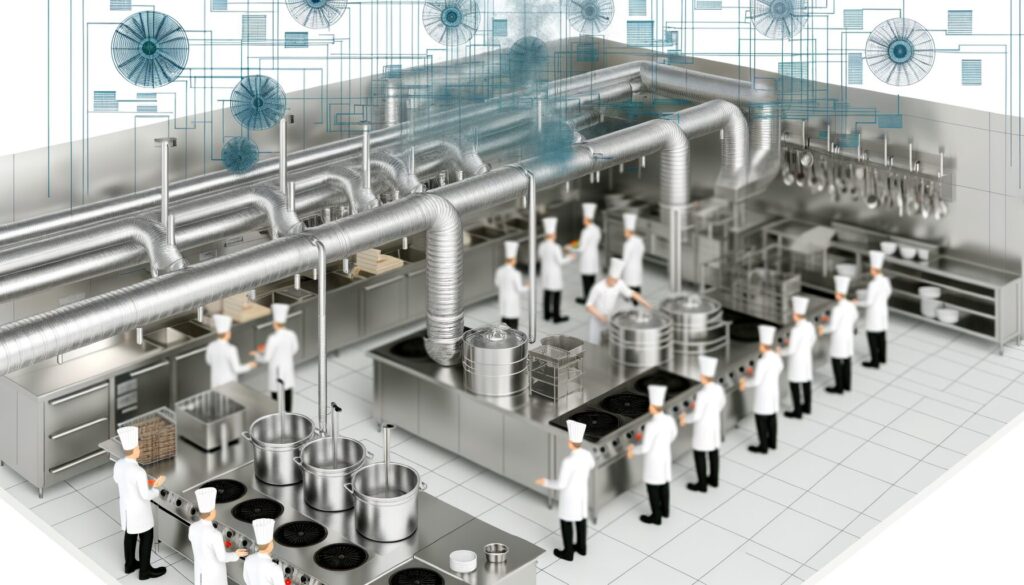
Designing Ventilation Systems for Commercial Kitchens
Commercial kitchens place some of the most demanding loads on a building’s mechanical systems. Heat, grease-laden vapours, smoke, combustion products, and odours must be captured and exhausted reliably—without creating uncomfortable dining spaces, negative pressure issues, or excessive energy use. In Ontario, kitchen ventilation design must also align with applicable codes and standards, coordinate with architectural and fire protection requirements, and support day-to-day operational realities such as menu changes, equipment upgrades, and maintenance access.
A well-designed system balances three fundamentals: effective capture at the source, safe and code-compliant exhaust and fire protection, and properly conditioned make-up air that maintains building pressure and comfort.
Start with the Cooking Process and the Hood Selection
The design process should begin with the kitchen concept: appliance list, duty ratings, cooking methods, and the layout of the line. Ventilation rates are not one-size-fits-all; a heavy-duty charbroiler and solid-fuel appliance generate a very different plume than a light-duty convection oven. Capturing and containing the thermal plume is the primary objective, and hood selection has a direct impact on performance and fan sizing.
Common hood categories include:
- Type I hoods for grease and smoke-producing appliances (e.g., fryers, griddles, ranges, wok stations).
- Type II hoods for heat and moisture where grease is not present (e.g., dishwashers, some ovens), subject to local acceptance and the actual process.
- Canopy hoods over a cooking line, typically requiring appropriate overhangs and mounting heights to improve capture.
- Back-shelf or proximity hoods that can reduce required airflow when appliances are against a wall and the hood is closer to the source.
Early coordination with the architect and kitchen consultant helps ensure adequate clearance to combustibles, workable mounting heights, lighting integration, and service access—each of which affects performance and compliance.
Airflow, Capture, and the Role of Make-Up Air
Exhaust airflow is often the headline number, but make-up air is what makes the system work in the context of the entire building. Without sufficient make-up air, commercial kitchens can pull air from adjacent spaces, causing drafts at entrances, odour migration into dining areas, and interference with combustion appliances or other exhaust systems.
Key ventilation objectives include:
- Maintain pressure relationships so the kitchen is typically negative relative to dining areas (to contain odours), while avoiding excessive depressurization that affects door operation and comfort.
- Provide tempered make-up air to support year-round operation in Ontario’s heating season and humid summers.
- Distribute supply air correctly so it does not short-circuit the hood (supply air blowing across the hood face can reduce capture).
Make-up air can be introduced through dedicated make-up air units (MAUs), rooftop units, or air handling systems serving the broader tenant space. The design should consider where the air is introduced—perforated ceiling diffusers, displacement strategies, or integrated hood supply—so the capture zone remains stable during peak cooking.
Energy Considerations: Right-Sizing and Demand Control
Kitchen exhaust is a major energy driver because every cubic foot per minute exhausted must be replaced, heated, and often cooled or dehumidified. Over-ventilating is costly and can create comfort issues. Right-sizing based on equipment duty and hood style, combined with a control strategy, can reduce annual operating costs while improving performance.
Options commonly considered in commercial kitchen projects include:
- Demand-controlled kitchen ventilation (DCKV) using temperature and/or optical sensors to modulate exhaust and make-up air based on actual cooking loads.
- Variable frequency drives (VFDs) on exhaust and supply fans to support turn-down during off-peak periods while maintaining minimum ventilation and pressure control.
- Heat recovery where practical and permissible, recognizing that grease and moisture can constrain the type of heat exchanger used and maintenance requirements.
Energy measures must be evaluated alongside operational needs: a system that saves energy but compromises capture, creates nuisance tripping, or adds maintenance burden will not be successful long-term.
Grease Ducting, Fire Protection, and Code Coordination
Type I hood systems require careful coordination of grease duct routing, shaft requirements, access panels, and fire-rated assemblies. From an engineering perspective, routing is not just about getting to the roof—each offset, horizontal run, and change in direction affects pressure loss, fan selection, and cleanability. Access for inspection and cleaning should be considered early to avoid conflicts with structure and ceilings.
Fire safety is integral to kitchen ventilation design and typically involves:
- Listed grease filters and proper installation to minimize grease carryover.
- Fire suppression systems integrated with the hood and cooking equipment, coordinated with the mechanical and electrical shutdown sequence.
- Interlocks between hood exhaust, make-up air, and gas/electrical supply as required by applicable codes and the authority having jurisdiction.
Contractors benefit from clear control narratives and wiring diagrams that define what must run, what must shut down, and what must be supervised when the suppression system activates.
Exhaust Discharge, Rooftop Coordination, and Neighbour Impacts
In dense urban areas and mixed-use developments, exhaust discharge location can be as challenging as the kitchen itself. Discharge velocity, separation from outdoor air intakes, and proximity to adjacent properties or patios must be considered to reduce odour complaints and re-entrainment. Rooftop coordination with other intakes, relief air openings, and equipment maintenance clearance is essential, particularly on multi-tenant buildings where different systems share limited roof space.
Where odour control is a concern, designs may incorporate filtration or treatment technologies appropriate to the cooking process, with an understanding of pressure drop, maintenance, and replacement cycles.
Commissioning, Balancing, and Long-Term Performance
A commercial kitchen can meet every drawing requirement and still perform poorly if it is not commissioned properly. Air balancing verifies the intended exhaust and make-up air rates and confirms pressure relationships between kitchen, dining, and corridors. Functional testing should verify sequences such as start/stop, modulation (where applicable), and safety interlocks. For renovations, it is also important to confirm that other building exhaust systems (washrooms, garbage rooms, parking areas) are not unintentionally competing for make-up air.
Designing for maintainability is equally important. Grease filters, access doors, fan service points, and control panels should be placed so routine work can be completed safely and without disrupting operations more than necessary.
Common Pitfalls to Avoid in Ontario Projects
- Undersized make-up air leading to strong negative pressure, comfort complaints, and door/combustion issues.
- Poor supply air placement that disrupts hood capture and increases spillage into the space.
- Inadequate duct access that complicates required inspections and cleaning.
- Late coordination with architectural, structural, and fire protection layouts, resulting in costly reroutes and site changes.
- Over-reliance on “rules of thumb” instead of aligning hood type, appliance duty, and control strategy with the actual operation.
Commercial kitchen ventilation is a specialized intersection of mechanical design, fire safety, and building performance. For property owners, developers, architects, and contractors in Ontario, early coordination and clear engineering documentation help reduce construction conflicts, support permitting, and deliver a kitchen that operates safely and efficiently. Engaging engineering consulting services in Ontario can also assist with system selection, code coordination, and construction-phase support to keep the project aligned from concept through commissioning.