

Which system is right for your Ontario home: HRV or ERV?
For most Ontario homeowners, an HRV is the better choice. Ontario winters are cold and dry, and an HRV exhausts excess indoor moisture while recovering 70–90% of heat from outgoing air. An ERV, by contrast, transfers both heat and moisture through an enthalpy core, making it better suited to humid or mixed climates where retaining indoor humidity through winter is a priority.
Key differences at a glance:
- HRV (Heat Recovery Ventilator): Transfers heat only. Exhausts moisture with stale air. Preferred in cold, dry Ontario winters to prevent excess indoor humidity and condensation.
- ERV (Energy Recovery Ventilator): Transfers heat and moisture. Retains some indoor humidity. Better for homes where winter air is uncomfortably dry or where hot, humid summers drive significant cooling loads.
- Ontario climate fit: HRV suits the majority of Ontario homes, particularly in colder regions. ERV may benefit homes in milder southern Ontario with air conditioning and humid summers.
- Moisture caution: Neither system replaces a dedicated dehumidifier when moisture problems stem from foundation leaks or plumbing failures.
Pro Tip: In very tight, small homes with high occupancy or many moisture sources (pets, plants, frequent cooking), an ERV can reintroduce too much humidity in winter. An HRV is often the safer choice in those cases.
How do HRV and ERV systems actually work?
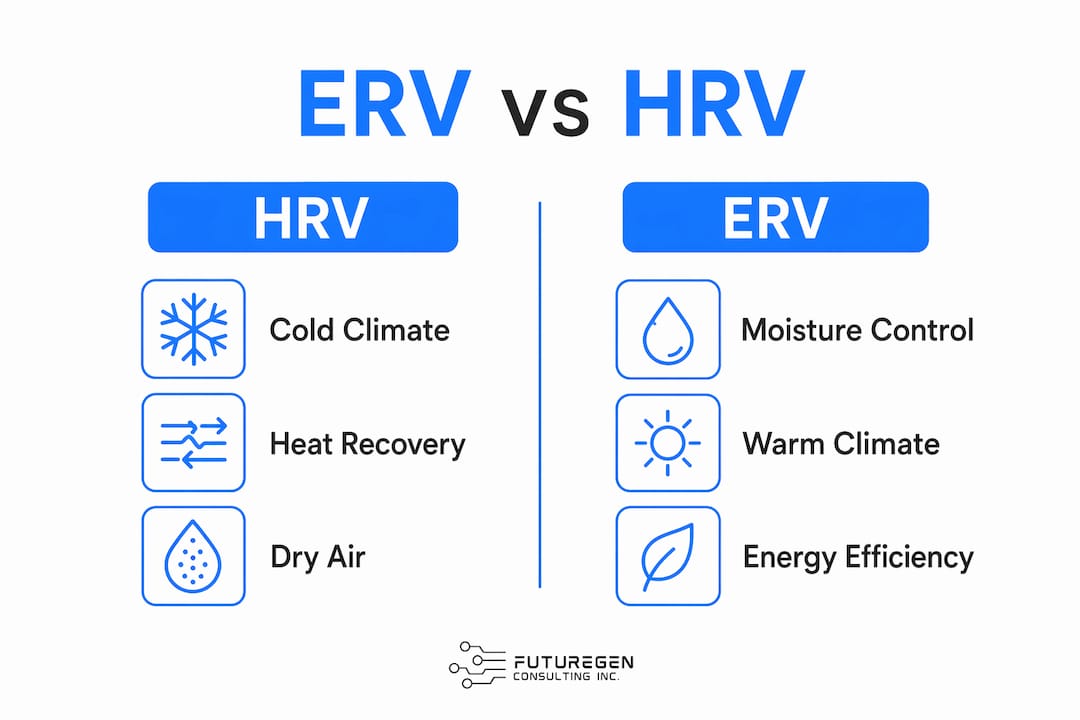
Both systems continuously replace stale indoor air with fresh outdoor air while recovering energy from the exhaust stream. The core difference lies in what the heat exchanger transfers.
HRV operation:
- Draws stale, humid air from bathrooms, kitchens, and laundry rooms.
- Passes exhaust air through a metal or plastic heat exchanger core.
- Transfers heat (but not moisture) to incoming fresh air before exhausting the stale air outdoors.
- Delivers preheated fresh air to bedrooms and living areas.
ERV operation:
- Uses a proprietary enthalpy core made from moisture-permeable materials.
- Transfers both heat and water vapor between exhaust and supply air streams.
- In summer, pre-cools and dehumidifies incoming outdoor air by transferring heat and moisture to the cooler exhaust stream.
- In winter, returns a portion of exhaust moisture to incoming air, raising supply humidity.
Both systems include fans, filters, defrost controls, and ductwork connections. Many units also offer a “boost” mode for high-moisture events like showers. The HRV does not replace a range hood; cooking exhaust requires a dedicated ventilation path above the stove.
How Ontario’s climate shapes your HRV or ERV choice
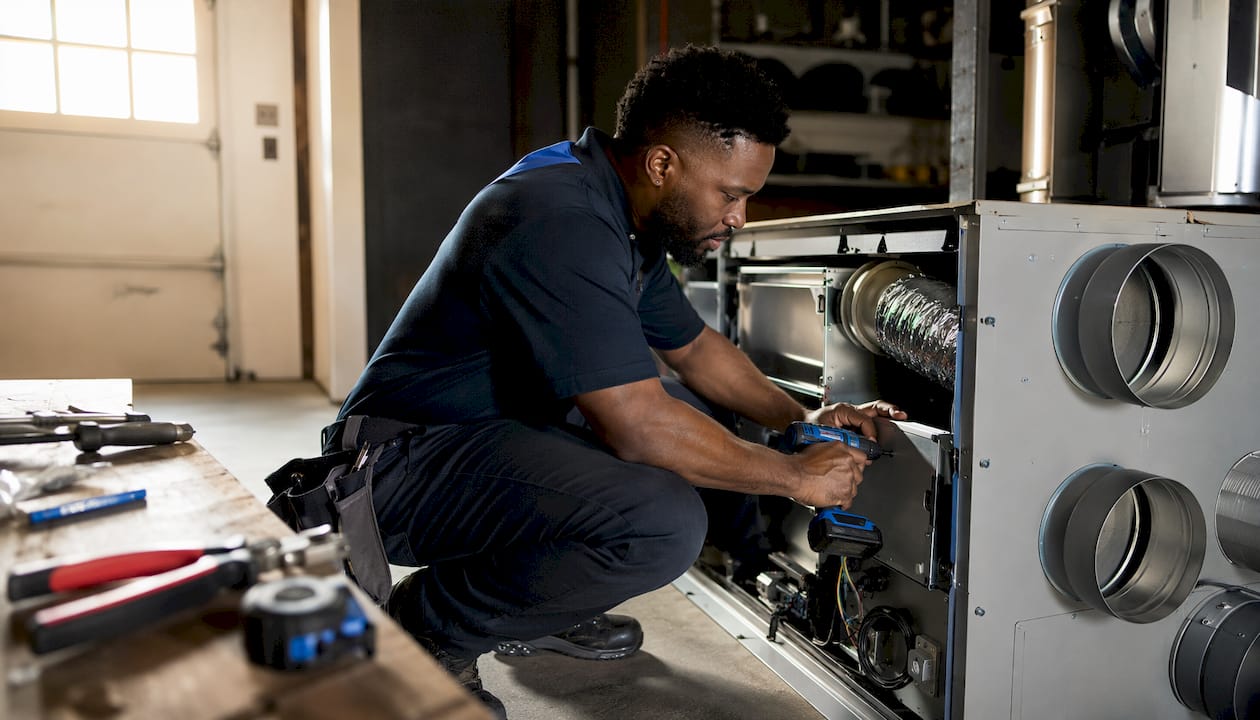
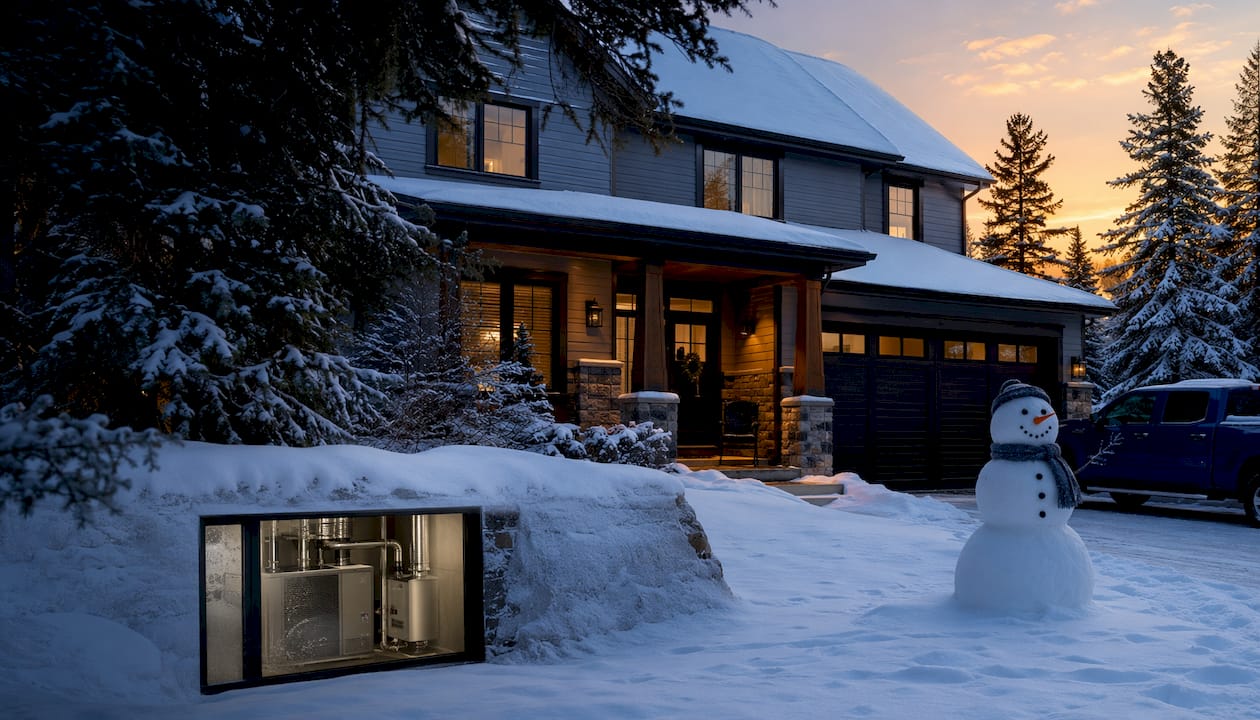
Ontario’s climate creates a clear decision framework. Winters are cold and often dry indoors due to heating, while summers in southern Ontario can be hot and humid.
| Factor | HRV | ERV |
|---|---|---|
| Cold, dry Ontario winter | Preferred: exhausts excess moisture | May over-retain humidity in tight homes |
| Hot, humid southern Ontario summer | Less effective at dehumidifying incoming air | Reduces cooling load by pre-dehumidifying supply air |
| Homes with high moisture generation | Better choice: removes moisture without recycling it | Risk of reintroducing too much humidity |
| Homes with very dry winter air | May worsen dryness | Recovers moisture to maintain comfort |
| Air-conditioned homes in humid regions | Adequate | More energy-efficient cooling season performance |
| Northern Ontario cold climates | Standard choice | Core condensation risk at extreme temperatures |
Practical considerations for Ontario homeowners:
- HRVs require a defrost mechanism for sustained cold periods; most Ontario-rated units include this.
- ERV cores generally freeze at lower temperatures than HRV cores, which can be an advantage in moderate cold but a liability in extreme northern Ontario conditions.
- Condensation on windows during winter often signals excess indoor humidity, a condition an HRV addresses directly.
- Homes with significant moisture sources (high occupancy, pets, frequent cooking) should default to an HRV regardless of climate zone.
Sizing your ventilation unit and integrating it correctly
Proper sizing is one of the most consequential decisions in ventilation system design. Ontario’s building code bases minimum residential ventilation rates on ASHRAE 62.2 standards, which define airflow requirements by floor area and number of bedrooms.
A common engineering practice is to size the unit at roughly twice the continuous ventilation target. This allows the system to run at low speed during normal operation, reducing noise and energy consumption, while retaining full capacity for boost mode when moisture or pollutant loads spike. A unit sized only to the minimum will run at maximum speed continuously, wearing faster and operating louder.
Statistic callout: Residential HRVs recover 70–90% of heat from exhaust air, depending on unit design and controls, far exceeding the performance of a standard exhaust fan.
Integration and control tips:
- Balance supply and exhaust airflows within 10% of each other to prevent house pressurization or depressurization, which can cause combustion backdraft risks from gas appliances.
- Connect the HRV or ERV to a programmable thermostat or dedicated controller to schedule ventilation around occupancy patterns.
- In forced-air homes, the unit can supply outdoor air into the furnace return duct; in homes without forced air, dedicated ductwork is required.
- Schedule annual filter cleaning and core inspection; most manufacturers recommend a professional service every one to two years.
- Confirm the installer commissions and balances the system after installation, not just connects it.
Which Ontario HVAC providers install and service HRV and ERV systems?
Selecting a qualified local contractor is as important as selecting the right unit. The providers below serve Ontario homeowners across multiple regions, with varying specializations and service structures.
| Provider | Service Region | Installation Services | Customer Rating | Certifications & Guarantees | Financing | Maintenance Plans |
|---|---|---|---|---|---|---|
| Dr HVAC | Brampton, Toronto, East York, GTA | Full HVAC and plumbing, HRV/ERV install | 4.8★ | BBB A+ accredited; transparent pricing | Not publicly listed | Annual HVAC and plumbing plans |
| Simcoe Muskoka Home Comfort | Simcoe Muskoka | Heating, cooling, air quality, custom installs | 4.9★ | BBB trust logo; free quotes | Available | Not publicly listed |
| Advantage Airtech ClimateCare | Durham Region | Heating, cooling, air quality, water heating | 4.9★ | Satisfaction guarantee; since 1987 | Not publicly listed | Not publicly listed |
| Link ClimateCare | Beaverton, Kawartha Lakes | Heating, cooling, geothermal, generators | 5★ | Satisfaction guarantee | Flexible financing | Available |
| Bryan’s Fuel | Orangeville area | HVAC sizing, install, maintenance, geothermal | 4.5★ (257 reviews) | Fair upfront pricing; 24-hr emergency | Not publicly listed | Available |
| D&B ClimateCare | Southwestern Ontario | Heating, cooling, air quality, water heating | 4.8★ (47 reviews) | WeCARE and WePROTECT programs | Available; rebates | WeCARE plan |
| ClimateCare | Province-wide (Ontario) | Full HVAC; national cooperative network | 5★ (28 reviews) | Satisfaction guarantee; Efficiency Canada ally | Not publicly listed | Not publicly listed |
| Airia Brands Inc. / Lifebreath | Ontario (manufacturer) | ERV/HRV equipment; contractor training | 2.9★ (27 reviews) | Lifebreath Certified Contractor program | — | — |
Notable distinctions among these providers:
Dr HVAC holds a Better Business Bureau A+ accreditation and serves the densely populated GTA corridor, making it a strong option for Brampton and Toronto homeowners who want guaranteed service and transparent cost structures.
Advantage Airtech ClimateCare has operated in Durham Region since 1987, offering 24/7 emergency response alongside its air quality and ventilation services. That depth of regional experience translates directly to familiarity with local building stock and code requirements.
Link ClimateCare specializes in tailored comfort solutions for Beaverton and the Kawartha Lakes area, with flexible financing and maintenance plans that suit homeowners managing longer-term equipment costs.
D&B ClimateCare’s WeCARE maintenance and WePROTECT extended coverage programs are structured specifically for homeowners who want defined service commitments rather than ad hoc repair calls.
Airia Brands Inc. / Lifebreath occupies a different position in this list: it is a manufacturer and training organization rather than a residential service contractor. Homeowners seeking Lifebreath equipment should engage a Lifebreath Certified Contractor for installation and commissioning.
What engineering best practices govern ventilation system design in Ontario?
Ventilation system performance depends as much on design and commissioning as on equipment selection. Ontario’s building code mandates mechanical ventilation for airtight homes, with airflow rates grounded in ASHRAE 62.2 minimum standards. Meeting the code minimum, however, is not the same as achieving optimal performance.
Design principles that matter:
- Size the unit above the minimum continuous ventilation target to allow quiet, low-speed background operation with boost capacity available on demand.
- Balance supply and exhaust airflows within 10% to protect the building envelope and prevent moisture damage or backdraft conditions.
- Integrate the ventilation system with the overall HVAC design, not as an afterthought; duct routing, filter access, and control wiring all affect long-term performance.
- Account for mold prevention and building envelope durability as primary design objectives, not secondary benefits.
- Commission and test the system after installation to verify actual airflow rates match design targets.
Pro Tip: Request a post-installation airflow measurement from your contractor. A system that is connected but not balanced can pressurize or depressurize the home, creating comfort problems and potential safety risks from combustion appliances.
Properly designed HRV and ERV systems contribute to building longevity by controlling indoor humidity, reducing condensation risk on windows and wall assemblies, and maintaining consistent air quality year-round.
How to choose the right ventilation system for your Ontario home
The decision between an HRV and ERV comes down to a structured assessment of your home’s specific conditions.
Key factors to evaluate:
- Climate zone: Most of Ontario favors an HRV. Southern Ontario homes with central air conditioning and humid summers may benefit from an ERV.
- Indoor humidity levels: Measure relative humidity in winter. If it consistently falls below 30%, an ERV’s moisture retention may improve comfort. If it exceeds 40%, an HRV is the correct choice.
- Home size and occupancy: Larger homes with more occupants generate more moisture; an HRV handles that load without recycling humidity back indoors.
- Existing HVAC compatibility: Confirm whether your furnace ductwork can accommodate the ventilation unit’s supply and return connections, or whether dedicated ductwork is required.
- Budget: Installation costs vary by system type, duct configuration, and contractor. Request itemized quotes from at least two certified local providers.
Questions to ask your HVAC provider:
- What airflow rate does this unit deliver at continuous and boost settings?
- How will you balance supply and exhaust after installation?
- What is the warranty on the unit and on your installation labor?
- Does this unit meet Ontario building code ventilation requirements for my home’s floor area and bedroom count?
- What does the annual maintenance plan include, and what does it cost?
Red flags to watch for:
- A contractor who recommends a unit without performing a load calculation or reviewing your home’s floor plan.
- No mention of post-installation balancing or commissioning.
- Vague warranty terms with no written documentation.
- Pressure to select the most expensive unit without a clear technical justification.
Key Takeaways
For Ontario homeowners, the HRV is the default choice in cold, dry conditions, while the ERV suits specific situations where humidity retention or summer dehumidification is a priority.
| Point | Details |
|---|---|
| HRV for most Ontario homes | Cold, dry Ontario winters make HRVs the preferred choice for moisture control and heat recovery. |
| ERV for specific conditions | ERVs suit homes with very dry winter air or air-conditioned homes in humid southern Ontario summers. |
| Heat recovery efficiency | HRVs recover 70–90% of heat from exhaust air, significantly outperforming standard exhaust fans. |
| Sizing above minimum | Size units to roughly twice the continuous ventilation target for quiet operation and boost capacity. |
| Futuregenconsulting for design | Futuregenconsulting provides HVAC system design and load calculations for Ontario residential projects, ensuring code compliance and correct sizing. |
The case for treating ventilation as a system, not an appliance
The ERV vs HRV debate often gets framed as a product selection problem, but the more consequential decisions happen before any unit is purchased. Airflow balance, duct routing, control integration, and commissioning collectively determine whether a ventilation system performs as designed or simply moves air without achieving its objectives.
Ontario’s building stock is diverse. A 1970s bungalow retrofitted for airtightness presents entirely different ventilation challenges than a new build constructed to current Ontario Building Code standards. Applying the same unit selection logic to both homes, without accounting for envelope tightness, occupancy patterns, and existing mechanical systems, produces predictably inconsistent results.
The providers and manufacturers listed in this article offer real expertise, but the engineering design layer, where load calculations, code compliance, and system integration are formalized, is where long-term performance is actually secured. Homeowners who skip that step often find themselves troubleshooting comfort and moisture problems that a properly commissioned system would have prevented from the start.
Futuregenconsulting: HVAC design expertise for Ontario ventilation projects
Ontario homeowners who want more than a contractor’s recommendation have a different option available. Futuregenconsulting delivers HVAC system design services for residential and commercial projects across Ontario, including ventilation load calculations, system configuration, and permit-ready engineer-stamped drawings that satisfy Ontario Building Code requirements.

Where a contractor selects and installs equipment, Futuregenconsulting’s engineering design process starts upstream: calculating the correct ventilation airflow for your home’s floor area and occupancy, specifying the appropriate unit type and capacity, and producing documentation that supports both permit approval and contractor installation. With over 30 years of MEP engineering experience, the firm brings the same design rigor to residential ventilation that it applies to complex commercial mechanical systems. For homeowners planning a new build, major renovation, or ventilation upgrade in Ontario, that level of technical precision is the difference between a system that meets code on paper and one that performs correctly in practice.