
For most Canadian commercial and residential development projects, the choice between fixed tilt and tracking is decided by site constraints and by how the project is valued, not by a single percentage gain. Trackers raise annual energy per module, but they add moving parts, ground area, wind and snow considerations and electrical design complexity. Fixed tilt is the simpler structure and the usual starting point on roofs, carports and constrained sites. The sound way to decide is to model both against the site’s real shading, land, load profile and interconnection limits, and to carry the result through the electrical design and the permit package.
This article is written for developers, contractors, architects, property managers and business owners who commission solar work and need to know what each mounting strategy changes in the design, the budget and the approvals.
TL;DR
- A fixed-tilt array holds modules at one set angle, while a tracker moves them to follow the sun. Single-axis trackers rotate east to west, and two-axis trackers also adjust for sun height.
- Tracking raises annual energy, and the published Canadian figures range widely depending on the comparison, the climate and the tracker type. Treat any single percentage as a hypothesis to model for your site.
- Fixed tilt carries lower upfront cost, fewer moving parts and a lower maintenance burden. Tracking adds sophistication, spacing and structural demands.
- Roofs, carports and tight lots generally point to fixed tilt, while open ground-mount land with a capped system size or a high value on energy per module can justify a tracker.
- Whichever mount is chosen, the decision should be carried into the load calculations, protection, interconnection and engineer-stamped drawings before pricing is fixed.
Table of Contents
- What the two mounting strategies actually are
- How much more energy does a tracker produce?
- Where the tracker’s extra energy is worth the extra cost
- Canadian conditions that change the answer
- Decision guide: fixed tilt, seasonal adjustment or tracker
- What the choice does to the electrical design
- Where our engineers come in
- Our perspective
- Frequently asked questions
- Sources
What the two mounting strategies actually are
A fixed-tilt array holds its modules at one angle for the life of the system. According to the U.S. Department of Energy’s solar design basics guide, that angle is set by local latitude, the orientation of the supporting structure and the electrical load being served. In Canada, fixed arrays typically face south, at a tilt that balances annual output against snow shedding and wind loading.
A tracker is a mount that moves. The same DOE guide describes ground-mounted tracking mechanisms that move panels automatically to follow the sun. One-axis trackers typically rotate east to west, and two-axis trackers let modules stay pointed at the sun through the day.
The most common commercial form is the horizontal single-axis tracker. Sandia National Laboratories’ PV Performance Modeling Collaborative describes it as having a north to south horizontal axis, so that the modules face east in the morning and west in the afternoon. That is why a tracker’s output curve is flatter across the day than a fixed array’s, which peaks around solar noon.
Two definitions help when reading proposals:
- Backtracking is a control strategy in which a tracker tilts away from the sun at low sun angles so that one row does not shade the next. Sandia notes that the algorithms factor in solar position and the ground coverage ratio, which is the share of the ground area covered by modules.
- Seasonal adjustment is a fixed-tilt variant in which the tilt is changed by hand or by simple mechanism a few times a year. It sits between the two options in cost and complexity.
How much more energy does a tracker produce?
The honest answer is that it depends on the comparison being made. Three Canadian and U.S. sources illustrate why a single number cannot be carried from one project to the next.
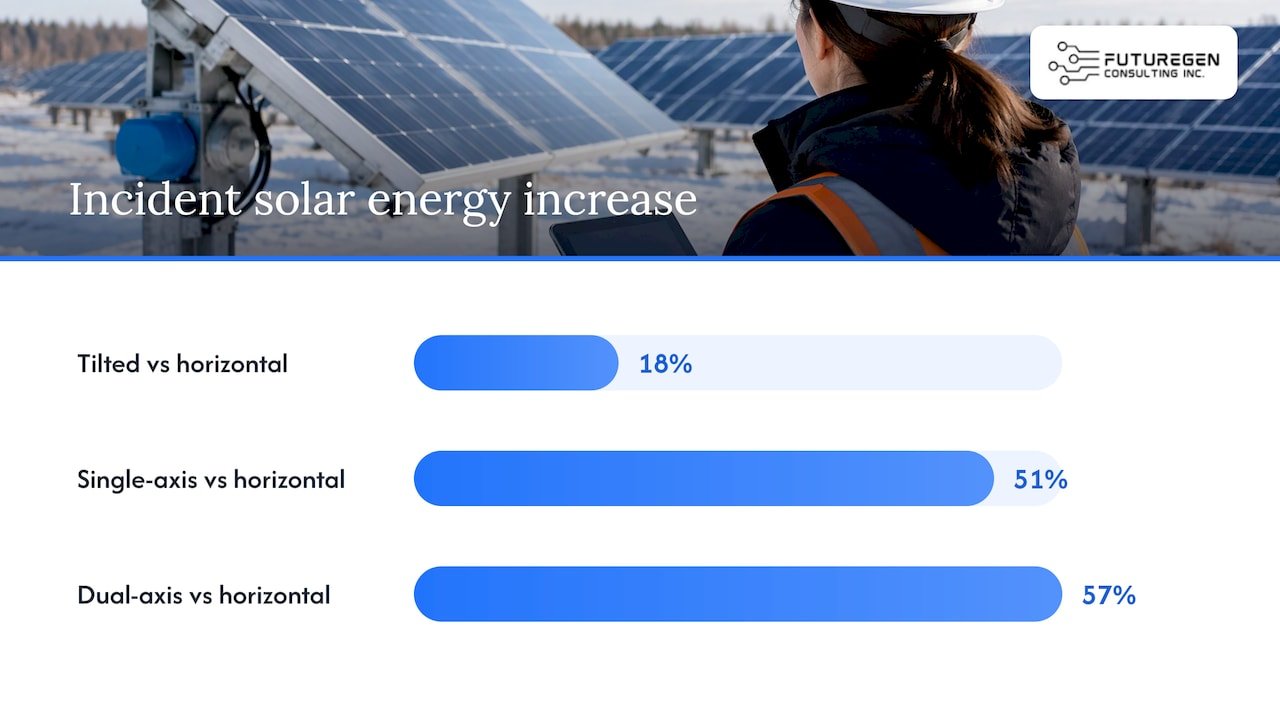
A 2013 thesis from the École de technologie supérieure in Montréal evaluated tracking systems under Canadian conditions. It reported increases in annual incident solar energy of 18% for tilted arrays, 51% for single-axis tracking and 57% for dual-axis tracking, relative to a horizontal array. Those are measures of sunlight reaching the modules rather than net electricity delivered, and the baseline is a horizontal array, so the figures should not be read as the tracker advantage over a well-set fixed tilt.
A 2015 field study presented at a Canadian Society for Bioengineering meeting compared a 5 kW fixed array with an electrically identical two-axis tracked array in Vermilion, Alberta. The tracker produced approximately 31% more annual energy. The same study found that the gap narrowed when the fixed array was adjusted seasonally and that the tracker’s advantage was strongest in summer.
The U.S. Energy Information Administration makes a qualitative point that matters for building owners: tracking can raise total annual output, reduce the seasonality of solar output and improve production early and late in the day compared with fixed south-facing arrangements.
What these sources have in common is a set of assumptions that decide the result:
- Sky view. A tracker earns its gain from a clear view of the sky from morning to evening. Nearby buildings, tree lines or berms that cut early or late sun remove much of it.
- Tracker type. Single-axis and two-axis systems differ substantially, and so do their costs and failure modes.
- The fixed baseline. A fixed array at a poor tilt or orientation makes a tracker look better than it would against an optimized one.
- Season. Because the gain is concentrated in the long summer days, the annual figure hides a much smaller winter benefit, when Canadian sun angles are low and snow is likely to cover modules.
- Shading between rows. Shading losses are nonlinear. Sandia gives the example that shading about 10% of a crystalline module’s area can cause roughly 70% power loss, which is the reason for backtracking and for wider row spacing on trackers.
A practical reading for a project team: a single-axis tracker can plausibly add a double-digit percentage of annual energy per module on an open, unshaded site, while the gain on a constrained site may be far smaller. Only a site-specific production model can tell you which applies.
Where the tracker’s extra energy is worth the extra cost
Energy gain is only half of the economics. The other half is what that energy is worth and what it takes to deliver it.
The DOE guide frames the trade-off plainly: tracking brings higher production and potential return, at the price of more upfront cost, more sophistication and more maintenance. Those are general design points rather than Canadian quotes, so the numbers have to come from a current estimate for the project.
Three questions decide whether the extra energy pays.
Is the system size capped?
When a site is limited by interconnection capacity, available roof or land area, or a program ceiling, extra energy per module is the only way to raise annual production. In that case a tracker can be the right tool. Where no such cap exists, adding modules to a simpler fixed structure is often the more economical way to reach the same energy. In Ontario, net metering under provincial regulation is bounded by a system size limit, and the design should confirm the limit and the local distribution company’s requirements before the mount type is chosen.
How is the energy valued?
The EIA notes that the value of solar output can depend on the time of day it is produced, and that west-leaning output can align better with afternoon and evening demand where time-of-use pricing applies. The EIA describes U.S. market arrangements, not Canadian tariffs, but the principle carries over: a building whose load peaks in the afternoon may value a flatter, later production curve more than the raw annual kilowatt-hours suggest. The building’s actual rate structure and load profile should be tested in the model, not assumed.
What does maintenance add?
A fixed structure has no moving parts. A tracker has drives, controllers and bearings, and the DOE guide states that tracking systems require more maintenance. Over a 25-year life, the lifecycle budget needs a line for inspection, repair and replacement of those parts, along with the control and communication wiring that serves them.
A 2025 Canadian techno-economic analysis of tracking technologies on Pelee Island illustrates that the comparison is a modelled one: tracker and control choices change net present cost, cost of energy and the renewable fraction, and the differences can be small in absolute terms. That is a reason to run the comparison for the actual project rather than rely on a rule of thumb.
Canadian conditions that change the answer
Most of the published tracker material comes from sunnier, flatter, lower-snow regions. Canadian sites bring their own factors.
Low winter sun and snow. At Canadian latitudes the winter sun is low and the days are short, so the tracker’s seasonal advantage shrinks just when snow covers the array. Fixed arrays at steeper tilts shed snow more readily. The Alberta study measured south-facing modules at 68 degrees against east and west-facing modules at 17.5 degrees, and found the south-facing modules produced about 35% more energy annually, while the east and west modules outproduced them in May, June and July. The lesson for designers is that tilt and orientation carry a large seasonal signature in Canada, and that steep fixed tilt is a serious option in its own right.
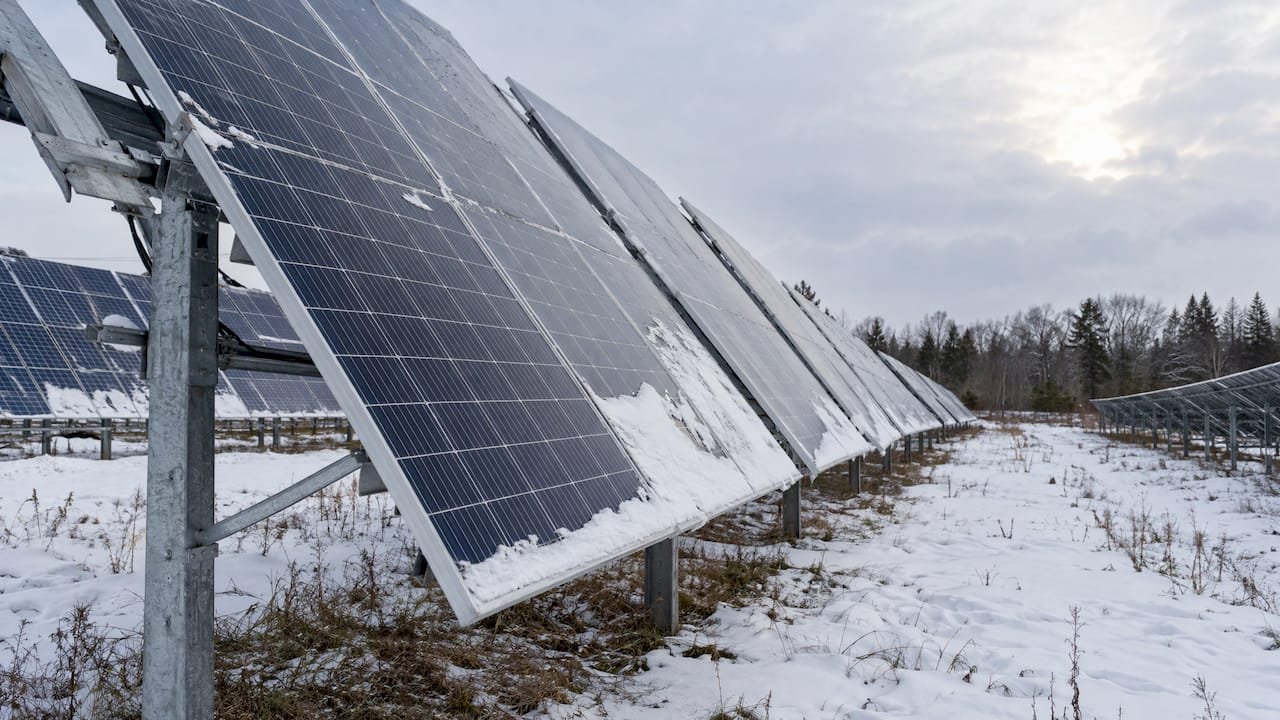
Wind and land. A 2016 Yukon Energy solar site inventory appendix lists high wind and large land requirements among the issues for solar trackers. Trackers need more ground per kilowatt than fixed arrays at comparable shading performance, and their drives and torque tubes have to be stowed and designed for design wind speeds. Structural and geotechnical input belongs in the early design, not in the final drawings.
Roofs and carports. Rooftop and carport arrays are, in practice, fixed structures. Roof loads, parapets, setbacks and fire access rules shape the layout, and a tracker is rarely a fit. Our guides on roof versus ground mount solar in Canada and on solar carport design explain how those site types affect the design and the plan review.
Electrical code and approvals. In Ontario, solar installations are designed to the Ontario Electrical Safety Code and inspected under the Electrical Safety Authority, and the building and fire provisions of the Ontario Building Code apply to the structure and its interaction with the building. Alberta projects follow the Canadian Electrical Code as adopted there. The mount type does not change which codes apply, but it changes what has to be documented: a tracker adds motor circuits, control power and communications to the single-line diagram and the protection scheme.
Decision guide: fixed tilt, seasonal adjustment or tracker
The table summarizes how the options compare on the factors that usually decide a Canadian project. It is a screening tool, not a substitute for a production model.
| Factor | Fixed tilt | Seasonally adjusted fixed tilt | Single-axis tracker |
|---|---|---|---|
| Annual energy per module | Baseline | Modestly higher than baseline | Highest of the three on an unshaded site |
| Upfront structure cost | Lowest | Low | Higher |
| Moving parts | None | Manual or simple adjustment | Drives, controls, bearings |
| Maintenance | Minimal | Low, plus adjustments | Highest |
| Ground area per kW | Lowest | Lowest | Higher, with wider row spacing |
| Snow and wind behaviour | Predictable, steep tilt sheds snow | Predictable | Requires stow and wind design |
| Suitable for roofs and carports | Yes | Limited | No, in practice |
| Output curve across the day | Peaks near noon | Peaks near noon | Flatter, earlier and later production |
A useful sequence for the project team:
- Define the constraint. Is the limit land, roof area, interconnection capacity, budget or the value of the energy? The constraint names the mount.
- Establish the shading picture. A site survey and shading analysis come before any tracker discussion, because a tracker without clear sky loses its advantage.
- Model both options. Run the fixed baseline at its optimized tilt, a seasonal variant if relevant, and the tracker with backtracking, using the site’s weather data and the building’s actual rate and load profile.
- Price the whole system. Include structure, foundations, electrical balance of system, controls, and a maintenance allowance for the tracker.
- Check the approvals path. Confirm the distribution company’s connection requirements, the structural and wind design basis and the code documentation each option needs.
What the choice does to the electrical design
The mounting decision reaches well beyond the racking. It changes the electrical scope in ways that should be priced before the contract is signed.
- Production profile and inverter sizing. A tracker’s flatter curve changes the DC to AC ratio that makes sense, and the inverter loading across the day.
- Interconnection and protection. The point of connection, the protection settings and any required studies depend on the maximum export, which a tracker raises for the same module count. A power system study is how that is verified.
- Cabling and layout. Tracker rows carry motor and control circuits in addition to the DC strings, and the cable routing has to allow for rotation.
- Building integration. For an existing building, the new generation has to be reconciled with the service size, the main distribution equipment and any emergency or standby power.
- Cost certainty. An early, detailed estimate of the electrical scope keeps a mounting decision from becoming a change order later. Our electrical construction cost estimation service is built for that stage.
Where our engineers come in
Our solar work is part of a broader mechanical and electrical engineering practice in Ontario, covering power distribution, emergency power, solar power system design, EV charger infrastructure and construction review, with permit-ready, engineer-stamped drawings prepared to the applicable Canadian codes. Developers and contractors who need the mount decision carried through to a permit package can read about our solar power system design in Ontario or review the full list of services. For a site where the answer is not obvious, the first conversation is about the constraint, the shading and the building’s load, before any equipment is selected.

To discuss a project, contact us through the FutureGen Consulting website.
Our perspective
Over three decades of mechanical and electrical design, the pattern we see in solar decisions is that the mount gets chosen too early and the electrical design gets blamed too late. A tracker is an attractive idea because the energy gain is easy to explain. Yet the projects that run smoothly are the ones where the mount is chosen after the constraint is understood.
For roofs, carports and most commercial sites in Ontario, we start from a well-optimized fixed-tilt design, because it carries the least structural, maintenance and approval risk and leaves the budget for the parts of the system that deliver value every day: the distribution, the protection and the integration with the building. Where land is open, the sky is clear and the system size is capped, we model a tracker alongside it and let the numbers decide.
What we offer is the engineering that makes either choice buildable: load calculations, single-line diagrams, protection coordination, code compliance and stamped drawings that move through plan review without surprises. That is why we bring the electrical design in at the concept stage rather than after the racking is chosen.
Sanjay
Frequently asked questions
Is a tracker always better than fixed tilt?
No. A tracker generally produces more energy per module on an open, unshaded site, but it costs more, needs more maintenance and uses more land. The DOE describes the trade-off as higher production against greater upfront cost and sophistication. The better option is the one that wins in a model built for the site and the building’s energy value.
What is the difference between single-axis and dual-axis trackers?
A single-axis tracker rotates around one axis, typically east to west, so the modules follow the sun across the day. A dual-axis tracker also adjusts for the sun’s height, keeping the modules pointed at the sun more closely. The ÉTS Montréal thesis reported larger incident energy gains for dual-axis than single-axis tracking, at the cost of added mechanical complexity.
Can a tracker go on a roof or a carport?
In practice, rarely. Roof loading, parapets, setbacks and access requirements favour fixed or low-profile racking, and carports are fixed structures by nature. Trackers are mainly a ground-mount option, where space and structural design allow for row spacing and wind stow.
Does tracking work in Canadian winters?
It can, but the benefit is concentrated in summer, when days are long. The Alberta field study found the tracker’s advantage more pronounced in summer, and at low winter sun angles with snow cover the gain is smaller. Steeper fixed tilts shed snow more readily, so the annual comparison should be modelled with local weather data.
Which should I choose for an Ontario commercial project?
Start from the constraint: roof or land area, interconnection capacity, budget and the value of the energy. Then model a fixed-tilt design and a tracker with the building’s own load and rate structure, and compare the total installed and lifecycle costs. Our engineers can carry the selected option through the electrical design and permit drawings.
Sources
- Solar Photovoltaic System Design Basics, U.S. Department of Energy
- Single Axis Tracking, PV Performance Modeling Collaborative
- Solar photovoltaic output depends on orientation, tilt and location, U.S. Energy Information Administration
- Performance evaluation of solar tracking photovoltaic systems, ÉTS Montréal, 2013
- Solar photovoltaic energy production comparison, CSBE/SCGAB, 2015
- Appendix 5.11 Solar Site Inventory, Yukon Energy, 2016
- Photovoltaic tracking technologies for sustainable energy, 2025