

Alberta building owners and facility managers are required to maintain life safety systems — the interconnected suite of fire protection and emergency response equipment installed in a building — in accordance with the National Fire Code – 2023 Alberta Edition (NFC(AE)), which replaced the 2019 edition on May 1, 2024. These systems include sprinkler systems, fire alarm and voice communication systems, portable extinguishers, emergency lighting, exit signs, fire pumps, standpipes, smoke control equipment, and door hold-open devices. Three actions every owner should take this week:
- Locate and organize all on-site inspection and service records into a labeled “Life Safety Records” binder.
- Confirm that all scheduled inspections are assigned to qualified, credentialed technicians.
- Verify that a written fire safety plan is in place and accepted by the local Authority Having Jurisdiction (AHJ).
The governing framework in Alberta is the NFC(AE) alongside the Safety Codes Act and applicable municipal guidance from authorities such as the City of Calgary and the City of Grande Prairie.
Table of Contents
- What life safety systems include and how each component protects occupants
- Which codes, standards, and municipal guidance apply in Alberta
- Inspection, testing, and maintenance schedules for common fire protection systems
- What belongs in a service report and how to manage records
- Who can lawfully install, test, and maintain these systems in Alberta
- Consequences for non-compliance with maintenance and reporting rules
- How much fire safety maintenance typically costs and how to plan for it
- When to hire an MEP engineering consultant for life safety compliance
- Key Takeaways
- Why proactive maintenance is the only defensible position
- Futuregenconsulting’s fire and life safety engineering services
- Authoritative sources and municipal guidelines to bookmark
What life safety systems include and how each component protects occupants
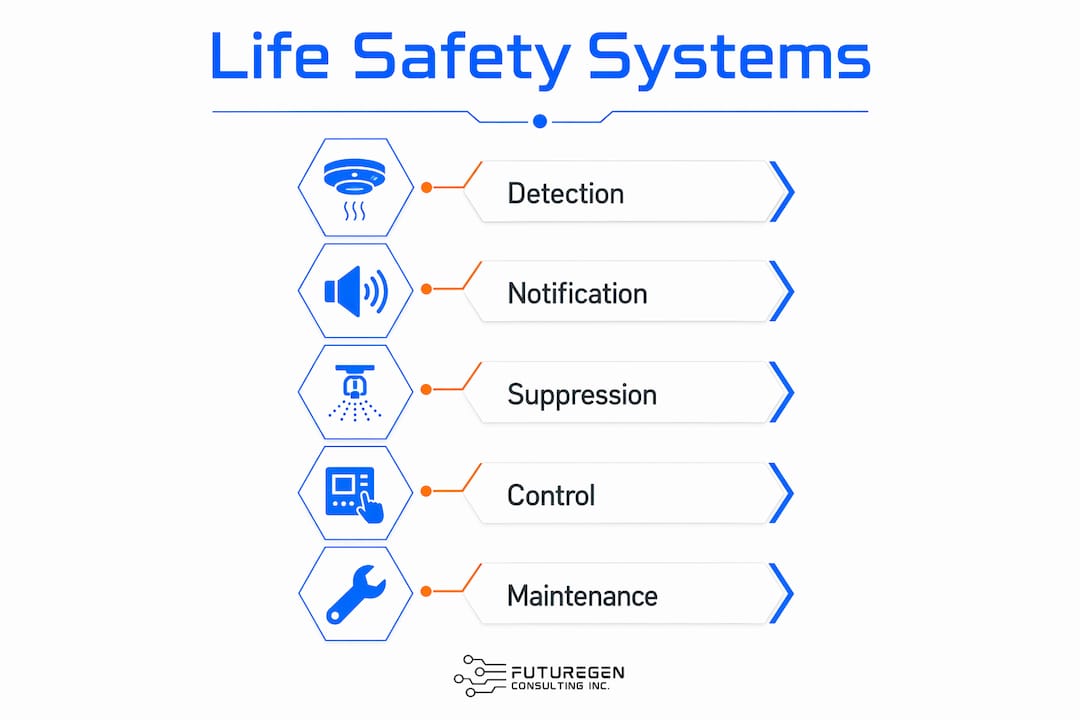
The term “life safety systems” covers every building system whose primary function is to detect, suppress, or manage fire and smoke, and to support safe occupant egress. The City of Calgary defines the category to include portable extinguishers, water-based sprinklers, special suppression systems, fire alarms, emergency lighting, exit signs, fire pumps, and smoke control equipment. Each component plays a distinct role:
- Portable fire extinguishers: Provide first-response suppression capability; require monthly visual checks and periodic hydrostatic testing.
- Water-based sprinkler systems: Automatically suppress fire at the point of origin; governed by NFPA 25 for inspection, testing, and maintenance (ITM).
- Special suppression systems: Cover commercial kitchens, server rooms, and other hazardous occupancies where water-based suppression is inappropriate.
- Fire alarm and voice communication systems: Detect fire conditions and alert occupants; tested under CAN/ULC-S536.
- Emergency lighting and exit signs: Maintain illuminated egress paths during power failure; require monthly functional tests and annual full-duration tests.
- Fire pumps and private mains: Maintain adequate water pressure for sprinkler and standpipe systems; tested under NFPA 25.
- Standpipes and hose systems: Provide firefighter water supply at elevated floors; inspected and tested on schedules aligned with NFPA 25.
- Smoke control and venting systems: Manage smoke movement to protect egress corridors and stairwells; include fans, dampers, and pressurization equipment.
- Door hold-open devices and electromagnetic locks: Hold corridor and stairwell doors open during normal occupancy, then release automatically on alarm activation.
- Elevator recall systems: Return elevators to the ground floor on alarm, preventing occupants from entering smoke-filled shafts.
The interconnection of these components is what makes integration testing so critical. When a fire alarm activates, it simultaneously triggers elevator recall, releases door hold-open devices, and initiates smoke control sequences. A failure in any one interface can compromise the entire evacuation sequence. Assembly occupancies, care facilities, commercial kitchens, and parkades each carry specific system requirements under the NFC(AE) that go beyond what a standard office building must maintain.
Pro Tip: Keep a system schematic posted in the fire control room showing every interconnected device and its trigger relationship. An AHJ inspector will often ask for this during a site visit, and it also helps technicians identify integration gaps before a formal test.

Which codes, standards, and municipal guidance apply in Alberta
The primary code governing fire safety system maintenance in Alberta is the National Fire Code – 2023 Alberta Edition, published by the National Research Council of Canada. It operates alongside the National Building Code – 2023 Alberta Edition, which governs new construction and major renovations. Together, they define both the design requirements for new systems and the ongoing maintenance obligations for existing buildings.

The broader legislative authority is the Safety Codes Act (Alberta), which empowers Safety Codes Officers to inspect buildings, issue orders, and pursue enforcement. Municipal fire prevention offices administer the code at the local level and may issue additional guidance through STANDATA — Alberta-specific code interpretations and clarifications published by the Safety Codes Council.
Key standards referenced by the NFC(AE) for ITM work include:
- CAN/ULC-S536: Inspection and testing of fire alarm systems.
- CAN/ULC-S1001: Integrated systems testing of fire protection and life safety systems.
- NFPA 25: Inspection, testing, and maintenance of water-based fire protection systems.
- NFPA 10: Portable fire extinguishers.
- CSA C282-15: Emergency electrical power supply for buildings (generator requirements).
The NFC(AE) Part 2 states: “This Part provides for the safety of the occupants in existing buildings, the elimination or control of fire hazards in and around buildings, the installation and maintenance of certain life safety systems in buildings, the installation and maintenance of posted signs and information, and the establishing of a fire safety plan for locations identified in Article 2.8.1.1.”
For municipal-level guidance, the City of Calgary’s fire safety systems page and the City of Grande Prairie’s Building Owner’s Fire Safety Maintenance Requirements document are the most detailed publicly available references in Alberta. Owners should also check their local AHJ’s STANDATA page for any Alberta-specific code interpretations that modify national standard requirements.
Contacts and immediate steps:
- Provincial code page: alberta.ca/fire-codes-and-standards
- City of Calgary Fire Prevention: calgary.ca fire safety systems
- Safety Codes Council (STANDATA): safetycodes.ab.ca
- Contact your local AHJ in writing to confirm which edition of the code applies to your specific building and occupancy type.
Inspection, testing, and maintenance schedules for common fire protection systems
Practical ITM planning requires mapping each system to its required frequency. The table below reflects typical schedules drawn from NFC(AE), NFPA 25, CAN/ULC-S536, NFPA 10, and CSA C282-15.
| System | Monthly | Quarterly | Semi-Annual | Annual | 3-Year | 5-Year |
|---|---|---|---|---|---|---|
| Portable extinguishers | Visual inspection | — | — | Full inspection | — | Hydrostatic test (5 or 12 yr by type) |
| Sprinkler systems (NFPA 25) | Valve position check | Waterflow alarm test | — | Main drain test, full inspection | — | Obstruction investigation |
| Fire alarm system (CAN/ULC-S536) | Visual | — | — | Full test and verification | — | — |
| Emergency lighting / exit signs | Functional test (30 sec) | — | — | Full-duration test (annual) | — | — |
| Fire pumps (NFPA 25) | Weekly churn test | — | — | Full-flow test | — | — |
| Emergency generator (CSA C282-15) | — | Monthly load test | — | Annual maintenance | — | — |
| Smoke control systems | — | — | — | Functional test | — | — |
| Standpipes / hose systems | — | — | — | Full inspection and flow test | — | — |
Note: Fire pump weekly churn tests are listed under “Monthly” for table simplicity; the actual requirement under NFPA 25 is weekly.
Emergency generators follow a distinct cycle under CSA C282-15: weekly visual inspections, monthly load tests, and annual full maintenance. Owners who treat generator testing as an afterthought often discover battery or transfer switch failures only during an actual power outage.
Integrated Systems Testing (IST) under CAN/ULC-S1001
Where two or more fire protection and life safety systems are installed and interconnected, CAN/ULC-S1001 requires an Integrated Systems Test. IST verifies that all interconnected systems operate correctly as a coordinated sequence, not just individually. The test must be planned, executed, and documented by a qualified Integrated Testing Coordinator. The resulting Integrated Testing Report — including the test plan, initial test forms, retest forms, and all associated documentation — must be retained on-site.
IST applies to buildings constructed under the NBC – 2019 Alberta Edition (and its successors) where two or more integrated systems exist. For existing buildings undergoing significant renovation or system upgrades, the AHJ may require IST as a condition of permit close-out.
Pro Tip: Schedule IST events to coincide with annual fire alarm verification and sprinkler annual inspections. Combining these into a single coordinated event reduces building disruption, minimizes the number of separate contractor mobilizations, and produces a unified documentation package for the AHJ.
What belongs in a service report and how to manage records
Every inspection, test, or maintenance event must produce a written service report. Municipal guidance is consistent: records must be kept on-site, organized, and made available to a Fire Safety Codes Officer on request. A labeled “Life Safety Records” binder in the fire control room or system room is the standard approach.
A compliant service report must include:
- Inspector/technician name and qualification (credential type and number where applicable).
- Date and time of inspection or test.
- System identification (type, location, panel ID or tag number).
- Findings — pass, deficiency, or impairment noted for each item tested.
- Corrective actions taken or recommended, with target completion dates for outstanding deficiencies.
- Tests performed, referencing the applicable standard (e.g., CAN/ULC-S536 Section X, NFPA 25 Table Y).
- Technician signature and, where required, owner or supervisor countersignature.
Recommended supporting attachments include test printouts from fire alarm panels, pressure test charts, calibration certificates for test equipment, and photographs of deficiencies.
Retention periods vary by municipality, but a minimum of two to five years of records is consistent with published Alberta municipal guidance. For IST documentation, the full Integrated Testing Report must remain on-site indefinitely as a permanent building record.
Reporting deficient systems to the AHJ
When a deficiency cannot be corrected immediately, the owner must notify the AHJ and implement an interim impairment plan. The reporting process typically involves:
- Notifying the local fire prevention office in writing, describing the deficiency, affected system, and interim protective measures in place.
- Implementing a fire watch or compensatory measures as directed by the AHJ.
- Scheduling and completing repairs with a qualified contractor.
- Submitting a follow-up service report confirming the deficiency has been corrected.
The AHJ may conduct a follow-up inspection to verify corrective actions before closing the file.
Who can lawfully install, test, and maintain these systems in Alberta
Not every technician is qualified to service every system. The City of Calgary explicitly requires owners to verify technicians’ documented competencies before engaging them for inspection or maintenance work. Accepted qualifications by system type typically include:
- Fire alarm systems: Certified fire alarm technician (e.g., CFAA Registered Fire Alarm Technician or equivalent provincial certification).
- Sprinkler systems: Journeyperson sprinkler fitter (Alberta apprenticeship trade).
- Electrical components (emergency lighting, generators): Journeyperson electrician licensed in Alberta.
- Fire suppression systems (special hazard): Licensed fire suppression technician with documented training on the specific suppression agent and system type.
- Integrated Systems Testing: Qualified Integrated Testing Coordinator with demonstrated competency in CAN/ULC-S1001 methodology.
For fire alarm system design and engineering-level work, a professional engineer (P.Eng.) with fire protection experience is required to stamp drawings and specifications submitted for permit.
Document checklist for procurement and AHJ inspections
Owners should request and retain the following from every service contractor:
- Copy of technician’s qualification certificate or trade license.
- Proof of WCB coverage and general liability insurance.
- Written scope of work referencing the applicable standard and code edition.
- Signed service report with all mandatory fields completed.
- Test printouts, calibration records, and photographs as applicable.
- For IST work: full Integrated Testing Report including plan, forms, and coordinator credentials.
- For design work: engineer-stamped drawings and permit documentation.
Consequences for non-compliance with maintenance and reporting rules
Enforcement authority in Alberta flows from the Safety Codes Act. A Safety Codes Officer who identifies non-compliant systems or missing records can issue orders requiring corrective action within a specified timeframe. Failure to comply with an order escalates to prosecution. Calgary’s published guidance notes that penalties under the Safety Codes Act can reach fines of up to $100,000 and/or imprisonment of up to 6 months in applicable cases.
Practical enforcement follows a graduated sequence. An initial inspection finding typically results in a written order with a compliance deadline. If the owner does not act, the AHJ may issue a stop-use order or restrict occupancy until deficiencies are corrected. For serious or repeated violations, the matter proceeds to prosecution.
Documented, on-site records are the owner’s primary defense during an enforcement action. An AHJ inspector who cannot locate service reports on-site will treat the inspections as if they never occurred — regardless of whether the work was actually done.
The Safety Codes Council notes that code enforcement in Alberta focuses on achieving an equivalent level of safety rather than requiring every existing building to meet new-build standards. AHJs have discretion to require upgrades based on building-specific risk factors. That discretion cuts both ways: a well-documented maintenance history demonstrating proactive compliance tends to result in more collaborative enforcement conversations.
How much fire safety maintenance typically costs and how to plan for it
Maintenance costs vary considerably based on building characteristics and system complexity. The main cost drivers are:
- Building size and occupancy type: A 10-storey mixed-use building with a parkade carries far more systems than a single-story retail unit.
- Number and complexity of systems: Buildings with sprinklers, fire alarms, smoke control, emergency generators, and standpipes require separate vendor contracts and potentially an IST coordinator.
- Integrated Systems Testing: IST coordination adds cost but is a one-time or periodic event rather than an annual line item for most buildings.
- Service frequency: Monthly and weekly inspection requirements (extinguishers, generators, sprinkler valves) accumulate labor hours quickly across large facilities.
- Accessibility and emergency power testing: Generator full-load tests and fire pump flow tests require specialized equipment and may need utility coordination.
For a small commercial building with a fire alarm, extinguishers, and emergency lighting, annual ITM costs typically fall in the range of a few thousand dollars. Mid-size buildings with sprinklers, a fire pump, and a generator can expect annual maintenance contracts in the range of $10,000–$30,000 or more, depending on system count and local labor rates. IST events for complex buildings with multiple integrated systems represent an additional cost that owners should budget for separately, particularly after major renovations.
Contracting approaches that tend to reduce total cost include:
- Single-source maintenance contracts covering multiple systems with one vendor, reducing mobilization costs and simplifying documentation management.
- Bundled IST events coordinated with annual fire alarm verification and sprinkler inspections.
- Retainer arrangements for emergency impairment response, which avoid premium after-hours call-out rates.
- Competitive procurement for major ITM contracts, using a defined scope of work that references the applicable standards so bids are genuinely comparable.
For electrical construction cost estimation on system upgrades or new installations, engaging a qualified engineering firm early in the project scope definition phase typically reduces change-order exposure during construction.
When to hire an MEP engineering consultant for life safety compliance
Routine vendor maintenance covers the majority of ITM obligations for most buildings. Engineering involvement becomes necessary when the scope exceeds what a service technician can address — specifically in the following situations:
- Integrated Systems Testing coordination for complex buildings where the IST plan, witness testing, and final report require a qualified coordinator with engineering-level system knowledge.
- Code interpretation for complex or existing buildings, particularly where the AHJ has issued an order requiring an upgrade and the owner needs a defensible compliance path.
- Design and upgrade of fire pumps, emergency generators, and emergency power distribution, where stamped engineering drawings are required for permit.
- Post-remediation verification and commissioning, confirming that repaired or upgraded systems meet the design intent and code requirements before AHJ sign-off.
- Preparation of fire safety plans for occupancies where the NFC(AE) requires a formal written plan accepted by the AHJ.
Deliverables a qualified engineering firm provides
An MEP engineering consultant engaged for life safety work should deliver:
- IST plans and final Integrated Testing Reports prepared under CAN/ULC-S1001.
- Engineer-stamped design drawings and permit-ready specifications for system upgrades.
- Field review reports documenting conformance of installed work to design documents.
- Test witness reports for fire pump commissioning, generator load testing, and smoke control verification.
- Remediation project oversight, including scope definition, contractor coordination, and AHJ liaison.
Questions to ask prospective engineering consultants
- Does the firm hold a Certificate of Authorization from APEGA (Association of Professional Engineers and Geoscientists of Alberta) or the equivalent provincial engineering authority?
- Can the firm provide examples of completed IST coordination or fire safety plan submissions accepted by Alberta AHJs?
- Will a licensed P.Eng. stamp all drawings and reports submitted for permit or AHJ review?
- Does the firm have direct experience with the NFC(AE) and Alberta-specific STANDATA interpretations?
- Can the firm provide references from building owners or contractors on comparable Alberta projects?
Futuregenconsulting brings over 30 years of MEP engineering experience to fire and life safety design, including fire alarm system design, fire suppression design, emergency power systems, and field review services. The firm’s project-based model means owners engage for a defined scope with clear deliverables, rather than an open-ended retainer.
Key Takeaways
Alberta building owners who maintain documented, scheduled ITM programs under the National Fire Code – 2023 Alberta Edition, engage credentialed technicians, and retain organized on-site records are best positioned to avoid enforcement orders and demonstrate compliance to the AHJ.
| Point | Details |
|---|---|
| Current code in force | The NFC(AE) replaced the 2019 edition on May 1, 2024; confirm your AHJ applies this edition to your building. |
| On-site records are mandatory | Keep a labeled “Life Safety Records” binder on-site; missing records are treated as missing inspections during enforcement. |
| IST applies to interconnected systems | Where two or more systems are integrated, CAN/ULC-S1001 requires a documented Integrated Systems Test by a qualified coordinator. |
| Penalties are significant | Non-compliance under the Safety Codes Act can result in significant fines and/or imprisonment. |
| Futuregenconsulting for engineering scope | Engage Futuregenconsulting for IST coordination, system upgrade design, stamped drawings, and AHJ-accepted fire safety plans. |
Why proactive maintenance is the only defensible position
The compliance conversation in Alberta tends to focus on what the code requires, but the more instructive question is what happens when a system fails during an actual emergency. From an engineering standpoint, the gap between a building that passes an annual inspection and one that is genuinely reliable is almost always found in the integration details: the smoke control sequence that was never tested under full alarm load, the generator transfer switch that trips on a cold start, the elevator recall that was wired correctly but never verified against the alarm panel’s zone mapping.
Owners who treat ITM as a documentation exercise rather than a functional verification program are taking on risk that no insurance policy fully covers. The records matter, but they matter because they reflect real, verified system performance. Spending maintenance dollars on integrated testing and engineering review of complex systems consistently delivers more risk reduction per dollar than adding redundant single-system inspections to a building that already has adequate coverage. When budgets are constrained, the priority should be: verify integration first, then fill gaps in individual system schedules.
Futuregenconsulting’s fire and life safety engineering services
Building owners and facility managers who have identified system deficiencies, received AHJ orders, or are planning major renovations need more than a maintenance contractor. They need engineering expertise that translates code requirements into permit-ready designs and defensible documentation.

Futuregenconsulting delivers fire protection and fire alarm system design services for commercial and residential projects, including fire alarm design, sprinkler and suppression system design, emergency power and generator design, smoke control coordination, and field review and commissioning. An initial engagement follows a straightforward sequence: site review and system assessment, scope definition with a written proposal, engineering design and permit documentation, and field review through construction close-out. Every deliverable carries a P.Eng. stamp and is prepared to meet AHJ submission requirements. To discuss your building’s compliance needs or request a project scope, visit futuregenconsulting.ca or contact the firm directly through the website.
Authoritative sources and municipal guidelines to bookmark
The following primary sources should be printed and kept in the life safety binder for AHJ inspections, or bookmarked for ongoing reference:
- National Fire Code – 2023 Alberta Edition (NRC): The authoritative code publication from the National Research Council; the definitive reference for all maintenance and fire safety plan requirements in Alberta.
- Alberta.ca — Fire codes and standards: Provincial page confirming the current code edition in force and links to STANDATA; the first stop for confirming which code applies to your building.
- City of Calgary — Fire safety systems: Practical guidance on system components, lockbox programs, technician qualification requirements, and enforcement; directly applicable to Calgary properties.
- City of Calgary — Building Owner Responsibilities (PDF): Detailed checklist of owner obligations, ITM frequencies, and referenced standards (NFPA 25, CAN/ULC-S536, NFPA 10); print this and keep it in the life safety binder.
- City of Grande Prairie — Building Owner’s Fire Safety Maintenance Requirements (PDF): One of the most detailed municipal ITM guides publicly available in Alberta; covers extinguisher intervals, generator cycles, IST requirements, and recordkeeping in a single document.
- CAN/ULC-S536: Standard for inspection and testing of fire alarm systems; available through ULC or the Safety Codes Council.
- CAN/ULC-S1001: Standard for integrated systems testing; required reading for any building with two or more interconnected fire protection systems.
- NFPA 25: Standard for the inspection, testing, and maintenance of water-based fire protection systems; governs sprinkler and fire pump ITM schedules.
- NFPA 10: Standard for portable fire extinguishers; governs monthly inspection and hydrostatic testing intervals.
- CSA C282-15: Emergency electrical power supply for buildings; governs generator inspection, testing, and maintenance cycles.
- Safety Codes Council (STANDATA): safetycodes.ab.ca — Alberta-specific code interpretations that modify or clarify national standard requirements; check this before finalizing any compliance interpretation for a complex or existing building.