

ASHRAE Guideline 36 is the vendor-neutral specification of high-performance HVAC control sequences that standardizes advanced sequences, built-in automated fault detection and diagnostics (AFDD), and supervisory data exposure to improve energy efficiency, occupant comfort, and long-term operability across common HVAC system types. For Canadian engineers and building automation professionals, three immediate implications follow from that definition:
- Procurement language must change. Specifications that simply call for “sequences of operation per Guideline 36” without requiring AFDD enablement, point list delivery, and factory acceptance testing leave significant performance on the table.
- BAS capability is a prerequisite, not an afterthought. Fully programmable direct digital control (DDC) systems with trending, alarming, and AFDD hooks are required before any sequence can be implemented correctly.
- Commissioning scope expands. Guideline 36 includes functional test procedures that verify sequence implementation, which means commissioning budgets and timelines must account for integrated system testing and AFDD tuning.
The current edition is Guideline 36-2024, maintained by ASHRAE’s Standing Guideline Project Committee 36 (SGPC 36) under Technical Committee 1.4, Control Theory and Application. Read-only access to the 2021 and 2024 editions is available through ASHRAE’s read-only standards portal.
Table of Contents
- What does ASHRAE Guideline 36 actually cover?
- What changed in the 2021 edition and why it matters
- Key sequences and technical details engineers must understand
- How AFDD works in Guideline 36 and what faults to watch for
- How to map Guideline 36 sequences to your BAS platform
- Commissioning, acceptance testing, and cost drivers
- What measurable outcomes should you expect from Guideline 36?
- Ontario implementation notes and procurement language for MEP teams
- Where to get the guideline, training, and implementation references
- Key Takeaways
- Why the conventional wisdom on Guideline 36 misses the point
- Futuregenconsulting brings Guideline 36 expertise to Ontario projects
- Primary sources and further reading
What does ASHRAE Guideline 36 actually cover?
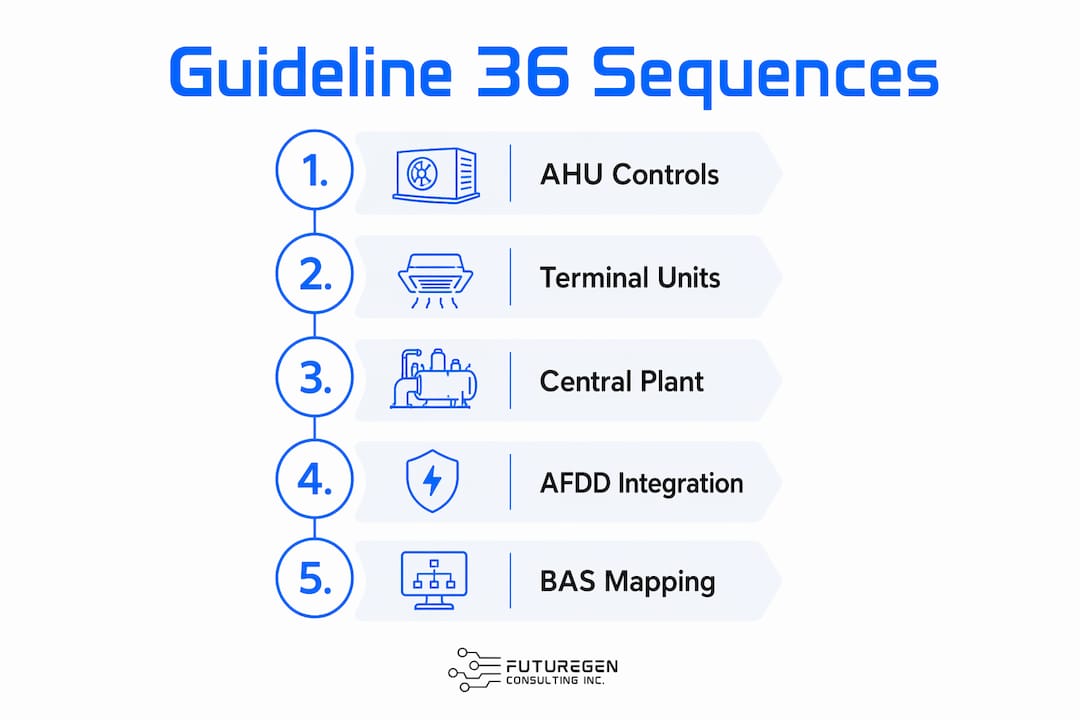
Guideline 36 addresses the sequence logic for the most common commercial HVAC system types found in office, institutional, and mixed-use buildings. Its scope includes variable air volume (VAV) air handling units, VAV terminal units with and without reheat, fan-coil units, dedicated outdoor air systems (DOAS), central chilled water and hot water plants, primary and secondary pumping systems, cooling towers, and supervisory control strategies that coordinate all of the above.
The design philosophy is deliberate and worth understanding before specifying the guideline on a project. ASHRAE experts describe it as a “less is more” corrective to over-engineered custom control logic, where decades of project-by-project programming produced inconsistent performance, difficult commissioning, and sequences that no one could maintain after the original controls contractor left the site. Standardization reduces that inconsistency. When the same trim-and-respond logic governs every VAV AHU on a project, commissioning agents, operators, and service technicians all work from a shared reference.
The guideline’s scope also extends to what data the sequences must expose to supervisory systems. Each sequence specifies which setpoints, request counts, commanded positions, runtime accumulators, and AFDD flags must be available for trending and alarming. That data exposure requirement is what makes Guideline 36 genuinely vendor-neutral: an owner can change BAS service providers without losing visibility into system performance, because the required data points are defined in the specification, not buried in proprietary controller logic.
Systems covered by Guideline 36 sequences:
- VAV AHUs: supply air temperature (SAT) reset, static pressure reset, economizer, minimum outdoor air control, and zone group mode coordination
- VAV terminal units: heating and cooling control, minimum airflow setpoints, occupancy-based setpoint adjustment, and demand-controlled ventilation
- Fan-coil units: heating/cooling sequencing and occupancy modes
- Central chilled water and hot water plants: lead/lag sequencing, delta-T optimization, staging logic, and plant enable/disable
- Primary and secondary pumping: differential pressure reset and variable speed drive control
- Cooling towers: fan speed control and condenser water temperature reset
- Supervisory control: global optimization, demand limiting, and AFDD aggregation
Pro Tip: Before specifying Guideline 36 on a project, confirm that the proposed BAS platform supports fully programmable DDC controllers, continuous data trending at configurable intervals, configurable alarm generation, and software hooks for AFDD logic. A BAS that cannot trend every required data point at a minimum 5-minute interval cannot support the AFDD requirements, regardless of how well the sequences are programmed.
What changed in the 2021 edition and why it matters
The 2021 edition represented a substantial expansion of Guideline 36’s coverage and a refinement of its maintenance model. Understanding those changes is necessary for engineers who are specifying projects today, because the 2024 edition incorporates 23 addenda to the 2021 baseline and the two editions must be read together to understand the current state of the guideline.
Principal changes introduced in the 2021 edition:
- Expanded system coverage. Fan-coil units and central hot and chilled water plant sequences were added, extending the guideline beyond its original VAV AHU and terminal unit focus.
- Plant lead/lag and staging logic. Detailed sequences for chiller and boiler staging, including delta-T optimization for chilled water plants, were formalized for the first time.
- Continuous maintenance model. ASHRAE placed Guideline 36 on continuous maintenance in May 2018, meaning addenda are published on a rolling basis rather than waiting for a full edition cycle. The 2021 edition consolidated earlier addenda and reset the baseline.
- AFDD integration tightened. The 2021 edition made AFDD requirements more explicit within each sequence section, rather than treating diagnostics as a separate appendix.
- Zone group mode coordination revised. The logic for warm-up, cooldown, setback, and setup modes was restructured so that zone-level controllers generate mode requests, reducing unnecessary network polling of zone controllers by system-level controllers.
2024 addenda with direct design impact:
The 2024 edition incorporated 23 addenda to the 2021 baseline. Three changes are particularly relevant for Canadian projects:
- Outdoor air pollution mode. Addendum a introduced a three-position software switch allowing economizers to be disabled automatically when outdoor PM2.5, ozone, or Air Quality Index (AQI) concentrations exceed configurable thresholds. This is directly relevant to Canadian projects in regions subject to wildfire smoke events, where manual economizer override has historically been the only option.
- Three new humidity-limiting and dehumidification strategies. These modular sequences address latent load control in humid climates and DOAS applications.
- Warm-up and cooldown peak demand logic. Addendum e revised the warm-up and cooldown mode logic to stagger zone start times based on individual zone thermal mass, reducing the risk of setting a building’s peak demand during morning startup.
For engineers referencing the ASHRAE Journal’s explanation of the 2021 update, that article remains the clearest narrative account of the edition’s rationale and is recommended reading before specifying the guideline on a new project.
Key sequences and technical details engineers must understand
Guideline 36 sequences are organized by equipment type, and each sequence defines both the control behavior and the data points that must be exposed to supervisory systems. The following walkthrough covers the sequences most commonly encountered on Ontario commercial projects.
VAV AHU sequences
The AHU sequences govern supply air temperature reset, duct static pressure reset, economizer operation, minimum outdoor air control, and zone group mode coordination. SAT reset uses a trim-and-respond algorithm: the SAT setpoint is trimmed upward (toward a warmer supply temperature) when few zones are requesting cooling, and responds downward when many zones send cooling requests. This demand-based building controls approach, often called DBBC, improves comfort stability by keeping the AHU from over-cooling zones that do not need it while still meeting peak loads when required. Static pressure reset follows the same trim-and-respond logic, reducing fan energy during partial-load conditions.
VAV terminal unit sequences
Terminal unit sequences define minimum and maximum airflow setpoints for heating and cooling modes, occupancy-based setpoint adjustment, and the logic for reheat valve control. The sequences require each terminal unit controller to generate “cooling requests” and “heating requests” that the AHU supervisory controller aggregates to drive SAT and static pressure resets. This request-based architecture is central to Guideline 36’s design: it eliminates the need for the AHU to poll individual zones, reducing network traffic and improving response time.
Central plant sequences
Chiller and boiler plant sequences address lead/lag staging, delta-T optimization for chilled water systems, and condenser water temperature reset for cooling towers. Delta-T optimization monitors the differential between chilled water supply and return temperatures; when delta-T falls below design values (indicating low flow or poor coil performance), the sequence generates an AFDD flag rather than simply running additional chillers. This prevents the common “low delta-T syndrome” that wastes chiller capacity and energy.
Supervisory data points required by the sequences:
- Zone cooling and heating request counts (aggregated at AHU level)
- SAT setpoint and measured SAT
- Duct static pressure setpoint and measured static pressure
- Outdoor air damper position and minimum outdoor airflow measurement
- Chilled water supply and return temperatures and flow rate
- Chiller and pump commanded states, speeds, and runtime accumulators
- AFDD fault flags and fault severity levels
- Economizer enable/disable status and outdoor air pollution mode status
Pro Tip: Adopt a consistent naming convention for all Guideline 36 data points at project inception. Using a structured tag format (for example, combining system identifier, equipment type, point function, and unit) aligned with Project Haystack or BRICK Schema conventions makes the point list portable across BAS platforms and simplifies future retrofits. Proprietary object names embedded in controller firmware are the single most common source of vendor lock-in on Guideline 36 projects.
How AFDD works in Guideline 36 and what faults to watch for
AFDD in Guideline 36 is not a bolt-on analytics layer. The diagnostic logic is embedded within the sequences themselves, and it must be implemented at the same time as the control sequences, not added later as a separate software module. This distinction matters because the AFDD rules reference the same setpoints, request counts, and commanded positions that the sequences use for control. A fault condition is defined as a deviation between commanded behavior and measured response, and detecting it requires the same data infrastructure that the sequences depend on.
Common fault signatures defined or implied by Guideline 36:
- Simultaneous heating and cooling: A terminal unit’s heating valve is open while the AHU is supplying cold air to the zone. This is one of the most energy-wasteful faults in VAV systems and is detectable by comparing valve position, zone temperature, and SAT.
- Stuck or leaking damper: The outdoor air or economizer damper position does not correspond to the commanded position. Detected by comparing commanded position to measured airflow or CO2 concentration trends.
- Supply air temperature sensor drift: The measured SAT deviates persistently from the expected value given the cooling coil valve position and chilled water supply temperature. Detected by cross-referencing multiple temperature measurements.
- Low delta-T syndrome: Chilled water return temperature is consistently close to supply temperature, indicating poor coil heat transfer or excessive bypass flow.
- Valve stuck open or closed: A heating or cooling valve does not respond to control commands, detectable by comparing valve position feedback to zone temperature response over time.
- Economizer high-limit fault: The economizer remains open when outdoor conditions exceed the high-limit setpoint, wasting cooling energy.
- Outdoor air pollution mode not activating: Air quality sensors indicate threshold exceedance but the economizer disable command is not generated, indicating a control logic or sensor wiring fault.
Alert definitions and recommended workflows:
Guideline 36 defines three alarm severity levels. Level 1 alarms require immediate operator attention (for example, outdoor air pollution mode activation or a critical equipment fault). Level 2 alarms indicate degraded performance that should be addressed within a maintenance cycle. Level 3 alarms are informational, such as a daily reminder that outdoor air pollution mode remains active.
Commissioning checklist items that verify AFDD include confirming that each fault flag is correctly generated during functional testing, that alarm routing to the operator workstation is configured, and that fault acknowledgement workflows are documented in the sequence of operations narrative.
How to map Guideline 36 sequences to your BAS platform
Implementing Guideline 36 on a real project requires translating the guideline’s sequence logic into the object model of the BAS platform being used. The vendor-neutral approach depends on using standard object types and open tagging conventions rather than proprietary extensions.
Step-by-step implementation checklist:
- Design phase: Confirm system types in scope, identify required sequences per equipment type, and document the full point list with Guideline 36 data point references.
- Specification phase: Write procurement language requiring pre-programmed, pre-debugged sequences, AFDD enablement, point list delivery in open format, and factory acceptance testing.
- Factory programming: Require the controls contractor to program and test sequences in a factory environment before site delivery. Manufacturers increasingly offer pre-programmed, pre-debugged Guideline 36 sequences as a procurement option, which reduces site commissioning time.
- Site integration: Map all required data points to the BAS network using standard BACnet objects or open tagging. Verify network communication between zone controllers, AHU controllers, and the supervisory system.
- Verification and commissioning: Execute functional tests per Guideline 36’s commissioning procedures, verify AFDD flag generation, confirm trending is active for all required points, and document results.
Data point mapping framework:
| Guideline 36 Data Point | BACnet Object Type | Haystack Tag Example |
|---|---|---|
| Zone cooling request count | Analog Value (AV) | zone cooling request |
| SAT setpoint | Analog Value (AV) | air temp sp |
| Measured SAT | Analog Input (AI) | air temp sensor |
| Duct static pressure setpoint | Analog Value (AV) | duct pressure sp |
| Outdoor air damper position | Analog Output (AO) | damper cmd |
| Chilled water supply temp | Analog Input (AI) | chw temp entering |
| AFDD fault flag | Binary Value (BV) | fault |
| Economizer enable status | Binary Value (BV) | economizer enable |
Pro Tip: Specify that all Guideline 36 data points must be exposed as standard BACnet objects with no proprietary extensions required for read access. Any point that requires a vendor-specific driver or middleware to read is a vendor lock-in risk. Include this requirement explicitly in the BAS specification and verify compliance during the factory acceptance test.
Legacy controllers with fixed-function firmware or limited memory cannot implement the full sequence logic or the required trending. When a project involves existing equipment with legacy controllers, a hardware upgrade assessment should be part of the design phase scope, not a change order discovered during commissioning.
Commissioning, acceptance testing, and cost drivers
Commissioning Guideline 36 sequences is more involved than commissioning conventional custom sequences, primarily because the guideline includes its own functional test procedures that must be executed in addition to standard TAB and controls verification. Project teams that do not account for this scope in their commissioning budgets consistently encounter change orders.
Commissioning checklist items tied to Guideline 36:
- Verify all required data points are trending at the specified interval
- Execute functional tests for each sequence mode (occupied, unoccupied, warm-up, cooldown, setback, setup)
- Test AFDD fault flag generation for each defined fault condition
- Verify alarm routing and acknowledgement workflows
- Confirm outdoor air pollution mode activation and economizer disable response
- Verify trim-and-respond logic for SAT and static pressure reset under simulated load conditions
- Document as-built point lists and sequence narratives
Typical commissioning timeline by phase:
| Phase | Typical Duration |
|---|---|
| Design and specification | 2–4 weeks |
| Factory programming and testing | 2–4 weeks |
| Site installation and integration | 2–6 weeks (varies by project size) |
| Functional testing and commissioning | 2–4 weeks |
| AFDD tuning and trending verification | 1–2 weeks post-occupancy |
Common cost drivers on Guideline 36 projects:
- Legacy controller replacements when existing hardware cannot support full programmability or trending
- Additional sensors required by sequences (for example, chilled water flow meters for delta-T optimization, or air quality sensors for outdoor air pollution mode)
- Extra site visits for AFDD tuning during the first weeks of occupancy, when fault thresholds need adjustment based on actual building behavior
- Data historian configuration and integration with the building’s network infrastructure
- Extended commissioning scope for integrated system tests that verify zone-to-AHU-to-plant coordination
What measurable outcomes should you expect from Guideline 36?
The business case for Guideline 36 is grounded in measurable outcomes, and project teams should define specific key performance indicators (KPIs) in the specification rather than accepting vague energy efficiency claims. The guideline’s benefits fall into four categories: energy reduction, comfort stability, reduced maintenance burden, and lower lifecycle costs.
Benefits by category:
- Energy reduction: Trim-and-respond reset logic for SAT and static pressure reduces fan and cooling energy during partial-load conditions, which represents the majority of annual operating hours in Canadian commercial buildings.
- Comfort stability: Request-based zone coordination prevents the over-cooling and over-heating cycles common in systems with fixed setpoints, reducing occupant complaints.
- Reduced maintenance: AFDD detects faults early, before they cause equipment damage or comfort failures, reducing reactive maintenance calls.
- Lower lifecycle costs: Vendor-neutral sequences and open data exposure reduce dependency on a single controls contractor for ongoing service and future modifications.
Metrics to include in project specifications:
- Energy use intensity (EUI) reduction target, expressed as a percentage relative to a documented baseline
- AFDD fault detection rate during the first year of operation
- Number of simultaneous heating and cooling events detected and resolved
- Chilled water system delta-T improvement relative to pre-implementation baseline
- Fan energy reduction measured by comparing variable frequency drive (VFD) runtime at reduced speeds before and after implementation
Published energy savings from Guideline 36 implementation typically fall in the 10–30% range, depending on baseline control quality and system type. Projects replacing poorly tuned custom sequences tend to see results at the higher end of that range.
Pro Tip: Establish a documented pre-implementation baseline by trending energy consumption, zone temperature deviations, and fault event counts for at least 30 days before cutover. Without a baseline, it is impossible to quantify savings or demonstrate compliance with specification KPIs during acceptance testing.
Ontario implementation notes and procurement language for MEP teams
Ontario engineers specifying Guideline 36 on commercial projects operate within a regulatory context that includes the Ontario Building Code (OBC), ASHRAE Standard 90.1 (referenced in Ontario’s energy efficiency requirements for commercial buildings), and the Ontario Electrical Safety Code (OESC) for any electrical work associated with BAS upgrades. Guideline 36 itself is not a mandatory code requirement in Ontario, but it is increasingly referenced in owner specifications and green building certification programs. When specifying the guideline, engineers should verify that minimum outdoor air quantities comply with ASHRAE Standard 62.1 as adopted or referenced under the OBC, and that any sensor additions comply with applicable electrical and mechanical permit requirements.
Procurement checklist items for RFPs and specifications:
- Require delivery of a complete point list in open format (CSV or equivalent) referencing Guideline 36 section numbers for each data point
- Require AFDD to be enabled and functional at substantial completion, not deferred to a post-warranty period
- Require factory acceptance testing with documented test results before site delivery
- Require sequence of operations narratives that reference specific Guideline 36 sections, not generic descriptions
- Require all data points to be exposed as standard BACnet objects with no proprietary read dependencies
- Require trending to be active and historian-connected at substantial completion
- Prohibit the use of proprietary sequence libraries that cannot be transferred to another controls contractor
Sample specification clause language:
“The controls contractor shall implement sequences of operation in strict conformance with ASHRAE Guideline 36-2024 for all systems identified in the sequence schedule. AFDD logic shall be enabled for all applicable sequences at substantial completion. A complete point list referencing Guideline 36 data point requirements shall be submitted for engineer review prior to factory acceptance testing. All data points shall be exposed as standard BACnet objects. Factory acceptance test results shall be documented and submitted as a project closeout deliverable.”
Ontario projects should also verify that ventilation minimum setpoints in the Guideline 36 sequences are consistent with the ventilation rates required by the OBC and ASHRAE 62.1. The guideline’s demand-controlled ventilation sequences use CO2-based or occupancy-based reset, which is permitted under 62.1 but requires the engineer to confirm that the reset logic does not reduce outdoor air below the code minimum under any operating condition.
Pro Tip: Frame commissioning deliverables in the specification as contractual closeout requirements, not optional services. Require the controls contractor to submit trending data, functional test reports, and AFDD configuration documentation as conditions of substantial completion. This framing eliminates the most common source of change orders on Guideline 36 projects: the controls contractor claiming that AFDD tuning and trending verification are out of scope.
For Ontario HVAC design projects where Guideline 36 is being specified for the first time, the procurement language above should be reviewed by the MEP engineer of record before inclusion in tender documents.
Where to get the guideline, training, and implementation references
Primary documents:
- Guideline 36-2024 (purchase): Available through the ASHRAE Store, which includes the full guideline text and supporting files including sequence diagrams and point lists.
- Read-only access: Free read-only versions of the 2018, 2021, and 2024 editions are available through ASHRAE’s read-only standards portal. This is sufficient for reference during design but does not include the supporting files.
- Published addenda: Individual addenda to the 2021 edition, including Addendum a (outdoor air pollution mode) and Addendum e (warm-up/cooldown peak demand logic), are available as free PDF downloads from ASHRAE’s standards addenda library.
Training options:
- ASHRAE instructor-led training on Guideline 36 is available through the ASHRAE Learning Institute. The full course, “Guideline 36: Best in Class HVAC Control Sequences,” covers sequence implementation, commissioning, and AFDD in a structured format suitable for engineers and controls professionals. A complimentary introductory course is also available for engineers who want an overview before committing to the full training.
- ASHRAE chapter events and webinars periodically cover Guideline 36 updates; the ASHRAE Manitoba chapter has published presentation materials covering the 2024 edition that are freely accessible.
Open-source and demonstration references:
- The CalNEXT supervisory control report and associated open-source demonstration projects provide worked examples of Guideline 36 sequence implementation in software, including point maps and sequence logic that can be adapted for project use. These resources are particularly useful for controls programmers who are implementing the sequences for the first time.
- The ASHRAE Guideline 36 project committee page lists current committee members and provides access to public review documents and addenda under development.
Key Takeaways
ASHRAE Guideline 36 delivers its full energy and operational benefits only when sequences, AFDD, supervisory data exposure, and commissioning verification are implemented together as an integrated package.
| Point | Details |
|---|---|
| Specify AFDD as a deliverable | Require AFDD to be enabled at substantial completion; sequences without AFDD omit the most operationally valuable part of the guideline. |
| Use open data point standards | Require all Guideline 36 data points as standard BACnet objects to preserve vendor neutrality and avoid proprietary lock-in. |
| Budget for expanded commissioning | Guideline 36 functional tests add 1–2 weeks of post-occupancy AFDD tuning beyond standard commissioning scope. |
| Target 10–30% energy savings | Published implementations report energy reductions in the 10–30% range; establish a 30-day baseline before cutover to quantify results. |
| Futuregenconsulting for Ontario projects | Futuregenconsulting provides MEP engineering design and BAS specification support for Guideline 36 projects in Ontario, including procurement language, factory test review, and commissioning oversight. |
Why the conventional wisdom on Guideline 36 misses the point
Most articles about Guideline 36 frame it primarily as an energy efficiency tool, which is accurate but incomplete. The more consequential value proposition for Ontario building owners and MEP engineers is operational resilience: the built-in AFDD features prevent small faults from compounding into major comfort failures or equipment damage, and the vendor-neutral data exposure requirement means that an owner is never held hostage to a single controls contractor for service or future modifications.
The energy savings, while real and well-documented in the 10–30% range, are largely a byproduct of eliminating the control instability and simultaneous heating and cooling that plague buildings with poorly tuned custom sequences. The trim-and-respond logic does not require expensive hardware; it requires disciplined programming and a BAS that can actually trend and alarm. That is a specification and procurement problem, not a technology problem.
What engineers consistently underestimate is the commissioning scope. Guideline 36 is not a specification that can be handed to a controls contractor and verified with a one-day walk-through. The functional test procedures embedded in the guideline are detailed and time-consuming, and AFDD tuning during the first weeks of occupancy is where the real performance gains are locked in or lost. Project teams that treat commissioning as a line item to be compressed are the ones who report disappointing results and conclude that the guideline does not deliver on its promises.
The other underappreciated dimension is the business case for MEP firms. Standardized sequences reduce custom programming time, simplify commissioning coordination, and produce documentation that is defensible and transferable. For a firm like Futuregenconsulting, specifying Guideline 36 correctly is not just a service to the client; it is a practice efficiency gain that compounds across projects.
Futuregenconsulting brings Guideline 36 expertise to Ontario projects
Ontario projects that specify Guideline 36 without experienced MEP engineering oversight routinely encounter the same problems: incomplete point lists, AFDD deferred to post-warranty, and commissioning scope that does not survive the first value-engineering round. Futuregenconsulting addresses those gaps directly.

With over 30 years of MEP engineering experience on Ontario commercial and institutional projects, Futuregenconsulting provides specification drafting, BAS point list development, factory acceptance test review, and commissioning oversight for Guideline 36 implementations. The firm’s HVAC system design services include procurement language that requires AFDD enablement, open data point delivery, and trending verification as contractual closeout conditions, not optional add-ons. For project teams preparing RFPs or reviewing controls contractor submittals, Futuregenconsulting’s engineering review process identifies specification gaps before they become change orders.
To discuss a Guideline 36 specification review or request support for an Ontario project, contact Futuregenconsulting through the MEP engineering services page.
Primary sources and further reading
-
ASHRAE Guideline 36-2024 (ASHRAE Store): The current edition of the guideline, including supporting files, sequence diagrams, and point lists. The authoritative reference for specification and implementation.
-
Read-only versions of ASHRAE Guideline 36 (2018, 2021, 2024): Free read-only access to all three editions. Sufficient for design reference; does not include supporting files.
-
Guideline 36-2021: What’s New and Why It’s Important (ASHRAE Journal): The clearest narrative account of the 2021 edition’s rationale and changes. Recommended reading before specifying the guideline on a new project.
-
ASHRAE Guideline 36: Best in Class HVAC Control Sequences (ASHRAE Learning Institute): The primary instructor-led training course for engineers and controls professionals implementing Guideline 36 sequences.
-
ASHRAE Guideline 36-2024 Presentation (ASHRAE Manitoba Chapter): A freely accessible presentation covering the 2024 edition’s key updates, including DBBC logic, energy savings data, and vendor-neutral implementation notes. Useful for project team briefings.
-
ASHRAE Addendum a to Guideline 36-2021 (Outdoor Air Pollution Mode): The full text of Addendum a, which introduced the outdoor air pollution mode sequences. Directly relevant for Canadian projects in regions subject to wildfire smoke or urban air quality events.
-
ASHRAE Addendum e to Guideline 36-2021 (Warm-up/Cooldown Peak Demand Logic): The full text of Addendum e, which revised warm-up and cooldown mode logic to reduce peak demand during morning startup.
-
ASHRAE SGPC 36 Committee Page: The governance page for the Standing Guideline Project Committee that maintains Guideline 36, including committee membership and public review documents.
-
ASHRAE Titles, Purposes, and Scopes: The official scope statement for Guideline 36-2024, confirming its purpose to provide uniform sequences that maximize energy efficiency, control stability, and real-time fault detection.