

For any Ontario property developer, contractor, or architect who needs a permit-ready electrical cost estimate, the single most important step is to commission an engineer-prepared, P.Eng-stamped estimate from a licensed Professional Engineers Ontario (PEO) member firm, not a contractor bid. The Ontario Building Code (OBC) and municipal permit intake processes require sealed engineering documentation for designated building categories, and only a licensed P.Eng can provide the professional attestation that municipalities rely upon. Futuregenconsulting delivers exactly this service, with over 30 years of MEP engineering experience in Ontario.
Immediate next steps:
- Request a written scope of work that references PEO’s extra-service guidance for detailed cost estimating, including a clear statement of deliverables, assumptions, and exclusions.
- Confirm the firm holds an active P.Eng registration with PEO and that all sealed documents will state their intended purpose (e.g., “For Permit” or “For Budget”).
- Ask for itemized unit prices, a list of governing assumptions, and a variance disclaimer consistent with PEO requirements.
- Verify the firm carries professional liability (Errors and Omissions) insurance and has direct experience with Ontario municipal permit submissions.
Table of Contents
- What does an engineer-stamped electrical cost estimate actually include?
- What deliverables should a permit-ready estimate include?
- What regulatory requirements govern who must sign and seal these documents?
- How do you vet and select the right P.Eng firm?
- What drives the timeline and cost of an engineer-prepared estimate?
- Sample scope of work you can use to commission an estimate
- How do contractors and municipalities use engineer-stamped estimates?
- Key Takeaways
- Why the engineer’s seal is misunderstood more often than it should be
- Futuregenconsulting delivers permit-ready electrical estimates for Ontario projects
- Useful sources
What does an engineer-stamped electrical cost estimate actually include?
An engineer-stamped electrical cost estimate is a professional opinion of probable construction cost, prepared or reviewed by a licensed P.Eng and sealed for a stated purpose. It is not a contractor bid. A contractor bid reflects a specific firm’s pricing, labour rates, and risk contingency for a defined scope; an engineer-prepared estimate reflects quantities, unit prices, and assumptions derived from engineering judgment and current market data, and it carries the engineer’s professional seal attesting to its suitability for the stated purpose.
The distinction matters for permitting and lender reporting. Municipal reviewers and financial institutions rely on sealed engineering documents because the P.Eng assumes professional responsibility for the engineering content. PEO guidance classifies detailed cost estimating as an extra service, which means it must be scoped separately from base design services and accompanied by appropriate assumptions and variance statements.
Common project scenarios that require this type of estimate include permit applications for commercial buildings, feasibility studies for new construction or major renovation, budget approvals for development financing, lender reporting, and complex infrastructure projects where municipal reliance on sealed documents is expected.
“When included as a special service… Engineers should indicate that they cannot guarantee the accuracy of estimates… provide clients with all conditions governing unit prices, alternative prices and separate prices.” — PEO Guideline: Professional Engineers Providing Mechanical and Electrical Engineering Services In Buildings
What deliverables should a permit-ready estimate include?
A well-scoped electrical construction cost estimate for an Ontario commercial project should include all of the following:
- Supporting technical documentation: photometric files, voltage-drop calculations, equipment schedules, and single-line diagrams where applicable, all prepared in accordance with ESA and CSA standards.
- Formal engineer statement and seal — identifying the intended purpose of the document (“For Permit” or “For Budget”) and a variance disclaimer consistent with PEO requirements.
The pricing date and geographic basis are particularly important. Material and labour costs in the Greater Toronto Area differ from those in Northern Ontario, and an estimate prepared without a stated pricing date becomes unreliable within months given market volatility.
What regulatory requirements govern who must sign and seal these documents?
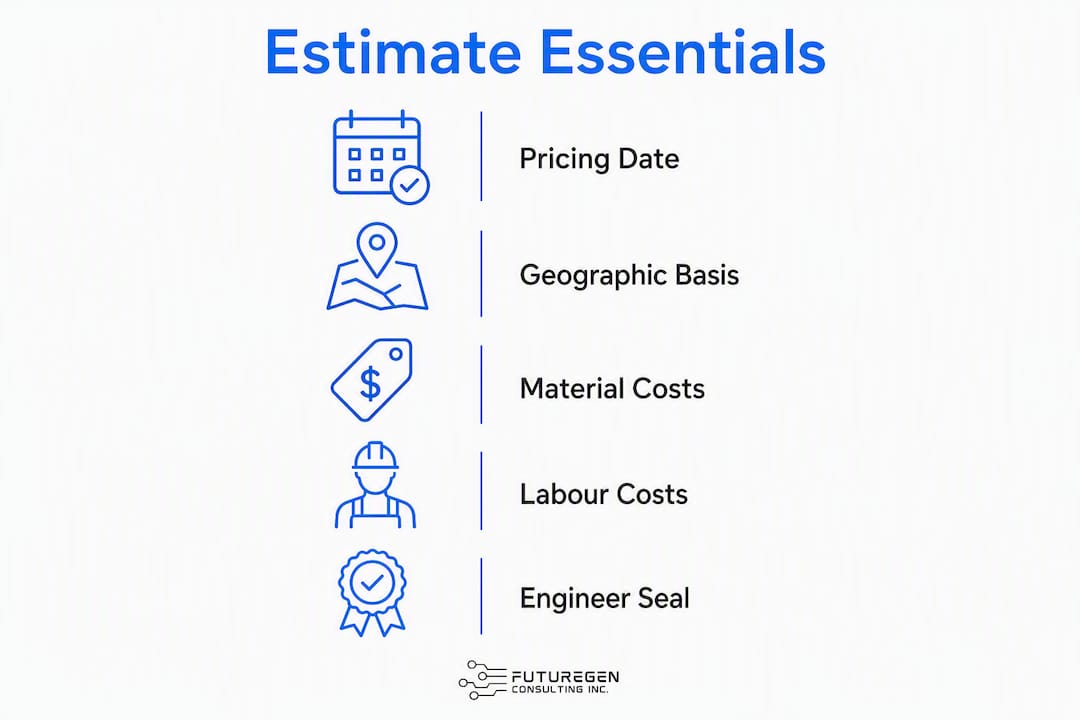
The Professional Engineers Act and Ontario Regulation 941 govern sealing responsibilities for P.Eng practitioners in Ontario. Amendments to Section 53 of Regulation 941 require practitioners to indicate the purpose of every sealed document, clarify that sealing constitutes assuming professional responsibility for the engineering content, and mandate safeguards against seal misuse. A sealed document without a stated purpose can be applied to uses the engineer never intended, creating liability exposure for both the engineer and the owner.
The PEO-OAA Joint Bulletin further specifies that design and general review of certain building categories under the Ontario Building Code must be carried out by a licensed architect or a P.Eng. For electrical systems in those building categories, the cost estimate and supporting calculations must be prepared by, or under the direct supervision of, a P.Eng.
The Electrical Safety Authority (ESA) and CSA Group standards (including the Ontario Electrical Safety Code, which adopts and amends the CSA C22.1 standard) govern technical compliance requirements that directly affect the scope and cost of electrical installations. Engineers preparing estimates must account for ESA inspection requirements and CSA-compliant equipment specifications, as non-compliant selections can materially alter project costs.
“Sealing an engineering document is akin to assuming professional responsibility… practitioners must indicate the purpose of the document they are sealing.” — Professional Engineers Ontario (PEO)
Pro Tip: Always request that the sealed estimate state its purpose explicitly on the cover sheet and on every page of the document. A document marked “For Permit” cannot be repurposed as a tender reference without the engineer’s written authorization, which protects both the owner and the practitioner.
How do you vet and select the right P.Eng firm?
Credentials and trust signals to verify
- Active P.Eng registration with PEO — confirm the individual engineer’s licence status directly on the PEO public register before signing any contract.
Questions to ask before engaging
- What is your experience preparing engineer-stamped electrical cost estimates for projects of this type and scale in Ontario?
- Can you provide examples of permit approvals obtained using your sealed estimates?
- How do you document assumptions and state variance in your estimates?
- Who specifically will seal the documents, and what is that individual’s PEO licence number?
- What is your typical timeline and fee basis for this scope?
Red flags to avoid
- Vague scope of work with no explicit deliverable list or stated document purpose.
- Unwillingness to provide a sample sealed document or references from comparable Ontario projects.
- No evidence of E&O insurance coverage.
- Fee proposals that bundle cost estimating into base design services without a separate terms of reference.
The ACECOntario Fee Guideline identifies the percentage-of-construction-cost method as one accepted basis for engineering fees on buildings projects. Firms that cannot explain their fee basis clearly or that offer unusually low flat fees without a defined scope warrant scrutiny.
What drives the timeline and cost of an engineer-prepared estimate?
| Fee/Timeline Driver | Effect on Scope |
|---|---|
| Project complexity (systems count, voltage levels, emergency power) | Higher complexity increases calculation time and deliverable volume |
| Level of detail required (budget-grade vs. tender-grade) | Tender-grade estimates require full quantity takeoffs and unit pricing |
| Site visits and existing conditions review | Adds time and travel cost; avoidable with complete as-built drawings |
| Technical calculations (photometrics, voltage drop) | Required for permit; scope these explicitly in the SoW |
| Number of revisions | Limit to two rounds in the contract to control cost |
| Urgency and expedited delivery | Premium fees apply; schedule permit milestones early |

For a straightforward commercial tenant improvement, a budget-grade estimate may be completed within one to two weeks. A tender-grade estimate for a mid-size commercial building with emergency power, fire alarm, and photometric requirements typically requires three to five weeks, depending on the completeness of the drawings provided.
Providing complete existing drawings, a clear design brief, and pre-agreed assumptions at project initiation is the single most effective way to reduce both cost and schedule.
Sample scope of work you can use to commission an estimate
A compliant terms of reference for an engineer-stamped electrical cost estimate should include the following elements:
- Project identification: address, building type, gross floor area, and applicable OBC classification.
- Intended document purpose: state explicitly whether the estimate is “For Permit,” “For Budget,” or “For Tender Reference.”
- Deliverables list: itemized unit prices, quantity takeoffs, assumptions and exclusions, photometric files, voltage-drop calculations, equipment schedules, single-line diagrams (if applicable), tendering instructions, and sealed engineer statement.
- Pricing basis: state the pricing date, geographic basis (e.g., Greater Toronto Area), labour and material markup rates, and HST treatment.
- Site visits: specify whether a site visit is included or whether the estimate will be prepared from drawings only.
- Revision allowances: define the number of revision rounds included in the fee.
- Fee structure and payment milestones: fixed fee or hourly rate, invoicing schedule, and conditions for additional services.
- Liability and reliance statement: confirm the estimate is a professional opinion for the stated purpose and is not a guarantee of construction cost.
- Confidentiality clause: restrict distribution of the sealed document to named parties.
- Dispute resolution: specify the governing law (Ontario) and resolution process.
The following disclaimer language, consistent with PEO guidance on variance, should appear on the sealed document:
- “This estimate represents a professional opinion of probable construction cost based on the assumptions and conditions stated herein. The engineer cannot guarantee cost accuracy. Where the degree of variance is critical to project decisions, an independent estimate is recommended.”
How do contractors and municipalities use engineer-stamped estimates?
Municipal building departments rely on sealed electrical cost estimates as part of the permit application package to confirm that the proposed electrical systems are adequately scoped and costed for the building classification. The Chief Building Official expects the document to identify the responsible P.Eng, state the document’s purpose, and include supporting calculations that demonstrate compliance with the OBC, ESA requirements, and applicable CSA standards.
Contractors treat engineer estimates differently from their own bids. A contractor converting an engineer’s estimate into a bid will add contingency for market risk, labour availability, and site conditions that the engineer’s assumptions may not fully capture. Communicating this distinction to bidders in the tendering instructions prevents misuse of the sealed document as a price ceiling.
“Engineers should clearly state the variables in the estimate and the inherent variance involved. Where the degree of variance is critical, they should obtain a second independent estimate.” — PEO Guideline: Professional Engineers Providing Mechanical and Electrical Engineering Services In Buildings
For lender and owner reporting, the sealed estimate provides a defensible, professionally attested cost basis for financing approvals and budget contingency planning.
Pro Tip: Before submitting the sealed estimate to the municipality, contact the permit intake team or Chief Building Official to confirm the required format and any jurisdiction-specific cover sheet requirements. Coordinating this early avoids resubmission cycles that delay permit issuance.
Key Takeaways
An engineer-stamped, permit-ready electrical cost estimate prepared by a licensed P.Eng is the only document type that satisfies Ontario municipal permit requirements and provides defensible professional attestation for lender and budget reporting.
| Point | Details |
|---|---|
| Hire a licensed P.Eng | Confirm active PEO registration and E&O insurance before signing any contract. |
| Use a compliant SoW | The scope of work must state the document’s purpose, deliverables, assumptions, and revision limits. |
| Require a variance disclaimer | PEO requires engineers to state variables and inherent variance; independent estimates are recommended when variance is critical. |
| Coordinate with the municipality | Confirm the permit intake team’s format requirements before submitting the sealed estimate to avoid resubmission delays. |
| Engage Futuregenconsulting | Futuregenconsulting delivers P.Eng-stamped, permit-ready electrical cost estimates with PEO-aligned SoW and municipal coordination for Ontario projects. |
Why the engineer’s seal is misunderstood more often than it should be
The most persistent misconception in Ontario permit submissions is that a P.Eng seal functions as a cost guarantee. It does not. The seal attests that the engineering content is suitable for the stated purpose, prepared by a qualified practitioner, and may be reasonably relied upon within the scope of the stated assumptions. Cost accuracy is a separate matter, governed by market conditions, labour availability, and site variables that no engineer can fully control at the time of estimate preparation.
What this means practically is that owners and developers who treat the engineer’s estimate as a fixed budget ceiling are setting themselves up for cost overruns that have nothing to do with engineering error. The correct use of the document is as a professionally informed reference point, with contingency budgeted for the variance the engineer has explicitly disclosed. Firms that skip the variance statement, or that produce estimates without explicit assumptions, are not following PEO guidance and are exposing their clients to exactly the kind of budget surprises the sealed document is supposed to prevent.
The other underappreciated issue is document purpose language. Regulation 941 amendments require the purpose to be stated on the sealed document, yet many estimates circulate without it. A document sealed “For Budget” that gets submitted to a municipality as a permit document, or distributed to bidders as a tender reference, has been misused. Owners bear some responsibility for controlling distribution, and the SoW should include an explicit confidentiality clause restricting the document to named parties.
Futuregenconsulting delivers permit-ready electrical estimates for Ontario projects

Futuregenconsulting provides engineer-stamped electrical cost estimation services for commercial and residential projects across Ontario, with P.Eng-sealed deliverables that meet municipal permit requirements and PEO extra-service standards. Every estimate includes itemized unit prices, explicit assumptions, supporting calculations (photometrics, voltage drop), and a formal variance disclaimer, structured around a PEO-aligned scope of work.
To request a preliminary estimate or scope review, send your existing drawings, design brief, project schedule, and any municipal correspondence to the Futuregenconsulting team. The firm will confirm the deliverable list, fee basis, and timeline before any commitment. For a full overview of MEP engineering services available for Ontario projects, visit the Futuregenconsulting website and contact the team directly to discuss your project requirements.
Useful sources
| Source | Why It Matters |
|---|---|
| PEO Guideline: Professional Engineers Providing Mechanical and Electrical Engineering Services In Buildings | Defines detailed cost estimating as an extra service, sets variance and assumption requirements, and governs deliverable standards for M&E engineers in Ontario. |
| PEO-OAA Joint Bulletin (Design and General Review) | Clarifies when a P.Eng or architect must provide design and general review under the Ontario Building Code for designated building categories. |
| Clarifying Sealing Requirements (PEO Practice Update, Regulation 941) | Explains Section 53 amendments requiring document purpose statements, sealing responsibilities, and anti-misuse safeguards for all sealed engineering documents. |
| ACECOntario Fee Guideline (2019) | Provides accepted fee basis methods for engineering services on Ontario buildings projects, including percentage-of-construction-cost and resident engineering fee structures. |
| Professional Engineers Ontario (PEO) | Primary regulatory body for professional engineering in Ontario; source for licence verification, sealing rules, and practice advisories. |