
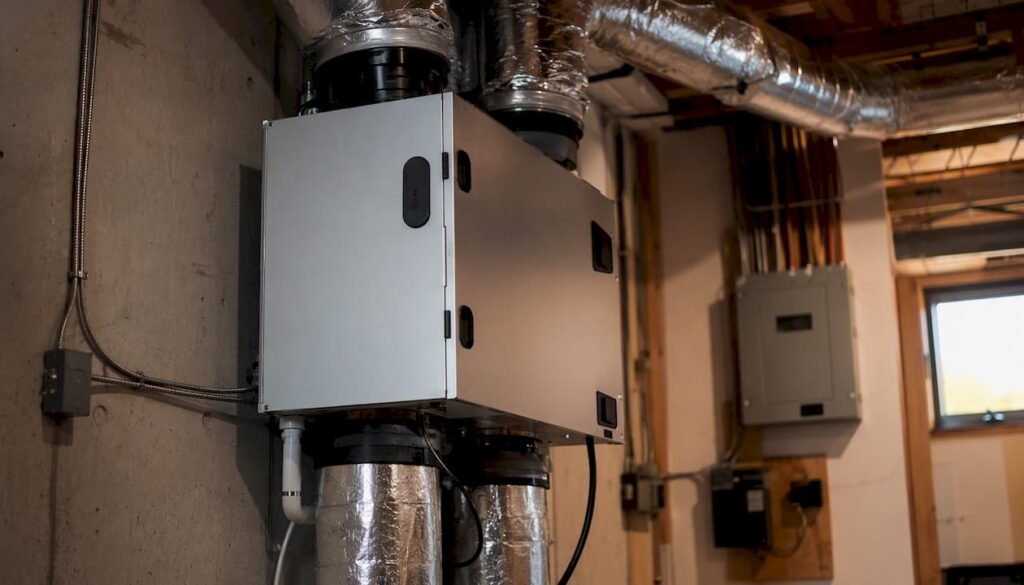
An energy recovery ventilator (ERV) is a whole-home mechanical ventilation device that brings fresh outdoor air into a building while simultaneously transferring both heat and moisture from the outgoing exhaust stream, delivering balanced ventilation with a significantly reduced energy penalty. For most Canadian homes, particularly those in mixed climates with humid summers, an ERV is the preferred choice; in very cold, dry regions such as the Prairies where interior humidity is already low in winter, a heat recovery ventilator (HRV) may serve better. Performance ratings for these units are governed by the CSA-C439 test standard. ENERGY STAR Canada and Natural Resources Canada (NRCan) provide the certification benchmarks that matter most when specifying equipment.
Key Takeaways
An ERV is the right ventilation choice for most Canadian homes in mixed or humid climates, provided it is correctly sized to the CSA-C439-18 test standard, commissioned with verified airflow balance, and maintained on a regular filter and core schedule.
| Point | Details |
|---|---|
| ERV vs. HRV selection | Choose an ERV for mixed or humid climates; an HRV suits cold, dry Prairie winters where interior humidity is already low. |
| Performance metrics to verify | Request SRE at 0°C (NRCan proposed minimum: 65%) and fan efficacy (proposed minimum: 0.57 L/s/W) from third-party test data. |
| Sizing baseline | Size to required ventilation rate in L/s using occupancy and floor area; use net supply airflow at CSA-C439-18 test conditions, not maximum rated airflow. |
| Commissioning is non-negotiable | Measure and balance supply and exhaust airflows after installation; unbalanced systems underperform and can affect combustion appliance draft safety. |
| Futuregenconsulting | Provides permit-ready HVAC design, ventilation calculations, and commissioning plans for Ontario residential and commercial ERV projects. |
Table of Contents
- How energy recovery ventilation actually works
- ERV vs. HRV: which one fits your Canadian climate?
- What types of ERV technology and components will you find?
- What are the real benefits of an ERV for Canadian buildings?
- How to size and select an ERV for a Canadian home
- Installation, operation, and maintenance basics that preserve performance
- Standards, certification, and the Canadian regulatory context
- Typical costs and payback factors for Canadian installations
- When should you involve an HVAC or MEP engineer?
- What Futuregenconsulting observes on Canadian ERV projects
- Futuregenconsulting’s HVAC engineering services for ERV projects
- Sources
How energy recovery ventilation actually works
An ERV transfers both sensible heat (temperature) and latent energy (moisture) between the outgoing exhaust air and the incoming fresh air supply, without allowing the two airstreams to mix. This is the fundamental distinction from a simple exhaust fan, which discards all the thermal and moisture energy in the air it removes.
Inside the unit, two separate airstreams pass on either side of an energy-exchange core. The exhaust air flows from the living space outward; the supply air flows from outside inward. The core material allows heat and water vapor to diffuse across it, so in winter the warm, humid exhaust air pre-warms and pre-humidifies the cold incoming air. In summer the process reverses: the cooler, drier indoor exhaust air pre-cools and dehumidifies the hot, humid incoming outdoor air before it enters the HVAC system.
The key performance metric is sensible recovery efficiency (SRE), which measures how much of the temperature difference between the two airstreams is recovered. A second metric, fan efficacy, expressed in liters per second per watt (L/s/W) or cfm/W, measures how efficiently the unit moves air relative to its electrical consumption. According to AHRI’s technical overview of energy recovery ventilators, proper sizing and installation are prerequisites for achieving rated performance in the field.
Typical sensible recovery range: Multiple sources, including the Minnesota Center for Energy and Environment, report that HRV and ERV units commonly achieve sensible recovery in the 60–85% range, depending on unit design and operating conditions.
Most residential ERVs also incorporate a frost control or defrost strategy to prevent the core from freezing at low outdoor temperatures. Common approaches include a recirculation bypass, a pre-heater on the intake, or a timed defrost cycle. The rated operating temperature range and the defrost method are both critical selection criteria for Canadian climates.
ERV vs. HRV: which one fits your Canadian climate?
The difference is straightforward: an HRV recovers sensible heat only, while an ERV recovers both heat and moisture. That single distinction drives the climate-based selection logic for Canadian projects.
In winter, an ERV retains some interior moisture in the outgoing exhaust stream and transfers it back to the incoming supply air. This is beneficial in climates where winter humidity is already moderate, because it reduces the need for supplemental humidification. An HRV, by contrast, exhausts moisture with the outgoing air, which can dry out a home’s interior during a long Prairie winter. In summer, the ERV’s moisture transfer works in reverse, pre-dehumidifying the incoming outdoor air and reducing the latent cooling load on the air conditioning system.
The City of Vancouver’s heat recovery ventilation guide confirms that ERVs transfer both sensible heat and moisture, making them particularly well-suited to humid coastal and mixed climates, while HRVs are generally preferred where winter air is very dry and interior humidity must be exhausted rather than retained.
Decision checklist for Canadian homeowners and designers:
- Cold, dry winters (Prairies, northern Ontario, most of Manitoba and Saskatchewan): Lean toward an HRV. Interior humidity is typically low; retaining moisture in winter is less of a priority, and HRVs tend to have simpler frost control.
- Mixed climates with humid summers (southern Ontario, Quebec, coastal BC): An ERV is generally the better fit. The moisture transfer reduces summer latent loads and moderates winter humidity loss.
- Very tight new construction with whole-home humidification already specified: Either unit can work; the humidification system compensates for HRV drying, so the choice shifts to cost and SRE performance.
- Retrofit in an older, leakier home: Confirm the envelope tightness first. A blower-door test result above 3.0 ACH50 may mean natural infiltration already provides some humidity moderation, which changes the calculus.
- Homes with combustion appliances (gas furnace, water heater, fireplace): Balanced airflow is non-negotiable. Both ERV and HRV provide balanced ventilation, but system pressurization must be verified after installation to protect appliance draft.
For a deeper comparison specific to Ontario conditions, the ERV vs. HRV guide for Ontario homeowners covers the regional decision factors in detail.
What types of ERV technology and components will you find?
Energy recovery ventilation is not a single proprietary technology. Four core designs appear across the residential and light-commercial market, each with distinct performance characteristics.
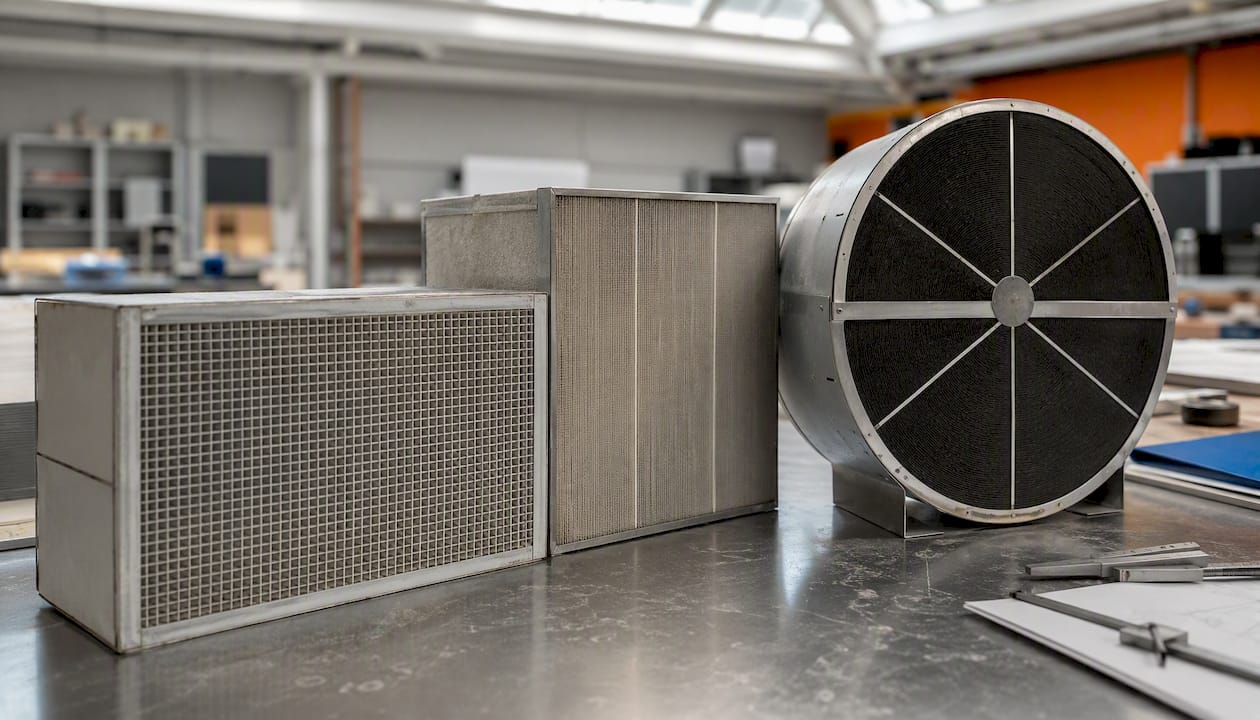
Static plate (fixed-plate) cores use a stack of flat or corrugated plates with alternating airflow channels. They have no moving parts, which means low maintenance and high reliability, but they transfer moisture only if the plate material is hygroscopic (enthalpic). Non-hygroscopic aluminum-plate units recover sensible heat only and are technically HRVs, not ERVs.
Enthalpic matrix cores use a hygroscopic paper or polymer membrane that allows both heat and water vapor to diffuse across it. These are the most common ERV core type in residential units sold in Canada. They are effective at moisture transfer but require careful attention to frost susceptibility at very low temperatures.
Rotary thermal wheels use a slowly rotating wheel of hygroscopic or desiccant-coated material that alternately absorbs heat and moisture from the exhaust stream and releases it to the supply stream. Wheels achieve high recovery efficiencies but introduce a small risk of cross-contamination between airstreams and require a motor and periodic cleaning.
Heat pipes and run-around coil systems are more common in commercial applications where the supply and exhaust ducts cannot be co-located. They transfer sensible heat only and are generally outside the scope of residential ERV selection.
Core components in a residential ERV unit:
- Supply and exhaust fans (typically EC motors for variable-speed operation)
- Energy exchange core (plate, membrane, or wheel)
- Supply-side and exhaust-side filters (typically MERV 8 minimum recommended)
- Supply and exhaust dampers (motorized or gravity)
- Controls (timer, occupancy sensor, CO₂ or humidity-based demand control)
- Frost control mechanism (bypass damper, pre-heater, or defrost cycle)
- Condensate drain provisions (required on some core types and climates)
Pro Tip: *When specifying or purchasing an ERV, confirm that both the supply-side and exhaust-side filters are accessible from the same service panel without disconnecting ductwork.
What are the real benefits of an ERV for Canadian buildings?
The three primary benefits are improved indoor air quality (IAQ), humidity moderation, and a substantially reduced ventilation energy penalty compared to uncontrolled infiltration or simple exhaust ventilation.
Energy recovery in practice: The Minnesota Center for Energy and Environment reports that HRV and ERV units typically recover 60–85% of the heat in the exhaust airstream, which directly reduces the heating or cooling energy required to condition incoming fresh air.
Comfort and health benefits:
- Continuous dilution of indoor pollutants: VOCs from building materials, CO₂ from occupants, cooking odors, and particulates are exhausted while filtered fresh air is supplied
- Humidity moderation in both seasons: ERVs reduce winter dryness (compared to HRVs) and pre-dehumidify summer supply air, reducing the latent load on air conditioning
- Odor control in bathrooms and kitchens when exhaust pickup points are located correctly
- Reduced condensation risk on windows and cold surfaces in winter, because incoming air is pre-warmed before entering the conditioned space
Energy and HVAC system benefits:
- Recovered heat reduces the heating load on the furnace or heat pump, particularly during the long Canadian heating season
- Moisture pre-conditioning in summer reduces the latent cooling load, which can allow a smaller or shorter-running air conditioning system
- Because the ERV handles ventilation as a dedicated system, the primary HVAC equipment can be sized to the thermal load rather than the ventilation load, a principle that supports accurate HVAC load calculations and potential equipment downsizing
A practical illustration: a 2,000 sq. ft. Ontario home requiring 40 L/s of ventilation air at -20°C outdoor temperature would need to heat that incoming air from -20°C to roughly 21°C, a 41°C rise.
How to size and select an ERV for a Canadian home
Base sizing on the required ventilation rate, which in Canadian residential practice is typically derived from ASHRAE 62.2 or the applicable provincial building code ventilation requirements, expressed in liters per second (L/s) or cubic feet per minute (cfm).
Step-by-step sizing example for a representative Canadian house:
A 10-room house (4 bedrooms, living, dining, kitchen, 2 bathrooms, utility) with 4 occupants in Ontario:
- Determine required ventilation rate. A common residential guideline is approximately 0.35 air changes per hour or a minimum of 7.5 L/s per person plus 0.15 L/s per m² of floor area. For a 185 m² (2,000 sq. ft.) home with 4 occupants: (4 × 7.5) + (185 × 0.15) = 30 + 27.75 = approximately 58 L/s total ventilation requirement.
- Select a unit with net supply airflow at or above that rate under test conditions (at 0°C per CSA-C439-18), not just rated maximum airflow.
- Verify SRE at 0°C (and at -25°C if the project is in a cold climate zone). NRCan’s proposed minimum SRE is 65% at 0°C.
- Check fan efficacy. NRCan’s proposed minimum is 0.57 L/s/W. Higher is better; units at 0.8 L/s/W or above represent strong performance.
- Confirm frost control rating and the lowest rated operating temperature for the unit.
Ventilation rates above are approximate and should be confirmed against the applicable provincial code or ASHRAE 62.2 for the specific project. Always use net supply airflow at test conditions, not maximum rated airflow, when comparing units.
NRCan’s recovery ventilators guidance page lists ENERGY STAR-certified units and the associated test data. Request third-party verified test reports, not manufacturer self-reported data, when specifying equipment for a permitted project.
Installation, operation, and maintenance basics that preserve performance
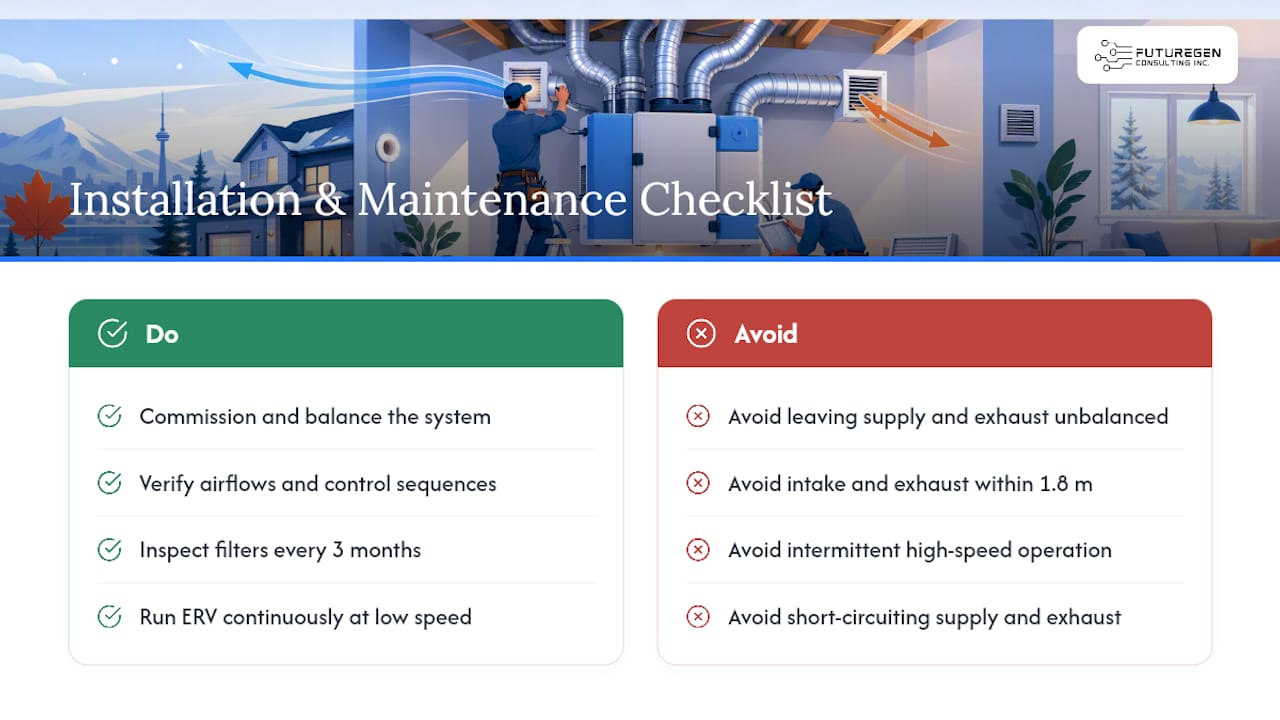
The single most important installation rule is this: commission and balance the system. Airflow is the currency of ventilation. An ERV installed with unbalanced supply and exhaust flows delivers neither the IAQ nor the energy performance it was designed for, and in homes with combustion appliances, an unbalanced system can create negative pressure conditions that affect appliance draft safety, as confirmed by the City of Vancouver’s HRV/ERV installation guidance.
Ducting and placement. Dedicated ERV ductwork, separate from the forced-air distribution system, gives the most reliable airflow control and avoids interactions with furnace fan cycling. Integrated systems that use the existing forced-air ducts are common in retrofits but require careful design to avoid short-circuiting supply and exhaust points. Outdoor intake and exhaust terminations must be separated by at least 1.8 m (6 ft.) horizontally and positioned to avoid recirculation of exhaust back into the intake.
Commissioning checklist. After installation, verify measured supply and exhaust airflows against design targets using a flow hood or calibrated anemometer. Confirm the control sequence operates correctly across all modes (continuous low, boost, and any demand-control triggers). Test the frost/defrost function by reviewing the control logic and, where possible, observing a defrost cycle. Document all measured airflows, balance settings, and control sequences in a commissioning report and hand it to the building owner.
Maintenance schedule. Filters on both the supply and exhaust sides should be inspected every 3 months and replaced or cleaned every 6 months in most residential applications, more frequently in homes with pets or high dust loads. The energy exchange core requires inspection at least annually; accumulated dust or biological growth on the core surface increases pressure drop, forces the fans to work harder, and reduces SRE. Fan motors and damper actuators should be checked annually for correct operation.
Pro Tip: Run the ERV at continuous low speed rather than intermittent high-speed cycles in any airtight home. Continuous low-speed operation maintains a steady dilution of indoor pollutants and a stable pressure balance. Intermittent high-speed operation creates pressure spikes, can disturb combustion appliances, and does not provide equivalent IAQ to the same total airflow delivered continuously. Most modern EC-motor ERVs consume less than 30–40 watts at low speed, making continuous operation the energy-efficient default.
Standards, certification, and the Canadian regulatory context
When specifying or purchasing an ERV for a Canadian project, four references define the compliance and performance landscape: NRCan guidance and proposed regulations, the CSA-C439-18 test standard, ENERGY STAR Canada certification listings, and AHRI rating definitions.
Certifications and test data to request from manufacturers:
- SRE reported at 0°C per CSA-C439-18 (and at -25°C for cold-climate applications)
- Net supply airflow at test conditions (not maximum rated airflow)
- Fan efficacy in L/s/W at the design operating point
- Third-party test verification (not manufacturer self-reported data)
- ENERGY STAR Canada listing confirmation
NRCan has proposed minimum energy-efficiency standards for energy and heat recovery ventilators, including minimum sensible heat-recovery efficiency values around two-thirds at moderate cold temperatures and minimum fan efficacy standards, with CSA-C439-18 as the referenced test method. These standards may apply to products manufactured after early 2026. Full details are available on the NRCan recovery ventilators regulatory page. Specifiers working on projects with long lead times should confirm that selected equipment meets or exceeds these proposed thresholds, as products manufactured after the effective date will be required to comply.
Pro Tip: Retain the manufacturer’s third-party test report, the ENERGY STAR listing printout, and the commissioning airflow report in the project file. The NECB 2020 framework and provincial building codes increasingly require documented equipment performance data for compliance verification. A missing test report at permit review or building inspection can delay occupancy.
Building code requirements for ventilation documentation vary by province and project type. In Ontario, the Ontario Building Code references ventilation requirements for residential and commercial occupancies, and the National Energy Code for Buildings (NECB) applies to most commercial and multi-unit projects. Both frameworks rely on documented equipment performance data, making third-party verified test reports a practical necessity rather than an optional extra.
Typical costs and payback factors for Canadian installations
Installed costs for residential ERV systems in Canada typically range from approximately $2,500 to $6,000 CAD, covering the unit, ductwork, electrical connection, and commissioning, according to market data for Ontario and Canadian installations. The lower end of that range applies to straightforward retrofits in homes with existing ductwork and accessible installation locations; the upper end reflects new dedicated ductwork runs, complex installations, or premium unit specifications.
Operating costs are modest. A residential ERV running continuously at low speed typically consumes 25–50 watts of fan power, translating to roughly $30–$75 CAD per year in electricity at Ontario’s current residential rates, depending on the unit’s fan efficacy and local time-of-use pricing. Filter replacement adds a further $50–$100 CAD annually for most units.
Payback timing depends on several interacting variables: local natural gas or electricity prices, the home’s envelope tightness, occupancy patterns, the baseline ventilation method being replaced, and whether the ERV enables HVAC equipment downsizing. In a well-sealed Ontario home replacing uncontrolled exhaust ventilation, the energy savings from heat recovery can be meaningful over a 15–20 year equipment lifespan, though formal payback calculations require project-specific inputs. Utility rebate programs through local distribution companies and provincial programs may offset a portion of the installed cost; check with your local utility and the NRCan recovery ventilators page for current incentive availability.
When should you involve an HVAC or MEP engineer?
Engage an MEP engineer when the project affects building pressurization, code compliance, multi-zone distribution, integration with combustion appliances or other mechanical systems, or when envelope changes are significant enough to alter the ventilation load calculation.
Scenarios where early MEP engagement is cost-effective or required:
- New residential construction subject to Ontario Building Code ventilation requirements or NECB compliance
- Major retrofits involving air sealing, window replacement, or envelope upgrades that change infiltration rates
- Multi-unit residential buildings (condominiums, townhouse blocks) where individual suite ventilation must be balanced against corridor and common-area pressurization
- Any building with gas-fired combustion appliances (furnaces, boilers, water heaters, fireplaces) where system pressurization affects appliance draft and carbon monoxide risk
- Projects seeking utility rebates or green building certification where documented ventilation calculations and commissioning records are required
- Commercial or institutional projects subject to NECB, where the mechanical engineer of record must stamp ventilation design drawings
Deliverables a qualified MEP engineer provides for an ERV project:
- Ventilation load calculations (L/s per zone, total building requirement)
- Equipment schedule with specified SRE, fan efficacy, airflow, and frost-control requirements
- Duct layout drawings with supply and exhaust pickup/delivery point locations
- Control sequences for continuous, boost, and demand-control modes
- Commissioning plan with acceptance criteria for airflow balance and defrost function
- Permit-ready stamped drawings for building permit submission
Early engagement reduces rework. Selecting an ERV without a coordinated mechanical strategy can result in duct conflicts, inadequate frost protection for the climate zone, or a system that fails commissioning because the airflow targets were never formally established. The NECB 2020 documentation requirements reinforce the value of having an engineer of record who can produce and retain the performance documentation that code compliance demands. For context on what integrated HVAC design in Ontario entails across the full mechanical system, the considerations extend well beyond the ERV unit itself.
What Futuregenconsulting observes on Canadian ERV projects
Three field observations stand out from ERV and HRV projects across Ontario. First, the most common performance failure is not equipment quality — it is commissioning that never happened. Units are installed, turned on, and left running without a single airflow measurement.
Second, filter and core access is consistently underweighted at the specification stage. A unit mounted in a mechanical room corner with 150 mm of clearance to the service panel will not be maintained on schedule. Specifying accessible service geometry at the design stage costs nothing and preserves performance for the life of the equipment.
Third, frost strategy is frequently mismatched to climate. A unit rated to -15°C installed in a northern Ontario location that regularly sees -25°C will spend extended periods in defrost mode, reducing effective ventilation and increasing energy consumption.
For complex projects, multi-unit buildings, or any installation where code compliance documentation is required, consulting with an experienced MEP engineering firm early in the design process avoids the rework and delay that under-specified ventilation systems routinely cause.
Futuregenconsulting’s HVAC engineering services for ERV projects
Specifying and commissioning an ERV correctly requires more than selecting a unit from a product sheet. Futuregenconsulting delivers HVAC system design services in Ontario that cover the full scope of a ventilation project: ventilation load calculations, equipment scheduling with verified SRE and fan-efficacy targets, duct layout, control sequences, commissioning plans, and permit-ready stamped drawings.

For developers, contractors, and architects working on new residential construction, major retrofits, or multi-unit buildings in Ontario, Futuregenconsulting provides the engineering documentation that satisfies Ontario Building Code and NECB requirements and supports utility rebate applications. With over 30 years of MEP engineering experience, the firm brings the technical depth to integrate ERV selection with the broader mechanical strategy, from HVAC load calculations to commissioning verification. Contact Futuregenconsulting to discuss your project’s ventilation requirements and receive a scoped engineering proposal.
Sources
The primary Canadian authorities for ERV specification and compliance are NRCan’s Office of Energy Efficiency, the National Research Council of Canada (NRC), and the standards bodies referenced in provincial building codes.
NRCan — Recovery Ventilators regulatory page (natural-resources.canada.ca): The definitive Canadian source for proposed minimum SRE and fan-efficacy standards, ENERGY STAR Canada listings, and CSA-C439-18 test method references. Essential for specifiers confirming equipment compliance.
City of Vancouver — Heat Recovery Ventilation Guide for Houses (vancouver.ca): A detailed, practical guide covering ERV and HRV operation, component descriptions, commissioning requirements, and maintenance schedules. Applicable beyond Vancouver for its technical content.
NRC Publications — NECB 2020 Revisions and Supplement (nrc-publications.canada.ca): The authoritative reference for understanding how building code compliance depends on documented mechanical system performance data, relevant for any permitted project.
AHRI — Energy Recovery Ventilators homeowner education page (ahrinet.org): Clear technical definitions of ERV and HRV function, rating approaches, and sizing guidance from the industry’s primary rating organization.
Homeowner.ca — HRV and ERV systems for Canadian homes (homeowner.ca): A practical decision framework covering climate-based selection, ducting options, and maintenance for Canadian homeowners.
Get a Better Quote — HRV vs. ERV in Ontario (getabetterquote.com): Regional cost data and installed-price ranges for Ontario and Canadian residential projects, useful for budgeting and payback estimation.
When working with any supplier or installer, request the manufacturer’s third-party test report under CSA-C439-18, the ENERGY STAR Canada listing confirmation, and a commissioning report with measured airflow data. These three documents together constitute the minimum evidence that a system was specified and installed to perform as designed.
- Recovery ventilators – Natural Resources Canada
- Heat recovery ventilation guide for houses — City of Vancouver
- NECB 2020 revisions and supplement — NRC Publications
- Energy Recovery Ventilators — AHRI
- HRV vs ERV in Ontario: Which ventilation system does your home need? — Get a Better Quote