
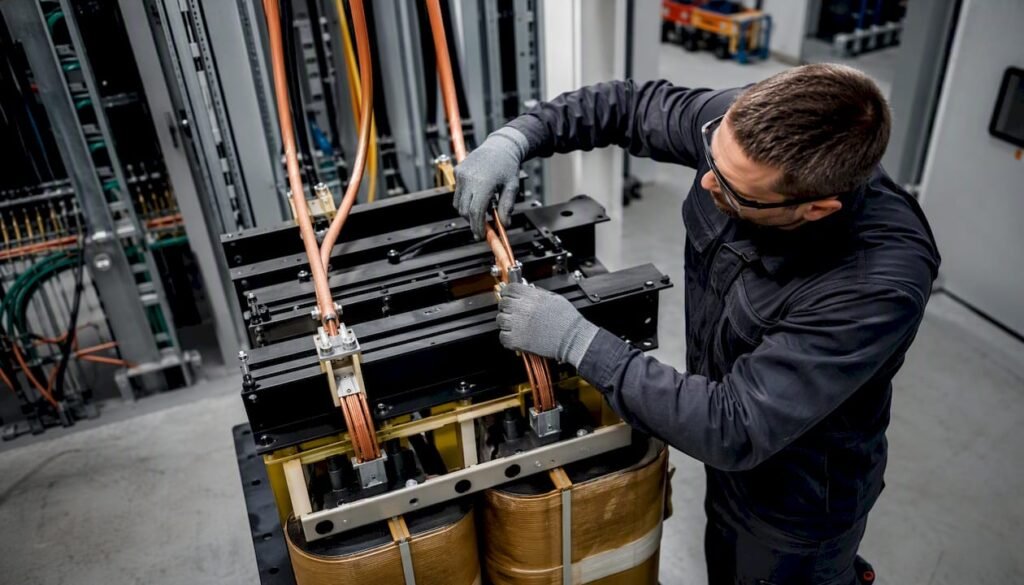
For most commercial buildings, the working answer is a dry-type isolation transformer, sized by calculating connected load, applying demand and diversity factors, then rounding up to the next standard kVA rating. Pad-mounted liquid-immersed units come into play for larger service entrances or when the utility interconnection point sits outside the building envelope. Correct transformer selection for commercial projects always starts with a load inventory, not a nameplate guess.
The immediate next step: build a load schedule, apply demand factors and continuous-load multipliers under the Canadian Electrical Code, add spare capacity for future growth, and route the result through a licensed P.Eng. for verification before it goes on a drawing.
Three compliance items belong on every spec sheet from day one:
- Certification to CSA C22.2 No. 47 for dry-type units, with cUL or CSA marking visible on the nameplate.
- Efficiency data referenced against NRCan’s dry-type transformer performance tables.
- Documentation ready for the authority having jurisdiction (AHJ) at permit review and final inspection.
Key Takeaways
Correct transformer selection for commercial buildings requires a calculated load inventory, code-compliant demand factors, CSA/cUL certification, and NRCan efficiency documentation verified by a licensed P.Eng.
| Point | Details |
|---|---|
| Size from load, not nameplate | Calculate connected load with demand factors, then round up to the next standard kVA size. |
| Cite CSA C22.2 No. 47 | Every dry-type transformer spec needs this certification referenced for AHJ approval. |
| Check percent impedance | This value drives voltage drop, fault current, and protective device coordination. |
| Plan for harmonics early | Specify K-rated units when nonlinear loads exceed roughly 15 to 20% of connected load. |
| Work with FutureGen Consulting | The firm delivers stamped load schedules, transformer specs, and AHJ-ready documentation for Ontario and Alberta projects. |
Table of Contents
- Transformer Sizing for Commercial Use: A Step-by-Step Method
- Which Transformer Type Fits Your Building and Site?
- Which Canadian Codes and Certifications Apply?
- Which Nameplate Specs Actually Matter?
- Harmonics, K-Factor, and When to Derate
- Protection, Coordination, and Commissioning Checklist
- Cost vs. Efficiency: What Drives Total Ownership Cost
- What Belongs on Your Transformer Spec Sheet
- How FutureGen Consulting Applies This Guidance
- Get a Transformer Specification Review From FutureGen Consulting
- Frequently Asked Questions
- Sources
Transformer Sizing for Commercial Use: A Step-by-Step Method
Sizing a transformer correctly is a sequence, not a lookup.
- Compile the load inventory. List every connected load in VA or kVA, and flag which loads are continuous (operating three hours or more) since the Canadian Electrical Code requires continuous loads to be calculated at 125% of their nameplate rating.
- Apply demand and diversity factors. Lighting, receptacles, HVAC, elevators, and tenant loads each carry different diversity assumptions. Not every circuit runs at once, and the code recognizes that.
- Sum the adjusted loads. Add the demand-adjusted totals to get required continuous kVA, then apply a sizing multiplier so continuous loading stays at or below 80% of nameplate capacity, a widely used engineering rule of thumb for distribution transformer sizing.
- Round to the next standard size. Manufacturers build in fixed increments (45, 75, 112.5, 150, 225 kVA, and up), so your calculated figure rarely lands exactly on a stock unit.
Worked example, small office floor:
Pro Tip: Add spare capacity before tenant fit-outs are even designed. A retail or office floor that adds EV charger circuits two years post-occupancy will blow past a tightly sized transformer fast. Building in 15 to 20% headroom up front is cheaper than a service upgrade later.

Which Transformer Type Fits Your Building and Site?
Dry-type transformers dominate indoor commercial installations because they avoid liquid coolant, simplify fire separation requirements, and suit electrical rooms without dedicated containment. Liquid-immersed units still make sense for larger pad-mounted services, particularly where the utility interconnection sits outside the building or where higher kVA ratings make liquid cooling more economical. Unit substations combine primary switching, transformer, and secondary distribution into one coordinated package, useful for large single-tenant buildings.
- Isolation transformers provide galvanic separation, often required for IT rooms, sensitive electronic loads, and certain life-safety circuits.
- Autotransformers save cost on voltage-matching applications but do not isolate the primary and secondary windings, which rules them out where isolation is code-mandated.
- Ambient temperature, altitude, and enclosure type (ventilated versus encapsulated) affect thermal performance and audible noise, a real concern near occupied office space.
Pro Tip: Confirm minimum clearances and fire separation requirements with your electrical room layout before finalizing enclosure type. Rooftop-mounted units introduce seismic anchoring and weatherproofing questions a basement electrical room never sees.
Which Canadian Codes and Certifications Apply?
Every commercial transformer specification needs to cite the standards an AHJ will check during permit review, not just the ones a manufacturer’s datasheet mentions.
- CSA C22.1 (Canadian Electrical Code) governs installation practices, clearances, and protection coordination.
- CSA C22.2 No. 47 sets construction, marking, and certification requirements for dry-type transformers, the standard AHJs expect referenced on procurement documents.
- CSA C802.2 establishes minimum efficiency values and recommends a total ownership cost methodology for selecting efficiency levels.
- NRCan’s Energy Efficiency Regulations set the mandatory minimum efficiency threshold; a 75 kVA three-phase 1.2 kV-class unit must meet 98.60% efficiency at 35% nominal load under SOR-2016-311.
AHJs typically require the certification mark, test reports, and nameplate efficiency data at inspection, not just at bid stage. Building that documentation into the RFQ avoids a scramble during final review.
Which Nameplate Specs Actually Matter?
The nameplate carries more decision-relevant data than most spec reviews give it credit for.
- kVA rating sets the base capacity; confirm it against your calculated continuous load, not the connected load total.
- Percent impedance determines voltage drop under load and available fault current, both of which affect protective device coordination downstream.
- Vector group determines phase-shift compatibility with upstream and downstream three-phase equipment and how neutral and grounding connections are handled.
- BIL (basic insulation level), temperature rise, and insulation class determine how the unit tolerates surges and sustained thermal loading.
- Taps and rated voltages allow field adjustment for utility voltage variance, which matters more in older Canadian commercial buildings than newer ones.
Percent impedance in particular gets overlooked. A transformer with high impedance limits fault current, which sounds protective until it also means larger voltage drop under motor starting or elevator inrush.
Harmonics, K-Factor, and When to Derate
Variable frequency drives, UPS systems, LED drivers, and EV chargers all generate triplen and odd harmonics that add heat beyond what a standard sinusoidal load produces. That extra heating shows up in the windings and, critically, in the neutral conductor, since triplen harmonics add rather than cancel across phases.
- If nonlinear loads make up more than roughly 15 to 20% of total connected load, specify a K-rated transformer (K-4 or K-13 depending on harmonic current profile) rather than derating a standard unit after the fact.
- Oversized neutral conductors, harmonic filters, and phase-shifted transformer arrangements are the common mitigation paths when K-rating alone doesn’t cover the load profile.
- IEEE technical guidance on commercial transformer selection has long flagged harmonic loading as a driver of premature transformer aging in mixed-use buildings.
Pro Tip: Measure harmonics on a representative circuit during design, or at minimum during commissioning, rather than relying on manufacturer default assumptions for the load type.
Protection, Coordination, and Commissioning Checklist
Selecting the right transformer means nothing if the protection scheme around it is wrong.
- Primary overcurrent protection commonly follows a 150% fuse or 300% breaker sizing guideline, adjusted when secondary protection or thermal devices are present.
- Coordinate settings with upstream switchgear and grounding systems, factoring in the transformer’s contribution to available short-circuit current.
- Downstream panelboard selection needs to match the transformer’s secondary voltage and fault current rating, not just its kVA output.
Commissioning should confirm:
- Insulation resistance (megger) testing before energization.
- Turns-ratio and polarity verification against nameplate data.
- Percent impedance confirmation and, for liquid units, oil dielectric testing.
- Full documentation package: nameplate photo, efficiency test report, and AHJ sign-off, similar in spirit to the records generated during generator load bank testing.
Cost vs. Efficiency: What Drives Total Ownership Cost
No-load and load losses compound over a transformer’s service life, often outweighing the incremental first cost of a premium-efficiency unit. NRCan’s minimum thresholds set the floor, but CSA C802.2’s total ownership cost methodology is the right framework for deciding whether to spec above that floor.
- Premium efficiency pays off fastest on high annual load factor buildings, where utility rebates or provincial incentive programs are available.
- Standard efficiency remains acceptable for low-utilization spaces like seasonal retail or lightly loaded mechanical rooms.
Pro Tip: Compare the incremental first cost against annual loss-energy cost using expected operating hours and load factor. A few hundred dollars in first cost often clears in under three years on a continuously loaded floor.
What Belongs on Your Transformer Spec Sheet
A complete spec avoids the RFQ back-and-forth that delays procurement by weeks.
- Required kVA, phase configuration, primary and secondary voltages, percent impedance, and vector group.
- Taps, temperature rise, insulation class, noise rating, and enclosure type.
- Certification marks (CSA/cUL), efficiency table reference, and test report requirements.
- Shipping and lead-time notes, since custom kVA ratings can push delivery well past standard stock.
Sample spec line: “Transformer shall be CSA C22.2 No. 47 certified, cUL listed, with efficiency documented against NRCan minimum performance tables and commissioning test reports submitted prior to energization.”
If the project shifts to a pad-mounted arrangement or a different utility service point, confirm AHJ and utility notification requirements early using the framework in electrical safety requirements for multi-unit buildings. A separate load calculation methodology is worth reviewing alongside this checklist for larger mixed-use projects.
How FutureGen Consulting Applies This Guidance
FutureGen Consulting’s electrical design deliverables on transformer-related projects typically include a load schedule, transformer schedule, procurement language, short-circuit and fault current calculations, coordination drawings, commissioning witness testing support, and the AHJ submittal package.
- A licensed P.Eng. reviews, signs, and stamps every drawing package before issue.
- Energy-efficiency documentation and AHJ coordination receive dedicated attention throughout the design cycle, not just at the permit stage.
Common Pitfalls We See on Commercial Projects
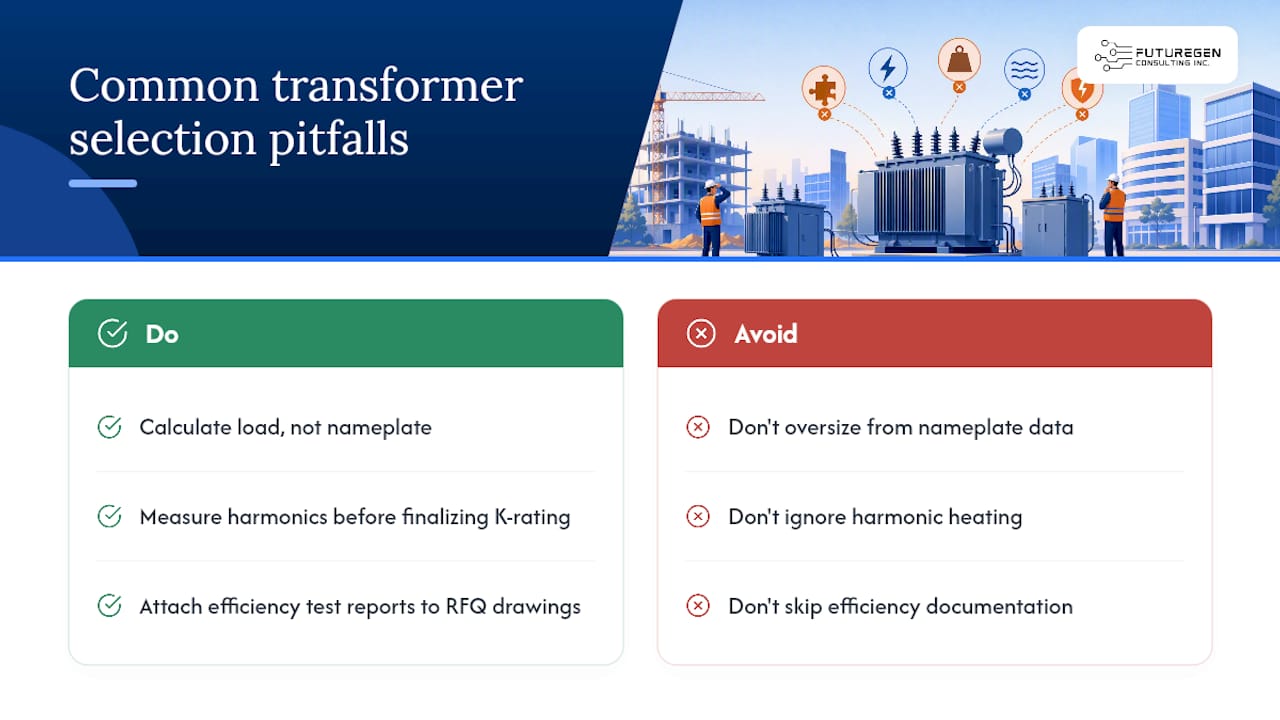
Oversizing from nameplate instead of calculated load, ignoring harmonic heating, and skipping efficiency documentation are the three recurring errors. My corrective note for each: calculate first, measure harmonics before finalizing K-rating, and attach efficiency test reports to the RFQ with the drawing set.
Get a Transformer Specification Review From FutureGen Consulting
Futuregenconsulting is the alternative to guessing your way through a transformer spec or relying on a supplier’s generic sizing sheet. Where a manufacturer catalog gives you standard kVA increments and a generic efficiency claim, Futuregenconsulting delivers a stamped load schedule, transformer schedule, and procurement language built around your actual building’s demand profile, harmonic loading, and AHJ requirements in Ontario and Alberta.

That means fewer change orders during commissioning and a permit package that doesn’t bounce back from the AHJ over missing efficiency documentation. FutureGen’s services cover load studies, transformer specification, commissioning support, and permit-ready stamped drawings, the exact deliverables referenced throughout this guide. Start with a site assessment or specification review to confirm your kVA calculation and certification requirements before the drawings go out to bid, or explore the firm’s broader MEP engineering services if the project scope extends beyond transformer selection.
Frequently Asked Questions
What is the standard method for transformer selection in commercial buildings?
Start with a load inventory, apply demand and diversity factors per load type, sum the adjusted kVA, then round up to the next standard manufacturer size while keeping continuous loading at or below 80% of nameplate capacity.
How do I know if I need a K-rated transformer?
If nonlinear loads such as VFDs, UPS systems, or EV chargers make up more than roughly 15 to 20% of connected load, a K-rated dry-type unit handles the added harmonic heating better than a standard unit.
Which Canadian standards govern commercial transformer certification?
CSA C22.1 (the Canadian Electrical Code) governs installation, CSA C22.2 No. 47 governs dry-type transformer construction and marking, and CSA C802.2 sets minimum efficiency values alongside NRCan’s regulatory thresholds.
Should I choose dry-type or liquid-immersed for a commercial project?
Dry-type units suit most indoor electrical rooms and avoid containment requirements; liquid-immersed or pad-mounted units become more practical for larger service entrances or exterior utility interconnection points.
How much spare capacity should a transformer selection include for future growth?
Ten to twenty-five percent spare capacity is a common allowance for tenant fit-outs, load growth, and additions like EV charger infrastructure, though the right figure depends on the building’s anticipated expansion plans.
Sources
- Dry-type transformers — Natural Resources Canada
- SOR-2016-311 — Energy Efficiency Regulations (Canada)
- CSA C22.2 No. 47 — Dry-type transformers (webstore listing)