
EV charger load management, formally implemented through an Energy Management System (EVEMS), is a monitoring and control system that shares available electrical capacity across multiple chargers to prevent overload and, under the Canadian Electrical Code, qualify for demand-factor relaxations. You need one when a site has multiple chargers, limited service capacity, or a goal of avoiding a costly panel upgrade. When done correctly, it lets you install more chargers on existing infrastructure, share limited amperage across users, and cut peak demand charges.
The benefits are concrete: deferred service upgrades, shared capacity across tenants or fleet vehicles, and lower demand costs. Before committing to hardware, take two steps.
- Have a licensed electrician or engineer audit your existing service capacity and load profile.
- Contact your local Authority Having Jurisdiction (AHJ) and utility before finalizing your charger count or EVEMS specification.
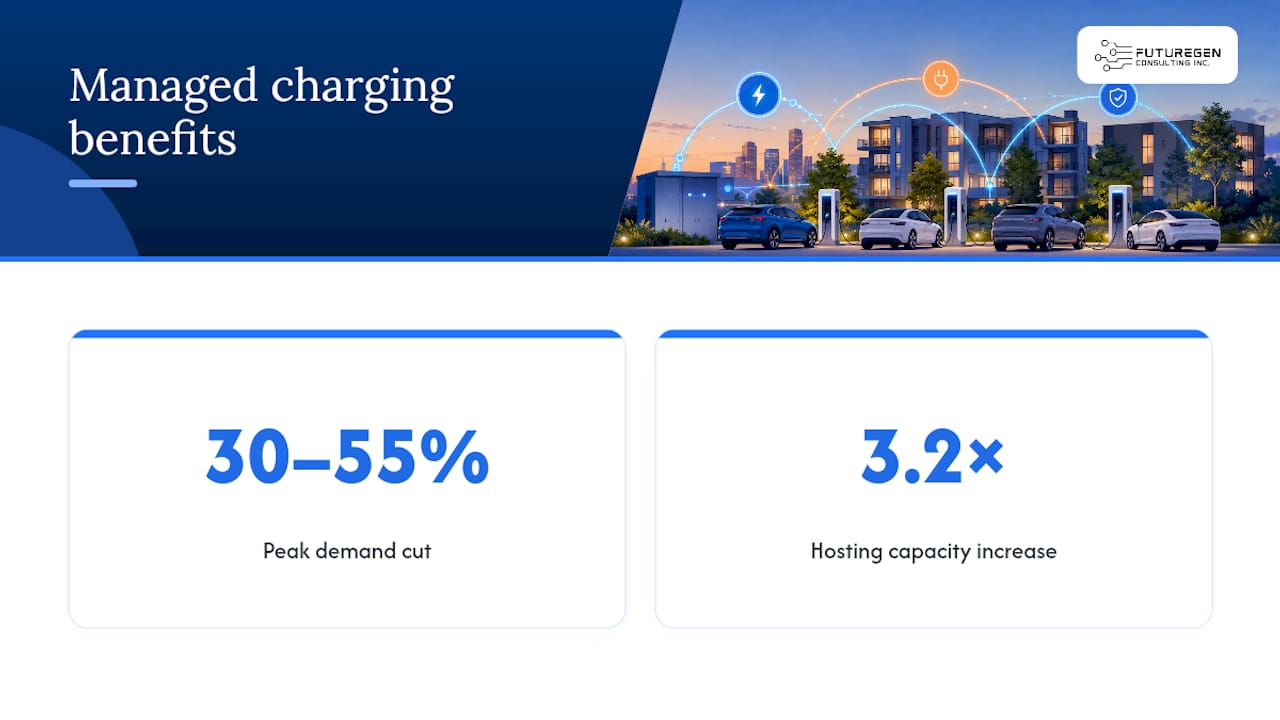
Active managed charging can reduce peak EV charging demand by roughly 30% to 55% compared to uncontrolled charging, a figure that changes the math on nearly every multi-charger project.
Key Takeaways
EV charger load management works by monitoring real-time electrical capacity and allocating it across chargers, which under CE Code Rule 8-106 can reduce calculated load and avoid a service upgrade entirely.
| Point | Details |
|---|---|
| Confirm the code hook first | CEC Rule 8-106(10) and 8-106(11) determine whether your EVEMS qualifies for demand-factor relaxation. |
| Match monitoring to CT placement | Service or feeder-level CTs under Rule 8-500 can allow greater load exclusion than branch-level monitoring. |
| Verify certification | Only an EVEMS certified to CSA C22.2 No. 343 reliably satisfies inspectors reviewing load-relaxation eligibility. |
| Expect real savings, not marginal ones | Managed charging can cut peak demand 30% to 55% and raise hosting capacity up to roughly 3.2 times in studied cases. |
| Engage engineering support early | Futuregenconsulting provides stamped load calculations, permit-ready drawings, and commissioning oversight for EVEMS projects. |
Table of Contents
- What types of EV charger load management exist?
- What Canadian codes govern EV charger load management?
- Does EV charger load management actually reduce costs?
- How do you implement EV charger load management step by step?
- How much does EV charger load management cost?
- When is load management not necessary?
- How does FutureGen Consulting handle EV charger load management projects?
- Are networked EV charger load management systems secure?
- How does load management affect the EV driver’s experience?
- Editorial Take: What the Data Actually Supports
- Get Permit-Ready EV Charger Load Management Design
- Sources
What types of EV charger load management exist?
Two broad approaches exist, and picking the wrong one wastes money. Static (passive) load management sets a fixed ceiling on total charger output, either through breaker sizing or a programmed cap, and works well for small sites with predictable demand. It’s inexpensive but inflexible: capacity sits unused whenever fewer vehicles are charging than the system was sized for.

Dynamic load management uses current transformers (CTs) to measure real-time building load, then allocates leftover capacity to chargers as it becomes available. An Eaton white paper on EVEMS describes how this monitoring lets a dynamic EVEMS respond to fluctuating building loads rather than a fixed worst-case assumption.
Systems also split by architecture:
- Local (on-site) hardware switches or throttles circuits without external connectivity, favoring reliability over flexibility.
- Networked EVEMS, often using OCPP communications, allow remote monitoring, software updates, and reporting, but depend on connectivity and vendor support.
A single-family home with one charger rarely needs dynamic control. A workplace lot with twelve chargers on a constrained service almost always does.
What Canadian codes govern EV charger load management?
Permit approval hinges on a handful of specific code references, and missing one causes rework.
- CEC Rule 8-106(10) and 8-106(11) permit demand-factor relaxations for EV supply equipment when a qualifying EVEMS controls it. Depending on the monitoring configuration, EVSE loads can be counted at the EVEMS maximum output or, in some cases, excluded from calculated load entirely.
- Rule 8-500 governs monitoring points, fail-safe behavior, and CT placement. Whether CTs sit at the branch circuit or at the service/feeder level determines whether EVSE loads must be counted at full nameplate rating or can be reduced, a distinction the Electrical Safety Authority’s bulletin spells out directly.
- CSA C22.2 No. 343 standardizes EVEMS design, manufacturing, and testing. An EVEMS that isn’t certified to this standard generally won’t satisfy an inspector looking for load-relaxation eligibility.
Permit submittals typically require sealed load calculations, an EVEMS verification protocol from the manufacturer, and posted signage identifying the system and its fail-safe state. Technical Safety BC’s bulletin confirms many EVEMS installations need sealed engineering submissions and documented testing before acceptance. Contact the AHJ and utility early. A load calculation submitted without prior utility sign off is one of the most common causes of permit delay.
Does EV charger load management actually reduce costs?
The evidence is specific, not aspirational. Active managed charging systems can cut peak EV charging demand by 30% to 55% and increase hosting capacity by up to roughly 3.2 times in studied scenarios. That kind of hosting-capacity gain is what lets a property add a dozen chargers to a service that, on paper, looked full.
Lower peak demand also reduces demand charges on commercial utility bills and, in many cases, defers a transformer or service upgrade by years. Sites with better charger availability see fewer complaints from tenants or fleet drivers competing for the same limited amperage. Load management also plays well with solar and battery storage, since the same monitoring architecture that allocates grid capacity can prioritize on-site generation first.
Pro Tip: If your site has just one charger and ample spare service capacity, a full EVEMS may deliver only marginal savings. Match the investment to the number of chargers and the tightness of your existing capacity, not to the technology’s ceiling.
How do you implement EV charger load management step by step?
- Audit the site. A licensed electrician or engineer measures existing service capacity, feeder loading, and demand profile, and forecasts future charger growth.
- Choose your approach. Decide between a fixed-rating EVEMS, an integrated dynamic EVEMS, or simple charger-level controls, based on charger count and headroom.
- Engage the AHJ and utility. Submit preliminary load calculations and confirm what documentation the inspector and utility will require before ordering equipment.
- Install with monitoring in mind by exploring tools built for domestic EV charger installers to streamline your workflow. CT placement, communications wiring, and fail-safe settings need to match what the sealed drawings specify, not what’s convenient on installation day.
- Commission and verify. Run the manufacturer’s verification protocol, document test results, and post required signage before final inspection.
Pro Tip: Ask your EVEMS vendor for their verification protocol and fail-safe documentation in writing before your engineer finalizes stamped drawings. This single request eliminates most of the back-and-forth that stalls permit approval.
Property owners planning new construction or major renovation should also review EV charger infrastructure design options early, since conduit and panel space are far cheaper to add before walls close up.
How much does EV charger load management cost?
Cost depends on how close your existing service sits to its ampacity limit, not on the number of chargers alone. Compare your panel’s spare capacity against the combined nameplate rating of the chargers you want, remembering that continuous-load rules typically require sizing at 125% of the charger’s rated current.
- EVEMS hardware and CTs generally cost far less than a full service or panel upgrade.
- Labor for retrofitting CTs at the service or feeder is a major cost driver, especially in older buildings with limited panel access.
- Utility connection upgrades, when unavoidable, are usually the single largest line item in the entire project.
A full service upgrade becomes unavoidable when spare capacity is close to zero, when the existing panel has no room for added breakers, or when the utility transformer itself is already near its rated load. A twelve-unit condo garage adding eight chargers to a service with 40 amps of headroom is a clear EVEMS candidate. That same garage with only 5 amps of headroom is a service-upgrade project regardless of what software gets layered on top.
When is load management not necessary?
Not every site needs an EVEMS, and forcing one onto a simple project wastes budget.
- A single home with one charger and confirmed spare service capacity often needs nothing more than time-of-use scheduling or a charger set to a lower current draw.
- App-connected “smart” chargers that only offer scheduling, without service or feeder-level monitoring, generally won’t satisfy CE Code relaxation requirements on their own.
- Short-term or low-utilization deployments, such as a single guest charger at a small commercial site, are often better served by reservation systems or a portable charging solution than a full EVEMS build-out.
How does FutureGen Consulting handle EV charger load management projects?
FutureGen Consulting’s approach to EV charger load management centers on permit-ready deliverables, not just equipment specification. A typical project includes a site assessment, stamped load calculations, permit-ready drawings, and commissioning supervision to confirm the installed EVEMS performs as documented.
- FutureGen coordinates directly with the AHJ and local utility during design, reducing the rework that comes from submitting drawings before capacity constraints are confirmed.
- Common pitfalls the firm flags on review include insufficient CT monitoring points, reliance on non-certified “smart” chargers marketed as EVEMS, and missing signage or verification testing at commissioning.
- Each of these gaps is addressed at the design stage, before equipment is ordered, which is where most costly permit rejections originate.
Owners considering EV charger infrastructure design work benefit from having these deliverables scoped before a contractor is engaged.
Are networked EV charger load management systems secure?
A networked EVEMS communicates constantly: charger status, current draw, user schedules, and sometimes billing data flow between chargers, a local controller, and a cloud dashboard. That connectivity is what makes dynamic allocation possible, and it also introduces risk that a static, hardware-only system doesn’t carry.
The most immediate concern is availability, not just data theft. If a cloud-connected EVEMS loses its connection to the vendor’s servers, the fail-safe behavior specified during commissioning determines whether chargers default to a safe reduced current or shut down entirely. This is why Rule 8-500 verification protocols matter as much for cybersecurity as for electrical safety. A system that fails open, allowing full uncontrolled current when communications drop, defeats the entire purpose of load management.
Data privacy matters most at multiunit and workplace sites, where charging schedules and usage patterns tied to individual units or employees pass through a third-party vendor’s servers. Property managers should ask vendors directly how charging data is stored, whether it’s shared with utilities or third parties, and how long records are retained. Local (on-site) systems that don’t rely on cloud connectivity avoid much of this exposure, trading some remote-monitoring convenience for a smaller attack surface.
Firmware update practices are worth scrutinizing too. An EVEMS that pushes automatic updates without local verification can introduce instability into a system your load calculations depend on. Ask any EVEMS vendor for their patch and update policy in writing as part of the same documentation package used for commissioning.
How does load management affect the EV driver’s experience?
Drivers judge a charging system by one thing: did the charger deliver a usable charge when they plugged in. Load management, done well, improves that experience by making more chargers available across the site rather than reserving full power for the first few vehicles to arrive.

A dynamic EVEMS reallocates capacity throughout the day, so a car plugged in during an overnight lull might charge faster than one plugged in during peak building demand. Most systems handle this transparently, but property managers should set expectations. Drivers accustomed to a home charger’s constant output can be surprised when a shared system throttles their session during a building’s peak load window.
Signage and basic user communication matter more than most property owners expect. A short posted explanation of how shared capacity works, and why charging speed might vary by time of day, resolves most driver complaints before they start. Reservation or scheduling features, where the EVEMS supports them, reduce the frustration of arriving to find every charger occupied by a vehicle that finished charging hours ago.
The tradeoff is real but manageable: a site with load management serves more vehicles overall, even if any single session occasionally charges slower than an unconstrained charger would. For workplace and multiunit sites, that tradeoff almost always favors more total availability over uncapped speed for a few.
Editorial Take: What the Data Actually Supports
Most guidance on this topic treats EVEMS as a technology decision. It isn’t. It’s a documentation decision that happens to require technology. The Canadian Electrical Code doesn’t reward clever hardware. It rewards a paper trail: sealed load calculations, a verification protocol from a certified vendor, CTs placed where Rule 8-500 expects them, and signage that matches what was actually installed.
The conventional advice to “install a smart charger with an app” undersells how specific Rule 8-106’s relaxation criteria are. A charger that schedules sessions is convenience. A charger monitored at the service or feeder level, with documented fail-safe behavior tied to a CSA C22.2 No. 343 certified EVEMS, is a code-compliant load-relaxation strategy. Those are different products solving different problems, and conflating them is the single most common reason permit reviews stall.
If you take one thing from this guide, prioritize the AHJ and utility conversation before you buy anything. Every other decision, static versus dynamic, local versus networked, follows from what your service capacity and inspector will actually accept.
Get Permit-Ready EV Charger Load Management Design
Futuregenconsulting is the practical route to a permit-ready EVEMS installation, without the guesswork of matching vendor marketing claims to what your local AHJ will actually accept. The firm delivers stamped load calculations, sealed permit drawings, and commissioning supervision as a single coordinated package, so the CT placement, fail-safe documentation, and signage requirements are settled before equipment gets ordered rather than discovered during inspection.

This fits property owners and managers who need a defensible engineering record behind their EVEMS, whether that’s a twelve-unit condo garage adding shared chargers or a commercial lot deferring a service upgrade through demand-factor relaxation. Review what MEP engineering covers for your project, or reach out to scope a site assessment and load calculation before your next permit submission.
Sources
- Electricalindustry
- Brattle Group report on managed EV charging impacts
- Electricalindustry
- Information Bulletin: EVSE and EVEMS (Technical Safety BC)