
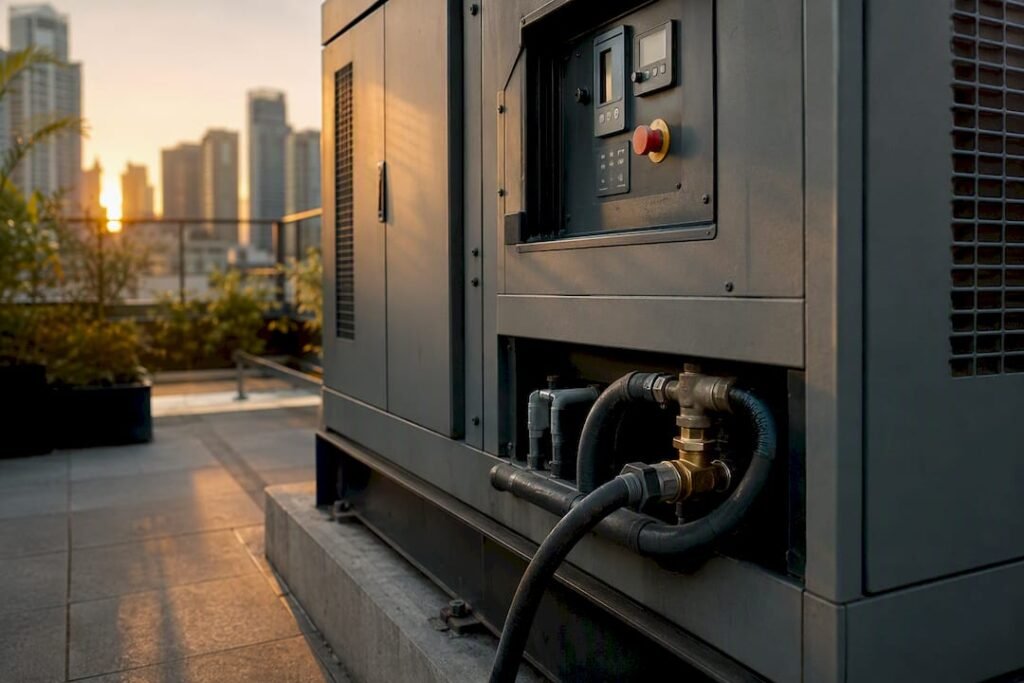
An installed commercial generator in Ontario runs from roughly $1,500 to $4,000 for a portable unit with a manual interlock, $6,500 to $15,000 for a small standby system on essential circuits, $20,000 to $50,000 for mid-size standby coverage, and $50,000 to well over $250,000 for large commercial or emergency systems tied into utility infrastructure. These figures are illustrative Ontario market benchmarks, not fixed quotes, and every range excludes HST unless a contractor states otherwise.
Before you request a single proposal, get a P.Eng.-stamped load calculation. It determines which of these bands actually applies to your facility, and it is the one document that keeps an installer’s quote honest.
- Portable + manual interlock: low-cost range installed
- Small standby systems: moderate range installed
- Mid-size standby systems: higher mid-range installed
- Large commercial/emergency systems: high cost ranges depending on utility connection scope
Key Takeaways
Ontario commercial generator costs scale from roughly $1,500 for portable units to $250,000 or more for large facility-wide systems, and the load calculation determines which band applies before any contractor quote means anything.
| Point | Details |
|---|---|
| Price bands by size | Portable ($1,500–$4,000), small standby ($6,500–$15,000), mid-size ($20,000–$50,000), and large commercial ($50,000–$250,000+) installed. |
| ESA review triggers cost | Installations over 10 kW in parallel or tied to life-safety systems require ESA plan review before work starts. |
| Utility connection is a wildcard | Hydro One’s own Class C estimates carry plus or minus 50 percent accuracy for larger DER connection costs. |
| Two quotes, same kW, different scope | Compare itemized equipment, labor, panel work, and commissioning before judging price on the total alone. |
| Design first, then bid | Futuregenconsulting’s P.Eng.-stamped load calculations and cost estimates lock in scope before contractors quote, reducing overrun risk. |
Table of Contents
- Commercial Generator Cost in Ontario by Size and Load
- What Makes Two Quotes for the Same Generator Look So Different
- Ontario Regulatory Steps That Affect Your Budget and Timeline
- What an Installed Quote Breaks Down Into, With Sample Budgets
- Who to Hire and How Long the Project Takes
- FutureGen’s Checklist for Avoiding Generator Budget Overruns
- Why the Generator Itself Is Rarely the Real Cost Driver
- Get a P.Eng.-Stamped Generator Design Before You Quote Contractors
- Sources
Commercial Generator Cost in Ontario by Size and Load
The size tier you land in depends less on square footage than on what you’re actually trying to keep running. A restaurant protecting walk-in coolers and point-of-sale terminals needs a fraction of the capacity that a medical clinic or a manufacturing line requires, and pricing scales accordingly.
Portable units with a manual transfer switch sit at the low end, typically $1,500 to $4,000 installed. You get a gas or diesel unit you wheel out and connect manually during an outage. The trade-off is obvious: someone has to be on-site to start it, and it won’t run life-safety loads unattended. Fine for a small retail shop; risky for anything with refrigerated inventory or after-hours occupancy.
Small standby systems (7–15 kW) cover essential circuits automatically through an automatic transfer switch, or ATS. Expect $6,500 to $13,000 installed for a straightforward job, closer to $15,000 once gas-line routing or panel work gets involved. This tier typically powers lighting, refrigeration, a few outlets, and basic security systems for a small office, café, or retail location.
Mid-size standby systems (20–50 kW) are where most multi-tenant commercial buildings, medical offices, and light industrial operations land. Installed costs generally fall between $20,000 and $50,000. At this size, facilities often need partial building coverage rather than full-load backup, and the equipment cost starts competing with site work for the bigger share of the budget.
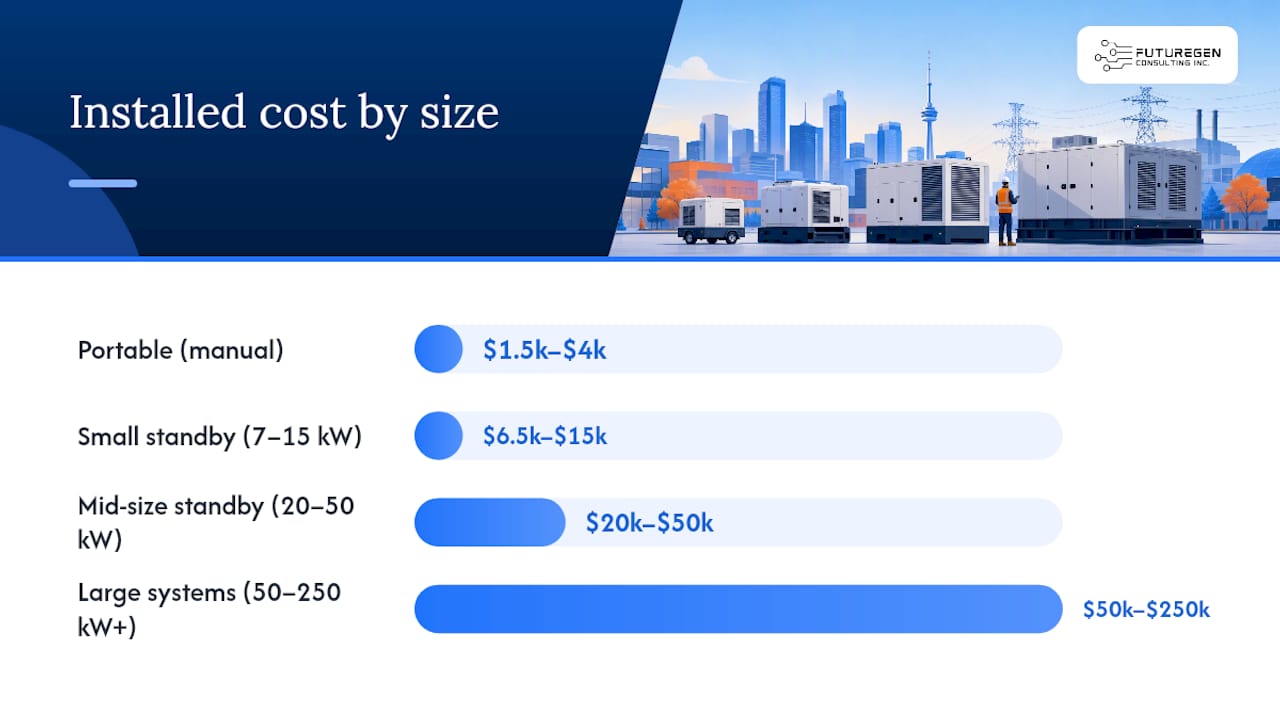
Large commercial and emergency systems (50–250 kW and up) serve full-facility backup, life-safety systems, or buildings with parallel generation requirements. Costs commonly exceed $50,000 and can climb past $250,000 once you factor in switchgear, utility coordination, and site civil work. This tier is also where the ESA and local distribution company (LDC) connection process starts driving both cost and schedule.
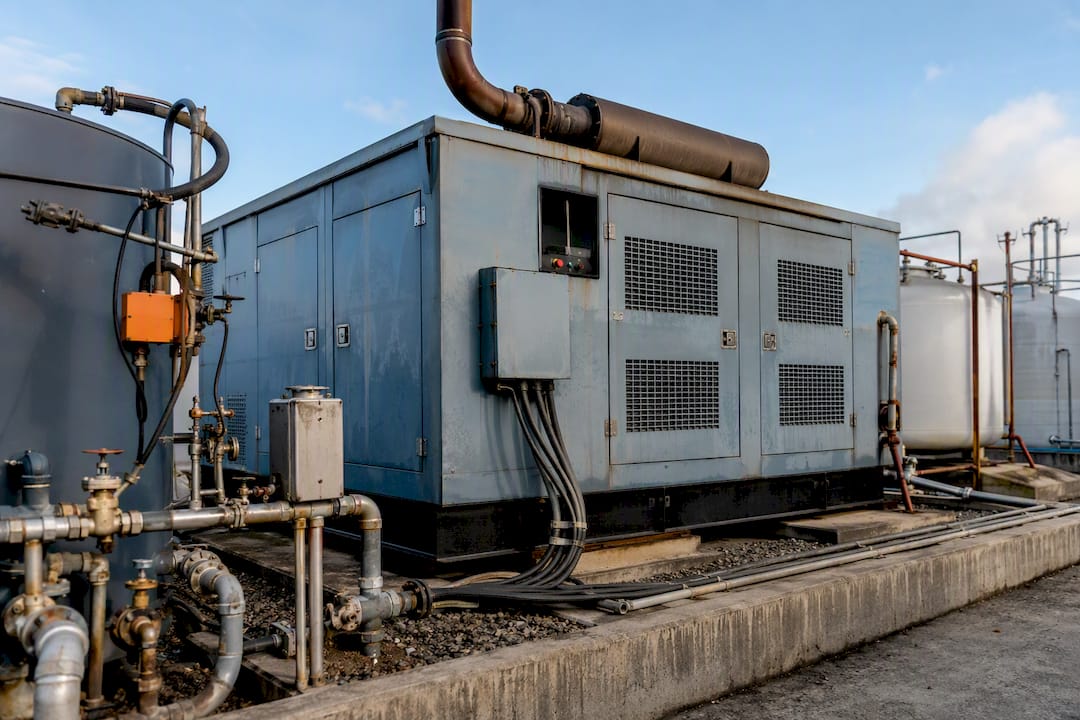
Fuel choice shifts these numbers meaningfully. Natural gas units cost less to run and eliminate on-site fuel storage, but only if a gas line is already nearby. Propane needs tank installation and periodic refills. Diesel gensets often cost less upfront per kW at larger sizes but require TSSA-compliant fuel storage and tend to derate more aggressively at altitude or in extreme cold, meaning you may need to size up to guarantee rated output.
What Makes Two Quotes for the Same Generator Look So Different
A 30 kW unit from one contractor at $28,000 and the same size from another at ARC Electrical – CloudSprout I.T & Digital Marketing Solutions at $47,000 usually isn’t a pricing scam. It’s a scope difference, and most business owners never ask the right questions to find it.
- Equipment versus labor split. The generator cabinet itself is often less than half the total cost. The ATS, control panel upgrades, and concrete pad frequently account for the larger share once installation begins.
- Electrical service capacity. If your building’s existing service can’t support the new load, a 100A to 200A panel upgrade adds thousands before the generator even gets connected.
- Fuel supply distance and complexity. A gas line 20 feet from the unit costs far less to trench and connect than one running 150 feet under pavement, and any fuel-related work must go through a TSSA-registered contractor.
- Noise and enclosure requirements. Some Ontario municipalities enforce nighttime noise limits around 45 dBA at the property line, which can force a sound-attenuated enclosure or a less convenient placement that adds trenching cost.
- Sizing accuracy. An oversized unit wastes capital; an undersized one fails when you need it most. Both stem from skipping a proper load calculation.
- Commissioning and service contracts. Load bank testing, warranty terms, and maintenance agreements are frequently quoted as add-ons, not baseline inclusions.
Pro Tip: Ask every bidder to itemize equipment, labor, electrical tie-in, and commissioning as separate line items. A contractor who won’t break down the quote is usually the one hiding the weakest number.
Ontario Regulatory Steps That Affect Your Budget and Timeline
Ontario’s approval chain is where generator projects most often blow past their original budget, mainly because business owners don’t realize how many parties need to sign off before installation can start.
Any generation installation operating in parallel with the utility above 10 kW, or tied into a life-safety system, triggers mandatory ESA plan review under the Ontario Electrical Safety Code. Plans and fees go through the ESA’s Electronic Permit and Reporting portal, and the review has to happen before installation, not after. If your project involves fuel piping (natural gas, propane, or diesel), the work must be performed or supervised by a TSSA-registered fuel contractor, governed under Ontario Regulation 215/01.
For larger or grid-connected systems, expect a Connection Impact Assessment from your local distribution company or Hydro One. Hydro One’s own guidance flags these estimates as Class C, meaning accuracy of only plus or minus 50 percent on connection cost projections for distributed energy resource projects, so a preliminary number is a planning figure, not a ceiling.
- Municipal electrical and gas permits, typically a few hundred dollars combined
- ESA plan review fees for parallel or life-safety-connected systems
- LDC or Hydro One CIA fees for larger DER projects
- Submit plans early: review queues routinely add weeks to a project timeline
What an Installed Quote Breaks Down Into, With Sample Budgets
A total installed price is really a stack of separate cost items, and seeing them broken out helps you judge whether a quote is complete or missing pieces.
- Generator cabinet and enclosure
- Automatic transfer switch (ATS)
- Concrete equipment pad
- Gas or fuel line hookup
- Electrical tie-in and panel work
- Permits and plan review fees
- Commissioning and load testing
- Landscaping or sound screening
A documented 16 kW turnkey installation in the Toronto area came in around $11,100 to $14,800, with the range driven almost entirely by gas-line length and the condition of the existing electrical panel.
Sample A: Small commercial, essential circuits (12–22 kW). Natural gas already nearby, minimal site prep, straightforward panel tie-in. Expect roughly $10,000 to $18,000 installed.
Sample B: Mid-size commercial (50–150 kW). Requires ESA plan review, possible panel upgrade, and coordination with the local distribution company. Budget $50,000 to $120,000, with connection fees as a variable add.
Sample C: Micro-embedded DER up to 250 kW. Involves a full Connection Impact Assessment. Hydro One’s own indicative ranges for these connection scopes carry that same plus-or-minus 50 percent uncertainty, so treat any early number as a placeholder pending the utility’s final study.
Who to Hire and How Long the Project Takes
A generator project has four distinct roles, and skipping one is how projects end up mid-installation with no clear approval path.
- A P.Eng. designer produces the load calculation and stamped drawings that ESA plan review requires.
- An ESA-licensed electrical contractor performs the tie-in, panel work, and ATS installation.
- A TSSA-registered fuel contractor handles any gas, propane, or diesel fuel supply work.
- A civil contractor builds the pad, trenching, and any enclosure or screening.
Ask every candidate for stamped drawings, written confirmation of ESA plan review status, TSSA registration proof, and a scope document with a schedule attached.
Timeline typically runs four to eight weeks for design and plan review, two to twelve weeks for permitting and utility coordination depending on your LDC’s queue, and one to four weeks for physical installation and commissioning. Build in contingency; utility coordination is the stage most likely to slip.
Pro Tip: Start the LDC or Hydro One conversation the same week you commission your load calculation, not after design is finished. Utility queues rarely move faster because your drawings are ready.
FutureGen’s Checklist for Avoiding Generator Budget Overruns
Most cost overruns on Ontario generator projects trace back to one decision: treating the generator as a purchase rather than a system integration project. A load calculation aligned with CSA C282, the National Standard of Canada for emergency electrical power supply to buildings, catches sizing errors before they become change orders. Pairing that with a detailed electrical construction cost estimate clarifies contingency and procurement sequencing before you sign a contract.
Before hiring anyone, request:
- P.Eng.-stamped load calculation and single-line drawings
- Written confirmation of the ESA and municipal permitting path
- A role matrix naming who handles electrical, fuel, and civil work
- A commissioning and load bank testing plan with sign-off criteria
Why the Generator Itself Is Rarely the Real Cost Driver
Most Ontario business owners budget for the generator and treat everything else as an afterthought. That’s backward. The unit is often the most predictable line item on the quote; the utility connection, the panel condition, and the fuel routing are where the actual risk sits, and they’re the pieces contractors are least likely to flag upfront.
The conventional advice, get three quotes and pick the middle one, falls apart here because generator quotes at the same kW rating routinely reflect wildly different scopes. A $28,000 quote and a $47,000 quote for the same nameplate capacity aren’t really comparable numbers unless you know whether both include panel upgrades, ATS specification, and commissioning testing.
If there’s one place readers consistently underinvest, it’s the load calculation itself. It’s treated as paperwork rather than as the document that determines every downstream cost. A properly engineered calculation, built to CSA C282 and cross-checked against actual critical loads, is what prevents a facility from discovering mid-installation that it needs a bigger unit or a service upgrade nobody budgeted for. Get that right first, and the rest of the process, permitting, procurement, installation, becomes far more predictable than most contractors let on.
— Sanjay
Get a P.Eng.-Stamped Generator Design Before You Quote Contractors
The single biggest lever on generator project cost isn’t the equipment, it’s getting the design and load calculation locked down before contractors start bidding. Futuregenconsulting delivers P.Eng.-stamped emergency power designs and detailed electrical construction cost estimates for Ontario commercial projects, which means your ESA plan review documentation, sizing, and budget scope are settled before procurement starts, not discovered mid-installation.

That sequencing is what separates a project that finishes on budget from one that racks up change orders after the pad is already poured. Futuregenconsulting’s emergency power design services cover the load calculation, single-line drawings, and ESA-ready documentation your electrical contractor needs to quote accurately the first time. For facilities weighing panel upgrades or complex fuel routing, the firm’s electrical construction cost estimation work gives you a real number to budget against before you sign with an installer. If you’re planning a commercial generator project in Ontario, request a load calculation and design scope from Futuregenconsulting before you send out bid requests.
Sources
- ESA bulletin — Plans and specifications / Plan review requirements (Electrical Safety Authority)
- DER project connection cost guidance (Hydro One)
- Generator installation cost Ontario pricing guide (Kolji Bros. Electrical)