
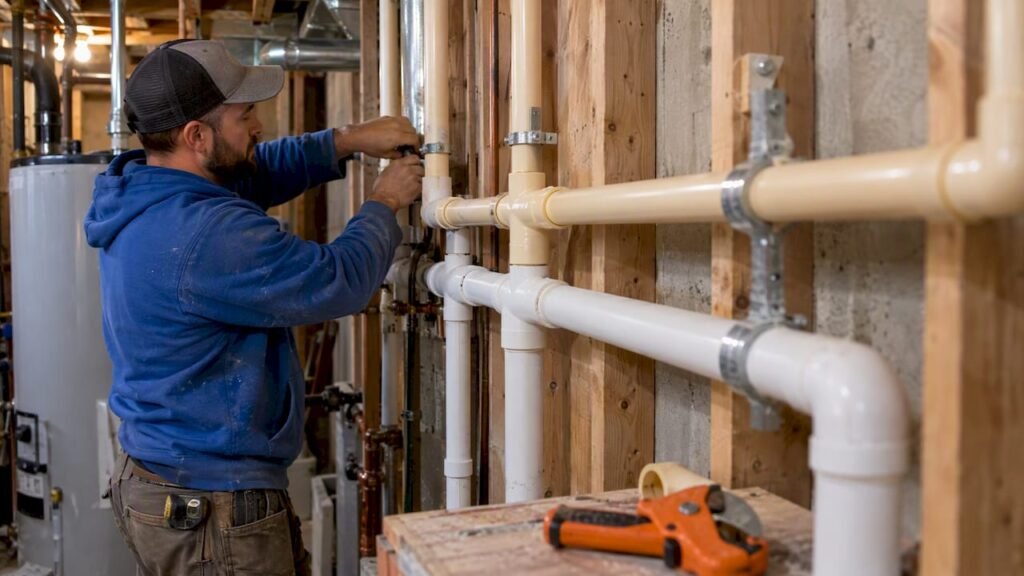
We recommend CPVC for hot potable water distribution and PVC for cold water, drain waste and vent (DWV), and irrigation lines, because CPVC’s higher heat tolerance and its permitted use under the National Plumbing Code make it the compliant choice where water runs hot. Whichever material you choose, specify only products certified to NSF/ANSI/CAN 61 for potable water contact.
TL;DR:
- PVC is suitable only for cold water, drains, and irrigation lines, with a maximum service temperature of around 60°C and lower material costs.
- CPVC is designed for hot and cold potable water, tolerates temperatures up to 82°C, and requires specific CSA standards and NSF certification, which must be checked on the pipe directly.
- Using PVC fittings on CPVC hot-water lines or mixing cement types risks joint failure due to incompatible chemical and thermal properties.
- Most CPVC failures stem from installation errors, such as wrong cement or mismatched fittings, rather than the material aging naturally.
- For larger or permit-requiring systems, engineer-stamped drawings ensure proper material selection, correct sizing, and compliance with code standards.
Table of Contents
- PVC and CPVC at a glance: the key differences
- Why temperature changes everything between these materials
- What Canadian codes require for each material
- Joining methods and where installers go wrong
- How long each pipe lasts and what shortens its life
- Is the water from these pipes safe to drink?
- How to choose between PVC and CPVC for your project
- Why pipe material selection still trips up experienced crews
- When a plumbing design needs an engineer’s stamp
- FAQ
- Sources
PVC and CPVC at a glance: the key differences
The two materials share a resin base, but their performance diverges once heat enters the picture.
| Property | PVC | CPVC |
|---|---|---|
| Maximum service temperature | Around 60°C | Up to 82°C (CSA product listing) |
| Typical working pressure at hot rating | Not rated for hot distribution | 690 kPa (100 psi) at 82°C (CSA product listing) |
| Common residential uses | Cold water supply, DWV, irrigation | Hot and cold potable water distribution |
| Joining method | Solvent weld with PVC cement | Solvent weld with CPVC-rated cement |
| Relative cost | Generally lower material cost | Generally higher material cost |
- For cold water supply, drains, and outdoor irrigation, PVC does the job at a lower material cost.
- For domestic hot water branches and risers, CPVC holds up where PVC would soften.
- Never fit a PVC component into a CPVC hot-water run: the pressure and temperature ratings do not match, and the joint will fail under thermal stress.
Why temperature changes everything between these materials
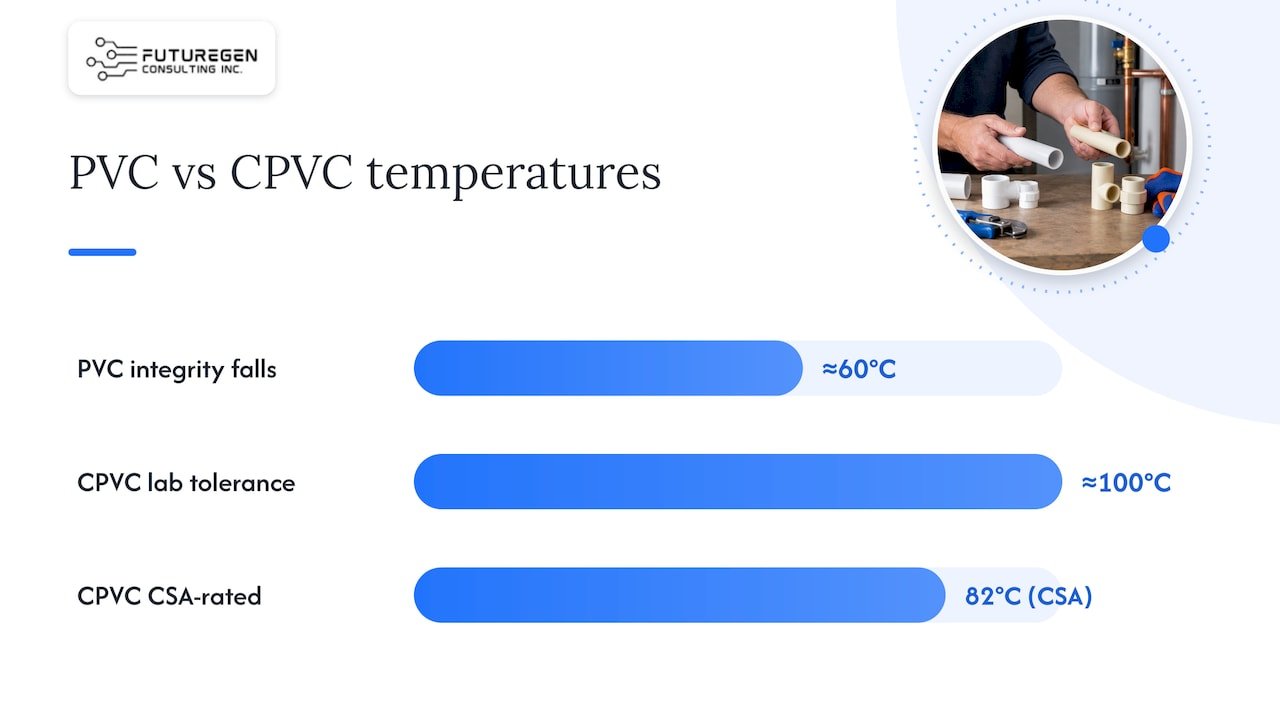
Unmodified PVC starts to lose structural integrity under sustained stress once temperatures approach 60°C, which is why codes keep it out of hot-water distribution. CPVC is produced by chlorinating PVC resin, and that process raises its working temperature ceiling substantially. Laboratory material testing has shown CPVC tolerating temperatures approaching 100°C, though the service limits set for safe working pressure are lower: CSA listings rate CPVC for operation up to 82°C at 690 kPa (100 psi) in standard configurations (CSA product listing), and that gap between lab capability and rated service limit exists specifically to preserve a safety margin under real plumbing loads (NRC technical review).
The chlorination that gives CPVC its heat resistance also makes it stiffer than PVC and more prone to thermal expansion over long hot-water runs, which affects hanger spacing and support intervals. Chemical resistance differs too: both materials resist most household chemicals, but strong solvents, certain cleaning compounds, and some petroleum-based products can degrade PVC and CPVC differently, so manufacturer compatibility charts should guide any run exposed to chemical process areas.
What Canadian codes require for each material
The National Plumbing Code of Canada restricts PVC to cold-water and DWV applications, while CPVC is permitted for both hot and cold potable water distribution. The governing standards are specific about scope and ratings, and confirming compliance starts with the standard reference, not the pipe color alone.
- CSA B137.6 sets allowable sizes, schedules, and maximum working temperatures and pressures for CPVC pipe, tubing, and fittings used in hot and cold distribution (standards references).
- CSA B181.2 covers PVC and CPVC for drain, waste, and vent applications, with its own sizing and application scope (standards references).
- NSF/ANSI/CAN 61 certifies that a potable-water component meets chemical leaching limits, and the certification mark should appear printed on the pipe itself (NSF/ANSI/CAN 61 certification).
Look for the standard number, pressure rating, and certification stamp printed directly on the pipe wall before installation, not just the product packaging.
Joining methods and where installers go wrong
Both materials join by solvent welding, but the cements are not interchangeable. PVC cement is formulated for PVC’s chemistry, while CPVC requires a CPVC-rated cement that bonds properly to the chlorinated resin and holds up under the higher service temperature. Using the wrong cement, or mixing a PVC fitting onto a CPVC hot-water line, creates a joint that looks sound on installation day and fails months later once it cycles through heat repeatedly.
- Confirm the pipe and fitting stamps match: CPVC is typically a cream, yellow, or off-white color, while PVC is usually white or gray, though color alone should never replace reading the printed standard.
- Apply primer where specified and the correct solvent cement, then allow the manufacturer’s stated cure time before pressure testing.
- Where transitioning to copper, metal, or PEX, use a rated transition fitting and account for CPVC’s greater thermal expansion with proper support spacing along the run.
- Pressure test the completed system before closing in walls or ceilings, following the method your local authority accepts.
Pro Tip: Keep a sample offcut of whichever pipe you install on site so inspectors and future contractors can confirm the material at a glance.
How long each pipe lasts and what shortens its life
Both materials can last decades in residential service when installed correctly, but their failure patterns differ. PVC exposed to prolonged UV or used outside its cold-water scope becomes brittle and cracks under impact. CPVC installed with the wrong cement, or stressed by heat cycling beyond its rating, tends to fail at the joint first rather than along the pipe body. Material cost for CPVC runs higher than PVC, and installed cost reflects that difference, though the gap narrows once labor and fitting counts are factored in for a typical hot-water branch.
Is the water from these pipes safe to drink?
Older PVC pipe, particularly stock manufactured before 1977, can carry higher residual vinyl chloride and may leach measurable concentrations into standing water (Health Canada technical document). Modern products certified to NSF/ANSI/CAN 61 are manufactured and tested to limit chemical leaching to levels acceptable for potable use (NSF/ANSI/CAN 61 certification), which is why certification matters more than brand or price when selecting components for a drinking water line.
- Select only pipe and fittings carrying the NSF/ANSI/CAN 61 mark for any potable water application.
- Flush a newly installed system thoroughly before putting it into regular domestic use.
- If you find pre-1977 PVC pipe during a renovation, treat replacement as a priority rather than an optional upgrade, and consider having any surrounding older insulation or wrap assessed for hazardous materials before demolition begins.
How to choose between PVC and CPVC for your project
Work through a short checklist before specifying either material, since the decision usually comes down to temperature, code scope, and what the pipe connects to.
- Identify whether the line carries hot or cold water: hot distribution needs CPVC or copper, cold distribution can use PVC.
- Check the temperature and pressure the line will actually see in service, not just at installation.
- Confirm the product carries the correct CSA standard number and NSF/ANSI/CAN 61 certification for its intended use.
- Check compatibility with existing plumbing in the building before tying in a new run.
- Compare installed cost, not just material cost, once fittings and labor are included.
For irrigation or outdoor cold-water lines, PVC is the straightforward choice. For domestic hot-water branches, CPVC or copper both work, with the choice often coming down to local pricing and installer familiarity. Drains and vent stacks remain PVC territory under CSA B181.2. Where a project involves mixed-material systems, a large commercial hot-water distribution network, or permit documentation for a municipal authority, bringing in a mechanical engineer earlier avoids rework once inspection begins. For context on sizing the hot-water side of that decision, see our guide to domestic hot water sizing, and for drainage runs where PVC is standard, our storm drainage design resource covers the compliance side.
Why pipe material selection still trips up experienced crews
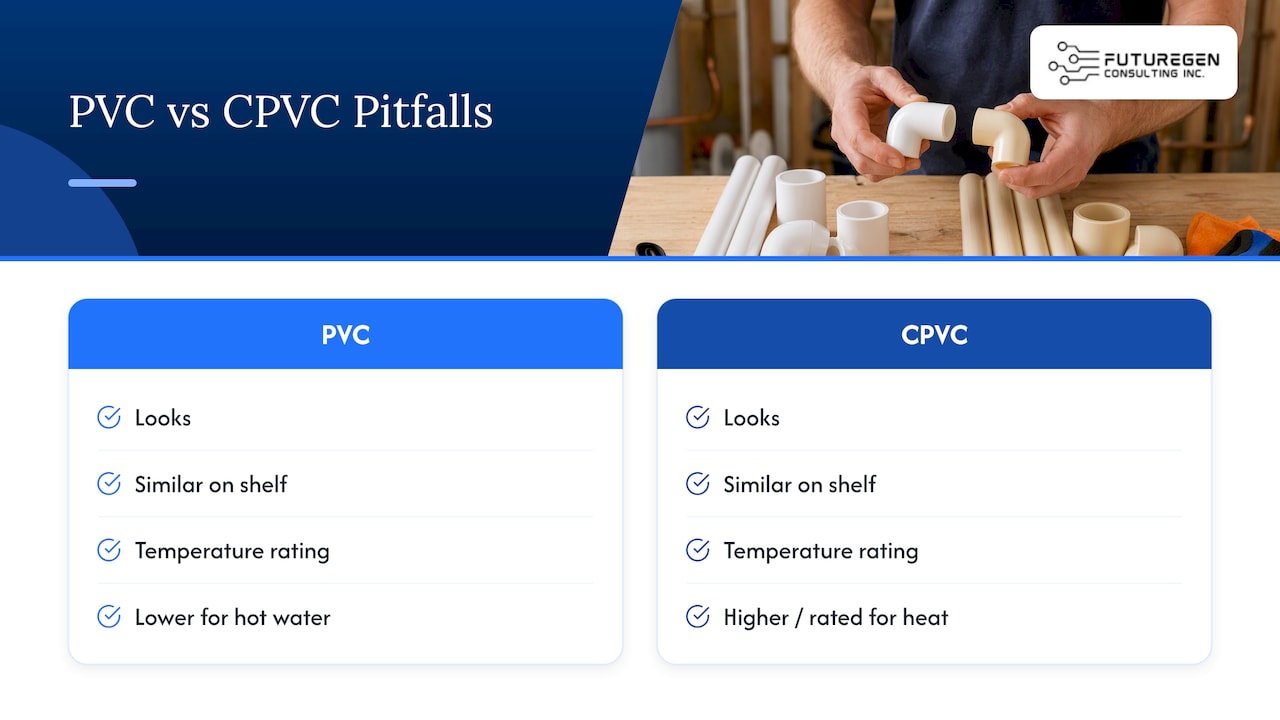
Plastic pipe looks interchangeable on a supply shelf, and that assumption causes more call-backs than almost any other plumbing mistake we see referenced in code enforcement discussions. The real failure point is rarely the pipe itself: it is a fitting swapped in from the wrong bin, a cement tube grabbed without checking the label, or a hot branch run in PVC because nobody flagged the temperature requirement before the walls closed in. Cost-driven substitution is the quiet culprit behind a large share of plastic pipe failures, and it almost always traces back to someone treating PVC and CPVC as the same product with a different price tag.
The standards exist precisely because the materials are not interchangeable, and the gap between “looks fine on install day” and “fails at year three” is exactly where temperature rating and certification do their work. Reading the stamp on the pipe takes thirty seconds and prevents a problem that takes a demolished wall to fix.
— Sanjay
When a plumbing design needs an engineer’s stamp
A straightforward pipe swap rarely needs a design engineer, but a multi-unit hot-water distribution system, a commercial build with mixed materials, or any project requiring permit-ready documentation benefits from engineered drawings rather than field judgment alone. Our Plumbing System Design Services deliver permit-ready, engineer-stamped drawings with code compliance built in from the first layout, along with field review during construction to catch material mismatches, incorrect sizing, and non-compliant joints before they become inspection failures.

- Drawings identify the correct pipe material and rating for every run, hot and cold.
- Construction progress is reviewed against the stamped design, not just the original permit set.
- Coordination with contractors and municipal reviewers helps keep approvals moving.
If your next project involves a hot-water distribution system, a mixed-material retrofit, or permit documentation for a developer or property manager, request a plumbing design consultation and get drawings built around the code requirements that apply to your build.
FAQ
What’s better, CPVC or PVC?
Neither material is universally better: CPVC suits hot potable water distribution because of its higher temperature rating, while PVC suits cold water supply, drains, and irrigation where its lower cost and adequate performance make more sense.
Can you use PVC fittings on CPVC pipe?
No, PVC fittings should not be used on CPVC hot-water lines, since the two materials require different solvent cements and PVC fittings are not rated for CPVC’s service temperature. Mixing them risks a joint failure once the line cycles through hot water repeatedly.
How to tell if a pipe is PVC or CPVC?
Check the stamp printed on the pipe wall for the material name and standard number, such as CSA B137.6 for CPVC, rather than relying on color alone. CPVC commonly appears cream, yellow, or off-white, while PVC is typically white or gray, though the printed marking is the reliable confirmation.
How many years will CPVC last?
CPVC can last decades in residential service when installed with the correct cement and kept within its rated temperature and pressure limits. Most failures trace back to installation errors, such as mismatched fittings or wrong cement, rather than the material aging out on its own.
Sources
- Standards references (CSA B137.6, CSA B181.2) — National publications archive
- Vinyl chloride and drinking water — Health Canada technical document
- NSF/ANSI/CAN 61 certification information
- Technical review: thermoplastics used in piping — NRC Publications