
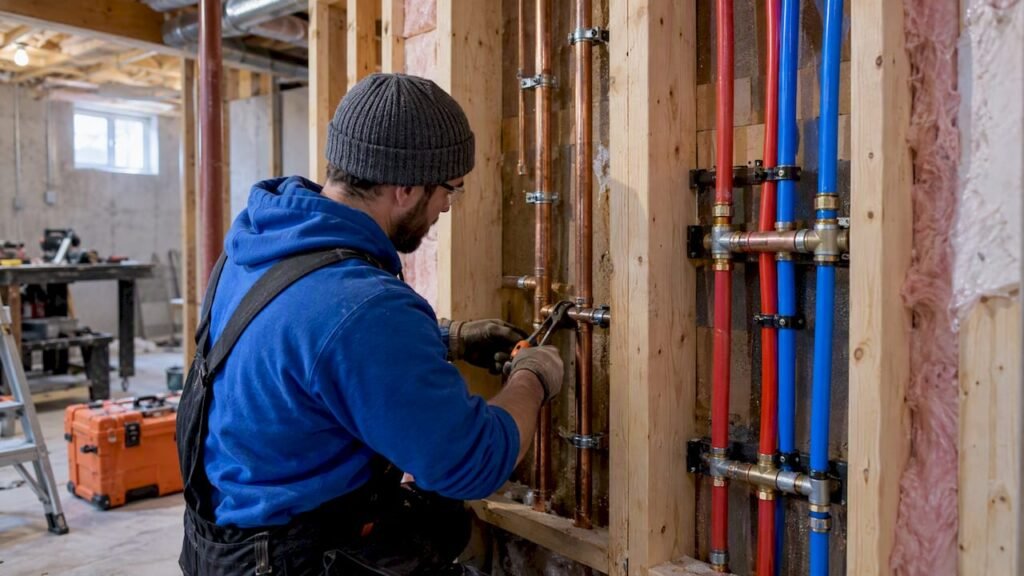
For most homeowner repipes, PEX is the practical choice: it costs less, installs faster, and resists the corrosion that eventually causes copper to pit and leak. Copper still earns its place on exposed mechanical runs, high-temperature loops near boilers, and anywhere UV exposure or visible finish work matters. Both materials are accepted under the National Plumbing Code of Canada (NPC) 2020 when products meet the applicable standards and installation is done correctly.
TL;DR:
- PEX is the preferred choice for most concealed residential plumbing due to its lower cost, faster installation, and resistance to corrosion.
- Copper is better suited for exposed mechanical systems, high-temperature loops, and areas where UV exposure occurs.
- Water chemistry influences lifespan: aggressive water can cause copper pitting in months or years, while PEX remains unaffected by corrosion.
- Proper installation and product certification (CSA B137.5) are crucial for code compliance, especially in large or complex projects requiring permits.
- Testing water for copper levels is advisable in older homes or well water setups, with flushing or treatment as potential solutions for elevated copper.
Table of Contents
- Copper vs PEX at a Glance
- What Copper and PEX Actually Are
- Durability, Corrosion, and Failure Modes
- Installation Effort and Real-World Cost
- Copper, Drinking Water, and When to Test
- Canadian Codes and What to Look For on the Product
- A Practical Checklist for Deciding
- An Engineer’s Note on Material Selection
- DIY or Call a Professional?
- When a Repipe Needs an Engineer’s Plan
- FAQ
- Sources
Copper vs PEX at a Glance
Before deciding, it helps to see the tradeoffs side by side. Material cost, labor, and failure risk all shift depending on where the pipe runs and what the water is like.
- Material cost: copper generally costs more per linear foot than PEX, and the price gap widens with copper market swings.
- Labor method: copper requires soldering (open flame, flux, and careful joint prep); PEX uses crimp, clamp, or expansion fittings that install faster, as detailed in the PEX Plumbing Design and Installation Guide.
- Corrosion behavior: copper can pit and develop pinhole leaks in aggressive water chemistry; PEX does not corrode.
- Freeze resistance: PEX flexes slightly under freeze pressure and is less likely to split than rigid copper.
- Temperature limits: copper handles higher sustained temperatures, which matters near boilers and some mechanical equipment.
- Typical use case: PEX for concealed, whole-house, and radiant distribution; copper for exposed mechanical rooms and high-heat zones.
Health Canada reminder: the guideline value for copper in drinking water sets a maximum acceptable concentration (MAC) of 2 mg/L and an aesthetic objective (AO) of 1 mg/L, a figure worth keeping in mind before assuming older copper plumbing is automatically a health problem, according to Health Canada’s copper guidance.
What Copper and PEX Actually Are
Copper pipe for residential plumbing usually comes in Type L or Type K, with Type L being the common wall thickness for most home water lines and Type K reserved for underground or higher-pressure applications. PEX is cross-linked polyethylene, a flexible plastic tubing sold in three main types based on how the crosslinking happens: PEX-A, PEX-B, and PEX-C, each with slightly different flexibility and fitting compatibility.
- Copper (Type L/K): rigid metal tubing, joined by soldering or mechanical fittings, standard in older homes.
- PEX-A: the most flexible type, often paired with expansion fittings; tolerant of tight bends.
- PEX-B: slightly stiffer, typically joined with crimp or clamp rings; widely available and cost-effective.
- PEX-C: straight-length tubing, less common in whole-home jobs, mainly used for fixed runs.
Both materials come in equivalent nominal sizes, so a 1/2 inch or 3/4 inch run can generally be matched size-for-size during a swap. The practical difference shows up in handling: PEX is dramatically lighter and can be snaked through walls and joists in long continuous runs, while copper’s rigidity demands more elbows, fittings, and precise measurements.
Durability, Corrosion, and Failure Modes
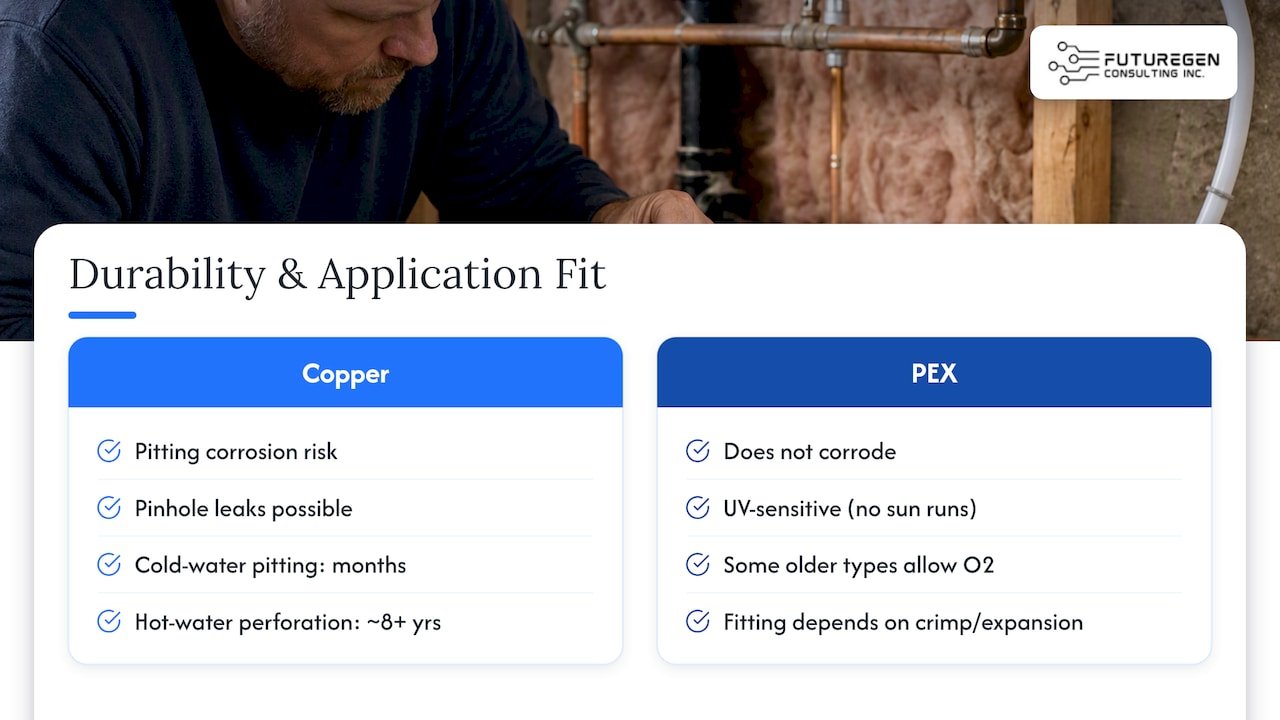
Copper’s main long-term risk is pitting corrosion, a localized attack that can perforate pipe walls and cause pinhole leaks. The water-chemistry drivers behind this include low pH, low alkalinity, and high dissolved oxygen, conditions more common in some well water and softened water systems. Pitting can develop in cold-water lines within months under aggressive conditions, while hot-water line perforation typically takes longer, often eight years or more depending on water chemistry, according to Health Canada’s technical consultation document on copper.
PEX does not corrode, since it is a polymer rather than a metal, which removes pitting and pinhole failure from its risk profile entirely. Its vulnerabilities lie elsewhere: PEX degrades under prolonged direct UV exposure, so it is unsuitable for sunlit outdoor runs without protection, and some older PEX formulations allow a small amount of oxygen permeation that can matter in closed hydronic loops with ferrous components. Fitting reliability also depends on proper crimp or expansion technique rather than material fatigue.
One comparison worth flagging: there is no single best pipe for every application, since copper tolerates higher sustained temperatures and holds up better in exposed mechanical-room settings, while PEX is usually the better fit for concealed, radiant, and whole-house potable water runs, according to a technical pipe material comparison. That distinction, more than brand preference, should drive the choice on any given run.
Installation Effort and Real-World Cost
Material price is only part of the cost picture. Copper installation requires soldering skill, open-flame safety precautions, and more fittings for the same layout, which adds labor hours. PEX uses crimp rings, cinch clamps, or expansion fittings and can be run as long, continuous lengths from a central manifold, cutting down the number of joints that can eventually fail.
- Copper: higher material cost, slower installation, requires torch work and flux, more joints per run.
- PEX: lower material cost, faster installation, crimp or expansion tool required, fewer joints with manifold distribution.
- Weight difference: 100 feet of 3/4 inch PEX weighs about 10.1 pounds versus roughly 45.5 pounds for the same length of Type L copper, a gap that affects both handling and shipping, per the PEX Plumbing Design and Installation Guide.
- Lifecycle view: factor in not just the upfront material and labor but the likelihood of future repairs; copper’s corrosion risk can mean repiping sooner in aggressive water, while PEX’s main long-term cost driver is fitting quality rather than pipe degradation.
Pro Tip: Before tearing into walls, have your water tested for pH and hardness. Aggressive water chemistry changes the math on which material actually saves money over 15 to 20 years.
Permits typically apply to whole-house repipes and any work that alters fixture count or pipe sizing, so check with your local building department before starting, and if the scope touches shared walls, multi-unit systems, or older asbestos-wrapped pipe insulation, test for asbestos before renovating rather than disturbing it blind.
Copper, Drinking Water, and When to Test
Copper entering tap water almost always traces back to corrosion inside household plumbing rather than the municipal supply itself. Health Canada’s guideline sets a maximum acceptable concentration of 2 mg/L for health protection and a lower aesthetic objective of 1 mg/L, the level at which copper starts to affect taste or cause staining, according to Health Canada’s copper guidance.
Testing makes sense in a few specific situations:
- Homes on private wells, where water chemistry is unmonitored and can shift seasonally.
- Older homes with original copper plumbing, especially if water sits in pipes overnight.
- Households with infants, since infants are more sensitive to elevated copper exposure.
If a test comes back elevated, flushing the tap for 30 seconds to a few minutes before drawing water for drinking or formula is a reasonable short-term measure, and using an alternate water source for infant formula until levels are confirmed safe is a sound precaution. Long-term fixes include installing a treatment device certified to reduce copper, or replacing aging copper piping outright, particularly if pinhole leaks have already appeared elsewhere in the system.
Canadian Codes and What to Look For on the Product
Both copper and PEX are accepted materials under the National Plumbing Code of Canada (NPC) 2020, provided the specific product meets its applicable standard and installation follows qualified trade practice. For PEX, that standard is CSA B137.5, and legitimate product should carry that marking stamped or printed on the tubing itself.
- Look for CSA B137.5 marking directly on PEX tubing before buying or accepting installed material.
- Check for a CCMC evaluation number on PEX products used in potable water or hydronic systems, since the Canadian Construction Materials Centre lists specific products as code-compliant when used within stated limitations.
- Confirm whether your municipality requires a permit for a whole-house repipe; most do, and skipping it risks failed inspections or resale complications.
- Hire or verify a qualified installer, since code acceptance of the material does not substitute for correct installation practice.
A Practical Checklist for Deciding
- Test your water for pH, alkalinity, and hardness if you suspect aggressive chemistry or have an older copper system.
- Check for visible corrosion or past pinhole leak repairs, which signal copper is already under stress.
- Identify exposed, high-heat, or mechanical-room runs where copper’s temperature tolerance still matters.
- Set a budget range and get at least two contractor quotes covering both material options.
- Ask for code proof: CSA B137.5 marking on PEX, or confirmation the installer follows the National Plumbing Code of Canada.
A small fix or single fixture swap rarely justifies switching materials. A whole-house repipe, radiant floor system, or boiler-room run is where the copper versus PEX decision carries the most financial and practical weight.
An Engineer’s Note on Material Selection
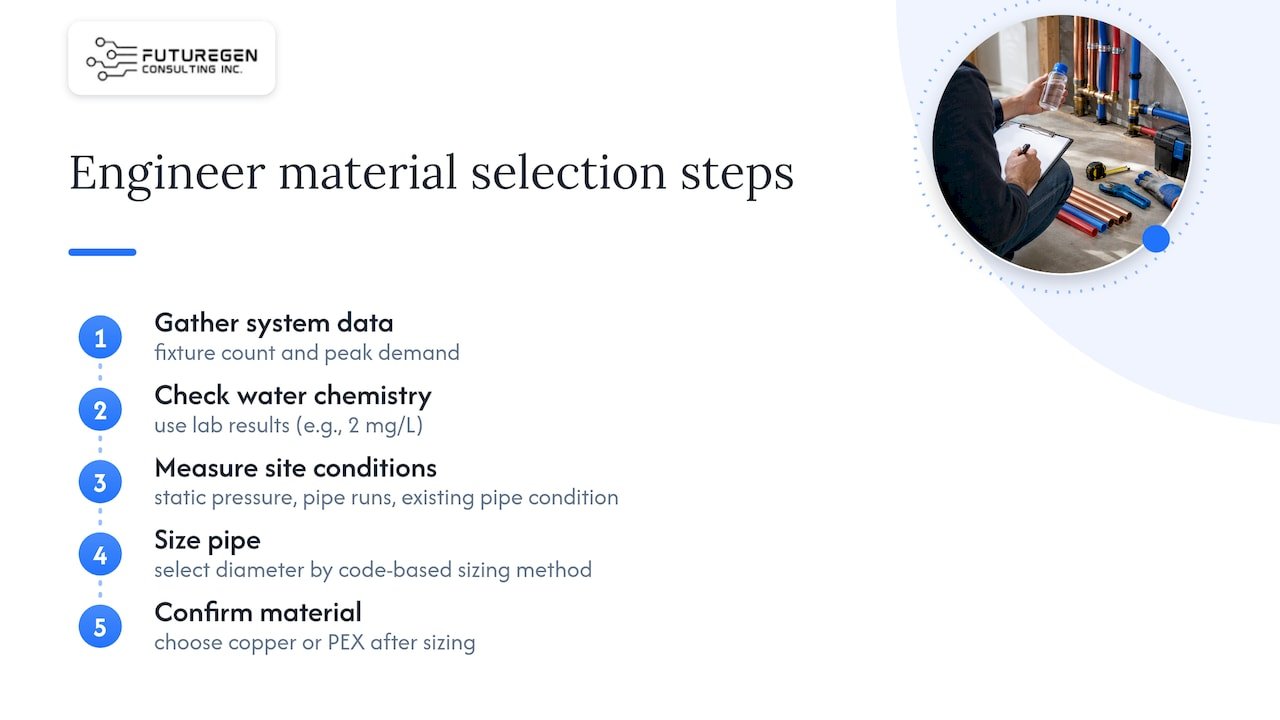
Plumbing designers evaluating copper versus PEX start with fixture count, peak demand load, and water chemistry results, then size pipe diameter before confirming material. We request measurements like static pressure, pipe runs to the furthest fixture, and existing pipe condition, since each changes the recommendation. Our code-based pipe sizing method is built to reduce permit and construction delays caused by undersized or non-compliant systems.
DIY or Call a Professional?
Small PEX repairs or single branch replacements are reasonable DIY projects for a confident homeowner. Whole-house repipes, concealed wall work, or anything requiring a permit benefit from a licensed plumber, and complex renovations or multi-unit buildings benefit from an engineer’s code-based plumbing design.
— Sanjay
When a Repipe Needs an Engineer’s Plan
Most single-family repipes come down to a straightforward contractor quote. Larger renovations, multi-unit buildings, or homes with genuinely aggressive water chemistry are different: getting the pipe sizing, material selection, and code compliance right on paper first avoids costly rework once walls are open.

We provide plumbing system design services for residential and commercial projects across Ontario, delivering permit-ready, engineer-stamped drawings rather than a verbal recommendation.
- We size pipes and select materials based on fixture load, water chemistry, and code requirements.
- We produce drawings intended to support municipal permit approval.
- We review construction progress against the approved design to catch issues before they become expensive.
If your project involves a large renovation, a multi-unit building, or water chemistry that makes the copper versus PEX decision complicated, visit our plumbing design services page to start a conversation about a permit-ready plan, or reach us through Futuregenconsulting for general inquiries.
This article is general information, not a substitute for advice from a qualified doctor. Consult a qualified healthcare professional about your own circumstances before acting on anything here.
FAQ
Is PEX really better than copper?
PEX is often the better choice for concealed, whole-house potable water distribution because it costs less, installs faster, and will not corrode. Copper still performs better in exposed mechanical runs and high-temperature applications, so the better material depends on where the pipe runs.
Why is copper piping no longer used as often?
Copper remains code-approved and is still used, but many homeowners and builders now prefer PEX for new installations because of its lower material cost, faster installation, and resistance to the pitting corrosion that can affect copper in aggressive water chemistry. Copper has not been phased out; it has simply lost market share for concealed residential runs.
Should I repipe my house with PEX or copper?
For most whole-house repipes, PEX offers lower cost and faster installation with no corrosion risk, making it the common recommendation. Keep copper for exposed mechanical-room piping or high-temperature loops where its heat tolerance matters.
What is the disadvantage of PEX?
PEX degrades under prolonged direct UV exposure, so it cannot be used in sunlit outdoor runs without protection, and some formulations allow minor oxygen permeation that can matter in closed hydronic loops with ferrous components. It also has a lower maximum temperature tolerance than copper, which rules it out for certain mechanical applications.
Sources
- National Plumbing Code of Canada (NPC) 2020
- Water talk – Copper in drinking water – Health Canada
- PEX Plumbing Design and Installation Guide, 3rd Ed.
- CCMC evaluation (PEX product references)