
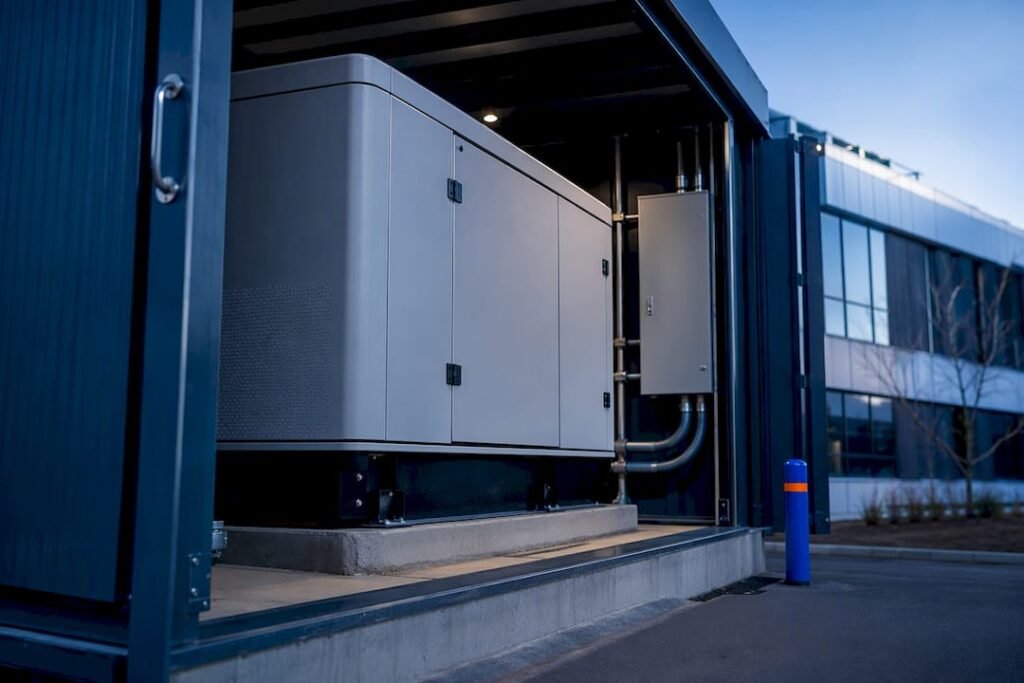
To meet emergency generator requirements in Ontario, building owners must design and install systems to CSA C282 alongside the Ontario Electrical Safety Code, Ontario Building Code, and Ontario Fire Code. That means certified transfer equipment with correct neutral and grounding configuration, adherence to environmental testing limits, and five years of retained test records. Fuel storage and siting decisions must also clear Fire Code review before occupancy.
TL;DR:
- Proper coordination of transfer switch configuration, grounding, and neutral bonding is essential to passing Ontario inspections and avoiding costly rewiring.
- Fuel tank size and siting must meet Fire Code thresholds and fire safety requirements, which significantly influence permit approvals and enclosure design.
- Emergency generator testing is limited to 60 hours annually without additional environmental approval, and detailed logs must be retained for at least five years.
- All installation and maintenance records, including ESA notifications and commissioning reports, should be compiled into a single compliance package for lifecycle management.
- Engaging an engineering consulting firm for integrated design and permit documentation reduces the risk of compliance failures and project delays.
Table of Contents
- What Does Ontario Require for Emergency Generator Installations?
- Electrical Design Essentials: Transfer Switches, Grounding, and ESA Notifications
- When Does the Standby Exemption Apply, and What Are the Operating Limits?
- Fire, Fuel, and Siting: Fire Code Triggers, Tank Sizing, and Ventilation
- Testing, Maintenance, and Lifecycle Recordkeeping
- How to Plan a Compliant Generator Project
- Why Integrated Design Prevents Compliance Failures
- Let FutureGen Handle Your Emergency Power Design and Permit Documentation
- Sources
- FAQ
What Does Ontario Require for Emergency Generator Installations?
Getting a generator project through permitting without rework starts with a short list of decisions made in the right order. Skip one, and you are usually looking at a change order or a failed inspection.
- Confirm the applicable code edition at the outset and document it in your permit submission, since Ontario periodically adopts updated CSA and electrical code cycles.
- Specify a transfer switch and grounding arrangement that matches your service configuration, and verify the equipment carries a recognized Canadian certification mark before it ships.
- Check fixed fuel storage volume against Ontario Fire Code thresholds, and plan foundation, bunding, and ventilation details early.
- Cap non-emergency testing and exercise runs at 60 hours per 12 months unless you have obtained an Environmental Compliance Approval for extended or non-emergency use.
- Build a maintenance and testing schedule from day one, and retain every log for multiple years to comply with retention requirements.
- Contact your municipality about noise permits and site plan requirements before you finalize enclosure and siting, since local rules can add conditions the province does not.
Treat this as a planning sequence, not a checklist to complete after design is finished. Each item touches the others: fuel tank size affects Fire Code review, and transfer switch configuration affects your Electrical Safety Authority notification.
Electrical Design Essentials: Transfer Switches, Grounding, and ESA Notifications
Neutral bonding is the single most common reason emergency generator installations fail inspection. When a generator’s neutral bonds directly to ground and the transfer switch does not correctly switch the neutral conductor, you create parallel neutral paths that violate grounding requirements. A four-pole, neutral-switching transfer switch is typically required whenever the generator is treated as a separately derived system with its own neutral to ground bond.
Design teams should treat the generator, the transfer switch, and the service grounding system as one engineered assembly rather than three separately procured components. Before placing an equipment order, confirm the generator’s factory bonding arrangement, the transfer switch’s pole configuration, and the service grounding point. Late discovery of a mismatch usually means rewiring or, worse, returning equipment that has already arrived on site.
The Electrical Safety Authority requires that any permanently connected standby generator use a transfer device to prevent backfeeding onto utility lines, and it expects notification of work filed with ESA before energizing. Hiring a Licensed Electrical Contractor is not optional for permanent installations. It is how you get ESA inspection scheduled and how you get a certificate of acceptance for the file.
When Does the Standby Exemption Apply, and What Are the Operating Limits?
Ontario’s environmental policy exempts emergency generators from certain approval requirements, but that exemption is conditional, not automatic. If a generator only runs during a genuine power outage or for routine testing, it generally qualifies. The moment you use it for peak shaving, demand response, or any scheduled non-emergency generation, the exemption may no longer apply, and the province requires an Environmental Compliance Approval with defined emission limits and monitoring conditions.
Testing and maintenance runs under the standby exemption are typically capped at 60 hours per 12 month period, and every test needs a written record. That is not a suggestion. Ontario’s standby power policy expects test logs retained for a minimum of five years, covering the date, start and end time, run duration, and purpose of each test.
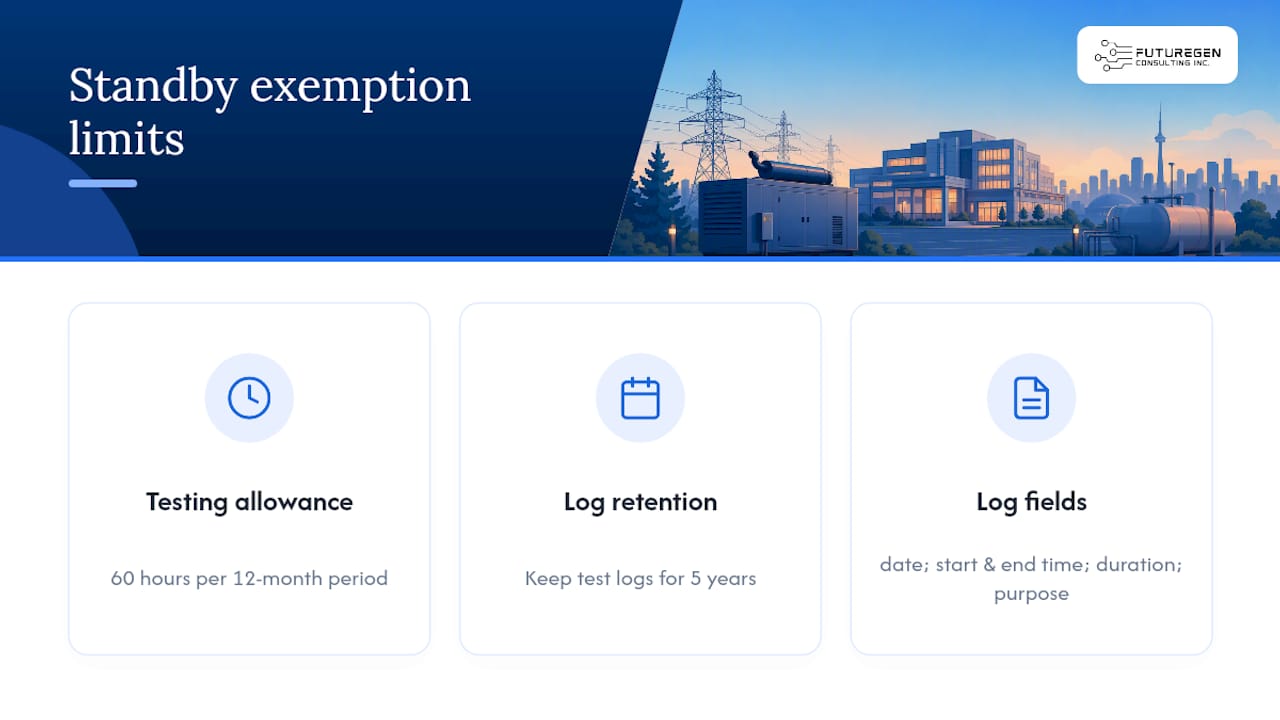
Fuel sulphur content and sound level limits can also apply depending on generator size and location, particularly in mixed-use or dense urban sites. If your facility plans to use the generator for anything beyond emergency backup and routine testing, involve an environmental specialist during design, not after commissioning. Log every test the day it happens. Reconstructing six months of run time from memory during an audit is not a position any facility manager wants to be in.
Fire, Fuel, and Siting: Fire Code Triggers, Tank Sizing, and Ventilation
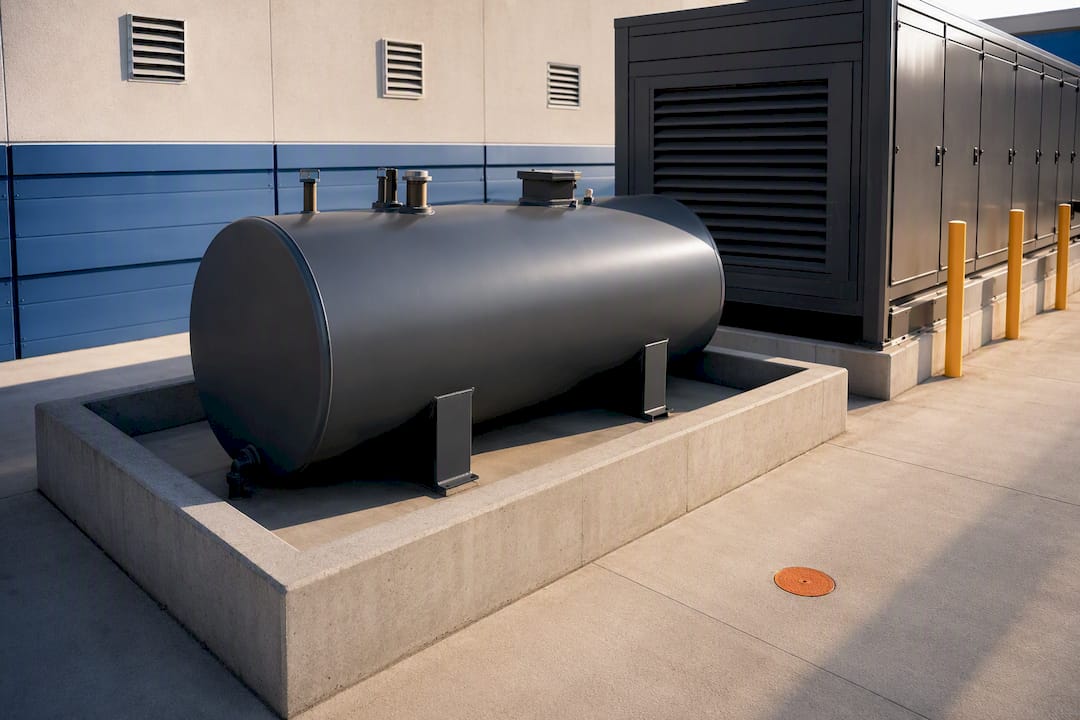
Fuel storage volume is the trigger point most owners underestimate. Fixed storage tanks above defined volume limits bring additional Fire Code controls into play, including secondary containment, separation distances, and tank construction requirements. The Ontario Fire Code also distinguishes fixed storage from vehicle-mounted or portable tanks, which changes which provisions apply.
For smaller standby units, advisory guidance from the Technical Standards and Safety Authority recommends placing generators on a firm, level foundation built to manufacturer specifications, a detail that gets overlooked when a project is racing toward substantial completion.
Bunding and spill control around fuel storage, adequate ventilation for combustion air and heat rejection, and clear access for maintenance and fire department response all factor into enclosure and siting decisions. None of this works well as an afterthought. Coordinate mechanical, electrical, and fire protection requirements during the permitting phase, because a fuel tank resized after the electrical room layout is locked almost always means a redesign.
Testing, Maintenance, and Lifecycle Recordkeeping
CSA C282 frames testing and maintenance as ongoing obligations tied to the building’s operating life, covering commissioning verification, periodic load testing, and inspection intervals that continue for as long as the generator remains in service. Every test log should capture the date, start and end times, run duration, and the reason for the test, whether that is scheduled maintenance or an actual outage response.
At project closeout, owners should receive an integrated package: stamped drawings, the commissioning report, transfer switch and grounding details, and the maintenance plan, held together as a single compliance file rather than scattered across contractor emails. Facility managers who track testing through a structured process, including load bank testing procedures, tend to catch capacity and fuel issues long before an actual grid outage exposes them.
How to Plan a Compliant Generator Project
A generator project runs smoother when the sequence is set before design work starts.
- Confirm the code basis and permit timeline with your municipality’s building department before finalizing equipment selection.
- Request the transfer switch pole configuration, generator factory bonding arrangement, and single-line grounding diagram from your consultant before placing any equipment order.
- Require an integrated closeout package covering ESA notification, inspection milestones, and commissioning records as a contract deliverable, not an optional add-on.
- Reach out to municipal noise and planning contacts early, since noise exemption applications in cities like Toronto can require submission weeks ahead of construction.
- Ask whether acoustical mitigation, such as sound attenuating enclosures, will be needed for your site before the enclosure is fabricated.
Pro Tip: Ask your electrical contractor for scheduling and site coordination tools they already use, such as trade-focused platforms like Presly, so generator delivery, ESA inspection, and fuel tank installation land on the same week instead of stretching across a month of missed handoffs.
Why Integrated Design Prevents Compliance Failures
The most common failure we see traces back to a transfer switch ordered before the grounding scheme was finalized, forcing a rewire mid-project. Coordinating neutral bonding, transfer switch selection, and service grounding as one decision, not three, is what emergency power design work by an engineering consulting firm is built to prevent, alongside delivering permit-ready documentation and commissioning support that closes the file cleanly.
— Sanjay
Let FutureGen Handle Your Emergency Power Design and Permit Documentation
An alternative to piecing together your emergency power project from a generator vendor, an electrician, and a fire consultant working from three different assumptions is to engage an engineering consulting firm that delivers coordinated, permit-ready drawings which account for CSA C282, ESA requirements, and Fire Code fuel storage rules in one design package instead of three separate reviews that catch conflicts too late.

Our Emergency Power Design services cover load hierarchy planning, transfer switch and grounding specification, commissioning support, and ESA liaison, backed by power system studies when your facility needs load verification before equipment selection. Reach out to Futuregenconsulting for a compliance checklist review or project scoping call before you finalize equipment orders, and get your generator project designed right the first time.
Sources
Four documents govern nearly every emergency generator project in the province, and each covers a different slice of the problem.
CSA C282 is the principal Canadian standard for the design, installation, operation, maintenance, and testing of emergency electrical power supply for buildings, with CSA C282:24 as the current edition. It is a lifecycle standard, not a one-time equipment spec. It expects owners to carry commissioning results, maintenance procedures, and test records forward through the building’s operating life, not just a datasheet at handover.
The Canadian Electrical Code Part I, adopted in Ontario as the Ontario Electrical Safety Code through O. Reg. 164/99, incorporates C22.1:24 with provincial amendments. This is the document that governs permanent connections, equipment approval marks, and the technical rules the Electrical Safety Authority enforces during inspection.
The Ontario Building Code and Ontario Fire Code round out the framework, addressing structural, ventilation, and fire separation requirements for generator rooms and enclosures, along with fuel storage and fire emergency system maintenance.
For permit applications, document the code basis explicitly: cite the CSA C282 edition, the C22.1/Ontario amendment cycle in force, and the applicable Building and Fire Code sections. Ontario has moved through several code transition periods in recent years, and inspectors will ask which edition governed your design date. Get that answer in writing from your consultant before submission.
FAQ
What Are the Rules for Running a Generator in Ontario Parks?
Ontario Parks campgrounds typically restrict portable generator use to designated daytime hours and often limit them to specific campsite types or backcountry exemptions, with rules varying by park. Check the specific park’s regulations before bringing a generator, since this differs from the commercial and residential emergency generator rules covered in this article.
What Is the 20/20/20 Rule for Generators?
There is no standardized rule recognized in Canadian generator codes or CSA C282 by that name. If you have seen such phrases, they likely refer to informal maintenance advice rather than a defined regulatory standard, so rely on your generator’s manufacturer schedule and CSA C282 testing guidance instead.
How Big of a Generator Do I Need for Emergencies?
Sizing depends on your emergency load hierarchy, meaning the life-safety loads, such as fire pumps and emergency lighting, that must run separately from optional continuity loads like HVAC or refrigeration. A proper load schedule that documents motor starting requirements and load-shedding logic is what determines generator capacity, which is why an engineered emergency power design study matters more than a generic wattage estimate.
Are You Allowed to Run a Generator All Night?
For emergency and testing purposes under the standby exemption, yes, but total non-emergency testing time is capped at 60 hours per 12 months. Running a generator overnight for non-emergency reasons, such as scheduled load management, can also trigger municipal noise bylaw restrictions, so check local noise permit rules before planning extended overnight runs.