
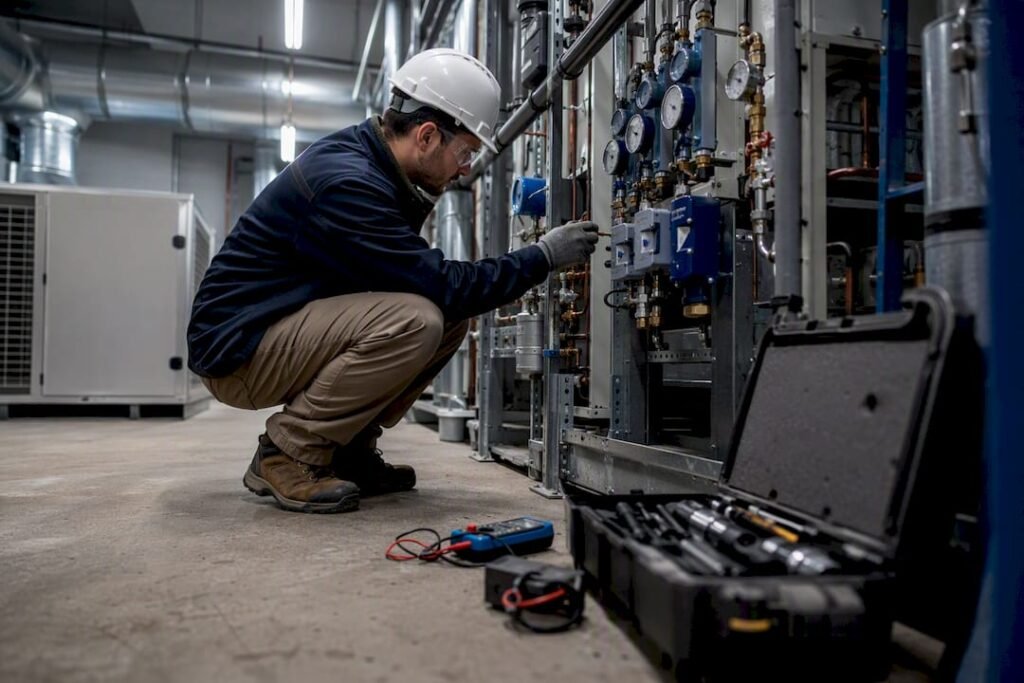
A complete HVAC commissioning checklist captures the Owner’s Project Requirements (OPR) and Current Facility Requirements (CFR), pre-commissioning verifications, start-up and static checks, functional performance testing (FPT), sampling-based verification of operational requirements, and final documentation through handover. Commissioning itself is quality assurance, not a compliance formality: the goal is confirming the mechanical system actually does what the owner needs, not just what the drawings show.
The checklist works as a sequence, not a single form:
- Project and OPR/CFR capture: document what the owner needs the system to do and how the facility will actually operate it.
- Pre-commissioning: design review, submittal checks, and equipment installation verification before anything gets powered on.
- Start-up and static verification: manufacturer start-up procedures, instrument calibration, and testing, adjusting, and balancing (TAB).
- Functional performance testing: scripted, repeatable tests confirming the system responds correctly under real operating conditions.
- Verification and documentation: sampling checks, the commissioning report, issue log, and owner handover package.
Pro Tip: Before scheduling a single test, confirm who holds the CxP authority on your project and whether test readiness (calibrated instruments, completed TAB, approved setpoints) has actually been verified in writing. Skipping this step is the single most common cause of failed or delayed functional tests.
Key Takeaways
A commissioning checklist only works when OPR-based success criteria, independent testing, and documented FPT acceptance criteria are locked in before construction reaches substantial completion.
| Point | Details |
|---|---|
| Start with measurable OPR | Every requirement needs a testable success criterion, not a vague performance statement. |
| Keep TAB independent | Use a separate testing and balancing agency so the CxP can validate results objectively. |
| Structure every FPT the same way | Objective, prerequisites, setup, steps, expected response, and recorded data prevent subjective sign-offs. |
| Sample by risk level | Test life-safety interlocks at 100%; sample repetitive terminal units at a defined lower rate. |
| Commissioning pays for itself | NRCan reports 5% to 20% energy savings with roughly a three-year payback on existing building commissioning. |
Table of Contents
- What Goes on an HVAC Commissioning Checklist?
- How Do You Plan and Run Commissioning on Site?
- How Do You Structure a Functional Performance Test?
- What Belongs in the Commissioning Report and Handover Package?
- Which Standards and Cost Data Justify the Commissioning Budget?
- Should You Use a PDF Checklist or a Digital Field Tool?
- FutureGen Consulting: How We Deliver Commissioning Value
- What the Checklist Won’t Tell You
- Sources
- FAQ
What Goes on an HVAC Commissioning Checklist?
An effective HVAC commissioning checklist has five working sections, each with fields your team fills in on-site or in a field-data app.
1. Project and contact details. Project name, address, mechanical consultant, contractor, TAB agency, and CxP contact. Include the OPR and CFR reference documents and revision dates. Every OPR item needs a measurable success criterion. A statement like “provide comfortable occupant conditions” isn’t testable. “Maintain 21°C to 24°C within occupied zones under design load” is.
2. Pre-commissioning checks. Design and submittal review against the OPR, equipment nameplate verification against approved schedules, and confirmation that control sequences match the specified sequence of operation. Flag any setpoint that hasn’t been formally approved by the design engineer before proceeding.
3. Start-up and static verification. This is where manufacturer start-up procedures get executed and logged, instruments get calibrated against a traceable standard, and TAB work gets completed to a minimum accuracy tolerance (typically within 10% of design airflow and 5% of design water flow, though your commissioning plan should state the actual figure). Nothing in this phase should be marked complete without a signed TAB report.
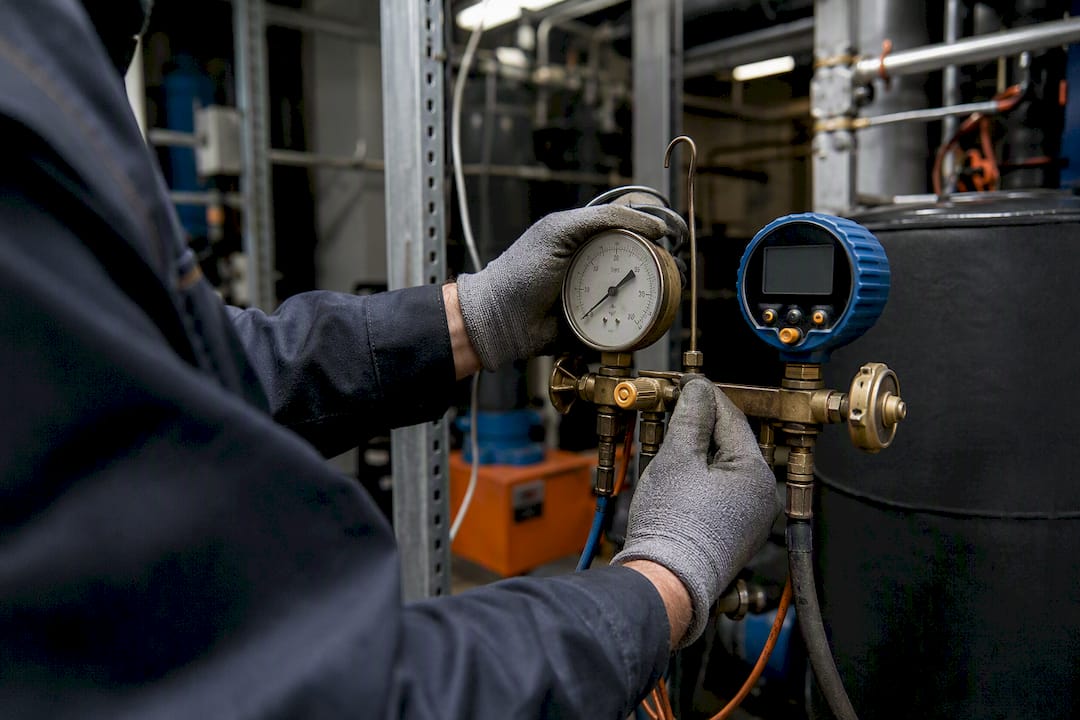
4. FPT checklist items. For each test: prerequisites met, test procedure followed as written, expected system response observed, and raw data recorded (not just pass/fail).
**5. Non-critical, repetitive terminal units can be sampled, often at rates like 100% of the first ten units and 10% to 25% thereafter, depending on what your BC Housing-aligned specification requires.
How Do You Plan and Run Commissioning on Site?
Commissioning fails most often not from bad equipment but from unclear roles and rushed scheduling.
- Owner approves the OPR and CFR and signs off on the final commissioning report.
- Commissioning provider (CxP/CxAg) writes the commissioning plan, develops FPT scripts, and independently verifies test results. ASHRAE Guideline 0 describes this role as spanning predesign through occupancy, not a punch-list activity bolted on at the end.
- Mechanical consultant confirms design intent and resolves discrepancies between as-built conditions and the sequence of operation.
- Mechanical contractor executes start-up, corrects deficiencies, and supports retesting.
- Independent TAB agency performs airflow and waterside balancing separate from the installing contractor, since a CxP validating a contractor’s own self-reported balancing numbers defeats the purpose of independent verification.
Build the commissioning plan as a living document tied to construction milestones, not a static PDF written once at contract award. Practitioners in the field consistently point to documentation as the real dividing line between a genuine commissioning process and a glorified equipment checklist. Before any FPT window, confirm test readiness: calibrated instruments, approved setpoints, and awareness of occupant impacts if the test requires overriding normal sequences during business hours.
This catches systemic installation errors early, when correcting them is cheap, rather than during FPT week when a failure means rescheduling trades.*
How Do You Structure a Functional Performance Test?
A functional performance test only works if it’s written the same way every time: objective, prerequisites, setup conditions, step-by-step commands, expected system response, and a data field for what actually happened. Loose, verbal “let’s see if it works” testing produces subjective sign-offs that fall apart the moment someone disputes a result months later.
Three examples show the pattern:
- AHU sequence of operation: Command occupied mode at design outdoor air temperature. Expected response: supply fan ramps to setpoint, mixed-air damper modulates to maintain minimum outdoor air, discharge temperature holds within ±1°C of setpoint within 15 minutes.
- Economizer and damper response: Simulate outdoor air conditions favorable for free cooling. Expected response: outdoor air damper opens proportionally, return damper closes in coordination, and the unit disables mechanical cooling when economizing alone satisfies the load.
- Chilled-water plant sequencing: Stage a lead/lag pump failure. Expected response: backup pump starts within the specified time delay with no loss of differential pressure below the low-limit alarm.
Every failed step gets logged in the issue log with a retest date, not just a verbal “fix it and we’ll check later.” Existing building commissioning best practices call for explicit acceptance criteria and documented retest protocols precisely because vague criteria are what stall projects at closeout. Acceptance means the recorded data meets the stated criterion twice: once on initial test, once on retest if the first attempt failed.
What Belongs in the Commissioning Report and Handover Package?
The commissioning report is the owner’s proof that the system was verified, not just installed. At minimum, it should include:
- Final scope statement and list of systems commissioned
- Participants and their roles (Owner, CxP, contractor, TAB agency)
- The commissioning plan as executed, including any approved deviations
- Test summaries for every FPT, with pass/fail status and retest history
- The full issue log, with each deficiency tied to a punch-list item or holdback release
- O&M manuals, equipment warranties, and a schedule for any deferred seasonal testing
| Deliverable | Purpose |
|---|---|
| Issue log | Tracks every deficiency from discovery through verified closure, linked to holdbacks. |
| Deferred/seasonal test schedule | Documents which tests (heating-mode economizer checks, peak cooling load) require a later season. |
| Commissioning Completion Certificate | Owner’s formal record that FPT results met acceptance criteria. |
Seasonal tests that can’t run at substantial completion, like heating-mode performance verified only in winter, get scheduled explicitly rather than dropped. Warranty review should happen close to the one-year anniversary of substantial performance, timed so the CxP can confirm persistence of results before warranty coverage lapses. Properly executed HVAC design reduces how many of these deficiencies surface at all.
Which Standards and Cost Data Justify the Commissioning Budget?
Commissioning scope isn’t arbitrary. In Canada, it’s shaped by a specific set of references:
- CSA Z320 and CSA Z5000, which define commissioning processes and requirements for buildings and energy-using systems.
- ASHRAE Guideline 0, which structures the commissioning process from predesign through occupancy and underpins most FPT documentation formats in use today.
- ASHRAE Guideline 1.2/1.3, relevant for HVAC-specific and technical commissioning process detail beyond the general framework.
These standards influence more than paperwork. They set expectations for sampling rigor, the format of test procedures, and how much documentation an owner can reasonably demand at handover.
The financial case backs the scope. Natural Resources Canada reports that existing building commissioning projects typically deliver energy and cost savings of 5% to 20%, with payback in roughly three years. Many of those early gains come from low-cost fixes: correcting schedules, adjusting setpoints, and eliminating simultaneous heating and cooling, not capital upgrades. That ROI case is worth citing directly when a client questions the line-item cost of a commissioning provider.
Should You Use a PDF Checklist or a Digital Field Tool?
A fillable PDF works fine for small, single-building projects with a short punch list and one CxP tracking everything manually. It’s fast to deploy and needs no software budget.
Mobile field-data apps earn their cost on larger or multi-phase projects where several trades need to see open issues in real time and where retest cycles are frequent enough that email chains become unmanageable.
Linking checklists to a building automation system or energy management information system pays off specifically for ongoing commissioning, where trended data needs to persist savings well past the initial handover date. Whichever format you choose, keep version control tight: every test result should trace back to a specific spec section and a stored raw-data file for future measurement and verification work.
FutureGen Consulting: How We Deliver Commissioning Value
Futuregenconsulting has spent over 30 years designing MEP systems across Ontario and Alberta, and that design background shapes how commissioning gets scoped from day one.
- We write the commissioning plan alongside the OPR, so FPT scripts reflect actual design intent rather than generic templates.
- Our deliverables include Cx plan development, FPT coordination, TAB oversight, the final commissioning report, and operator training.
- Early OPR alignment reduces the rework that shows up during FPT week, and we help owners structure ongoing commissioning so savings persist rather than fading within a year or two.
If your project needs HVAC system design paired with commissioning support, or you’re deciding whether to hire a third-party CxP versus relying on in-house facilities staff, get in touch with Futuregenconsulting to scope the engagement against your OPR and project timeline.
What the Checklist Won’t Tell You
The conventional advice on commissioning treats it as a paperwork exercise: fill in the boxes, get the signatures, close the file. That undersells what actually separates a commissioning process that saves an owner money for a decade from one that gets forgotten within a year.
The judgment this research actually supports is that documentation discipline, not test volume, determines outcomes. A project can run every FPT on the checklist and still fail if the commissioning plan was never tied to a specific, measurable OPR, or if the issue log doesn’t survive past substantial completion into the warranty period. I’d argue the industry underrates seasonal and ongoing commissioning specifically because it happens after the ribbon-cutting, when attention and budget have already moved elsewhere.
If you take one thing from this guide, prioritize the OPR conversation before you prioritize the test scripts. A beautifully executed FPT against a poorly defined requirement just confirms the system does the wrong thing very precisely.
Sources
- Existing Building Commissioning (EBCx) – Natural Resources Canada
- CSA Z5000 announcement (as cited by AIBC)
- Building Commissioning Guidelines (BC Housing)
FAQ
What is the difference between an HVAC startup checklist and a full commissioning checklist?
A startup checklist confirms equipment operates after installation. A full commissioning checklist goes further, verifying that equipment performance matches the OPR through documented functional performance testing, not just confirmation that a fan turns on.
How long does the HVAC commissioning process typically take on a commercial project?
Timing depends on project size and system complexity, but functional performance testing usually runs over several weeks near substantial completion, with seasonal tests (heating-mode economizer checks, for example) deferred to the appropriate season afterward.
Who is responsible for functional performance testing acceptance criteria?
The commissioning provider (CxP) typically writes and enforces acceptance criteria in coordination with the mechanical consultant, though the owner has final approval authority over the commissioning plan those criteria are built from.
Do all HVAC systems need 100% functional performance testing?
No.