
Domestic hot water sizing is defined as the process of matching a water heater’s output capacity to a household’s peak demand, using metrics like First-Hour Rating (FHR) and peak flow rate rather than tank volume alone. The industry standard term is “domestic hot water load calculation,” and it governs whether your system delivers reliably or leaves you with a cold shower on a February morning. Department of Energy and IRC 2024 standards require sizing by FHR, not tank capacity. A 4-person household typically needs an FHR of 60–80 gallons. Getting this wrong costs money upfront and in energy bills every month.
What is the First-Hour Rating and why does it matter more than tank size?
First-Hour Rating is the total gallons of hot water a heater can deliver during the first hour of peak use. It combines usable tank volume with the recovery rate, which is how fast the burner or element reheats incoming cold water. That combination is what FHR measures, and it is the number that actually predicts real-world performance.
Tank capacity alone is misleading. A 60-gallon electric tank with a slow recovery rate can deliver less hot water per hour than a 50-gallon gas tank with a fast burner. A 50-gallon gas unit often achieves an FHR of 67 gallons or more, outperforming some 60-gallon models with lower recovery rates. The label on the side of the tank tells you storage volume. The FHR label tells you what the system can actually do under load.
Typical FHR ranges by household size
| Household size | Recommended FHR |
|---|---|
| 1–2 people | 30–40 gallons |
| 3–4 people | 60–80 gallons |
| 5+ people | 80–100+ gallons |
Gas water heaters recover at roughly twice the rate of standard electric resistance units. That faster recovery means a smaller gas tank can match the FHR of a larger electric model. For Ontario homeowners on natural gas, this is a meaningful sizing advantage, especially in older homes where mechanical room space is limited.
Pro Tip: Check the yellow EnerGuide label on any tank water heater. The FHR figure appears there directly. Use that number, not the tank volume, when comparing models.
How to size a tankless water heater using peak flow rate
Tankless water heaters do not store hot water. They heat water on demand, so the critical metric shifts from FHR to gallons per minute (GPM) delivered at a target output temperature. Sizing a tankless unit requires two inputs: peak simultaneous flow demand and temperature rise.
Follow these steps to calculate your peak flow demand:
- List every fixture that could run simultaneously. A typical morning peak in a 4-person home includes two showers (2.0 GPM each), one bathroom faucet (0.5 GPM), and a dishwasher (1.0 GPM).
- Add the flow rates together. That scenario totals 5.5 GPM of simultaneous demand.
- Determine your temperature rise. Ontario groundwater temperatures average around 8–10°C (46–50°F) in winter. A target output of 49°C (120°F) means a rise of roughly 70°F.
- Match GPM to BTU input. A 3–4 person household needs 4.0–5.5 GPM, which requires a gas unit rated at 180,000–199,000 BTU in cold climates.
- Size for the coldest day, not the average. Groundwater temperature drops in january and february in Ontario. A unit sized for average conditions will underperform in peak winter months.
Ignoring groundwater temperature is the most common tankless sizing error. Manufacturers publish flow rates at a fixed temperature rise, often 35°F. Ontario winters demand a rise closer to 70°F, which cuts effective GPM nearly in half on some units.
Electric tankless units carry an additional constraint. A whole-home electric tankless heater at 5.5 GPM capacity requires a 200-amp or larger electrical panel. Many Ontario homes built before 1990 have 100-amp service. A panel upgrade adds cost that must factor into the total system budget.
Pro Tip: Always request the GPM rating at a 70°F temperature rise from the manufacturer, not the standard 35°F rating. That number reflects actual Ontario winter performance.
Key factors affecting hot water system design and capacity
Several variables interact to determine the right system size. Understanding each one prevents both undersizing and the costly penalties of oversizing, which include paying $300–$500 more upfront and absorbing higher standby energy losses every year.
Recovery rates by fuel type
Recovery rate measures how many gallons per hour a heater can raise from cold to the set temperature. Gas units recover at roughly 40–50 gallons per hour. Standard electric resistance units recover at 20–30 gallons per hour. Heat pump water heaters recover more slowly than both, which is why heat pump units require 20–40% larger tanks than conventional models to maintain adequate supply during cold spells.
System type comparison
| System type | Recovery rate | Energy efficiency | Upfront cost | Best for |
|---|---|---|---|---|
| Gas storage tank | High | Moderate | Low to moderate | Most Ontario homes |
| Electric resistance tank | Moderate | Lower | Low | Smaller households |
| Tankless gas | On-demand | High | Moderate to high | High-demand homes |
| Heat pump (hybrid) | Low | Highest | High | Energy-focused buyers |
Heat pump water heaters deliver the lowest operating cost over time, but their slower recovery requires careful sizing. Professionals factor in lifestyle variables like simultaneous shower use, recirculation loops, and seasonal guest occupancy rather than relying on headcount alone.
Diversity factors are a tool professionals use to avoid oversizing. Rather than adding every fixture’s peak flow rate, engineers apply a diversity factor that reflects the statistical probability of simultaneous use. Designers calculate peak simultaneous load instead of total fixture count, which produces a more accurate and cost-effective result. For residential projects, this approach is less common, but property managers overseeing multi-unit buildings benefit significantly from it.
Key lifestyle factors that affect sizing decisions:
- Morning peak windows (6:00 AM to 9:00 AM concentrate demand)
- Recirculation loops in larger homes that keep pipes warm but increase standby draw
- Guest bedrooms that sit unused most of the year but spike demand during holidays
- High-flow showerheads versus low-flow WaterSense fixtures, which reduce demand by up to 20%
Pro Tip: If your home has a recirculation loop, account for its continuous draw when calculating peak demand. A loop that runs overnight adds meaningful load that a basic headcount formula misses entirely.
How to calculate the right water heater size for your home
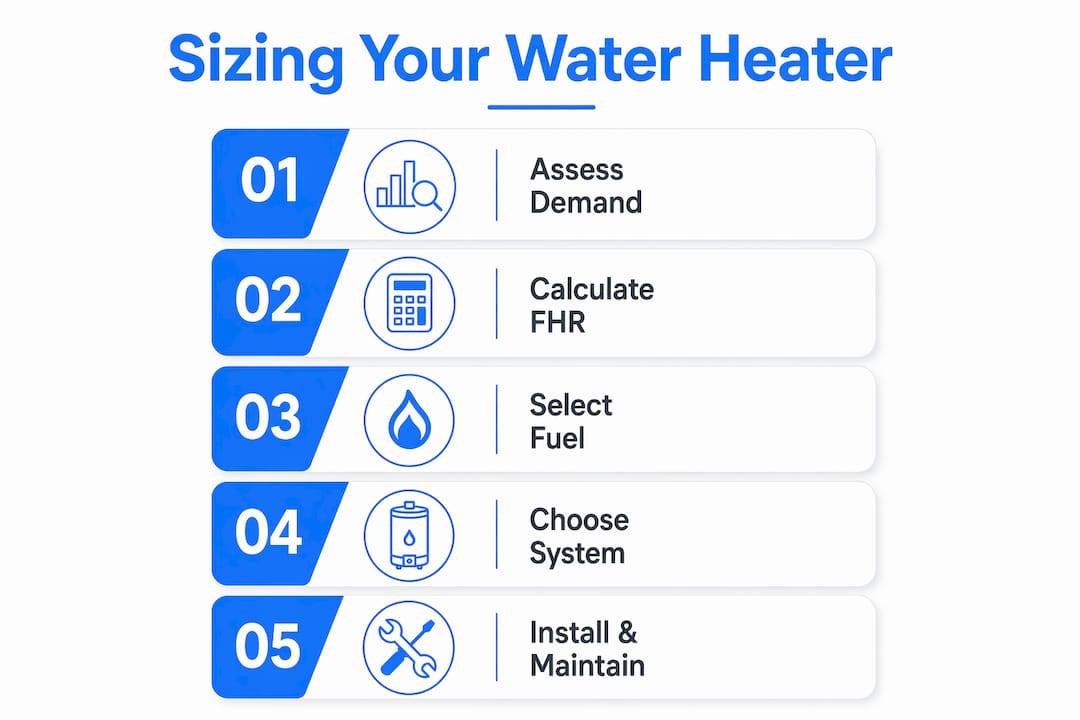
A reliable hot water requirements calculation follows a defined sequence. Skipping steps produces an undersized or oversized system.
Step-by-step sizing method
- Gather household data. Record the number of occupants, number of bathrooms, and all hot-water-using appliances.
- Identify your peak hour. For most Ontario households, this is the morning window when showers, sinks, and dishwashers overlap.
- List fixtures active during peak hour. Assign each a flow rate. Standard showers run at 2.0 GPM, bathroom faucets at 0.5 GPM, kitchen faucets at 1.5 GPM, and dishwashers at 1.0–1.5 GPM.
- Calculate peak hour demand in gallons. Multiply each fixture’s GPM by its expected minutes of use during the peak hour, then sum the totals.
- Match to FHR or GPM capacity. For a tank heater, select a unit whose FHR meets or exceeds your peak hour demand. For tankless, match peak simultaneous GPM at your local temperature rise.
- Adjust for climate. Ontario’s cold groundwater temperatures require sizing at the lower end of the annual groundwater range, not the annual average.
- Round up to the next standard size. Standard tank sizes run in 40, 50, 60, and 80-gallon increments. Choose the next size up when your calculation falls between standard options.
Common sizing mistakes to avoid:
- Sizing by household headcount alone without checking fixture flow rates
- Using manufacturer GPM ratings at a 35°F rise for an Ontario installation
- Ignoring future usage changes such as a growing family or added bathroom
- Assuming a larger tank always means more hot water without checking recovery rate
- Overlooking plumbing code compliance requirements that govern minimum output temperatures and pressure relief specifications
For multi-unit properties, consider installing two smaller units in parallel rather than one oversized tank. Parallel units provide redundancy and allow one unit to be serviced without cutting hot water to the entire building. This approach also aligns with the HVAC load calculation principles used in residential mechanical design, where redundancy and zoning improve both reliability and efficiency.
Key Takeaways
Proper domestic hot water sizing requires matching peak hour demand to First-Hour Rating for tank systems, or peak GPM at local temperature rise for tankless units, with fuel type and recovery rate determining which system delivers the best balance of capacity and efficiency.
| Point | Details |
|---|---|
| FHR beats tank volume | A 4-person household needs an FHR of 60–80 gallons; tank size alone does not predict performance. |
| Tankless sizing uses GPM and temperature rise | Size for coldest groundwater temperature, not manufacturer averages, to avoid winter shortfalls. |
| Recovery rate drives system selection | Gas units recover twice as fast as electric resistance; heat pump units need 20–40% larger tanks. |
| Oversizing carries real costs | Oversized equipment adds $300–$500 upfront and increases standby energy losses annually. |
| Lifestyle factors matter as much as formulas | Peak timing, recirculation loops, and guest usage patterns all affect the accurate load calculation. |
What I’ve learned from sizing hot water systems that formulas don’t tell you
After working through dozens of residential and commercial mechanical design projects in Ontario, the pattern I see most often is not undersizing. It’s oversizing driven by anxiety. Homeowners and property managers worry about running out of hot water, so they buy the biggest tank available. The result is a unit that cycles on and off constantly to maintain temperature in a tank that rarely gets fully drawn down. That standby loss adds up quietly on every gas or hydro bill.
The second pattern is treating the sizing formula as the final answer. Code books lack specific volume rules precisely because usage patterns vary so much. A family of four with staggered schedules has a very different peak demand profile than four people who all shower within the same 30-minute window. The formula gives you a starting point. Lifestyle observation gives you the accurate number.
Heat pump water heaters are worth serious consideration for Ontario homeowners, particularly those in homes with good basement insulation. The operating cost savings are real and measurable. The trade-off is slower recovery, which means the tank sizing logic changes completely. Applying conventional tank sizing rules to a heat pump unit produces a system that runs out of hot water by mid-morning on a busy day.
My consistent advice: run the calculation twice using two different methods, compare the results, and if they diverge significantly, consult a licensed mechanical engineer before purchasing. A one-hour consultation costs far less than replacing an undersized unit two years after installation.
— Sanjay
How Futuregenconsulting can support your hot water system design
Selecting the right water heater size is one decision in a larger mechanical design process. The fuel type, venting configuration, pressure relief specifications, and integration with recirculation loops all affect system performance and code compliance in Ontario.

Futuregenconsulting provides MEP engineering services for residential and commercial projects across Ontario, including complete plumbing system design and hot water load calculations. With over 30 years of experience in mechanical and electrical design, the firm delivers sizing analyses grounded in current Department of Energy standards and Ontario Building Code requirements. Whether you are planning a new build, a renovation, or a multi-unit property upgrade, Futuregenconsulting offers the technical depth to get the system right the first time. Contact the team through plumbing design services to request a project assessment.
FAQ
What is First-Hour Rating and how is it used in sizing?
First-Hour Rating is the total gallons of hot water a tank heater delivers in the first hour of peak use. Department of Energy and IRC 2024 standards require water heater sizing by FHR, not tank capacity.
How many GPM does a tankless water heater need for a family of four?
A 3–4 person household typically requires 4.0–5.5 GPM. That figure must be evaluated at the local groundwater temperature, not the manufacturer’s standard 35°F temperature rise rating.
Why do heat pump water heaters need larger tanks?
Heat pump water heaters recover more slowly than gas or electric resistance units. They require tanks 20–40% larger than conventional models to maintain adequate hot water supply during periods of high demand.
Does oversizing a water heater save money in the long run?
Oversizing does not save money. Oversized equipment costs $300–$500 more upfront and generates higher standby energy losses, increasing operating costs every year without improving hot water availability.
When should a homeowner consult a professional for hot water sizing?
Consult a licensed mechanical engineer when the home has a recirculation loop, multiple bathrooms with simultaneous peak demand, or when considering a heat pump or tankless system that requires panel or venting upgrades.