

An ESA plan review is a formal audit of an electrical design for compliance with the Ontario Electrical Safety Code (OESC), conducted by the Electrical Safety Authority (ESA) before installation begins. The immediate action is to submit through the ESA Electronic Plan Review (EPR) portal — email, fax, and paper submissions are no longer accepted. Every submission requires, at minimum:
- Completed two-page Plan Review submittal form (downloadable from the EPR portal homepage) and a single-line diagram; a P.Eng.-stamped grounding study is required only if the project involves a high-voltage station ground electrode design not exempted under Bulletin 36-10-*
Pro Tip: ESA will give you only 10 business days to correct an incomplete submission before it is cancelled. A pre-submission completeness check against the EPR checklist eliminates the most common administrative rejections before they happen.
Futuregenconsulting prepares all three deliverables, including P.Eng.-stamped grounding studies, as part of its standard plan-review package.
Table of Contents
- Which OESC edition applies to your ESA plan review?
- Why submitting early saves money
- What are the typical ESA review timelines?
- What documents do ESA reviewers check?
- How to prepare your ESA plan review submission
- Common reasons ESA requests additional information
- Best practices for managing ESA submissions across projects
- What happens after ESA accepts your plan review?
- Futuregenconsulting delivers plan-review-ready electrical packages
- Key Takeaways
Which OESC edition applies to your ESA plan review?
The edition of the OESC that governs a project is the edition in force on the official submission date. If a submission expires or is resubmitted after a new code cycle activates, the project may be required to meet the newer, potentially stricter requirements. Schedule submissions before known code-cycle transitions to lock in the applicable edition and avoid unplanned redesign costs.
Why submitting early saves money
Identifying non-compliance at the design stage costs far less than correcting installed systems. An early ESA plan evaluation flags issues — omitted ground-fault protection, undersized panelboards, incompatible generator ground-fault schemes — before procurement or site mobilization. Starting electrical installation before a mandatory plan review is complete violates the OESC and results in a defect issued to the Licensed Electrical Contractor (LEC), triggering inspection failures and rework. Early submission also preserves schedule flexibility if ESA requests additional information.

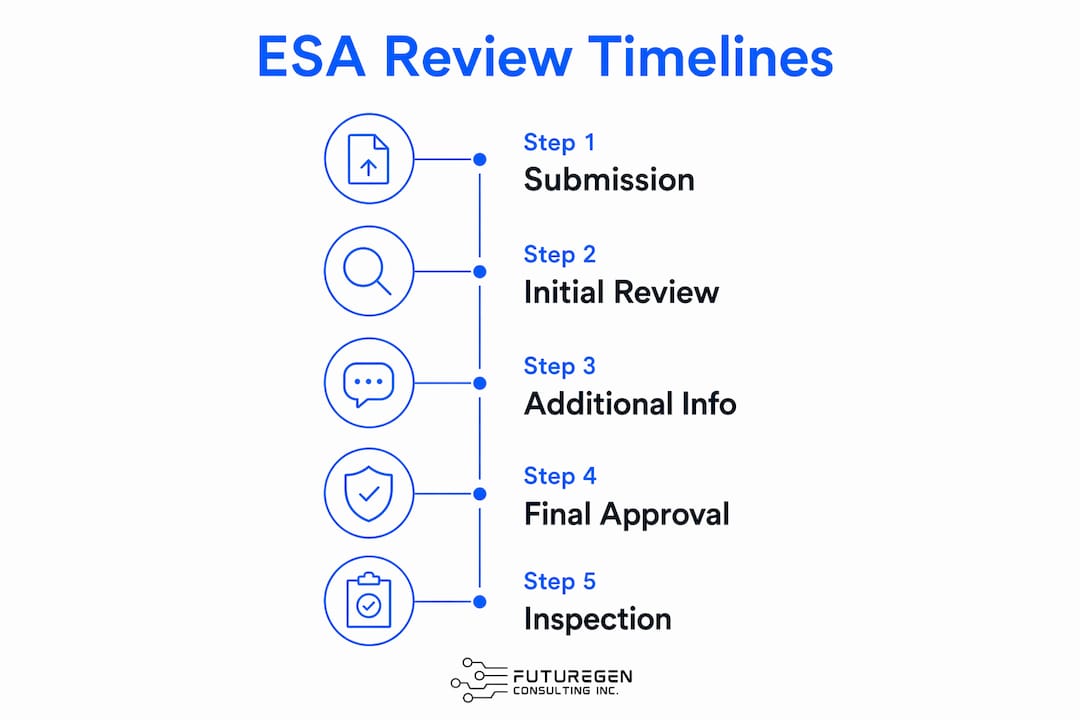
What are the typical ESA review timelines?
ESA targets 10–20 business days to start low-voltage reviews and 20–30 business days to start reviews involving customer-owned high-voltage equipment. Actual completion depends on submission complexity and completeness. For urgent projects, ESA offers a rush review at the Plan Review Manager’s discretion, with a three-hour administrative charge added to minimum review fees — requested at the time of EPR portal submission, not guaranteed.
What documents do ESA reviewers check?
The two-page submittal form functions as both a project information record and a document checklist. Reviewers verify: single-line diagram, load calculations, ground-fault protection scheme (required when multiple power sources are present), service and feeder sizing, emergency power supply documentation for life-safety systems, and — for generating equipment or energy storage systems exceeding 10 kW operating in parallel with the supply authority — system configuration details. For EV charger and EVSE installations, a plan review is required when aggregate nameplate output exceeds that 10 kW threshold.
How to prepare your ESA plan review submission
- Confirm applicability. Rule 2-010 of the OESC triggers mandatory plan review for three-phase services at or above 400 A, single-phase services at or above 600 A, feeders above 1,000 A, emergency power for life-safety systems, generating equipment or energy storage above 10 kW in parallel, and any installation above 750 V.
- Assemble documents. Complete the two-page submittal form, prepare the single-line diagram, and include the P.Eng.-stamped grounding study if applicable. A detailed electrical load list reduces sizing queries during review.
- Register and submit via EPR. Contact ESA at 1-800-746-6480 to register. Each civic address requires its own separate submission — multiple sites cannot be grouped under one application.
- Pay the prescribed fee. Fees follow ESA’s current fee guide; rush review carries an additional three-hour administrative charge.
- Monitor and respond. Track submission status in the EPR portal and respond to any requests for additional information within 10 business days to avoid cancellation.
Common reasons ESA requests additional information
The most frequent causes of rejection or information requests include: incomplete submittal form fields, missing single-line diagram, absent ground-fault protection scheme where multiple power sources exist, omitted P.Eng. stamp on grounding studies, incorrect service sizing for fire pumps, and hybrid inverter configurations that trigger additional scrutiny. For multi-unit projects, submitting multiple civic addresses under a single application is explicitly prohibited and will result in rejection. Note that ESA plan review confirms OESC compliance but does not certify engineering work or substitute for P.Eng.-stamped deliverables.
Best practices for managing ESA submissions across projects
Maintain a submission log that records EPR portal reference numbers, submission dates, OESC edition in effect at submission, and response deadlines. Assign a single point of contact per project to monitor the portal and handle information requests. For multi-site programs, track each civic address as a discrete submission with its own timeline. Coordinate with the Licensed Electrical Contractor early — the LEC receives any defects and must be aligned on submission status before mobilization. For projects with standby generation or life-safety systems, flag the 20–30 business-day high-voltage start window in the project schedule from day one.
What happens after ESA accepts your plan review?
Plan review acceptance is not final installation approval. The ESA inspector in the field gives final approval of the completed installation. Post-acceptance obligations include: constructing strictly to the reviewed drawings (major scope or design changes may invalidate the submission and require reapplication), obtaining the required electrical permit in Ontario before work begins, coordinating with the supply authority or Local Distribution Company (LDC) for service connection requirements, and scheduling field inspections at the stages specified in the OESC. If the related electrical installation has not commenced and the plan review report is no longer based on the current or previous OESC edition, the submission expires and a new application is required.
Futuregenconsulting delivers plan-review-ready electrical packages
Engineering teams that need permit-ready deliverables without the back-and-forth of incomplete submissions work with Futuregenconsulting. The firm produces P.Eng.-stamped single-line diagrams, grounding studies, load lists, and completed submittal forms mapped directly to ESA’s EPR checklist — covering power distribution, emergency power, fire alarm, and EVSE installations across Ontario.

With over 30 years of MEP engineering experience, Futuregenconsulting runs a pre-submission QA pass against the EPR portal checklist, coordinates with the LEC and supply authority, and manages resubmissions when ESA requests additional information. The result is fewer review cycles and a submission that holds its OESC edition lock. Request a proposal or pre-review consultation at futuregenconsulting.ca.
This article provides general information about the ESA plan review process in Ontario. Confirm current requirements with ESA directly or a licensed Professional Engineer for your specific project.
Key Takeaways
An ESA plan review locks in OESC compliance at the submission date, making early and complete submission the single most effective way to protect project schedules and budgets in Ontario.
| Point | Details |
|---|---|
| EPR portal is mandatory | All submissions go through the ESA Electronic Plan Review portal; email and paper are not accepted. |
| OESC edition locks at submission | The code edition in force on the submission date governs the project; resubmission after a code cycle change may trigger stricter requirements. |
| Review start times vary by voltage | Low-voltage reviews start within 10–20 business days; high-voltage reviews start within 20–30 business days. |
| Incomplete submissions are cancelled | Missing documents trigger a 10-business-day correction window; no response results in cancellation. |
| Futuregenconsulting manages the full process | The firm delivers P.Eng.-stamped drawings, grounding studies, and EPR checklist QA to minimize review cycles for Ontario projects. |
Recommended
- Blog | Futuregen
- The Ultimate Guide to EV Charger Infrastructure Design in Ontario: Everything You Need to Succeed | Futuregen
- Fire Alarm System Design in Ontario: A Guide for Developers and Owners | Futuregen
- HVAC Design in Ontario: Why Getting It Right Matters for Your Building’s Future | Futuregen