
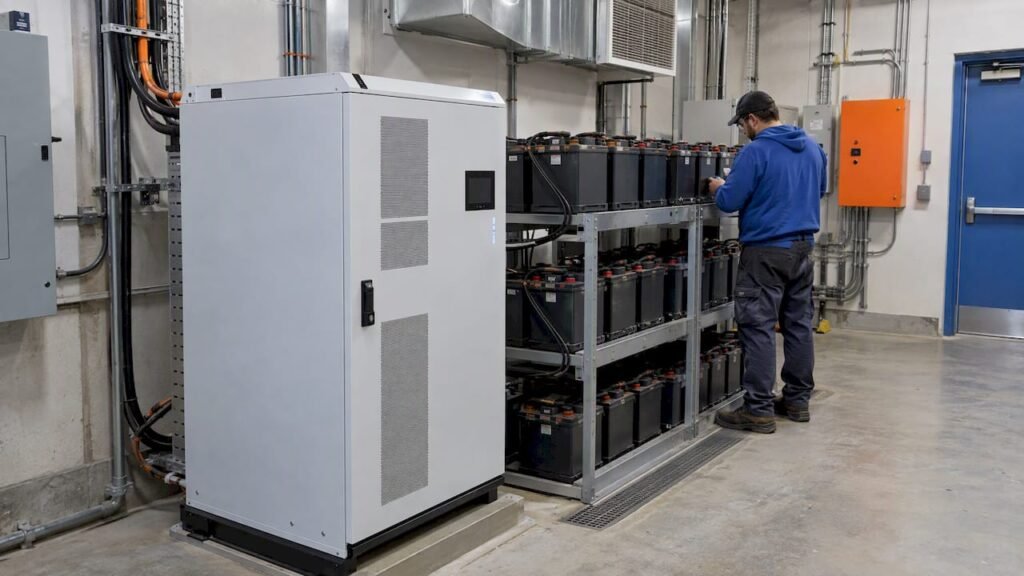
Lithium iron phosphate (LFP) batteries generally deliver the best outcome for daily cycling applications such as solar storage, offering longer service life and higher usable energy despite a steeper purchase price. Lead-acid batteries remain a defensible choice when upfront cost is the dominant constraint or when the application involves infrequent, low-cycle backup duty. The right answer depends on duty cycle, installation constraints, and total cost of ownership, which we unpack below.
TL;DR:
- Lithium iron phosphate batteries typically retain about 97% of capacity after 2,000 cycles, offering longer lifetime throughput and reducing total ownership costs compared to lead-acid.
- Lead-acid remains a suitable choice for low-cycle backup applications where upfront cost is the primary concern, despite its shorter cycle life and lower usable capacity.
- Regulatory rules in Canada restrict lithium installations below grade and require specific fire-propagation testing, making site assessment and compliance essential before installation.
- Replacing lead-acid with lithium requires system updates, including verifying compatibility, updating charge profiles, and reassessing protection and mounting requirements.
- Lithium is more thermally stable and cobalt-free, making it safer and less reliant on ethically complex supply chains, especially in space-constrained or high-cycle daily use applications.
Table of Contents
- Lithium vs lead acid: the core differences at a glance
- Why lithium and lead-acid chemistries behave so differently
- Lifespan and total cost of ownership: cycles, throughput, and payback
- Safety, transport, and installation rules that shape the decision
- Matching the battery to the job: solar, backup, vehicles, and portable gear
- Compatibility checklist before swapping lead-acid for lithium
- What we check during a battery system assessment
- An engineer’s closing take on choosing between lithium and lead-acid
- How FutureGen Consulting supports battery and energy storage projects
- FAQ
- Sources
Lithium vs lead acid: the core differences at a glance
The two chemistries diverge sharply once you look past sticker price.
- Energy density and weight: lithium cells pack more usable energy per kilogram, which matters for space-limited or weight-sensitive installations.
- Cycle life: LFP cells commonly retain about 97% of capacity after 2,000 cycles, while lead-acid life varies widely with depth of discharge and is typically much shorter.
- Usable capacity: lead-acid is usually limited to shallower discharge to preserve life, while lithium tolerates deeper, more frequent cycling.
- Maintenance: flooded lead-acid needs watering and ventilation for hydrogen off-gassing, while lithium relies on an integrated battery management system (BMS) and needs no watering.
- Cost profile: lead-acid wins on upfront price; lithium tends to win on lifetime cost once cycle count and replacement frequency are factored in.
LFP batteries commonly retain approximately 97% capacity after 2,000 cycles, a figure that drives most of the lifetime cost advantage discussed later in this article.
Why lithium and lead-acid chemistries behave so differently
Lithium iron phosphate is the chemistry most often specified for stationary storage, distinct from nickel manganese cobalt (NMC) and nickel cobalt aluminum (NCA) lithium variants used more commonly in electric vehicles and portable electronics. Electrode chemistry and nominal cell voltage drive the practical differences: LFP cells operate at a lower nominal voltage than NMC or NCA but tolerate more charge and discharge cycles before capacity fades meaningfully, which is why cycle life and usable energy differ so much between lithium variants, not just between lithium and lead-acid.
Temperature sensitivity also varies by chemistry. Peer-reviewed cell studies show that degradation in lithium-ion cells depends strongly on temperature, depth of discharge, and discharge rate, with LFP generally showing favorable cycle lifetime and round-trip efficiency across many of the conditions tested.
- LFP is cobalt-free, which reduces exposure to the ethical and supply-chain risks associated with cobalt mining that affect NMC and NCA chemistries.
- LFP cells tend to be more thermally stable than NMC or NCA, a factor that matters directly for the safety discussion later in this article.
Lifespan and total cost of ownership: cycles, throughput, and payback
Comparing batteries on purchase price alone misses the economics that matter for a multi-year installation. The useful framework is lifetime usable energy throughput: multiply usable depth of discharge by cycle count and battery capacity to estimate total kilowatt-hours delivered over the battery’s life.
- Start with rated capacity and the chemistry’s usable depth of discharge, since lead-acid is typically cycled shallower than lithium to preserve service life.
- Multiply by expected cycle count. LFP batteries retaining about 97% capacity after 2,000 cycles deliver far more lifetime throughput than lead-acid batteries with shorter, DoD-dependent cycle lives.
- Factor in round-trip efficiency, since lab studies show LFP cells often achieve higher round-trip efficiency than lead-acid under comparable conditions, reducing the energy wasted per cycle.
- Add replacement labor, maintenance, and disposal costs, since lead-acid’s shorter life means more replacement events and more hazardous-waste handling over an equivalent project lifespan.
Lifetime throughput, not sticker price, usually decides which chemistry is cheaper over a 10-year horizon, according to cycle-life research comparing lithium chemistries under realistic cycling conditions.
Safety, transport, and installation rules that shape the decision
Regulatory constraints in Canada materially affect which chemistry is practical for a given site. Transport Canada regulates lithium batteries as dangerous goods under the Transportation of Dangerous Goods Act and Regulations, with air-transport restrictions that do not apply the same way to lead-acid. Spent lead-acid batteries are instead handled as hazardous waste, with manifest requirements for larger shipments in several provincial regimes.
Installation location is governed by the Canadian Electrical Code (CSA C22.1). Under this code, lithium-ion energy storage systems face restrictions on below-grade placement under Rule 64-918, while flooded lead-acid installations must meet Rule 64-802 ventilation and spacing requirements to manage hydrogen gas accumulation.
- Confirm whether the proposed location is below grade, which can trigger Rule 64-918 restrictions for lithium-ion systems.
- Verify ventilation provisions for any flooded lead-acid bank under Rule 64-802.
- Check that any lithium enclosure has undergone fire-propagation testing consistent with UL 9540A guidance, which informs how building-mounted systems manage thermal runaway risk.
Pro Tip: Treat any grid-connected or building-integrated battery system as requiring an engineered design and a permit review before installation, not an afterthought once equipment is already purchased.
Matching the battery to the job: solar, backup, vehicles, and portable gear
Different jobs favor different chemistries, and the mismatch between spec sheets and actual duty cycle causes most of the regret we see after installation.
- Solar or off-grid systems with frequent shallow cycling: lithium LFP is usually the better fit given its higher usable depth of discharge and longer cycle life under daily use.
- UPS or backup power with infrequent discharge: lead-acid can remain acceptable where the battery sits at float charge most of the time and low upfront cost outweighs lifetime savings.
- Vehicle starting versus deep-cycle mobility: lead-acid still suits cranking applications where the vehicle’s charging system expects it, while lithium suits deep-cycle mobility uses, provided the inverter and charger are rated for it.
- Weight-sensitive or space-limited installations: lithium’s higher energy density per kilogram generally wins when physical space or payload is constrained.
Compatibility checklist before swapping lead-acid for lithium
Replacing a lead-acid bank with lithium is a system redesign, not a drop-in part swap.
- Confirm nominal voltage and usable capacity equivalence against the existing inverter or charger’s rated input range.
- Update charge profiles and firmware, and confirm the lithium pack’s BMS communicates properly with the existing charge controller.
- Reassess fuse, breaker, and cable sizing, since lithium’s discharge characteristics differ from lead-acid and can require different protection ratings.
- Plan for mounting, thermal management, and compliant transport or disposal of the retired lead-acid units.
Pro Tip: Long-term storage habits differ by chemistry: lead-acid should be kept near full charge to avoid sulfation, while lithium stores better around 50% state of charge for extended idle periods.
What we check during a battery system assessment
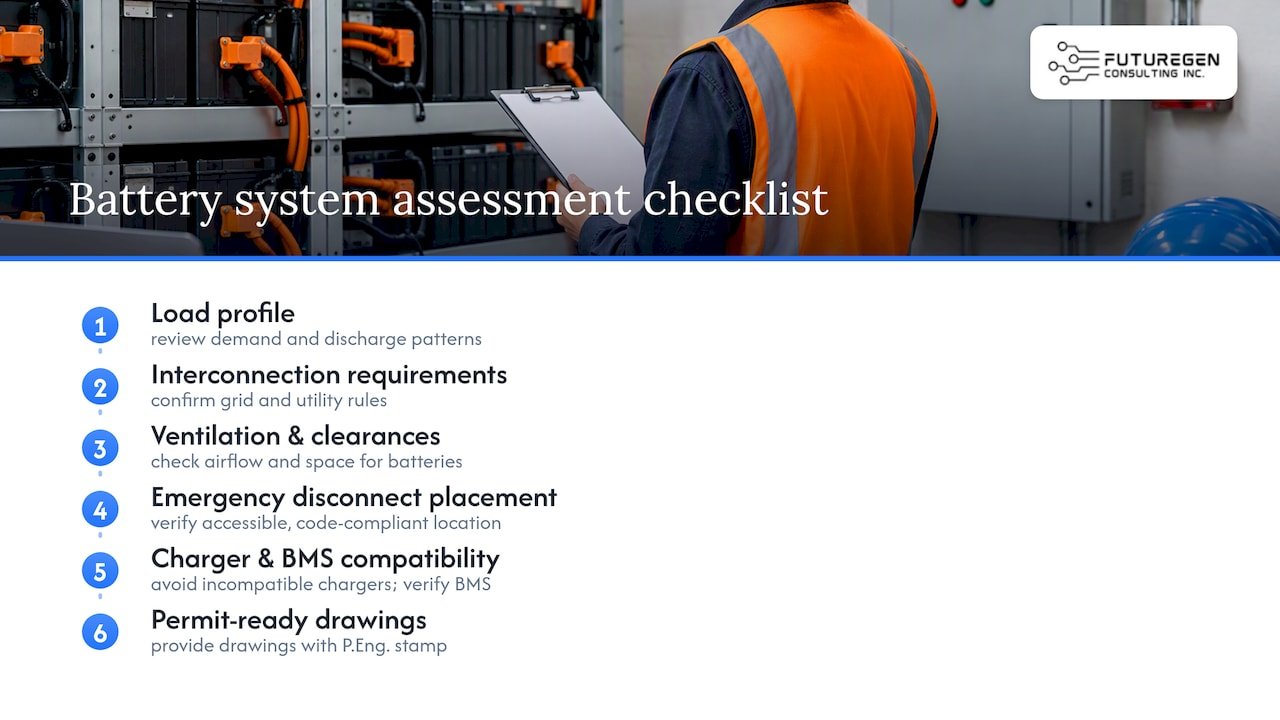
During a site assessment, we review the load profile, interconnection requirements, ventilation and clearance provisions, and emergency disconnect placement before recommending a chemistry. Recurring pitfalls we see include reusing an incompatible charger after a lithium retrofit, skipping BMS verification, and underestimating ventilation clearances for lead-acid banks. Any grid-connected or building-integrated energy storage system typically needs permit-ready drawings and a P.Eng. stamp before installation proceeds.
An engineer’s closing take on choosing between lithium and lead-acid
Lithium LFP suits daily cycling and space-constrained jobs; lead-acid still earns its place in low-cycle backup where upfront cost rules. Neither choice should bypass Canadian Electrical Code review, and any grid-tied or building-mounted system benefits from a professional engineering review before equipment selection locks in.
— Sanjay
How FutureGen Consulting supports battery and energy storage projects
Choosing a battery chemistry is only part of a compliant installation. We provide power distribution engineering, emergency power design, EV charger infrastructure design, and solar power system design for residential and commercial projects, with permit-ready, engineer-stamped drawings that address Canadian Electrical Code requirements for energy storage installations.

Our review covers load calculations, interconnection requirements, ventilation and clearance compliance, and emergency disconnect placement, so the resulting design is constructible and code-compliant from the first submission.
- Power distribution and interconnection design for battery-integrated electrical systems
- Emergency power and backup system design sized to the building’s actual load profile
- EV charger infrastructure design that accounts for site electrical capacity
- Solar-plus-storage system design matched to inverter and charger specifications
| Service | Outcome |
|---|---|
| Power Distribution | Interconnection design that meets Canadian Electrical Code requirements |
| EV Charger Infrastructure Design | Site capacity assessment for charging and storage integration |
| Solar Power System Design | Storage sized to match inverter and charger compatibility |
| Emergency Power Design | Backup systems sized to actual building load |
For a deeper technical comparison between lithium chemistries, the LFP vs NMC battery comparison from Yacht Consulting Group offers additional engineering context. When you are ready to move from chemistry selection to a permit-ready design, request a consultation through our power system studies team to start your site assessment.
FAQ
Is lithium better than lead-acid for most applications?
For frequent cycling applications like solar storage, lithium LFP generally offers longer service life and higher usable capacity, as reflected in cycle retention data showing LFP cells holding about 97% capacity after 2,000 cycles. Lead-acid remains a reasonable choice for infrequent backup duty where upfront cost is the overriding factor.
What are the disadvantages of a lithium-ion battery?
Lithium-ion batteries cost more upfront, require a functioning BMS for safe operation, and are regulated as dangerous goods for transport under Transport Canada’s TDG rules. Some chemistries, such as NMC and NCA, are also more thermally sensitive than LFP.
Can I just replace a lead-acid battery with lithium?
Not as a direct swap: you need to confirm inverter and charger compatibility, update charge profiles, and reassess fuse and cable sizing before installing lithium in a system designed for lead-acid. Mounting, ventilation needs, and disposal of the retired lead-acid unit under provincial hazardous waste rules also need to be addressed.
Why don’t all vehicles use lithium batteries for starting?
Traditional cranking batteries rely on lead-acid’s ability to deliver a short, very high current burst cheaply, which suits standard vehicle charging systems already designed around that chemistry. Lithium suits deep-cycle mobility applications better than cranking duty, provided the vehicle’s charger and inverter are rated to support it.
Sources
- Energy storage system guidance (Alberta) — comparative data summary
- Transporting batteries (Transport Canada)
- Degradation of commercial lithium-ion cells as a function of chemistry and cycling conditions (peer-reviewed study)
- Understanding UL 9540A and NFPA-855 (UL Solutions)
- Waste batteries factsheet (British Columbia)