
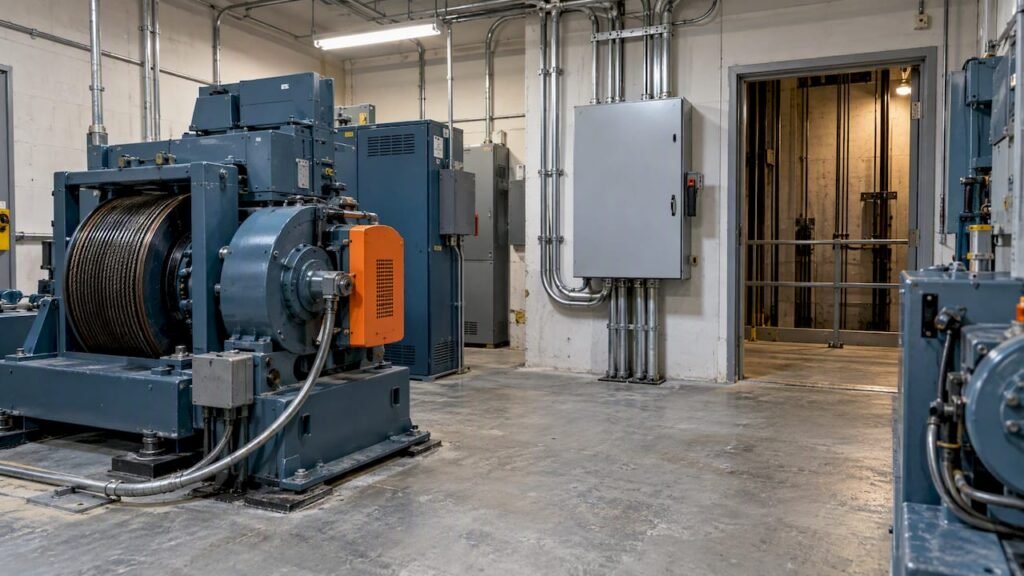
Most elevators serving storeys above the entrance level in buildings taller than 36 meters must be supplied from an emergency power source, typically a generator, once the building meets the height and life-safety thresholds set out in the National Building Code of Canada. The owner’s first move is a code review with a qualified engineer to confirm the building’s designation, then a check of existing testing and logbook records before any design work begins.
TL;DR:
- Emergency generators must supply full-load power for at least two hours for elevators serving buildings over 36 meters tall and for firefighter elevators, per the National Building Code of Canada.
- Proper sizing and sequencing of emergency power systems are critical, with oversized generators costing more and undersized ones complicating rescue timing during outages.
- Annual CSA C282 full-load testing and meticulous logbook recordkeeping are essential to passing inspections and avoiding compliance gaps.
- Occupant evacuation elevators require continuous emergency power for communication, signage, and lighting during emergencies, especially for accessibility needs.
- Engineering oversight ensures compliance by verifying load calculations, sequencing logic, and proper documentation, ultimately reducing permit delays and safety risks.
Table of Contents
- Which codes and standards determine elevator emergency power requirements
- Generator, UPS, or ARD: choosing the right backup approach
- Sizing capacity and sequencing elevators on emergency power
- Testing, maintenance, and recordkeeping owners must track
- Occupant evacuation elevators and accessibility during emergencies
- What building owners and facility managers should do next
- Why an engineering consultant matters for emergency power compliance
- Balancing safety, cost, and compliance in emergency power decisions
- How FutureGen Consulting supports elevator emergency power compliance
- FAQ
- Sources
Which codes and standards determine elevator emergency power requirements
Three bodies of regulation govern this area, and each plays a distinct role. ASME A17.1 and its Canadian counterpart, CSA B44, set the design and operational rules for elevators, including how a car must behave once it transfers to an emergency supply and how that behavior gets tested and certified. The National Building Code of Canada requires an emergency generator capable of running at full load for a minimum duration required by the National Building Code of Canada for elevators serving storeys above the first storey in buildings more than 36 meters high, and for firefighter elevators regardless of height.

CSA C282 governs the emergency electrical power supply itself: generator sizing philosophy, transfer switch behavior, and the annual testing and logbook obligations that follow once the system is installed. Ontario’s Electrical Safety Authority publishes bulletins that interpret CSA C282 for local enforcement, clarifying when a test counts as routine maintenance and when it triggers a formal notification of work. Owners who treat these three sources as one connected system, rather than separate paperwork exercises, avoid most of the compliance gaps inspectors flag.
Generator, UPS, or ARD: choosing the right backup approach
The right system depends on run time, load, and how the elevator’s drive behaves once utility power drops. Each option fits a different risk profile.
- Emergency generators supply the two-hour, full-load capacity that the National Building Code requires for elevators in taller buildings and for firefighter elevators. They remain the default choice wherever code mandates sustained life-safety power.
- UPS and battery systems cover shorter gaps, typically enough to complete a rescue operation or hold emergency lighting until a generator starts, but they rarely carry the capacity for continuous elevator operation.
- Automatic rescue devices (ARDs) move a stalled car to the nearest floor and open the doors during a power interruption, a function distinct from sustained emergency operation and often paired with, not substituted for, a generator.
Modern elevator drives complicate the UPS and battery option because regenerative drives can feed power back toward the supply, which creates power quality issues that a standard UPS was never built to absorb. Buildings exploring energy storage or vehicle-to-building sources as a supplement should treat that pairing as a plan-review trigger, since it changes transfer switch logic and may require additional engineering sign-off. A detailed look at generator sizing and design choices is worth reviewing before committing to any one approach.
Sizing capacity and sequencing elevators on emergency power
Sizing starts with a decision every owner should understand before an engineer presents a single-line diagram: will the emergency source run every elevator in the bank simultaneously, or will it serve them in sequence? A generator sized for full-building elevator load costs more and runs less often at capacity, while a selectively assigned system costs less upfront but demands precise sequencing logic to stay code-compliant.
Sequencing itself follows a defined pattern under elevator emergency operation rules. Phase I recall sends cars to a designated floor automatically, and where one generator cannot power an entire group, the system must assign power in sequence rather than attempt to run every car at once, with manual switches available for fire department central control.
- Request a load schedule that itemizes every elevator motor, lighting circuit, and control load tied to the emergency bus.
- Review the single-line diagram showing how the transfer switch isolates emergency circuits from normal power.
- Confirm the sequencing logic in writing, including which car recalls first and how manual override works for fire service use.
- Ask for a written test plan tied to commissioning, not just a verbal commitment to test later.
Pro Tip: Undersizing a single generator to save on upfront cost often forces more complex sequencing later, which raises the chance of a rescue delay during an actual outage.
Testing, maintenance, and recordkeeping owners must track
CSA C282 requires an annual full-load test of the emergency generator, exercising the unit under its rated load rather than a light idle run, and the results belong in a logbook that inspectors and the Electrical Safety Authority expect to review on demand. Ontario guidance also clarifies that certain routine test activities do not require a separate notification of work, provided a current CSA C282 logbook is available for inspection.
Owners frequently fail inspections for incomplete logbooks rather than equipment failure. Investing in accurate load-bank testing and documentation reduces both permit risk and the odds of a failed municipal inspection.
- Keep the logbook current with every test date, load percentage reached, and technician sign-off.
- Schedule the annual full-load test on a fixed calendar date rather than “when convenient.”
- Retain generator commissioning reports, elevator certification records, and transfer switch maintenance logs together for inspectors.
Occupant evacuation elevators and accessibility during emergencies
Occupant evacuation elevators, or OEEs, differ from firefighter elevators in purpose: firefighter elevators move emergency responders to a fire floor, while OEEs are built for self-evacuation by building occupants, including those who cannot use stairs. Accessibility Standards Canada ties OEE design to ASME A17.1/CSA B44 requirements covering two-way communication, signage, and minimum illumination levels inside the car and at each landing.
- Two-way communication must remain functional on emergency power throughout the evacuation period.
- Signage and lighting must meet minimum illumination levels even if normal lighting fails.
- OEE operation must be written into the building’s fire safety plan and any personal emergency evacuation plans (PEEPs) for occupants with mobility limitations.
Engineers designing these systems need to coordinate emergency lighting circuits with the elevator’s emergency power feed so illumination and communication survive the same outage that triggers the evacuation.
What building owners and facility managers should do next
A compliance gap rarely announces itself until an inspection or an actual outage exposes it, so the sequence below moves from information-gathering to engagement.
- Pull every existing record: generator specifications, UPS or ARD documentation, and the elevator’s emergency designation under the building permit.
- Arrange a compliance review with an engineer who can confirm whether the building’s height and occupancy trigger NBC emergency generator requirements.
- Schedule any overdue full-load tests and assemble the CSA C282 logbook before the next inspection cycle.
- Ask prospective engineers or contractors about direct CSA C282 testing experience, permit coordination history, and load-bank testing capability.
Pro Tip: Ask any contractor bidding on generator work to show a completed CSA C282 logbook from a past project before awarding the contract.
Why an engineering consultant matters for emergency power compliance
Emergency power design sits at the intersection of elevator code, electrical code, and fire safety planning, which is why it benefits from engineering oversight rather than contractor judgment alone. FutureGen Consulting has delivered mechanical and electrical engineering design across Ontario for over 30 years, producing permit-ready, engineer-stamped drawings for emergency power systems that municipal reviewers can approve without repeated revision cycles. A contractor can install a generator, but an engineer verifies load calculations, sequencing logic, and code mapping before equipment ever gets ordered, which is the step that prevents a failed inspection months later.

Balancing safety, cost, and compliance in emergency power decisions
The temptation to undersize a system or defer a full-load test always looks cheaper in the short term, until a failed inspection or a stalled rescue proves otherwise. Documented testing and a code-experienced engineer brought in early cost less than a permit delay or an occupancy hold, and they are the two decisions that most reliably separate a compliant building from one carrying hidden risk.
— Sanjay
How FutureGen Consulting supports elevator emergency power compliance

FutureGen Consulting designs emergency power systems, conducts power system studies, and prepares permit-ready documentation that moves through municipal review without the back-and-forth that undersized or poorly sequenced designs tend to invite. Where a building already has a generator, FutureGen can coordinate load-bank testing and logbook preparation so existing equipment meets CSA C282 before an inspection finds the gap first. Building owners and facility managers ready for a compliance review can start with FutureGen’s emergency power design services to confirm what their building needs and what documentation is missing.
FAQ
What are the emergency power requirements for elevators?
Elevators serving storeys above the first storey in buildings more than 36 meters high, and firefighter elevators regardless of height, must run from an emergency generator capable of full-load operation for at least two hours under the National Building Code of Canada. CSA C282 then governs how that generator is sized, tested, and documented once it is installed.
Do elevators work on emergency power?
Yes, where the building’s height and elevator designation trigger the requirement, the elevator transfers to the emergency supply and operates under a defined sequence rather than running normally. Systems that cannot power every car at once must automatically assign emergency power in sequence and recall cars to a designated floor.
What is the 3/4 rule for elevators?
There is no recognized “3/4 rule” in ASME A17.1, CSA B44, or the National Building Code of Canada governing elevator emergency power; this phrase does not correspond to a defined code provision. Owners encountering the term should ask their engineer for the specific code clause being referenced rather than assume a standard requirement.
Do elevators need three-phase power?
Most mid-rise and high-rise elevator installations use three-phase power because the motor loads involved require it, but the exact requirement depends on the elevator’s drive system and the building’s electrical service design. An engineer reviewing the load schedule can confirm the service type the specific installation requires.
Sources
- ESA requirements for mandatory testing and maintenance of existing emergency generators required by the Ontario Building Code Rules 2-003, 2-004
- Application and installation requirements for emergency generators: The discussion continues – IAEI Magazine
- 3016.9 Elevator Operation on Emergency Power
- 22. Annex E: Elevators – Accessibility Standards Canada