

A Request for Information (RFI) is the formal, documented query contractors use during construction to get a timely clarification that protects schedule, quality, and contractual entitlement. The contractor typically initiates the request, and the architect or a relevant consultant provides the answer, often coordinating with the project manager before issuing a response. We rely on a disciplined RFI process because unresolved ambiguity on drawings or specifications translates directly into schedule risk, cost exposure, and disputes over entitlement.
TL;DR:
- A clarification that leaves price and time unchanged returns as a Supplemental Instruction; changes to either move into the Proposed Change or Change Order process.
- Each RFI should address one issue and cite drawing or specification references, location, supporting photos or markups, and a proposed interpretation when available.
- Submit questions before affected work proceeds, after checking drawings, specifications, and addenda; late requests can weaken later claims for added time or cost.
- Routine responses often take a few business days, while requests requiring multiple disciplines or a site visit can take two to three weeks.
- Teams should prioritize RFIs affecting the critical path, seek same day acknowledgment for urgent items, and review the backlog weekly with contractors, architects, and consultants.
Table of Contents
- RFI Roles and Where They Fit in Contract Administration
- Step-by-Step RFI Workflow From Identification to Closeout
- What Every RFI Should Include to Avoid a Second Round of Questions
- When an RFI Makes Sense and When It Does Not
- Best Practices That Shrink Turnaround Time and Cut Repeat Requests
- Choosing Tools That Keep RFI Volume Under Control
- How RFI Delays Translate Into Schedule and Cost Risk
- Checklists and Coordination Workflow That Reduce MEP-Related RFIs
- Balancing Responsiveness With Document Quality
- How We Help Reduce RFIs and Speed Permit Approvals
- FAQ
- Sources
RFI Roles and Where They Fit in Contract Administration
An RFI is a written request for clarification on a design document, specification, or site condition that the contract documents do not resolve on their own. Common use cases include conflicting dimensions between architectural and structural drawings, a missing spec section for a specified product, or a site condition that differs from what the drawings show. Each of these situations creates a gap that someone with design authority has to close before work can proceed correctly.
The roles involved follow a predictable pattern. The general contractor or a subcontractor identifies the issue and drafts the RFI. The architect of record typically owns the response and coordinates with structural, mechanical, electrical, or plumbing consultants when the question touches their discipline. The project manager or owner’s representative tracks the request, confirms it reached the right reviewer, and signs off once the answer is distributed to the project record. The OAA Practice Advisory on responding to RFIs confirms that the architect holds responsibility for providing answers and coordinating with consultants when the scope of the question requires it.
An RFI is not the only document in a contractor’s toolkit, and confusing it with a submittal or a change order causes delays of its own.
- RFI: seeks clarification on an ambiguity in the contract documents and does not, on its own, change scope, price, or schedule.
- Submittal: provides shop drawings, product data, or samples for the design team to review against the specifications before fabrication or installation.
- Change order: formally modifies the contract price, time, or scope, often triggered when an RFI response reveals that the original design needs to change.
Under standard Canadian contract administration frameworks such as the CCDC 2 Stipulated Price Contract, an RFI response that simply clarifies intent is issued as a Supplemental Instruction, while a response that affects cost or time moves into the Proposed Change or Change Order process. Keeping these three documents distinct protects everyone’s paper trail when a dispute over entitlement eventually surfaces.
Step-by-Step RFI Workflow From Identification to Closeout
A consistent workflow turns the RFI process from a source of friction into a predictable administrative routine. The sequence below reflects how most Canadian commercial projects handle requests under CCDC-style contract administration.
- Identify the gap. Before drafting anything, confirm the drawings, specifications, and any prior addenda do not already answer the question, and note what you checked.
- Draft a single-issue request. Write one clear question per RFI, reference the specific drawing number or spec section, and attach photos or markups that show the conflict.
- Route to the right reviewer. Submit through the project’s designated channel so the request reaches the architect or the consultant whose discipline the question touches, with the project manager copied for tracking.
- Review and coordinate. The architect or consultant evaluates the question, pulls in other disciplines if the answer affects their work, and drafts a response.
- Respond with the correct instrument. A clarification that does not change price or time comes back as a Supplemental Instruction; an answer that does alter cost or schedule triggers a Proposed Change or Change Order, consistent with CCDC 2 contract administration procedures.
- Close the loop. The contractor acknowledges receipt, confirms the answer resolves the field condition, and the project record gets updated so the response is reflected in as-built documentation.
The handoff between steps five and six is where projects most often lose the thread. An RFI that quietly becomes a change order without a documented Change Order reference creates confusion later about whether the contractor had proper authorization to proceed, and that gap is exactly what our guide to construction change orders addresses for owners and contractors managing that transition. The CCA Construction Playbook recommends that contractors use RFIs proactively, raising questions about ambiguous performance specifications before work begins rather than after, since clarifying intent in advance prevents both costly delays and the risk of performing additional scope without compensation.
What Every RFI Should Include to Avoid a Second Round of Questions
An RFI that is missing context forces a reviewer to ask a follow-up question before they can answer the original one, which doubles the cycle time for no good reason. A complete request includes the following fields as a baseline.
- Project identification: project name, RFI number in sequence, date issued, and the requester’s name and company.
- Location reference: the specific area, floor, room, or grid line the question concerns.
- Document references: drawing numbers, revision dates, and spec section numbers tied directly to the question.
- Supporting evidence: photos, markups, or a short sketch showing the conflict or missing detail.
- A proposed answer or options: when the requester has a reasonable interpretation, stating it speeds up the reviewer’s decision.
Sample forms based on the AIA G716 format and the CHOP excerpt on RFIs illustrate how these fields fit into a standard layout, and most project management platforms replicate this structure directly in their RFI module. A short sample framing might read: “Drawing A-201 shows a 200 mm gap between the curtain wall mullion and the structural column at grid line C4, while structural drawing S-302 shows no clearance allowance. Please confirm which dimension governs.” That single sentence gives the reviewer the location, the conflicting documents, and the specific decision needed.
Pro Tip: Keep one issue per RFI, even when two problems sit on the same drawing; bundling unrelated questions slows down the reviewer and makes the response harder to trace back to a single answer.
When an RFI Makes Sense and When It Does Not
RFIs exist to resolve genuine ambiguity, not to shift design responsibility onto the architect or to create a paper trail for a claim that has little basis. Knowing the difference protects both the schedule and the relationship between contractor and design team.
Appropriate situations include:
- Drawings from two disciplines conflict on a dimension, elevation, or material callout.
- A specification section references a product or standard that was never actually included in the documents.
- Field conditions differ from what the drawings represent, such as an unmarked utility line or an unexpected structural element.
Less appropriate uses include asking the architect to design a detail the contractor was expected to coordinate, or submitting a question the drawings already answer because the field team did not check first. Timing matters for entitlement: an RFI submitted after the work in question has already proceeded weakens any later claim for additional time or cost, so documenting the research done and the assumption made before submitting strengthens the contractor’s position if the answer eventually supports a change. Recognizing this pattern, some project teams include supplementary conditions, as described in the OAA Practice Advisory on managing RFI administrative burden, that allow the architect to flag unnecessary RFIs and recover administrative costs above a set threshold, which discourages using the process as a substitute for basic document review.
Best Practices That Shrink Turnaround Time and Cut Repeat Requests
Teams that handle RFIs well treat the process as a quality system rather than a formality to get through. A few habits consistently separate projects with tight RFI cycles from ones where requests pile up unanswered.
- Standardize the template. Require every field from the checklist above before a request leaves the field office, and reject incomplete submissions at intake rather than after a reviewer has already opened the file.
- Set response SLAs. Define a short acknowledgment window, typically within a reasonable business period, and a substantive response window tied to the urgency of the question, with a clear escalation path if a reviewer misses it.
- Triage by impact. Sort incoming requests into critical-path, high-priority, and routine categories so the reviewer’s time goes to the requests actually blocking work.
- Hold a weekly RFI review. Bring the contractor, architect, and relevant consultants together on a fixed cadence to clear the backlog and catch any request that is aging without a response.
- Feed lessons back into the documents. When the same question comes up twice across similar projects, treat it as a signal that the design document checklist needs an update before the next milestone.
A documented triage rubric that sorts requests by trade, critical-path impact, and long-lead-item status, paired with an escalation SLA for critical requests, meaningfully reduces the delays that come from critical-path RFIs sitting unanswered, according to research quantifying RFI time and cost impacts. That triage step matters more than any single software feature, because it determines which requests actually get a reviewer’s attention first.
Choosing Tools That Keep RFI Volume Under Control
Most mid-size and large projects now manage RFIs through some combination of field apps, document management systems, and integrated project management platforms, each suited to a different part of the workflow. Field apps excel at capturing the request at the point of discovery, letting a site superintendent photograph a conflict and draft the question on a tablet before leaving the area. Document management systems handle the version control and audit trail once the RFI enters formal review. Integrated project management platforms tie the RFI into the broader schedule, so a critical-path request automatically flags its potential effect on the completion date.
Whichever category a team chooses, a few features matter more than the rest.
- Drawing markup tools that let the requester annotate directly on the relevant sheet rather than describing the conflict in prose alone.
- A full audit trail showing every date, reviewer, and revision tied to the request.
- Routing rules that send mechanical questions to the mechanical consultant automatically rather than through a generalist inbox.
- Scheduling integration that flags when an open RFI sits on or near the critical path.
Tracking the right metrics matters as much as the tool itself. Useful indicators include open RFI counts by trade, average response time against the SLA, the percentage of RFIs that convert into change orders, and an aging heatmap that highlights requests sitting unanswered past a set threshold. A pre-RFI checklist at intake, batching related questions from the same drawing set, and a fixed weekly coordination meeting round out the operational controls that keep volume manageable rather than letting it accumulate silently.
How RFI Delays Translate Into Schedule and Cost Risk
Response times for RFIs on active Canadian commercial projects typically fall somewhere between a few business days for routine clarifications and two to three weeks for requests that need multi-discipline coordination or a site visit. A request sitting on the critical path consumes float with every day it goes unanswered, and once the float is gone, the delay shows up directly in the completion date.
Research measuring the time and cost impact of the RFI process has found that RFIs impose measurable schedule and cost consequences on construction projects, reinforcing why fast, well-documented responses matter on critical-path items. That finding, drawn from research quantifying RFI time and cost impacts, lines up with what most contract administrators already see in practice: an unanswered RFI rarely stays a documentation issue for long. It becomes a labor-cost issue when crews stand idle waiting on a decision, and a cost issue when the eventual answer requires a change order negotiated under time pressure rather than through a structured review. Accurately tracking crew hours lost to an RFI delay also matters for substantiating any resulting claim, which is where disciplined field time tracking earns its place in the broader documentation chain. Mitigation tactics for critical-path RFIs include flagging them at submission, routing them for same-day acknowledgment, and holding a dedicated coordination call rather than waiting for the weekly review cycle.
Checklists and Coordination Workflow That Reduce MEP-Related RFIs
Mechanical, electrical, and plumbing coordination generates a disproportionate share of RFIs on most commercial projects, largely because three or more disciplines are drawing in the same ceiling space and conflicts surface late if no one checks early. Our 6-Step P.Eng and BIM Electrical Coordination Checklist walks developers through the sequence we use to catch clearance conflicts, load discrepancies, and missing panel schedules before they reach the field as an RFI.
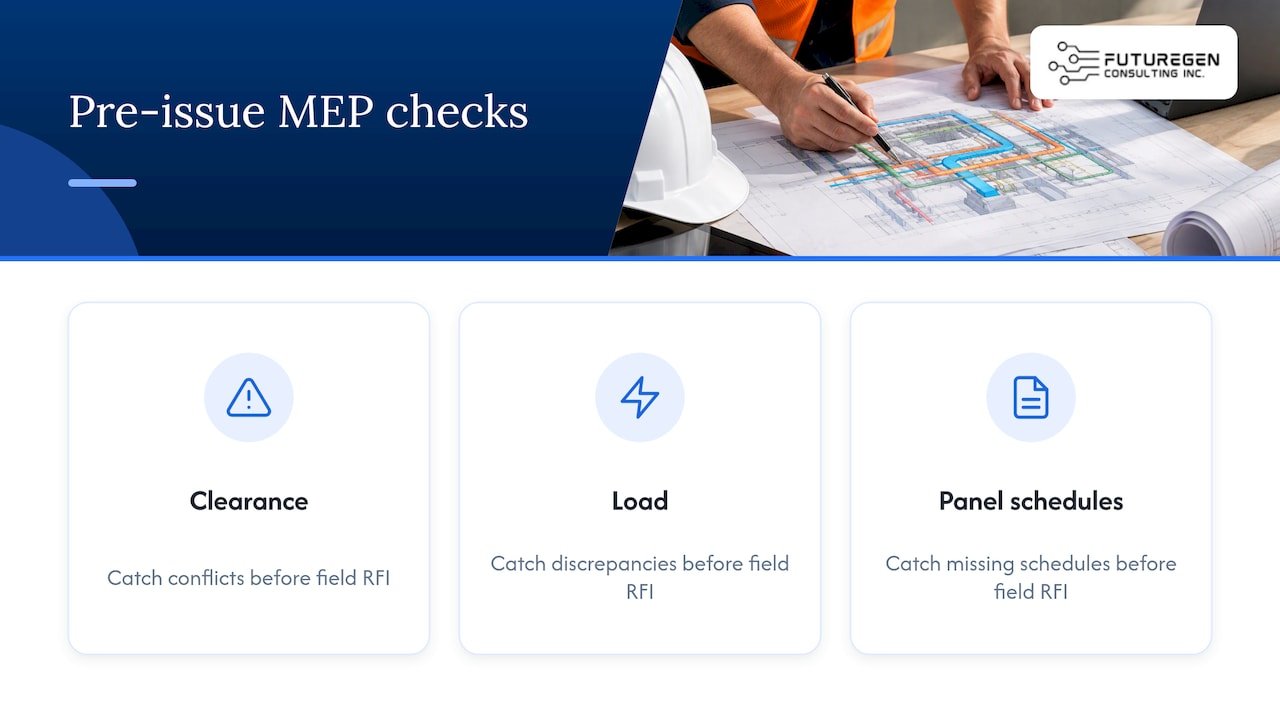
Prevention works better earlier in the schedule than reaction does later, which is why we built our coordination cadence around a weekly review rather than an as-needed one. The BIM weekly workflow we follow for MEP coordination sets a fixed checkpoint for reviewing clashes across disciplines before they harden into an RFI, and our seven-item weekly MEP coordination checklist gives project managers a short, repeatable list to run through at that checkpoint.
When RFIs do arrive, we sort them using a simple triage rubric: critical-path items affecting active work go first, long-lead equipment questions go second, and routine clarifications fill the remaining review time. Once an answer is issued, we confirm it is reflected in the as-built record so the final documentation matches what was actually built.
Pro Tip: Run the MEP coordination checklist before issuing drawings for permit, not after; catching a clash during the weekly BIM review costs a markup session, while catching the same clash through an RFI during construction costs field time and a change order.
Balancing Responsiveness With Document Quality
The RFI failure mode we see most often is not a slow response. It is a request that never needed to exist, because a clash review would have caught the conflict months earlier at a fraction of the cost. Prevention through better documents and earlier coordination consistently beats speed on the back end, no matter how tight the response SLA is. Our checklists exist because the cheapest RFI is the one nobody has to write.
— Sanjay
How We Help Reduce RFIs and Speed Permit Approvals
We design mechanical, electrical, and plumbing systems with the clash reviews and documentation completeness that help keep RFIs rare rather than routine, aiming to reduce stalled crews and speed permit turnaround on construction projects.

Our relevant services for teams looking to cut RFI volume at the source include:
- Construction Review to help catch conflicts during construction before they reach the field as formal requests.
- HVAC System Design Services, offered with engineer-stamped drawings intended to reduce clarification gaps that might otherwise prompt requests from contractors.
- Power Distribution and related electrical services, coordinated with mechanical and architectural drawings prior to issue to minimize conflicts.
If RFI delays or document gaps have slowed a current project, reach out through our services page to discuss permit-ready MEP design for your next build.
FAQ
What does RFI stand for in construction?
RFI stands for Request for Information, a formal written question a contractor or subcontractor submits to the design team to clarify an ambiguity in the drawings, specifications, or site conditions. It is distinct from a submittal, which seeks approval of a product or shop drawing, and from a change order, which modifies the contract itself.
How long does the RFI process typically take?
Routine RFIs are usually answered within a few business days, while more complex requests needing multi-discipline coordination or a site visit can take longer. Research on RFI time and cost impacts confirms that delays in this process carry measurable schedule and cost consequences, which is why setting clear response SLAs matters.
What are the different types of RFIs in construction?
Common categories include clarification RFIs for ambiguous drawings, information requests for missing specification detail, and design discrepancy RFIs for conflicts between disciplines. Each type typically gets resolved through a Supplemental Instruction unless the answer changes price or time, in which case it becomes a Proposed Change under CCDC contract administration procedures.
What is an RFI in quality control?
In a quality control context, RFI volume and aging serve as a lagging indicator of document completeness and design coordination quality rather than a separate process. Tracking RFI counts by trade and the percentage that convert into change orders helps a project team identify where constructability reviews need to improve before the next design milestone.
How should a team decide whether to submit an RFI?
A team should submit an RFI only after confirming the drawings, specifications, and prior addenda do not already answer the question, since documenting that research protects entitlement if the answer later justifies a change. The CCA Construction Playbook recommends raising ambiguous performance specification questions before work begins rather than after, to avoid both delays and uncompensated scope.
Sources
- CCA Construction Playbook (Canadian Construction Association)
- OAA Practice Advisory: Responding to Requests for Information (CHOP excerpt)
- CCDC 2 – Stipulated Price Contract (Canadian Construction Documents Committee)