
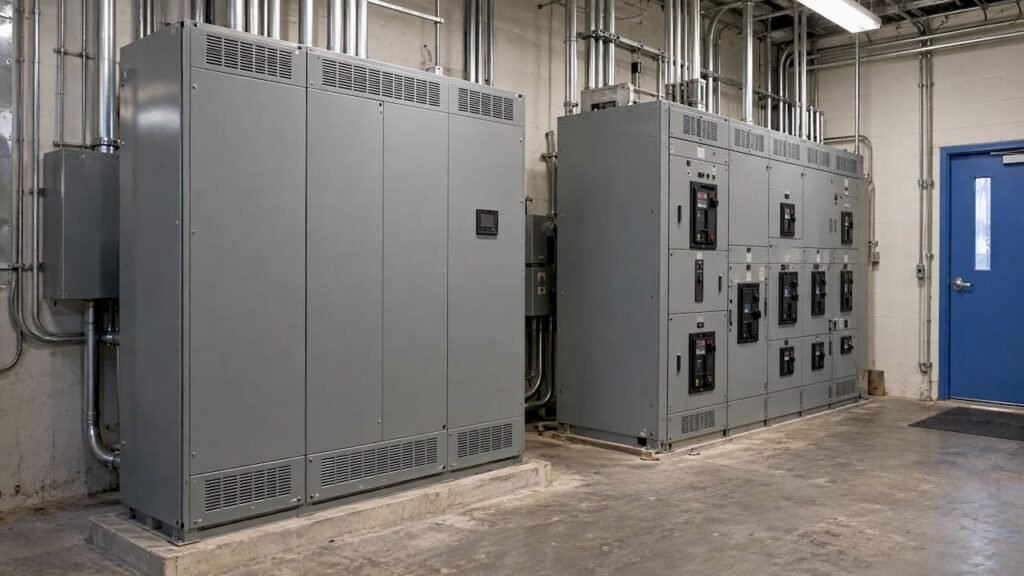
A switchboard is a front-accessible, fixed-breaker distribution assembly rated for lower-voltage service, while switchgear is a compartmentalized assembly built around drawout breakers that handles higher fault currents and more demanding protection schemes. The distinction matters at the specification stage: CSA C22.2 No. 244 governs switchboards up to 1,000 V, and CSA C22.2 No. 31 governs switchgear assemblies up to 46 kV. We rely on both standards daily when preparing power distribution drawings for Ontario and Alberta projects.
TL;DR:
- CSA C22.2 No. 244 covers switchboards rated at 1,000 V or less, while CSA C22.2 No. 31 covers switchgear assemblies up to 46 kV.
- Switchgear power breakers withstand roughly 30 cycles, compared with three cycles for switchboard breakers, supporting selective coordination across multiple downstream panels.
- Drawout breakers can be serviced without deenergizing the rest of the bus, while fixed switchboard breakers generally require a planned shutdown.
- Ontario projects may require ESA plan review when feeders exceed 1,000 A; confirm utility metering early, since Hydro One requires a UMC in service entrance switchgear.
- Before ordering, verify the CSA mark and nameplate short circuit rating against calculated fault current, and involve an engineer when coordination remains uncertain.
Table of Contents
- What Is a Switchboard?
- What Is Switchgear, and How Does It Differ?
- Design, Protection, and Maintenance: The Technical Differences
- Where Each Assembly Type Fits a Project
- A Step-by-Step Checklist for Specifying the Right Equipment
- FutureGen Consulting’s Role in Power Distribution Specification
- The Practical Takeaway for Specifiers
- An Engineer’s Note on Cost Versus Fit
- How We Help You Choose and Specify the Right Equipment
- FAQ
- Sources
What Is a Switchboard?
A switchboard is a dead-front or open-chassis assembly that distributes power through bus bars to a bank of fixed-mounted molded-case circuit breakers (MCCBs). Metering, basic overcurrent protection, and feeder breakers sit behind a single accessible panel, which keeps the footprint compact and the installed cost lower than a comparable switchgear line-up.
Under CSA C22.2 No. 244, switchboards are nominally rated at 1,000 V or less, and the standard aligns with UL 891 testing requirements that specifiers commonly reference on equipment nameplates. Some clauses reference available symmetrical short-circuit currents up to 200,000 amperes, which covers most commercial and light industrial feeders.
Typical switchboard characteristics include:
- Front-only access, which allows wall mounting or placement against a wall in tight electrical rooms.
- Fixed breakers bolted or plugged into the bus, with no drawout mechanism.
- Shorter lead times and lower unit cost compared to an equivalent switchgear line-up.
What Is Switchgear, and How Does It Differ?
Switchgear is a compartmentalized assembly that houses drawout air or power circuit breakers, protective relays, and metering inside individually isolated cells. Each breaker can be withdrawn for inspection or replacement without disturbing adjacent compartments, which is the defining feature that separates switchgear from a switchboard.
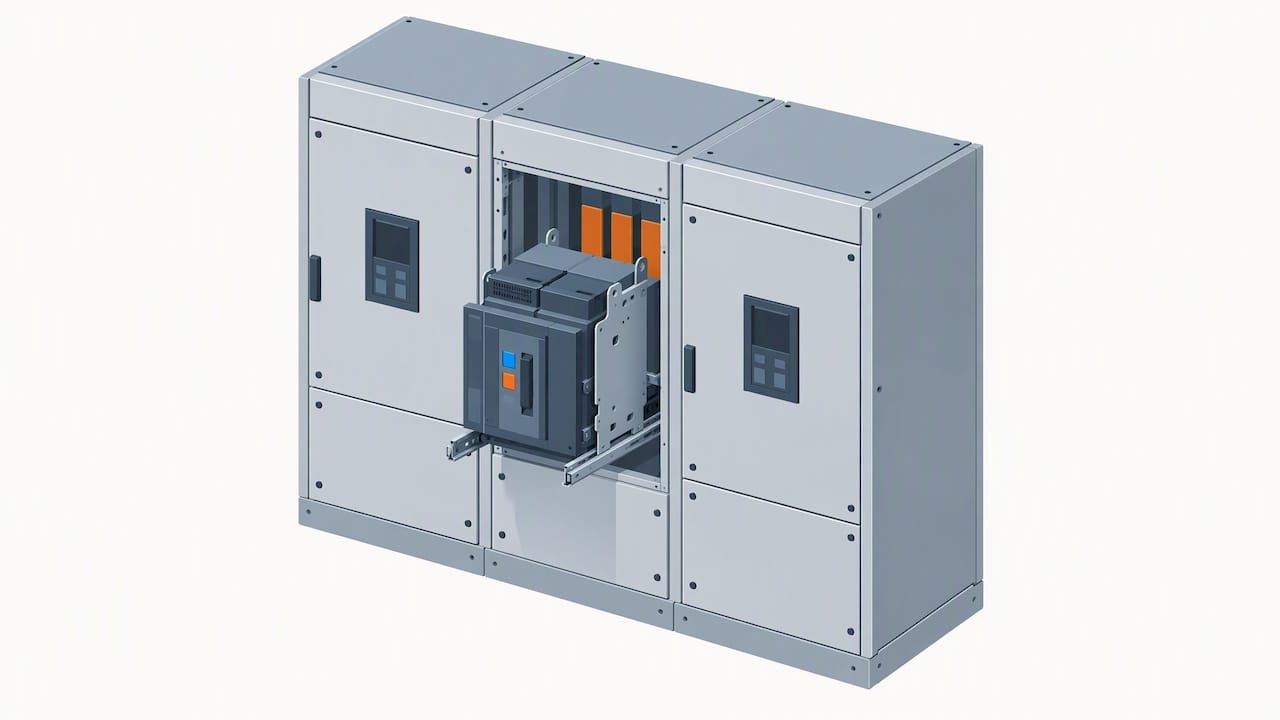
CSA C22.2 No. 31 sets requirements for switchgear assemblies with nominal voltages up to 46 kV and distinguishes low-voltage clauses from high-voltage clauses within the same standard. That voltage range makes switchgear the default choice at the service entrance for buildings drawing utility power at medium voltage, and for facilities where an outage carries real consequences.
Key switchgear features include:
- Drawout breaker construction, enabling maintenance on one unit while adjacent feeders stay live.
- Higher short-time withstand ratings that support selective coordination across multiple protection tiers.
- Arc-resistant enclosure options for installations where personnel safety during a fault event is a design priority.
Design, Protection, and Maintenance: The Technical Differences
The construction gap between the two assembly types drives every downstream decision a specifier makes, from fault-current coordination to how long a facility stays offline during service.
- Bus exposure: Switchboards typically expose bus bars behind a single front panel, while switchgear compartmentalizes bus, breakers, and relays into separate cells that limit fault propagation between sections.
- Short-time rating: Fixed-mounted MCCBs in switchboards carry a three-cycle short-time tolerance, while drawout power circuit breakers in switchgear are rated for roughly 30 cycles, which supports more aggressive selective coordination schemes.
- Maintenance access: A switchboard generally requires a planned shutdown to service a breaker, while a drawout breaker in switchgear can be racked out and replaced with the rest of the bus energized.
- Arc-flash mitigation: Arc-resistant construction and remote racking are standard options in switchgear; switchboards offer far fewer arc-flash mitigation features by design.
- Footprint and access: Switchboards need front clearance only, which suits wall-mounted installations in finished electrical rooms, while switchgear typically requires front and rear (or front and side) access for breaker withdrawal and cable terminations.
The three-cycle versus 30-cycle short-time rating gap is the single technical fact that most often decides between the two assembly classes, since it determines whether a facility’s protection scheme can support true selective coordination across multiple downstream panels without nuisance tripping.
These differences explain why switchgear costs more per ampere of capacity: the compartmentation, drawout mechanisms, and higher short-time ratings all add material and labor that a switchboard does not need.
Where Each Assembly Type Fits a Project
Switchboards handle building-level distribution, tenant metering, and cost-sensitive commercial fit-outs where a planned maintenance shutdown is acceptable. They remain the default for mid-rise commercial buildings, retail distribution, and light industrial feeders that fall within the 1,000 V scope of CSA C22.2 No. 244.
Switchgear takes over at the service entrance for hospitals, data centers, utilities, and heavy industrial sites where downtime has a direct operational or life-safety cost. A guide to power transitions for data center builds illustrates how mission-critical facilities plan redundant power paths around switchgear’s drawout capability rather than around a simpler switchboard.
Many projects use both in sequence:
- Utility-metered switchgear at the service entrance feeds downstream switchboards and motor control centers.
- Switchboards then distribute to panelboards on individual floors or tenant spaces.
- Emergency and standby power systems often connect through dedicated switchgear sections to isolate critical loads from normal feeders.
A Step-by-Step Checklist for Specifying the Right Equipment
Work through these steps before issuing a specification or RFQ:
- Confirm system voltage and fault current at the point of connection, then check whether that falls within the switchboard scope of CSA C22.2 No. 244 or the switchgear scope of CSA C22.2 No. 31.
- Determine selective coordination requirements across the distribution tree, since switchgear’s longer short-time rating supports schemes that a switchboard cannot.
- Ask manufacturers about serviceability: drawout versus fixed breakers, spare compartment positions, and breaker interchangeability across the line-up.
- Verify nameplate certifications, including CSA marks and the listed short-circuit rating, against the project’s calculated fault current.
- Check utility metering requirements early, including whether a UMC is required and who supplies it, and confirm whether the project triggers ESA plan review.
- Request lead times and modular options, since modular low-voltage switchboard products can shorten delivery schedules on tight projects.
Pro Tip: Build your RFQ questions around ratings, serviceability, and certification together, not each in isolation, so a vendor’s answer on one point cannot hide a weakness on another.
FutureGen Consulting’s Role in Power Distribution Specification
During power distribution design, we review single-line diagrams, confirm fault-current calculations against proposed equipment ratings, and check shop drawings for CSA compliance before issuance. We also coordinate utility metering requirements, including UMC placement, directly with the serving utility and manage ESA plan-review submissions where feeder or service thresholds apply. A power system study or P.Eng.-stamped drawing set becomes necessary whenever short-circuit ratings or selective coordination are in question.
The Practical Takeaway for Specifiers
The simple rule holds: choose a switchboard for front-accessible, lower-voltage distribution within standard cost and schedule constraints, and choose switchgear when drawout serviceability, higher short-time ratings, or utility-metered service entrance requirements apply. Run any ambiguous case, especially mission-critical or high-fault-current scenarios, past a qualified engineer before finalizing the specification.
An Engineer’s Note on Cost Versus Fit
A lower quoted price on a switchboard can mask a mismatch with your actual fault-current or coordination requirements, and that gap only surfaces after installation, when correcting it costs far more than the original price difference. Bringing an engineer into the coordination and code-compliance review early, rather than after equipment orders are placed, remains the most reliable way to avoid that outcome.
— Sanjay
How We Help You Choose and Specify the Right Equipment
Matching a switchboard or switchgear specification to your actual fault current, coordination needs, and utility metering requirements takes more than a nameplate comparison. Our power distribution design services cover single-line diagrams, equipment specification, and permit-ready drawings for projects across Ontario and Alberta.

When fault-current verification or selective coordination is in question, our power system studies confirm ratings before equipment is ordered. Reach out through our power distribution engineering services page to start a project review.
FAQ
What’s the difference between switchgear and a circuit breaker?
A circuit breaker is a single protective device that interrupts current during a fault or overload, while switchgear is the larger compartmentalized assembly that houses multiple breakers along with relays, metering, and bus work. Switchgear organizes and protects an entire distribution system; a circuit breaker is one component inside it.
What’s the difference between a distribution board and a switchboard?
The terms are often used interchangeably in general distribution contexts, but in Canadian engineering practice, a switchboard refers to the fixed-breaker, front-access assembly covered under CSA C22.2 No. 244. A distribution board or panelboard is typically a smaller, downstream subset that a switchboard feeds.
What is the point of a switchboard?
A switchboard distributes power from a main feed to multiple branch circuits through fixed-mounted breakers, providing metering and overcurrent protection in a compact, front-accessible assembly. It suits projects where lower installed cost and a smaller footprint matter more than live-servicing capability.
What are the two main types of switchgear used in an electrical system?
Switchgear is generally grouped by voltage class: low-voltage switchgear for systems up to 1,000 V and medium-voltage switchgear for systems extending up to the 46 kV scope defined in CSA C22.2 No. 31. The choice between the two depends on the utility service voltage and the facility’s distribution design.
Sources
Specification decisions rest on two standards and one provincial authority. CSA C22.2 No. 244 covers switchboards rated 1,000 V or less and harmonizes with UL 891 testing protocols. CSA C22.2 No. 31 covers switchgear assemblies up to 46 kV and includes separate clauses for low-voltage and high-voltage designs, which matters when a project straddles both classes on the same single-line diagram.
In Ontario, the Electrical Safety Authority requires plan review when feeders exceed 1,000 A or when consumer services or generation capacities exceed defined thresholds, a trigger that captures most switchgear and many larger switchboard installations. Utilities add their own layer: Hydro One’s metering standards require a dedicated Utility Metering Compartment (UMC) in service-entrance switchgear, with construction responsibilities split between the customer and the utility.
Before equipment ships, confirm:
- CSA C22.2 No. 244 (switchboards) / ANSI Webstore
- CSA C22.2 No. 31:23 Switchgear assemblies (ANSI / CSA listing)
- The fundamentals of low-voltage switchgear — Electrical Industry News Week
Equipment that lacks a visible CSA mark or a stamped short-circuit rating should not go to site, regardless of how the vendor’s catalog describes it.