
For most retrofits and budget-sensitive projects, a cold-climate air-source heat pump is the practical choice, offering strong performance at a fraction of the installed cost of a geothermal system. Where site conditions and budget allow, and peak-load reduction matters over the long term, a ground-source system delivers superior year-round efficiency. The right answer always depends on site constraints, available budget, and a proper heat-loss calculation rather than a blanket rule.
TL;DR:
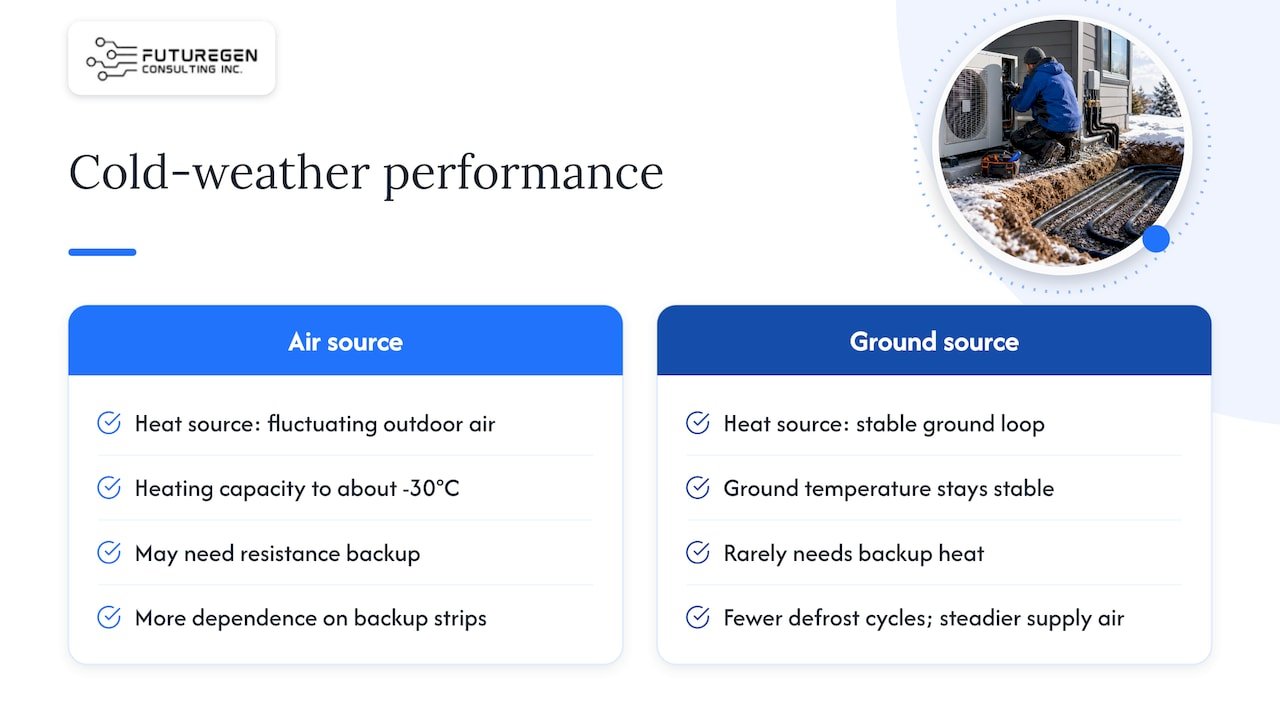
- Cold climate air source models can operate to about 30°C below zero, although extreme cold may trigger costly resistance backup if sizing is inadequate.
- Ground source systems can reach winter efficiencies up to 3.5 times an oil furnace or boiler and rarely need backup heat during severe cold.
- Ground source installations typically cost about twice as much as comparable air source systems and require loop drilling or trenching plus a specialized installer.
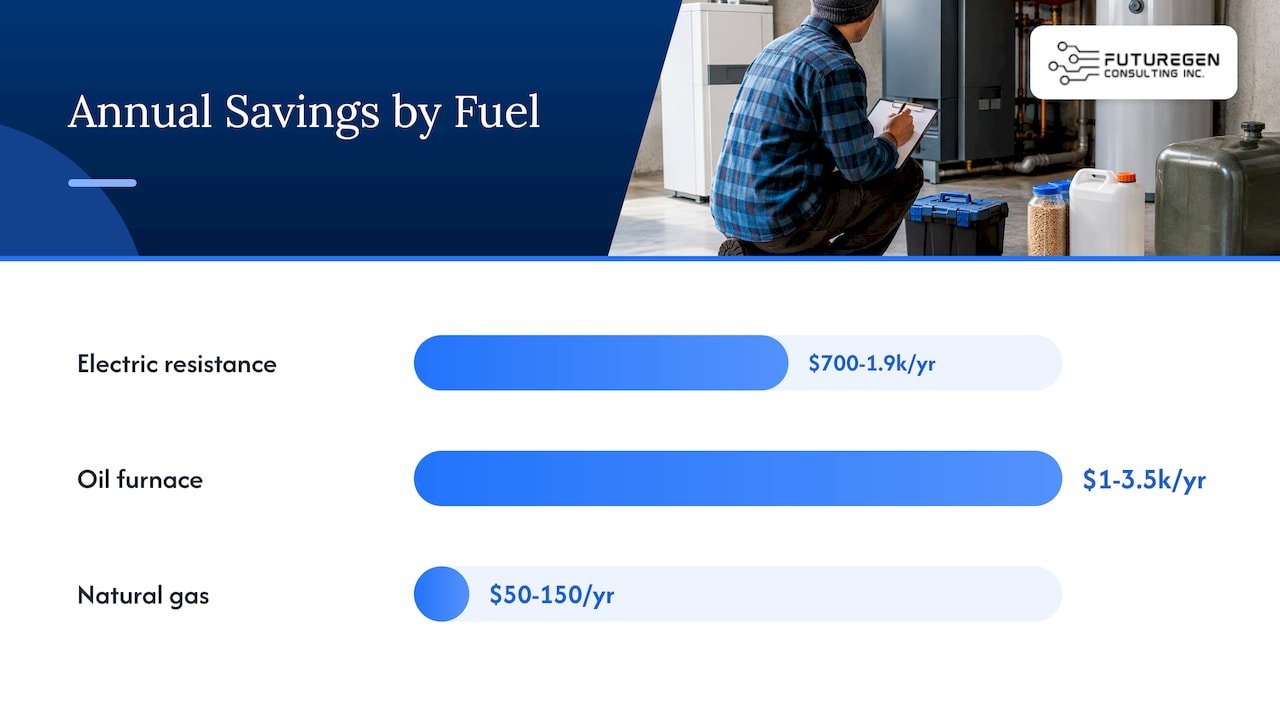
- Annual savings from replacing electric resistance heat reach $700 to $1,900, while oil replacement saves $1,000 to $3,500 and natural gas only $50 to $150.
- Request a professional heat loss calculation and expected coefficient of performance at local design temperature; fuel prices, building type, and ownership horizon shape geothermal payback.
Table of Contents
- How Air Source and Ground Source Systems Actually Compare
- Efficiency and Cold-Weather Performance
- Upfront Costs, Operating Savings, and Payback Math
- What Each System Needs on Your Site
- Sizing the System Correctly Before You Commit
- How We Scope and Document a Heat Pump Project
- Weighing Private Payback Against Grid-Level Benefits
- Get Engineering Support for Your Heat Pump Project
- FAQ
- Sources
How Air Source and Ground Source Systems Actually Compare
An air-source heat pump (ASHP) extracts heat from outdoor air and transfers it indoors through a refrigerant cycle, while a ground-source heat pump (GSHP) draws on the more stable temperature of soil or groundwater through a buried loop. That difference in heat source drives nearly every practical distinction between the two technologies.
Capacity and coefficient of performance (COP) respond differently to outdoor temperature. ASHP output and efficiency decline as outdoor air gets colder, though cold-climate models now operate effectively down to about -30°C. GSHP performance stays comparatively flat because underground temperatures barely shift with the seasons.
The practical differences homeowners notice most:
- Footprint: GSHPs need a buried loop field or borehole; ASHPs need only an outdoor condenser unit similar in size to a central air conditioner.
- Noise: ASHP outdoor units produce audible fan and compressor sound near the home; GSHPs run nearly silent outdoors since the loop is underground.
- Disruption: GSHP installation involves drilling or trenching across the yard; ASHP installation is closer to a standard HVAC swap.
- Maintenance: ASHPs follow familiar HVAC service routines; GSHPs need occasional loop and refrigerant checks from a specialized contractor.
Efficiency and Cold-Weather Performance
Efficiency is where the two systems diverge most, and cold climates sharpen that divide. Natural Resources Canada confirms that cold-climate ASHPs are built to maintain heating capacity down to roughly -30°C, a substantial improvement over older heat pump generations that lost most of their output well above 0°C.
Ground-source systems can reach efficiencies up to 3.5 times that of an oil furnace or boiler in winter conditions, a gap that reflects the stability of underground heat exchange compared with fluctuating outdoor air.
During extreme cold snaps, ASHPs may lean on electric resistance backup to maintain indoor temperature, which raises operating costs and strains local grid capacity during peak demand periods. GSHPs rarely need backup heat in the same conditions because the ground loop temperature does not drop with the weather. For occupants, this translates into fewer defrost cycles, steadier supply air temperatures, and less dependence on auxiliary heating strips when an ASHP is sized correctly for the climate zone.
Upfront Costs, Operating Savings, and Payback Math
The capital cost gap between the two systems is the single biggest factor in most decisions. HRAI notes that ground-source installations typically cost roughly double a comparable air-source or conventional system, driven by ground heat exchanger drilling, trenching, and the specialized labor that installation demands.
Operating savings depend heavily on what fuel the heat pump replaces. Replacing electric resistance heat with a cold-climate ASHP typically saves $700 to $1,900 per year, and replacing an oil furnace saves roughly $1,000 to $3,500 annually, while savings against natural gas are smaller, often just $50 to $150 a year depending on local gas prices.
CanmetENERGY’s lifecycle analysis found that cold-climate ASHPs generally beat electric resistance and oil on operating cost, but whether a GSHP pencils out over its lifecycle depends on the building archetype and fuel price assumptions, with new, highly efficient homes tending to favor geothermal over a multi-decade horizon.
Before estimating payback, gather:
- Current fuel type and recent utility bills or seasonal usage.
- Local electricity and gas rates in your service territory.
- Available rebates or incentive programs in your province.
- A contractor’s or engineer’s estimated installed cost for each option.
What Each System Needs on Your Site
- Ground-source loop field. Horizontal loops need a large, excavatable yard area; vertical boreholes need less surface space but require drilling rigs and geotechnical input on soil and rock conditions; open-loop systems need access to a suitable water source.
- Air-source outdoor unit. A compact pad or wall mount near the building envelope, with clearances for airflow and service access, usually the simplest retrofit path.
- Permitting and standards. GSHP design and installation in Canada must follow the CSA C448 standard, which governs loop sizing, geology assessment, and system commissioning.
- Contractor expertise. GSHPs call for a specialized geothermal installer familiar with loop sizing and CSA C448 requirements; ASHPs can generally be installed and serviced by a general HVAC contractor.
Readers weighing a retrofit can find more on cost drivers and sequencing in our heat pump retrofit guide, and on permit documentation in our piece on Canadian HVAC design standards.
Sizing the System Correctly Before You Commit
A heat pump that is not sized to the building’s actual heat loss underperforms regardless of which technology you choose. Professional load calculations, using tools such as HOT2000, determine the design-day heating load and prevent oversized equipment or excessive reliance on backup heat.
Distribution systems matter as much as the heat pump itself:
- Hydronic or radiant floor systems pair naturally with ground-source heat pumps because both favor steady, lower-temperature output.
- Forced-air retrofits generally suit air-source systems, since ductwork is often already in place.
Hybrid configurations, pairing a cold-climate ASHP with gas or electric backup and smart switching controls, can balance upfront cost against emissions and comfort.
Pro Tip: Ask any designer for the expected COP at your region’s design temperature, not just the manufacturer’s rated COP at standard test conditions.
Our HVAC load calculation services outline exactly what that process involves for residential projects.
How We Scope and Document a Heat Pump Project
When we take on a heat pump project, our deliverables typically include a full heat-loss calculation, equipment selection guidance matched to that load, ground-loop sizing inputs where geothermal is being considered, a control strategy for backup and staging, and permit-ready, engineer-stamped drawings that satisfy municipal and utility review.
We add the most value in optimizing loop sizing against actual soil conditions, coordinating ventilation with the new heating strategy, and flagging electrical service upgrades early, since a heat pump conversion often changes the building’s electrical load profile. Before we start, we typically request existing building plans, recent utility costs, any available soil or geotechnical data, and details on the current HVAC system being replaced.
Weighing Private Payback Against Grid-Level Benefits
The economics that matter to an individual homeowner are not always the economics that matter to the broader energy system. HRAI and Dunsky’s analysis found that ground-source systems reduce peak electricity demand and can deliver system-level cost savings that justify their higher installed cost in cold climates, even when private payback periods look long.
Air-source systems remain the pragmatic choice for most retrofit budgets. The honest answer is to weigh the decision against your building’s archetype and how long you plan to own it, not against a single average payback figure.
— Sanjay
Get Engineering Support for Your Heat Pump Project
Choosing between air-source and ground-source equipment is only half the project. Getting a design that passes permit review on the first submission, with a heat-loss calculation sized to your actual building, is what keeps installation on schedule and operating costs predictable.

Our HVAC System Design Services cover load calculations, equipment selection, and permit-ready, engineer-stamped drawings for both residential and commercial projects across Ontario. We recommend bringing us in during feasibility or schematic design, before equipment is selected, so loop sizing, distribution, and electrical capacity are coordinated from the start. Reach out through our HVAC System Design Services page to request a consultation.
FAQ
How do I know if my heat pump is air to air or geothermal?
An air-to-air (air-source) heat pump has a visible outdoor condenser unit that looks like a central air conditioner, mounted on a pad or wall bracket. A geothermal (ground-source) system has no large outdoor unit; instead, buried pipes run from the yard or a borehole into an indoor mechanical unit.
Are ground source heat pumps good?
Ground-source heat pumps deliver strong, stable efficiency year-round because they draw on steady underground temperatures rather than fluctuating outdoor air. NRCan notes they can reach efficiencies up to 3.5 times that of an oil furnace or boiler, though higher upfront installation costs mean they suit certain sites and budgets better than others.
What are the downsides of geothermal heat pumps?
The main downsides are higher upfront installation costs, often roughly double a comparable air-source system according to HRAI, along with the need for a loop field or borehole and a specialized geothermal contractor. Installation also tends to disrupt more of the yard than an air-source retrofit.
What does research say about air source heat pump savings?
Savings depend on the fuel being replaced: NRCan reports that switching from electric resistance heat to a cold-climate air-source heat pump saves roughly $700 to $1,900 per year, and switching from an oil furnace saves about $1,000 to $3,500 annually. Savings compared with natural gas are smaller, generally in the $50 to $150 range per year.
Sources
- Natural Resources Canada — Heat pumps (Canada Greener Homes Initiative)
- HRAI — Installing a ground source heat pump? Here are some considerations