
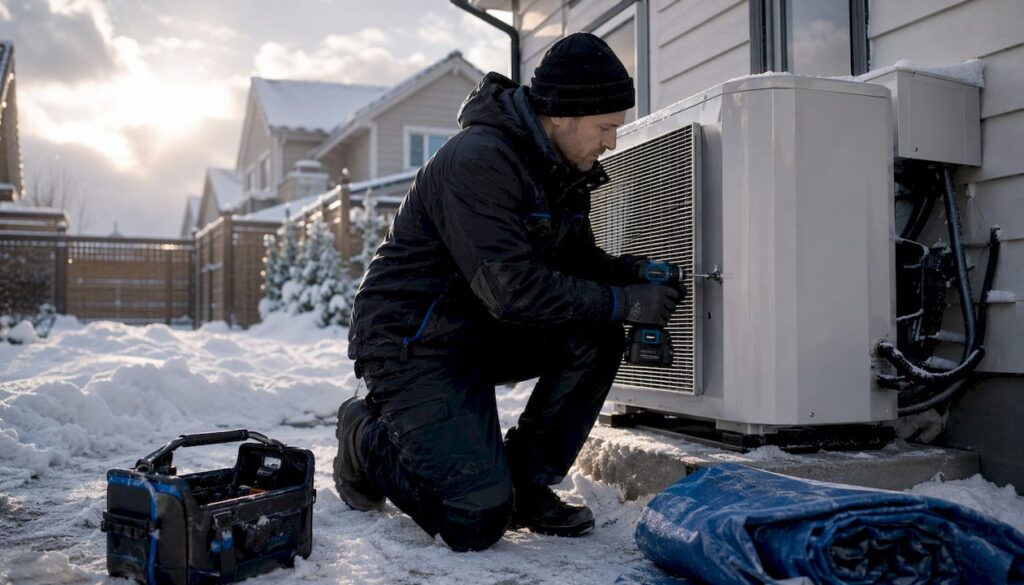
Heat pump retrofits are a technically viable and cost-effective path for Alberta homeowners seeking to reduce heating costs and carbon output, provided the project follows a disciplined assessment and preparation sequence. Modern cold-climate heat pumps operate efficiently at temperatures well below freezing, and Alberta installations routinely use hybrid configurations to maintain comfort during extreme cold snaps. Retrofit costs for air source systems can be significant, but rebate programs in select municipalities help to reduce the upfront investment.
Key practical benefits of a heat pump system upgrade include:
- Lower operating costs compared to electric resistance or propane heating
- Dual-function capability providing both heating in winter and cooling in summer
- Reduced greenhouse gas emissions relative to fossil fuel combustion systems
- Improved indoor air quality when paired with ventilation upgrades
- Compatibility with existing ductwork in most forced-air homes
Rebate spotlight: The Alberta CEIP offers up to $3,500 toward qualifying heat pump installations, meaningfully reducing the net cost of a retrofit project.
What heat pump types work best for Alberta retrofits?
Alberta’s climate demands equipment rated for sustained cold-weather performance, and three system types are relevant to most retrofit scenarios.
Air source heat pumps (ASHPs) are the most common retrofit option. Cold-climate ASHPs use advanced variable-speed compressors and refrigerants detailed in Heat Exchange Examples: A Practical Guide for Engineers that maintain meaningful heating capacity at outdoor temperatures well below 0°C. Hybrid or dual-fuel configurations pair an ASHP with an existing gas furnace, allowing the furnace to carry the load only on the coldest days. This approach limits upfront cost while protecting comfort.
Ground source (geothermal) heat pumps extract heat from the earth at a stable subsurface temperature, making them largely indifferent to outdoor air temperature swings. Their Coefficient of Performance (COP) is consistently high, but ground loop installation adds significant cost and site disruption. Envirotech Geothermal Ltd. has specialized in this technology since 2006 and is one of the few Alberta contractors with documented ground loop design expertise.
Ductless mini-split systems suit homes with hydronic or radiant heating where extending ductwork is impractical. They are also effective for room additions or supplemental zoning in larger homes.
- Air source: lowest upfront cost, requires cold-climate rated unit, hybrid backup recommended
- Ground source: highest efficiency and longest service life, higher installation cost, site assessment required
- Mini-split: no ductwork needed, ideal for targeted zones or non-ducted homes
Why the “Envelope First” approach is mandatory in Alberta
Improving the building envelope before installing a heat pump is not optional in Alberta’s climate. It directly determines system sizing, operating cost, and long-term comfort. Industry guidance for 2026 consistently identifies envelope improvements as the prerequisite step that allows a smaller, less expensive heat pump to meet the full heating load.
Common envelope measures that should precede heat pump installation include:
- Attic insulation upgrades to current Alberta Building Code minimums
- Air sealing at penetrations, rim joists, and electrical boxes
- Basement wall insulation where unfinished space allows
- Window replacement or interior storm panel installation in older homes
- Weatherstripping on exterior doors
Pro Tip: Commission a room-by-room heat loss assessment before specifying any equipment. This calculation, required under good engineering practice, determines the actual heating load after envelope improvements and prevents oversizing, which causes short-cycling and reduced efficiency.
Retrofitting also creates an opportunity to upgrade ventilation and control systems simultaneously, improving air quality and overall system performance beyond what heating efficiency alone would deliver.
What does a heat pump retrofit cost in Alberta?
Air source heat pump retrofit costs in Alberta typically range from $8,000 to $18,000, depending on system size and type. Ground source systems carry a higher price point due to ground loop excavation. Permits, electrical panel upgrades, and engineering assessments add to the total.

| Cost Component | Estimated Range (CAD) |
|---|---|
| Air source heat pump equipment | $8,000–$18,000 |
| Installation labor | — |
| Ductwork modifications | — |
| Electrical panel upgrade (if needed) | $3,500 |
| Building permit | — |
| Envelope improvements (basic) | — |
| CEIP rebate (select municipalities) | available credit to offset costs |
Financing options available in Alberta include manufacturer-backed loan programs, deferred payment promotions (Romaniuk Heating and Air Conditioning offers deferred payment options on select packages), and heat pump leasing through providers such as Rob’s Albertan Service Experts, which offers prepaid credit promotions on new heat pump leases. Arpi’s Industries Ltd. offers financing programs for qualified customers.
Tips for reducing upfront costs:
- Apply for CEIP rebates before installation begins, as eligibility must be confirmed in advance
- Time the retrofit to coincide with the existing furnace reaching end of life, avoiding premature replacement costs
- Bundle envelope improvements with the heat pump installation to qualify for combined incentive programs
- Request itemized quotes from at least three certified contractors to compare scope and pricing
Certified heat pump retrofit providers in Alberta
Selecting a certified contractor is the single most consequential decision in a retrofit project. The following providers serve Alberta homeowners and property managers with documented credentials and heat pump experience.

| Provider | Service Area | Specializations | Certifications | Financing | Rating |
|---|---|---|---|---|---|
| Romaniuk Heating and Air Conditioning | Edmonton area | Full HVAC, heat pumps, plumbing, electrical | — | Deferred payment promotions, financing | 4.8★ |
| Arpi’s Industries Ltd. | Calgary | Mechanical contracting, Lennox dealer | NATE Certified Technicians | Financing programs | 4.8★ |
| Rob’s Albertan Service Experts | Province-wide | Heat pump install and leasing, air quality, alternative energy | — | Leasing, prepaid credit promotions | 4.8★ |
| Alberta Mountain Air Heating & Air Conditioning | Calgary | Lennox Premier dealer, emergency furnace repair | — | — | 4.8★ |
| Trust Home Comfort | Edmonton | Cold-climate heat pumps, background-checked technicians | Alberta-certified, TSSA-licensed | — | 5★ (753) |
| Comfort Union | Calgary | Boiler and hydronic heating, heat pumps | Red Seal HVAC/R, Gas Fitting (Alberta), 313D Refrigeration Mechanic, Sheet Metal Worker | — | 4.9★ (242) |
| Airology Heating and Air Conditioning | Calgary | Furnace and HVAC, energy efficiency upgrades | Google Guaranteed | Low price guarantee | 5★ (155) |
| Envirotech Geothermal Ltd. | Alberta (commercial and residential) | Geothermal ground loop design, net zero partnerships | — | — | 4.9★ (47) |
Trust Home Comfort stands out for homeowners specifically seeking cold-climate heat pump expertise in Edmonton. Its TSSA licensing and Alberta certification, combined with background-checked technicians, address the trust and compliance requirements that a technically complex retrofit demands.
Comfort Union carries the most extensive credential set among Calgary providers, with Red Seal HVAC/R technicians, a Gas Fitting Ticket issued under Alberta regulations, and a 313D Refrigeration Mechanic certification. For retrofits involving hydronic systems or boiler replacement, this credential depth is directly relevant.
Envirotech Geothermal Ltd. is the appropriate choice when ground source technology is under consideration. Its commercial partnership experience and ground loop design specialization since 2006 distinguish it from general HVAC contractors.
Arpi’s Industries Ltd. and Alberta Mountain Air both hold Lennox dealer status in Calgary, which matters when specifying Lennox cold-climate equipment with full manufacturer warranty support.
Provider credentials should be verified against the Alberta Journeyperson certification registry, and all electrical work connected to a heat pump installation must comply with the Alberta Electrical Utility Code and the Canadian Electrical Code, Part I (CSA C22.1).
How to choose the right heat pump retrofit provider in Alberta
Key criteria for evaluating and selecting a contractor:
- Verified Alberta certification: Confirm journeyperson or master HVAC credentials through the Alberta Apprenticeship and Industry Training registry
- Documented heat pump retrofit experience: Request references from completed cold-climate retrofit projects, not just new construction installs
- Heat loss calculation capability: A qualified contractor performs or commissions a proper load calculation before specifying equipment size
- Transparent scope of work: The written quote must itemize equipment, labor, permits, ductwork, and electrical separately
- Warranty and maintenance terms: Confirm both manufacturer equipment warranty and contractor labor warranty duration
- Financing and rebate assistance: Ask whether the contractor handles CEIP rebate paperwork on the homeowner’s behalf
Pro Tip: Ask every contractor to provide ductwork airflow calculations.pdf) alongside the equipment proposal. Undersized or deteriorated ducts are a common cause of heat pump noise, reduced efficiency, and premature component failure in retrofit applications.
Code compliance is non-negotiable. All mechanical work must conform to the Alberta Mechanical Code (based on the National Plumbing Code of Canada), and electrical connections must meet the Canadian Electrical Code, Part I. Permits are required for both mechanical and electrical scopes in virtually all Alberta municipalities.
What is the typical timeline for a heat pump retrofit in Alberta?
A well-managed retrofit follows a defined sequence from initial assessment through commissioning.
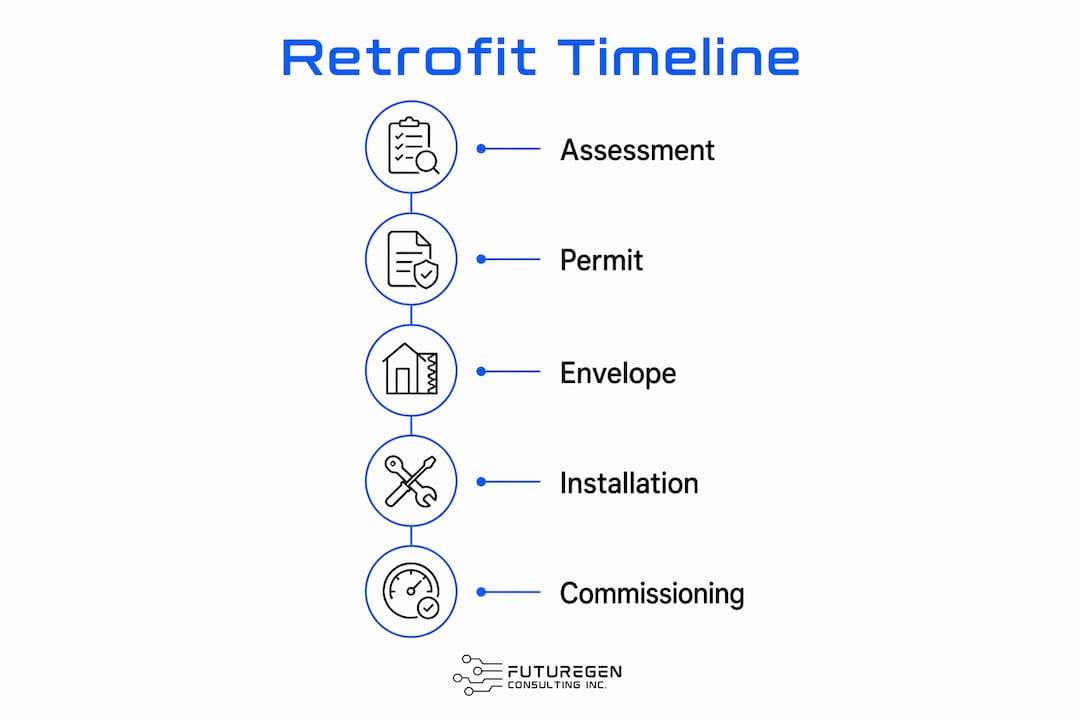
Weeks 1–2: Assessment and design. A certified contractor or mechanical engineer conducts a heat loss assessment, inspects existing ductwork, evaluates the electrical panel, and identifies required envelope improvements. This phase produces the engineering basis for equipment selection.
Weeks 3–4: Permit applications. Mechanical and electrical permits are submitted to the local authority having jurisdiction. Processing times vary by municipality but typically run one to three weeks.
Weeks 5–6: Envelope improvements. Insulation, air sealing, and any window or door work are completed before equipment arrives. Sequencing envelope work first allows the contractor to confirm final equipment sizing.
Week 7: Equipment installation. The heat pump outdoor unit, air handler or coil, refrigerant lines, and electrical connections are installed. Ductwork modifications occur in parallel.
Week 8: Commissioning and inspection. The system is commissioned, refrigerant charge is verified, airflow is balanced, and the municipal inspector signs off on mechanical and electrical permits. The contractor provides operational training and hands over warranty documentation.
Total elapsed time from first assessment to occupancy with a functioning system is typically six to ten weeks, depending on permit processing and equipment lead times.
Maintenance and long-term performance for retrofit heat pumps in Alberta
A heat pump installed as a retrofit requires a maintenance schedule calibrated to Alberta’s climate. Annual professional servicing should cover refrigerant charge verification, coil cleaning (both indoor and outdoor), electrical connection inspection, and filter replacement. The outdoor unit must be kept clear of snow and ice accumulation during winter, which is a more active requirement in Alberta than in milder climates.
Homeowners should replace or clean air filters every one to three months depending on household conditions. Ductwork in retrofit applications warrants inspection every three to five years, as older duct systems can develop leaks that reduce system efficiency. Ground source systems have a distinct advantage here: indoor components typically last 25 years, and ground loops carry service life estimates exceeding 50 years, substantially longer than air source equipment.
Performance expectations for a properly sized and installed cold-climate ASHP in Alberta are realistic. The system will handle the majority of the annual heating load, with the backup furnace or resistance element activating only during the coldest periods. Monitoring thermostat data over the first full heating season helps identify any sizing or airflow issues early.
What disruptions should you expect during a retrofit installation?
Retrofit installations in occupied homes involve a defined set of disruptions that homeowners should plan for in advance. Heating will be unavailable for one to two days during the cutover from the existing system to the new heat pump. In winter installations, temporary electric space heaters are standard practice to maintain habitable temperatures.
Ductwork modifications require access to mechanical rooms, attic spaces, and sometimes finished ceilings or walls. Older homes with asbestos-containing duct insulation require abatement before any duct work proceeds, adding time and cost. Electrical panel upgrades, when required, involve a service interruption coordinated with the local utility.
Noise during installation is temporary but significant. Refrigerant line brazing, sheet metal work, and concrete pad placement for the outdoor unit are the primary sources. Most installations complete the active work phase within two to three days.
Heat pump retrofit vs. complete HVAC system replacement in Alberta
The choice between retrofitting an existing system and replacing it entirely depends on the age and condition of current equipment, ductwork integrity, and the homeowner’s long-term energy goals.
A retrofit preserves functional components, such as a furnace with remaining service life, and adds heat pump capability at lower total cost than full replacement. This is the correct approach when the existing furnace is fewer than ten years old and ductwork is in acceptable condition. The retrofit decision aligns best with the existing system’s end-of-life cycle to avoid premature write-off of capital equipment.
A complete replacement makes sense when the furnace is beyond its service life, ductwork requires extensive modification, or the homeowner wants to transition fully to electric heating. Full replacement also allows right-sizing the entire system from scratch, which can improve efficiency and comfort over a piecemeal retrofit. The upfront cost is higher, but the long-term operating cost and maintenance profile may favor replacement when the existing system is already degraded.
For property managers overseeing multiple units, a phased approach, replacing systems at end of life with heat pumps rather than like-for-like furnace replacements, is the most cost-controlled path to decarbonizing a building portfolio.
Futuregenconsulting offers engineering design support for complex retrofits
If the retrofit project involves commercial property, a multi-unit residential building, or a technically complex mechanical system, the local HVAC contractors listed above handle installation, but the engineering design layer requires a different discipline.

Futuregenconsulting is a Canadian MEP engineering firm with over 30 years of experience in HVAC system design for residential and commercial projects. Where a retrofit requires stamped engineering drawings for permit submission, detailed load calculations to justify equipment sizing, or code compliance review under the Alberta Mechanical Code and Canadian Electrical Code, Futuregenconsulting provides the engineering documentation that contractors and authorities having jurisdiction require. This is a different service than installation: it is the design and compliance layer that protects the project from costly field changes and permit rejections. Property managers and developers coordinating retrofits across multiple units will find that engaging an MEP engineer at the design stage reduces total project cost by eliminating rework.
Key Takeaways
A heat pump retrofit in Alberta is cost-effective and technically sound when the building envelope is addressed first and equipment is properly sized through a professional heat loss assessment.
| Point | Details |
|---|---|
| Retrofit cost range | Air source heat pump retrofits in Alberta typically range from $8,000 to $18,000, depending on system size and type. |
| CEIP rebate availability | The Alberta Clean Energy Improvement Program offers rebates in select municipalities to help offset costs. |
| Envelope First priority | Insulation and air sealing upgrades must precede equipment installation to enable accurate sizing. |
| Contractor credentials | Verify Alberta journeyperson certification and request ductwork airflow calculations before signing any contract. |
| Futuregenconsulting role | For projects requiring stamped engineering drawings or detailed load calculations, Futuregenconsulting provides MEP design and code compliance documentation. |