

Installing EV charging stations in an Ontario condominium requires navigating the Ontario Condominium Act, Ontario Regulation 48/01, and the Ontario Electrical Safety Code, while coordinating among condo owners, boards, property managers, and licensed electrical contractors. The process differs depending on whether the corporation or an individual owner initiates the installation, and both paths carry formal procedural requirements, cost-sharing implications, and mandatory compliance with the Electrical Safety Authority (ESA). Key considerations include:
- Whether the installation affects common elements or a private parking stall
- Who bears the cost of electrical infrastructure upgrades
- The building’s existing electrical capacity and load constraints
- Applicable government funding programs and rebate eligibility
- Licensing requirements for all installation work
Table of Contents
- How condo EV charging works when the corporation leads
- What individual condo owners must do to get approval
- Planning and electrical infrastructure for sustainable EV charging
- Safety, compliance, and licensing requirements you cannot skip
- Ontario EV charging providers: how they compare
- Government rebates and incentives for condo EV charging infrastructure
- How to communicate with residents about EV charging plans
- Futuregenconsulting brings engineering precision to your condo EV project
- Key Takeaways
How condo EV charging works when the corporation leads
When a condominium corporation decides to install electric vehicle charging stations on common elements, it may proceed without a formal owner vote under specific conditions established by the Ontario Condominium Act. The corporation must send proper written notice to all owners, after which owners have 60 days to requisition a meeting. If no meeting is requisitioned within that period, or if a meeting occurs but owners do not vote against the installation, the corporation may proceed.
All costs associated with a corporation-led installation are treated as common expenses, meaning every owner contributes proportionally as set out in the corporation’s declaration. This cost-sharing model can make building-wide installations more financially accessible per stall than individual owner-funded projects.
- Provide advance written notice to all owners before commencing any work
- Allow the full 60-day requisition window before scheduling contractors
- Engage a licensed electrical contractor holding an ESA permit for all work
- Budget for ongoing maintenance as a recurring common expense item
- Consult a qualified electrical engineer to assess building-wide load capacity before finalizing scope
Pro Tip: A comprehensive retrofit covering the majority of parking stalls at once typically reduces the average cost per stall compared to piecemeal installations, because infrastructure runs and panel work are completed in a single mobilization.
What individual condo owners must do to get approval
An owner who wants to install an EV charger in their designated parking stall must submit a formal application to the corporation under Ontario Regulation 48/01. The application process follows a defined sequence:
- Prepare the application. The application must describe the proposed installation, identify the parking stall, specify the equipment, and address insurance and cost responsibility.
- Submit by an accepted delivery method. Acceptable methods include personal delivery, registered mail, fax, email, or any other electronic method the board has approved in writing.
- Await the board’s written response. Once the corporation receives a complete application, the board must respond in writing within 60 days, either accepting or rejecting it.
- Enter into a written agreement. If the board accepts the application, the corporation and owner must execute a written agreement within 90 days of acceptance. The agreement governs installation terms, cost responsibility, insurance, and ongoing operation.
- Proceed with a licensed contractor. All physical work must be performed by a licensed electrical contractor with an ESA permit. The owner is responsible for installation costs unless the agreement specifies otherwise.
- Resolve disputes through mediation and arbitration. Any disagreement about the agreement or the installation process must be submitted to private mediation and arbitration, not litigation.
Changes to common elements, including electrical infrastructure runs from a shared panel, require insurance compliance and board approval even when the owner funds the entire installation.
Planning and electrical infrastructure for sustainable EV charging
The most consequential decision in any condo EV charging project is the electrical capacity assessment. Uncoordinated, ad hoc charger approvals consume available panel capacity quickly, leaving later applicants with no viable connection point without a costly service upgrade. Boards that approve requests on a first-come, first-served basis without a building-wide plan risk what engineers describe as “electrical bankruptcy,” where the building’s service capacity is exhausted before most residents can access charging.
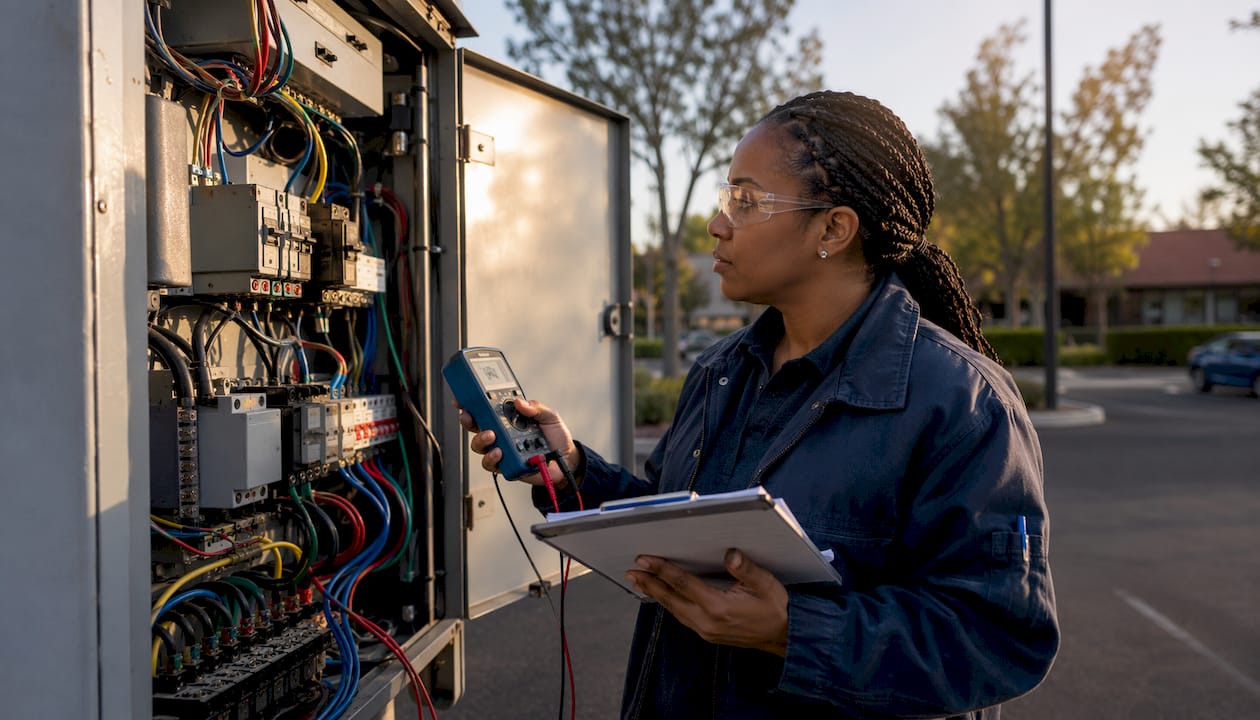
A qualified electrical engineer should assess the building’s service entrance capacity, existing load, and available headroom before any charger is approved. Older buildings are particularly vulnerable, as their electrical infrastructure was designed decades before EV adoption was anticipated.
| Charger Level | Voltage | Approximate Range per Hour | Typical Use Case |
|---|---|---|---|
| Level 1 | — | 5 km | Overnight charging, low daily mileage |
| Level 2 | — | 30 km | Daily commuters, higher mileage drivers |
- Conduct a building-wide load calculation before approving any individual applications
- Consider Energy Management Systems (EVEMS) to allow more chargers on existing infrastructure by dynamically allocating power
- Evaluate staged deployment: rough-in conduit and sub-panels now, install chargers as demand grows
- For older buildings with constrained capacity, shared charging stalls with load-sharing technology may be the most practical near-term solution
- Direct-to-meter wiring, where the charger circuit connects to the resident’s own meter rather than a common panel, can reduce common element wiring costs and simplify billing
Pro Tip: Roughing in conduit and panel capacity during a building renovation or parking garage repair is far less expensive than returning later to cut concrete and run new conduit. Boards should treat any major parkade project as an opportunity to future-proof EV infrastructure.
Safety, compliance, and licensing requirements you cannot skip
Every EV charging station installation in an Ontario condominium must be completed by a licensed electrical contractor holding an ESA permit. This requirement applies without exception, whether the installation is corporation-led or owner-initiated. Non-compliant work creates fire hazards, voids equipment warranties, and can invalidate the building’s insurance coverage.
The Ontario Electrical Safety Code governs all wiring, circuit protection, and grounding requirements for EV charger installations. The ESA inspects completed work and issues a Certificate of Acceptance, which boards should require before any charger is energized. Key compliance obligations include:
- Verify the contractor holds a valid ESA license before signing any contract
- Require an ESA permit to be pulled before work begins, not after
- Obtain the Certificate of Acceptance upon completion and retain it in building records
- Confirm the charger equipment itself carries appropriate certification marks (CSA or ULC)
- Assess whether the installation affects the building’s fire alarm or sprinkler zones, particularly in underground parking garages
- Establish a regular electrical maintenance schedule, especially for buildings more than 10 years old, per ESA guidance on aging electrical systems
Ontario EV charging providers: how they compare
Condo boards and property managers in Ontario have access to several specialized providers. The table below summarizes their service scope, specializations, and key differentiators.
| Provider | Service Offerings | Specializations | Location | Customer Ratings | Unique Benefits |
|---|---|---|---|---|---|
| Signature Electric Ltd | Condo electrical services, EV charging infrastructure, solar installation, commercial electrical | Condo building electrical management, EV infrastructure | Ontario | Not publicly listed | Deep focus on condo-specific electrical management |
| metroEV | Condo and apartment EV installations, commercial and retail charging, fleet management | EV charging contracting, fleet charging infrastructure | Ontario (Canada-wide) | Not publicly listed | Rewards cashback program: earn 10¢ per kWh charged |
| Futuregenconsulting | MEP engineering design, EV charger infrastructure design, load calculations, permit-ready drawings | Condo and commercial EV infrastructure engineering, power distribution | Ontario | Positive client feedback on record | Engineer-stamped, permit-ready drawings; 30+ years of MEP expertise |
| ChargePoint | Public EV charging network, station access at multiple Ontario locations | Public charging network | Ontario locations | Not publicly listed | Suitable for visitor and common-area charging |
Government rebates and incentives for condo EV charging infrastructure
Federal and provincial funding programs can materially reduce the capital cost of installing EV charging infrastructure in Ontario condominiums. The Zero Emission Vehicle Infrastructure Program (ZEVIP), administered by Natural Resources Canada (NRCan), has funded multi-unit residential charging installations across Canada, with eligible applicants including condo corporations, co-operatives, and non-profit housing operators. In past intake rounds, ZEVIP has covered up to 50% of eligible installation costs.
Ontario’s Save on Energy program has also included multi-unit EV charging incentives, though program terms and intake periods change. An EV Ready Plan, prepared by a licensed electrical contractor or electrical engineer, can qualify for a rebate of up to 75% of plan preparation costs to a maximum of $3,000 while funding lasts. Boards should verify current program status directly with NRCan and the Ontario Ministry of Energy before finalizing project budgets, as eligibility criteria and funding availability shift between intake periods.
How to communicate with residents about EV charging plans
Resident communication is a procedural requirement under the Ontario Condominium Act, but it also determines whether a board-led project proceeds smoothly or generates opposition. Boards that share clear, factual information about costs, timelines, and the approval process before a vote tend to encounter less resistance than those that present a completed plan for ratification.

Effective communication strategies include distributing a plain-language summary of the proposed installation scope, cost implications per unit, and the funding programs being pursued. Holding an information session before the formal requisition window opens allows residents to ask questions and raise concerns in a structured setting. For owner-initiated applications, property managers can reduce processing delays by publishing a clear checklist of application requirements, acceptable delivery methods, and the board’s response timeline, so applicants submit complete packages the first time.
Futuregenconsulting brings engineering precision to your condo EV project

Condo boards and property managers who have navigated the procedural steps above still face a technically demanding task: translating approval into a code-compliant, future-proof electrical design. Futuregenconsulting delivers exactly that. With over 30 years of MEP engineering experience in Ontario, the firm produces engineer-stamped, permit-ready drawings for EV charger infrastructure projects in both residential and commercial buildings, covering load calculations, power distribution design, and ESA compliance documentation. Unlike installation contractors who focus on the physical work, Futuregenconsulting provides the engineering foundation that makes the installation approvable, insurable, and expandable as EV demand grows. Contact Futuregenconsulting to request a project assessment for your condominium’s EV charging infrastructure.
Key Takeaways
Installing EV charging in an Ontario condo requires formal board approval, ESA-licensed contractors, and a building-wide electrical capacity assessment before any charger is energized.
| Point | Details |
|---|---|
| Corporation-led process | Corporations may proceed without a vote if owners do not requisition a meeting within 60 days of written notice. |
| Owner application timeline | Boards must respond to a complete owner application in writing within 60 days of receipt. |
| Level 1 charging capacity | A 120V outlet delivers 5–8 km of range per hour, sufficient for average daily driving when charged overnight. |
| ESA licensing requirement | All installations must be completed by a licensed electrical contractor with an ESA permit and a Certificate of Acceptance. |
| Futuregenconsulting’s role | Futuregenconsulting provides engineer-stamped, permit-ready EV charger infrastructure drawings for Ontario condo and commercial projects. |