

Electrical load calculation is the engineering process of determining the total electrical demand of a building using Canadian Electrical Code (CEC, CSA C22.1) methods and occupancy-specific demand factors, so that service conductors, feeders, and overcurrent devices are sized correctly. Under CEC Section 8, the calculated load must never exceed the ampacity of the conductors or the rating of the overcurrent devices protecting them. Getting this right matters beyond permit approval: an undersized service creates persistent overload risk, while an oversized one wastes capital on conductors and switchgear that the building will never need.
Key considerations that govern every load calculation in Canada:
- Load classification: Loads are either continuous (persisting more than 1 hour in any 2-hour period) or non-continuous. Dwelling unit loads under Rules 8-200 and 8-202 are treated as non-continuous; most commercial loads are continuous and must not exceed 80% of the overcurrent device rating unless the device is marked for 100% continuous operation.
- Applicable standards: CEC Part I (CSA C22.1), CSA standards, and local Authority Having Jurisdiction (AHJ) requirements in Alberta.
- Common load types included: general lighting, receptacles, electric space heating, air conditioning, electric ranges, water heaters, EV supply equipment (EVSE), and motor loads.
- Demand factors: applied per CEC Section 8 rules to reduce connected load to a realistic coincident demand for conductor sizing.
Table of Contents
- How residential load calculations work under the CEC
- Trusted electrical load calculation service providers in Alberta
- Commercial and industrial load calculations: what changes
- Software and tools used for electrical load calculations
- Integrating renewable energy sources into load calculations
- Planning for load growth and future expandability
- Futuregenconsulting delivers engineer-stamped load calculations for Alberta projects
- Key Takeaways
How residential load calculations work under the CEC
For single-family dwellings in Alberta, CEC Rule 8-200 provides two calculation paths. The first starts with a 5,000 W basic load for the first 90 m² of living area, then adds 1,000 W for each additional 90 m² or portion thereof. The second option uses a flat minimum: 24,000 W for dwellings with a floor area of 80 m² or more, and 14,400 W for smaller units. These minimums exist to prevent undersized conductor and busbar selections.
Additional loads are stacked onto the basic load at the following demand factors:
- Electric space heating: 100% per Section 62 (thermal storage and electric furnaces also at 100%).
- Air conditioning: 100%, but Rule 8-106(3) requires using only the larger of heating or air conditioning, never both. Adding both is the most common service-sizing error among practitioners.
- Electric range: 6,000 W plus 40% of any amount exceeding 12 kW.
- Tankless water heaters, hot tubs, pools: 100%.
- EVSE loads: treated as continuous loads per 2024 CEC updates; added at 100% after all other demand factors, unless an Energy Management System (EMS) per Rule 8-500 controls the EVSE load.
- Additional loads over 1,500 W: 25% when an electric range is present; 100% up to 6,000 W then 25% of the balance when no range is installed.
Sample single-family dwelling calculation (185 m², Alberta):
| Load Component | CEC Reference | Watts Applied |
|---|---|---|
| Basic load (first 90 m²) | Rule 8-200(1)(a)(i) | 5,000 W |
| Additional area (95 m² excess) | Rule 8-200(1)(a)(ii) | 1,000 W |
| Electric space heating | Section 62 | 1,500 W |
| Air conditioning (larger of heating/AC) | Rule 8-106(3) | 100% load for electric space heating |
| Electric range | Rule 8-200(1)(a)(iv) | 6,000 W |
| Hot tub water heater | Rule 8-200(1)(a)(v) | 7,500 W |
| Additional loads at 25% | Rule 8-200(1)(a)(vii) | 1,875 W |
| Total calculated demand | 25,000 W / 104 A |
For multi-unit row housing, Rule 8-202 applies tiered demand factors: 100% for the heaviest unit, 65% for the next two, 40% for the following two, 25% for the next 15, and 10% for all remaining units. A well-structured electrical load list is the most defensible documentation format for AHJ submissions.
Trusted electrical load calculation service providers in Alberta
Alberta project managers have several qualified contractors and engineering firms to consider. The table below summarizes key providers by service focus and positioning.
| Provider | Service Specialization | Residential / Commercial | Load Calculation Expertise | Client Positioning |
|---|---|---|---|---|
| Futuregenconsulting | MEP engineering design, power distribution, code compliance | Both | 30+ years; permit-ready stamped drawings | Developers, contractors, architects |
| Hauer Power Electrical Services | Residential and commercial electrical, service upgrades, EV charger installation | Both | Load calculations, service upgrades | Customer satisfaction, fair pricing |
| Can Electric | Construction wiring, electrical upgrades | Both | Licensed electricians, safety code alignment | Fully insured contractor |
| Professional Electrical & Controls Ltd | Electrical renovations, panel upgrades | Both | Load calculations, panel upgrades | Reliable residential and commercial |
| ElectraTek Limited | Residential and commercial wiring | Both | Regulatory compliance focus | Strong client relationships |
Futuregenconsulting stands apart from the contractors listed above by delivering engineer-stamped, permit-ready drawings with full code compliance documentation, rather than installation-only services. For projects requiring defensible load analysis, feeder sizing reports, or AHJ submissions, an engineering consultant with formal MEP credentials is the appropriate engagement.
Commercial and industrial load calculations: what changes
Commercial and industrial demand load calculation follows Rule 8-210 and Table 14 of the CEC, which assigns occupancy-specific watts-per-square-metre rates and service conductor demand factors. An office, for example, carries a 70% demand factor on its basic lighting and receptacle load when sizing service conductors. The process diverges from residential calculation in several important ways.

Motor loads require special treatment under CEC Section 28: size at 125% of the largest motor’s full-load amperage (FLA), then add 100% FLA for each remaining motor. This accounts for start-up current without oversizing the entire service. Electric space heating in non-residential occupancies uses a 75% demand factor per Section 62, except for thermal storage systems and electric furnaces, which remain at 100%. The heating-versus-air-conditioning rule from Rule 8-106(3) applies equally here: use only the larger load, never both. Applying both is the single most common error on commercial service sizing calculations.
For a three-phase service, the current formula is: I (A) = P (W) ÷ (√3 × V_L). Using the panel schedule total instead of the CEC calculated demand load consistently overstates demand, sometimes by more than 70% on a typical commercial project. Selecting the right panelboard depends directly on this calculated demand figure, not the connected load total.
Software and tools used for electrical load calculations
Structured calculation tools reduce transcription errors and produce defensible documentation for AHJ review. Spreadsheet-based templates aligned to CEC Section 8 remain common on smaller projects, though they carry inherent version-control and formula-error risks. Purpose-built platforms such as SKM Power Tools, ETAP, and EasyPower handle complex multi-feeder commercial and industrial systems with built-in CEC demand factor libraries. For residential calculations in Alberta, the Regional Municipality of Wood Buffalo publishes a CEC Rule 8-200 calculation form that contractors can use directly for permit submissions.
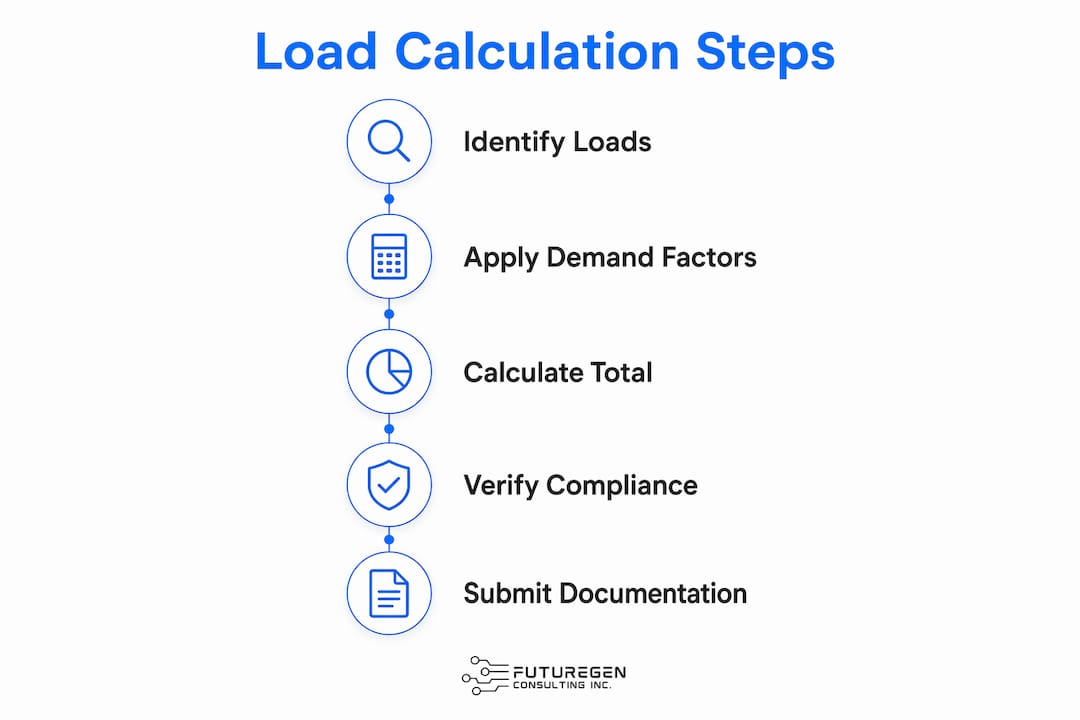
Pro Tip: Whatever platform you use, verify that demand factors are applied per load category, not as a single blanket reduction across the total connected load. The CEC requires category-specific factors under Section 8, and a correct formula applied to the wrong input produces a non-compliant answer.
Regardless of the tool, the output must show each load category, the applicable CEC rule, the demand factor applied, and the resulting calculated demand in watts and amperes. That paper trail is what AHJs and inspection authorities in Alberta require.
Integrating renewable energy sources into load calculations
Solar photovoltaic (PV) systems and other distributed generation sources affect service sizing in ways the base CEC calculation does not automatically capture. Under CEC Section 64, a grid-tied PV system connected via a supply-side tap or a load-side interconnection changes the effective demand the utility service must carry. For residential HVAC and electrical load integration, engineers must account for whether the generation offsets demand or operates as a net-metering arrangement, since the service conductor must still be sized for the full calculated load without generation credit unless the AHJ explicitly permits a reduction.
Battery storage systems introduce additional complexity: charge loads must be treated as connected loads during their charging cycle, and the interaction with EVSE loads and EMS controls under Rule 8-500 requires careful sequencing in the calculation. Alberta’s grid-interconnection requirements, administered through AESO and the local distribution utility, add a layer of review beyond the CEC itself.
Planning for load growth and future expandability
A load calculation sized precisely to today’s connected loads creates a service that cannot accommodate future demand without a costly upgrade. Standard engineering practice in Alberta is to include a capacity reserve, typically by selecting the next standard service size above the calculated demand, or by explicitly documenting anticipated future loads such as additional EVSE circuits, process equipment, or tenant fit-outs in the calculation notes.
AHJs increasingly accept demonstrated loads based on 12-month metered consumption data as an alternative method for existing building upgrades, per CEC Rule 8-106(8). This approach improves accuracy for retrofit projects where the installed load has never operated at its theoretical maximum. For new construction, the calculation must be forward-looking: a developer adding EV charging infrastructure to a multi-unit residential building today should model the full EVSE load at 100% per the 2024 CEC updates, then evaluate whether an EMS under Rule 8-500 can defer a service upgrade. Emergency power systems also depend on this forward-looking load model to size standby generators correctly.
Futuregenconsulting delivers engineer-stamped load calculations for Alberta projects

For project managers and developers who need more than a contractor’s estimate, Futuregenconsulting provides full MEP engineering design services, including permit-ready, engineer-stamped electrical load calculations aligned to the CEC and Alberta AHJ requirements. With over 30 years of experience across residential and commercial projects, the firm delivers power distribution design and detailed load analysis that satisfies both inspection authorities and construction lenders. The concrete advantage over a general electrical contractor is the formal engineering sign-off: a stamped drawing carries legal accountability and removes ambiguity at the permit desk. Contact Futuregenconsulting to request a project assessment and receive a code-compliant load calculation package ready for AHJ submission.
Key Takeaways
Accurate electrical load calculation under the CEC requires applying category-specific demand factors to each load type, treating EVSE as a continuous load added after derating, and using only the larger of heating or air conditioning loads, never both.
| Point | Details |
|---|---|
| Heating vs. AC rule | CEC Rule 8-106(3) requires using only the larger of heating or air conditioning load, never both. |
| EVSE as continuous load | 2024 CEC updates require EVSE loads added at 100% after demand factors, unless an EMS per Rule 8-500 is in place. |
| Residential minimums | Dwellings of 80 m² or more carry a 24,000 W minimum load; smaller units carry 14,400 W under Rule 8-200. |
| Commercial motor loads | Size at 125% of the largest motor’s FLA plus 100% FLA for each remaining motor per CEC Section 28. |
| Futuregenconsulting | Delivers engineer-stamped, permit-ready electrical load calculations for residential and commercial projects in Alberta. |