
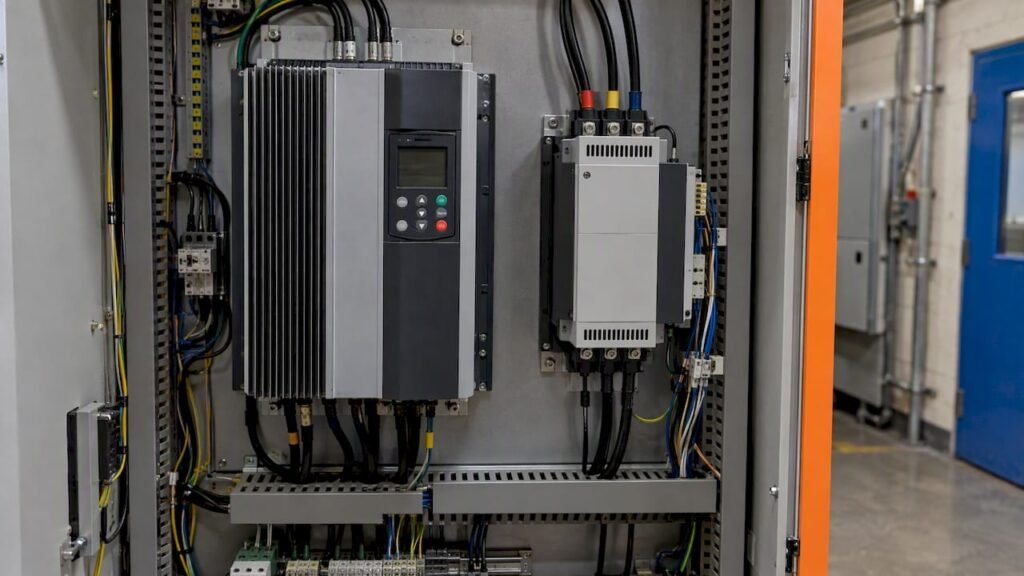
For variable-speed process control and energy savings on centrifugal loads, we recommend a variable frequency drive (VFD); for fixed-speed machines where only reduced starting torque is needed, a soft starter is usually sufficient. Electrical network constraints and applicable code requirements can shift that recommendation, so a short engineering study is warranted whenever load conditions or site capacity are uncertain.
TL;DR:
- Soft starters typically limit starting current to 350% to 500% of motor full load amperage and may need thermal derating above 8 to 10 starts per hour.
- A 20% speed reduction can cut centrifugal pump or fan power use by roughly 50%, so measure changing demand before estimating energy savings.
- VFDs add upstream harmonic distortion, so specify line reactors and assess filters; sustained low speed may also require an external motor blower.
- Log motor current and run hours for one to two weeks, then check site capacity, voltage drop, short circuit levels, and applicable electrical codes.
- Compare energy, installation, and maintenance costs over the equipment’s service life; consider a pilot and operator training when introducing VFDs to a plant.
Table of Contents
- Side-by-side technical comparison: electrical, torque, control, and thermal behavior
- Application mapping: which loads and duty cycles favor each device
- Protection, harmonics, bypass, cooling, and code/regulatory touchpoints
- How an engineering consultant evaluates your site and specifies motor control equipment
- Author’s perspective for procurement and maintenance managers
- How FutureGen Consulting can help: site studies, TCO analysis, and specification delivery
- FAQ
- Sources
Side-by-side technical comparison: electrical, torque, control, and thermal behavior
A VFD controls a motor by varying both voltage and frequency, typically through pulse-width modulation (PWM) switching delivered by insulated-gate bipolar transistors (IGBTs). That electronic conversion lets the drive hold usable torque across a speed range, including at low speeds, which a soft starter cannot do. A soft starter instead applies thyristor-based voltage reduction during acceleration and deceleration, bringing the motor smoothly up to full speed and then operating it at line frequency for the remainder of the run.
The practical differences show up in several measurable ways:
- Torque range: VFDs maintain controllable torque from near-zero to full speed; soft starters only manage the ramp to full speed and then step out of the circuit.
- Starting current: Soft starters typically limit inrush to roughly 350 to 500% of motor full-load amperage (FLA), compared with across-the-line starting, while VFDs can hold starting current much closer to full-load current throughout the ramp.
- Cycling tolerance: Soft starters generate heat in their thyristors during each start and are commonly limited to about 8 to 10 starts per hour before thermal derating becomes a concern; VFDs tolerate far more frequent starts and stops because the power semiconductors are not subjected to the same resistive heating pattern.
- Harmonic content: VFDs introduce harmonic distortion into the upstream electrical system, which soft starters do not produce to the same degree once the motor reaches full voltage.
Soft starters typically limit inrush current to 350 to 500% of motor FLA, a figure worth checking against your switchgear and protective device coordination study before specifying one on a weak or heavily loaded feeder.
Harmonic mitigation is the main design cost that comes with choosing a VFD. Line reactors, and in some cases passive or active harmonic filters, are commonly specified alongside the drive to keep total harmonic distortion within acceptable limits for the facility’s electrical system. These components add to installed cost and panel space requirements, and they should be sized as part of the original specification rather than added after commissioning reveals a problem.
Application mapping: which loads and duty cycles favor each device
Device selection follows directly from the physics of the load. For centrifugal pumps and fans, the affinity laws mean that power consumption scales roughly with the cube of speed. Reducing the speed of a centrifugal machine by 20% can cut power consumption by roughly 50%, which is the central argument for specifying a VFD on any load where demand varies over time, such as HVAC fans, cooling tower pumps, or process pumps with changing flow requirements.
Fixed-speed loads tell a different story. Conveyors, compressors, and hoists that run at one speed for the bulk of their duty cycle often need nothing more than a controlled, gentler start to protect belts, couplings, and mechanical drive components; a soft starter does that job at lower installed cost and with less commissioning effort.
A short checklist helps narrow the decision before specification work begins:
- Measure the actual duty cycle, including starts per hour and run time at varying loads.
- Determine whether the process needs continuous speed control or only a controlled start.
- Check start frequency against soft starter thermal limits if that option is under consideration.
- Run a basic total cost of ownership (TCO) comparison that includes energy price, maintenance, and expected service life.
Pro Tip: Log motor amperage and run hours with a clamp-on data logger for one to two weeks of normal operation before committing to either device; that data turns a duty-cycle assumption into a measured input for the engineering study.
Protection, harmonics, bypass, cooling, and code/regulatory touchpoints
Installation details affect both cost and code compliance, regardless of which device is chosen.
- Harmonics: Specify line reactors as a baseline mitigation item on VFD installations, and add passive or active filtering when the drive load represents a meaningful share of the facility’s total electrical demand.
- Bypass and disconnects: Provide a maintenance bypass contactor or a manual bypass arrangement so the motor can run across the line if the drive or soft starter requires service, along with a properly rated disconnect ahead of the unit.
- Code compliance: Motor control installations in Ontario must meet the requirements of the Ontario Electrical Safety Code (OESC), and the 2024 edition governs plan submissions and installation requirements for projects reviewed from its effective date forward; consult the applicable Canadian electrical code and your local authority having jurisdiction before finalizing a design submitted for permit.
- Motor cooling: Standard motors running at sustained low speed under a VFD can lose cooling airflow from their shaft-mounted fans, which may call for an external blower or a motor re-rated for variable-speed duty.
- Commissioning: Tune PID control loops where the drive manages a process variable, and verify thermal protection and overload settings on both device types before handover.
How an engineering consultant evaluates your site and specifies motor control equipment
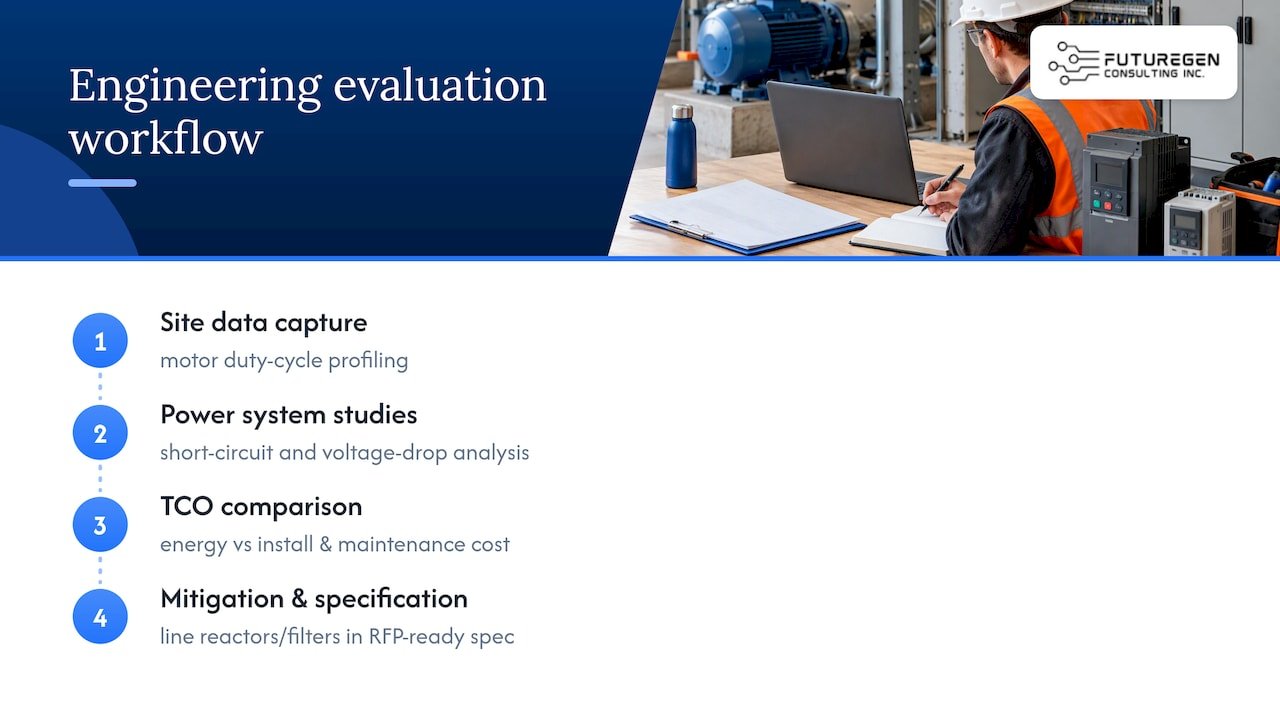
A sound specification rests on three deliverables: a motor duty-cycle survey, a short-circuit and voltage-drop study, and a TCO comparison between VFD and soft starter options. Our approach starts with site data capture and duty profiling, moves into a TCO comparison that weighs energy cost against installed and maintenance cost, and ends with mitigation items such as line reactors or filters built into an RFP-ready specification. Readers managing a network study or a distribution upgrade alongside a drive project can review our power system studies and power distribution design services for the supporting engineering work.
Author’s perspective for procurement and maintenance managers
The lowest purchase price rarely produces the lowest lifetime cost. Weigh total cost of ownership and your maintenance staff’s familiarity with drive technology before committing to either device, and consider a pilot installation with operator training when introducing VFDs to a plant that has run soft starters for years. For mid-to-large installations, bring in an engineering consultant early enough to influence the specification rather than after equipment has already been ordered, or consider technical services and rental support for process equipment during testing or commissioning.
— Sanjay
How FutureGen Consulting can help: site studies, TCO analysis, and specification delivery
We provide engineering services to develop defensible specifications for VFD-versus-soft-starter decisions, including duty-cycle surveys, network studies, and construction-ready drawings appropriate for project conditions.

Our relevant services include:
- Power system studies to quantify harmonic impact, voltage drop, and transformer sizing before a drive is ordered.
- Power distribution design when added motor control equipment affects switchgear or feeder capacity.
- Electrical construction cost estimation to compare installed cost across device options.
- Construction review to confirm the installed system matches the engineered specification.
Request a motor-duty survey or a TCO estimate for a specific pump or fan train through our services page to get a specification built around your actual load data.
FAQ
How does a VFD starter work?
A VFD converts incoming AC power to DC and then back to AC at a controlled voltage and frequency, typically using pulse-width modulation through IGBT switching. That conversion lets the drive ramp the motor smoothly from standstill and hold any speed within its rated range, unlike a soft starter, which only reduces voltage during acceleration.
What are the four types of starters?
Common motor starting methods include across-the-line (direct-on-line) starters, reduced-voltage soft starters, variable frequency drives, and star-delta (wye-delta) starters. Each limits starting current and torque differently, and the right choice depends on motor size, load type, and how often the equipment starts and stops.
What are the advantages of a soft starter?
A soft starter reduces mechanical stress and starting current compared with an across-the-line start, which protects belts, couplings, and gearboxes on fixed-speed equipment. It is generally more compact and less expensive to install and commission than a VFD when the process does not need speed control, as noted in Schneider Electric’s comparison of the two technologies.
Should I get a network study before specifying a VFD?
A short-circuit and voltage-drop study is good practice before specifying a VFD on a facility with limited electrical capacity or existing harmonic-sensitive equipment, since drives add harmonic distortion that reactors or filters may need to address. Our power system studies service covers this analysis as part of an RFP-ready specification package.
Sources
- Variable Frequency Drives – Natural Resources Canada
- What are the main differences between Variable Frequency Drives and Soft Starters? | Schneider Electric Canada
- 2024 Ontario Electrical Safety Code (ESA)