

An electrical maintenance plan (EMP) is a documented, standards-aligned program that defines what electrical equipment gets serviced, how often, and by whom, using condition data rather than a fixed calendar. The fastest path to a working program follows five moves: build an asset inventory, rank assets by criticality, set condition-based intervals tied to a CMMS, document a corrective maintenance workflow, and train personnel to execute it safely.
A working EMP needs:
- A complete asset inventory with unique identifiers and nameplate data
- Condition-based intervals rather than blanket calendar cycles
- Written procedures for inspection, testing, and lockout/tagout
- A corrective maintenance workflow with sign-off and record retention
- CMMS scheduling that creates an audit trail
Start with an asset inventory and condition assessment, then load both into your CMMS before setting a single interval.
Key Takeaways
A working electrical maintenance plan ties documented asset criticality to condition-based intervals, executed through a CMMS and backed by NFPA 70B and CSA Z463 alignment.
| Point | Details |
|---|---|
| Start with the inventory | Capture asset ID, criticality, and condition data before setting any maintenance interval. |
| Use condition, not the calendar | Base intervals on asset condition and criticality rather than fixed time cycles alone. |
| Pilot before scaling | Run two full maintenance cycles on one critical system before rolling intervals facility-wide. |
| Close the corrective loop | Document every finding through authorization, repair, testing, and sign-off in the CMMS. |
| Bring in a specialist when needed | Futuregenconsulting supports system studies, EMP drafting, and CMMS setup for complex facilities. |
Table of Contents
- What Is an Electrical Maintenance Plan, and Why Does It Matter?
- What Types of Electrical Maintenance Should a Plan Include?
- How Do You Build an Electrical Maintenance Plan Step by Step?
- Which Standards Govern Electrical Maintenance Programs?
- What Does a Corrective Maintenance Workflow Look Like?
- What KPIs and Records Prove an EMP Is Working?
- How Long Does It Take to Roll Out an EMP, and What Drives Cost?
- When Should You Bring in an Engineering Consultant?
- How Futuregenconsulting Supports Your Electrical Maintenance Program
- Useful Standards and Source Documents to Consult
- Sources
What Is an Electrical Maintenance Plan, and Why Does It Matter?
An EMP is a living program document, not a one-time checklist you print and file away. It gets revised as equipment ages, as failure data accumulates, and as standards change. Three references anchor most defensible programs today: NFPA 70B for program structure and interval guidance, CSA Z463 for maintenance requirements specific to Canadian facilities, and a qualified engineering consultant like Futuregenconsulting for validation on complex or mixed-vintage systems.
The stakes are concrete. Most electrical equipment failures are preventable through routine preventive maintenance, and components excluded from a maintenance program fail at noticeably higher rates than those included in one. A functioning EMP reduces unplanned downtime, lowers total cost of ownership across the equipment’s service life, and gives auditors and insurers something concrete to review.
Pro Tip: Align your EMP with the facility’s Electrical Safety Program (ESP) from day one. A maintenance task performed without proper lockout/tagout coordination can turn a routine inspection into an arc flash exposure.
What Types of Electrical Maintenance Should a Plan Include?
A mature program blends five approaches rather than leaning on one:
- Preventive: scheduled servicing based on time or run hours, such as breaker cleaning and torque checks.
- Predictive: condition monitoring that catches degradation before failure, like infrared thermography on switchgear.
- Corrective: planned repair once a defect is found, scheduled by risk rather than convenience.
- Failure-finding: periodic tests that expose hidden faults in protective devices, such as insulation resistance testing on standby equipment.
- Emergency: unplanned response to unexpected outages, which a good EMP minimizes but never eliminates.
Critical assets in harsh environments should lean predictive and failure-finding; low-criticality, low-consequence equipment can often stay on simple preventive cycles.
How Do You Build an Electrical Maintenance Plan Step by Step?
A defensible EMP follows a sequence, not a shortcut. Skipping the inventory step to jump straight to scheduling is the most common reason programs collapse within the first year.
- Run a site survey and system study. Map power distribution, protective device coordination, and single-line diagrams before touching a schedule.
- Build the asset inventory. Capture manufacturer, model, voltage class, install date, unique asset ID, and environmental notes (dust, moisture, heat) for every piece of equipment.
- Assess condition and rank criticality. Score each asset on safety impact, process impact, and probability of failure.
- Define tasks and tests per asset. Match each asset to specific procedures, whether that’s thermal scanning, insulation testing, or partial discharge detection.
- Set initial intervals and load them into a CMMS. Base starting intervals on OEM recommendations and NFPA 70B/CSA Z463 guidance, then treat them as a first draft.
- Define the corrective maintenance process and spare parts strategy. Decide authorization levels and stock critical spares before you need them.
- Train personnel and formalize lockout/tagout procedures. No task proceeds without a qualified person and documented isolation steps.
- Implement, record, audit, and adjust. Run the program, capture data, and revise based on what actually happens.
For every asset, your CMMS record needs at minimum: asset ID, location, criticality score, last inspection date, next due date, assigned technician, and a field for test results. A clean work-order life cycle (opened, scheduled, completed, reviewed, closed) is what gives you an audit trail an inspector or insurer can actually follow.
Pro Tip: Run two full maintenance cycles on one critical system, like your main switchgear, before rolling standard intervals out facility-wide. NFPA guidance supports adjusting intervals after observing two cycles of real condition data, which is far more reliable than guessing at frequencies up front.

OEM recommendations set a floor, not a ceiling. Where OEM guidance and NFPA/CSA interval tables disagree, the more conservative interval generally wins until your own condition data justifies otherwise. A load list built early in the process makes step two far faster.
Which Standards Govern Electrical Maintenance Programs?
“An EMP that stays in a drawer, disconnected from the Electrical Safety Program, doesn’t reduce risk. It just documents it.” That’s the practical takeaway from guidance on integrating electrical safety programs with maintenance planning.
Three standards carry the most weight for a Canadian facility. NFPA 70B was elevated from a recommended practice to a full Standard in 2023, which means it now uses mandatory “shall” language for program elements, including condition-based intervals. CSA Z463 is the Canadian standard specifying maintenance requirements for electrical equipment, meant to be used alongside CSA Z462 for workplace electrical safety.
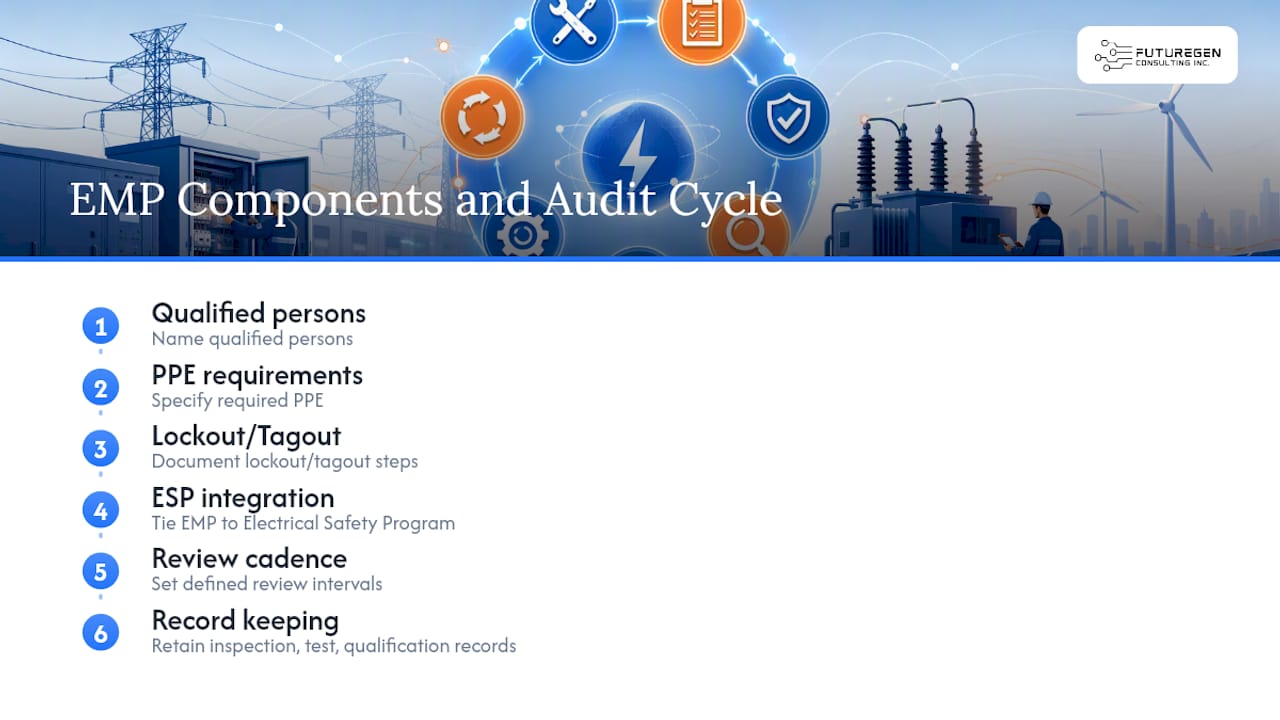
Your EMP needs to name qualified persons, PPE requirements, and lockout/tagout steps explicitly, tying directly into your ESP. Standards expect a review cadence, not a set-and-forget document; plan on revisiting the program at defined intervals and retaining inspection records, test results, and qualification records well beyond a single audit cycle.
What Does a Corrective Maintenance Workflow Look Like?
An inspection finding without a repair path is just documentation of a known hazard. A working corrective process moves through defined stages:
- Discovery: a defect surfaces through inspection, test, or failure-finding.
- Risk evaluation and temporary mitigation: rate the finding and apply interim controls if needed.
- Authorization and scheduling: a qualified reviewer approves the repair and slots it against a response window.
- Resourcing and permit/LOTO: assign technicians and lock out equipment per procedure.
- Repair and test: complete the fix and verify performance before returning equipment to service.
- Close-out and condition update: sign off the work order and update the asset’s condition rating.
Priority typically weighs safety impact, process criticality, and failure probability, with higher-risk findings getting shorter response windows. Retain test results, photos, parts used, and the reviewer’s signature on every closed work order.
What KPIs and Records Prove an EMP Is Working?
Track a handful of numbers consistently rather than a long list occasionally:
- Percent of scheduled tasks completed on time
- Backlog age (how long open items sit unresolved)
- Mean time to repair (MTTR) and mean time between failures (MTBF)
- Number of overdue safety-critical items
- Predictive-technology detection rate (faults caught before failure)
- Audit findings closed versus opened
Retain inspection logs, test results, condition assessments, personnel qualification records, closed work orders, and system studies indefinitely, or per your jurisdiction’s retention rules. A simple monthly dashboard pulling these fields from your CMMS exposes trends long before they become failures.
How Long Does It Take to Roll Out an EMP, and What Drives Cost?
Most facilities can expect a phased rollout: months zero to three cover site survey and asset inventory; months three to six move pilot assets into the CMMS; months six to twelve handle full rollout and training; the first formal program review lands around month twelve to eighteen.
Cost drivers worth budgeting for:
- Contractor testing services (infrared thermography, partial discharge detection)
- Downtime and outage planning, including generator load bank testing for backup systems
- Spare parts and bill-of-materials procurement
- CMMS licensing and configuration
- Training and consultant fees
Compare contractor-as-needed pricing against a bundled service agreement or a single-source provider; predictable annual costs usually beat reactive contractor calls.
When Should You Bring in an Engineering Consultant?
Complex power distribution, mixed-vintage equipment, or an EMP that must hold up to a regulator or insurer’s scrutiny are the moments to call in outside expertise. A qualified consultant typically provides:
- Site assessments and system studies
- EMP document drafting aligned to NFPA 70B and CSA Z463
- CMMS configuration and data migration support
- Pilot testing and interval tuning
- Staff training and competency assessments
- Audit support and documentation review
Pro Tip: If your facility has equipment installed across three or more decades, get a system study before setting a single interval. Mixed-vintage systems hide coordination problems that a generic interval table won’t catch.
Futuregenconsulting brings over 30 years of MEP engineering experience across Ontario and Alberta commercial and residential projects, which is the kind of track record that matters when an EMP needs to survive an insurance audit.
A note from the field
Sanjay has watched facility teams treat electrical maintenance as an afterthought for years, and the ones who fix that build programs that actually hold up. A properly built EMP, tied to real condition data instead of a printed calendar, is the difference between predictable operations and expensive surprises.
How Futuregenconsulting Supports Your Electrical Maintenance Program
Futuregenconsulting gives facility teams a faster route to a defensible EMP than assembling one from scratch with internal staff alone. Where a generic contractor might hand you a generic interval sheet, our engineers build the system study, asset criticality ranking, and CMMS-ready documentation as one coordinated package, backed by three decades of MEP design work across Ontario projects.

Services relevant to EMP work include site assessments and system studies, full EMP document drafting aligned to NFPA 70B and CSA Z463, CMMS setup support, staff training coordination, and audit-readiness review. Facilities with mixed-vintage equipment or complex power distribution get the most value from an outside system study before intervals get locked in.
If your facility needs a program that will hold up under insurer or regulator review, request a scoping call through FutureGen Consulting’s MEP engineering services to discuss a site assessment for your electrical systems.
Useful Standards and Source Documents to Consult
- NFPA 70B: program structure, required elements, and interval tables.
- CSA Z463: Canadian maintenance requirements and design-for-maintainability guidance.
- CSA Z462: workplace electrical safety alignment for lockout/tagout and qualified-person rules.
- Plant Engineering’s EMP-building guidance: practical integration with electrical safety programs.
Sources
- Standard for Electrical Equipment Maintenance (NFPA 70B) | NFPA
- CSA Z463:24 — Maintenance of electrical systems | CSA Group
- HSB Standard for Electrical PM Program (NPIP)