
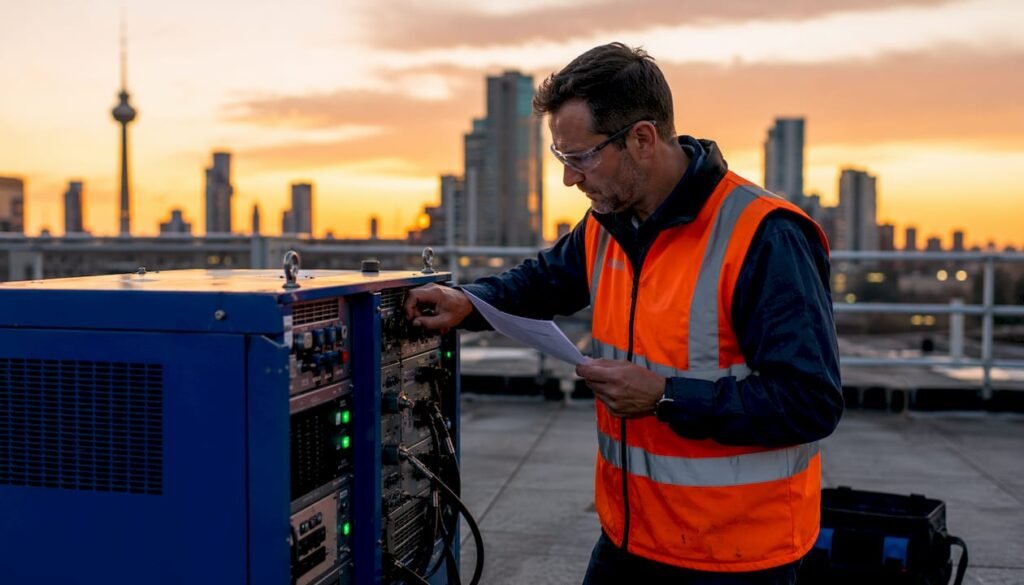
Generator load bank testing applies a controlled electrical load to a standby generator to verify that it will carry required building loads under real demand conditions and satisfy Canadian compliance obligations under CSA C282, the standard governing emergency electrical power supply for buildings. For life-safety emergency generators, CSA C282 requires an annual full-load test with a minimum 2-hour continuous run at rated capacity. That single requirement drives the scheduling, documentation, and engineering oversight decisions that facility managers in Ontario must plan around.
TL;DR: Schedule a qualified technician for a 2-hour annual full-load test, confirm which edition of CSA C282 your Authority Having Jurisdiction (AHJ) enforces, and retain a signed permanent log book entry for every test.
Key compliance and operational facts:
- CSA C282 mandates annual full-load testing for life-safety emergency generators, with a minimum 2-hour run.
- The Electrical Safety Authority (ESA) in Ontario acts as the AHJ and will request the permanent log book during inspections.
- Load bank testing is the only method that verifies full operational capability, including wet stacking clearance and voltage/frequency stability under sustained demand.
- Commissioning tests for new installations typically require a 4-hour full-load run before the unit enters service.
Table of Contents
- What does generator load bank testing actually verify?
- How does CSA C282 govern emergency generator testing in Canada?
- When should you schedule a load bank test?
- Which load bank type is right for your generator?
- Pre-test planning checklist
- What measurements should you capture during the test?
- Who should perform and witness the test?
- What a compliant test report must contain
- What does load bank testing cost and how long does it take?
- What to do after the test reveals issues
- Key Takeaways
- Why load bank testing belongs at the center of emergency power design
- Futuregenconsulting: engineering support for load bank test planning and compliance
- Useful sources and standards references
What does generator load bank testing actually verify?
Load bank testing applies a calibrated electrical load, produced by resistive or reactive load bank equipment, to the generator set while it is disconnected from the building distribution system. The test exercises the engine, alternator, automatic voltage regulator (AVR), governor, cooling system, fuel delivery system, and automatic transfer switch (ATS) interactions simultaneously, under conditions that replicate real building demand.
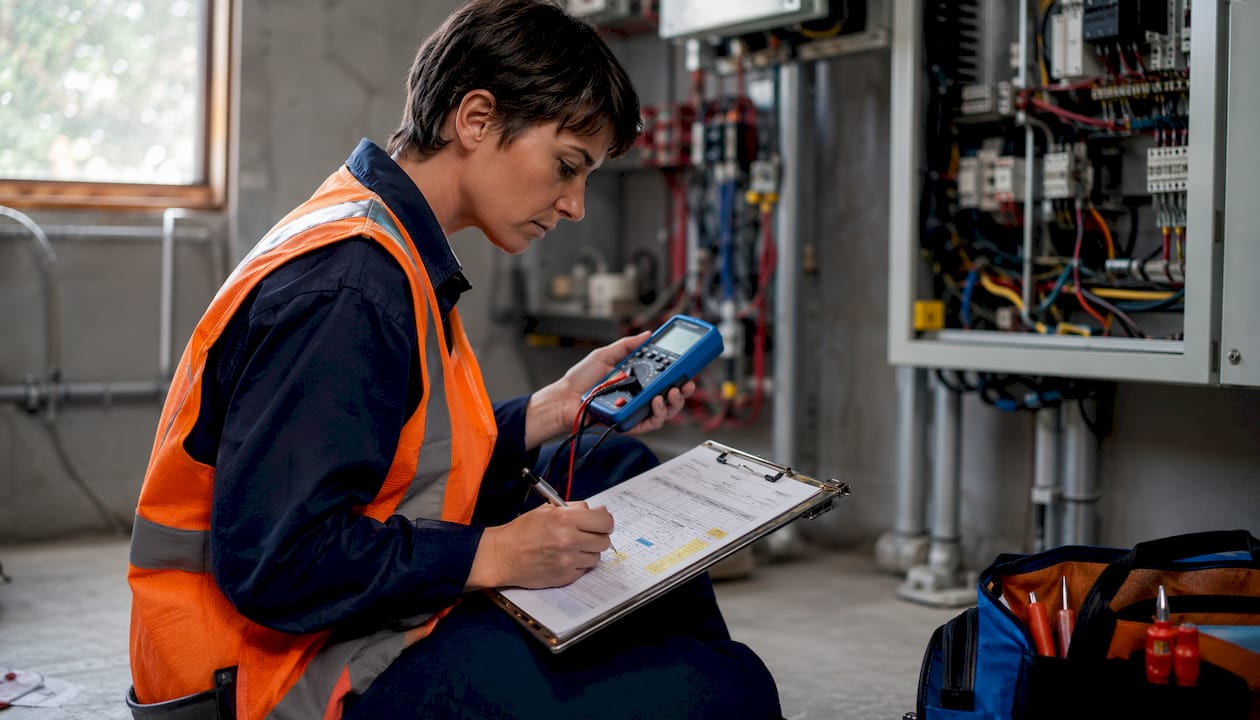
Monthly no-load or light-load exercises start the engine and confirm it runs, but they do not verify sustained performance. A generator that passes a no-load exercise can still fail to hold voltage and frequency when the building’s actual load connects. Worse, generators that run regularly below 30% of rated kW output are prone to wet stacking, a condition where unburned fuel and soot accumulate in the exhaust system, degrading performance and creating a fire hazard.
Two test profiles serve different diagnostic purposes:
- Stepped load test: Load increases in stages, typically 25%, 50%, 75%, and 100% of rated kW, with a hold period at each stage. This profile evaluates governor stability, AVR response, and cooling system behavior across the load range.
- Block load test: Full rated load is applied in a single step. This profile assesses transient load acceptance, voltage dip recovery, and frequency recovery time, which are the parameters most relevant to critical loads like life-safety systems.
Pro Tip: If your facility runs motor-dominated loads such as HVAC compressors or elevators, request a block load test in addition to the stepped profile. The transient response data it produces is more representative of your actual worst-case switching event.
How does CSA C282 govern emergency generator testing in Canada?
CSA C282, Emergency Electrical Power Supply for Buildings, is the primary Canadian standard covering the design, installation, operation, maintenance, and testing of emergency generators. The current edition clarified load testing requirements, updated annual inspection obligations to align with NFPA 70B, and added provisions for parallel generator systems during operational tests.
For Ontario facility managers, the compliance picture involves three layers:
- CSA C282 obligations: Annual full-load testing for life-safety generators, minimum 2-hour continuous run; 4-hour full-load test at commissioning for many installations; and permanent log book maintained on site.
- AHJ enforcement: The ESA in Ontario enforces CSA C282 requirements. Inspectors will request the permanent log book and signed test reports. Notably, mandatory testing disconnections and reconnections performed under CSA C282 do not require a separate notification of work to the ESA, but the log book must be available on request.
- Insurance and audit readiness: Insurers and building owners increasingly require documented test results as evidence of due diligence. A signed test report is the primary deliverable that satisfies both AHJ inspections and insurance audits.
Compliance note: CSA C282 has been revised across multiple editions. The edition your AHJ enforces determines which specific clauses apply to your installation. Confirm the adopted edition with the ESA or your local AHJ before scheduling any test, and document that confirmation in your log book.
Pro Tip: Contact the ESA directly or consult an Ontario-licensed engineer to confirm which CSA C282 edition governs your building classification. The answer affects test duration, load profile, and documentation requirements.
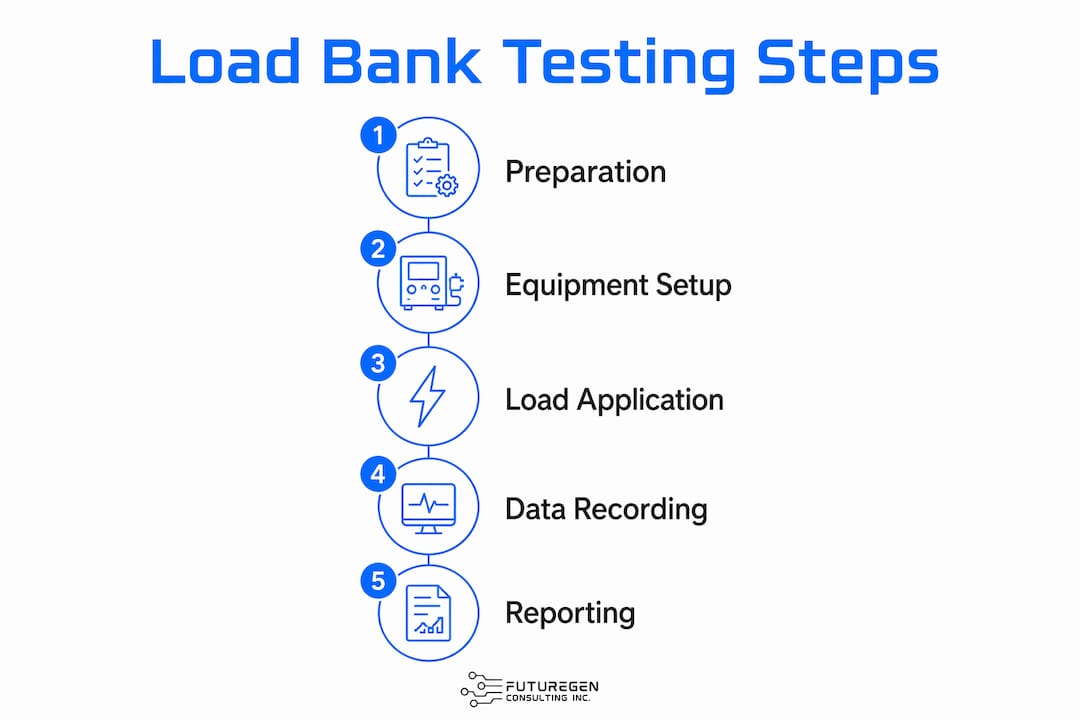
When should you schedule a load bank test?
The baseline requirement for most commercial standby units subject to CSA C282 is an annual full-load test. Beyond that calendar anchor, several operational triggers should prompt an unscheduled test:
- Commissioning: A new or replacement generator requires a full-load test, typically 4 hours, before entering service.
- Post-repair: Any major repair to the engine, alternator, AVR, governor, or fuel system warrants a full-load verification before the unit returns to standby duty.
- Extended idle periods: A generator that has not run under load for more than 6 months should be tested before a high-risk season or planned building event.
- Alarm events: Any alarm, fault code, or abnormal behavior during a routine exercise run is a trigger for a full load bank test.
- Mission-critical environments: Data centers, hospitals, and facilities with continuous critical loads should consider semi-annual testing given the consequences of generator failure.
Typical site time for a stepped load bank test runs 2–4 hours for the test itself, with setup and teardown adding 1–2 hours on either side. Budget 3–8 hours total for most commercial installations.
Which load bank type is right for your generator?
Three categories of load bank equipment address different generator and facility load profiles:
- Resistive load banks: Simulate purely resistive loads such as lighting and heating. They are the most common type for standard CSA C282 compliance testing and are widely available as portable units.
- Reactive (inductive) load banks: Simulate inductive loads such as motors and transformers, allowing the test to exercise the generator at a realistic power factor below unity. Required when the facility’s actual load mix is motor-heavy.
- Combined resistive/reactive load banks: Provide the most complete simulation by allowing the operator to set both kW and kVAR independently, replicating the facility’s actual power factor.
Sizing the load bank to the generator’s nameplate kW rating is the starting point, but altitude and ambient temperature both derate generator output. A unit rated at 500 kW at sea level and 25°C will produce less at Ontario elevations during summer heat. The load bank must be sized to reach 100% of the derated output, not the nameplate figure.
Portable load banks are appropriate for most commercial and institutional sites. Permanent load banks are justified for mission-critical facilities where annual testing logistics are complex or where semi-annual testing is required.
Pro Tip: Request the generator’s derated output curve from the manufacturer before sizing the load bank. Testing to nameplate kW when the unit is derated means you never actually reach 100% load, which invalidates the test for CSA C282 purposes.
Pre-test planning checklist
Thorough planning is the most common differentiator between a test that runs efficiently and one that incurs additional mobilization costs or safety incidents. Proper coordination of cables, external power, and personnel qualifications is critical before any equipment arrives on site.
- Confirm the CSA C282 edition your AHJ enforces and obtain any required permits or AHJ notifications.
- Schedule the AHJ inspector or witness if required for your installation class.
- Review the electrical load list to confirm load bank sizing and cable requirements.
- Verify fuel level (minimum 75% tank capacity recommended), oil level, and coolant level.
- Size and route load bank cables: confirm conductor ampacity, connection points, and clearances from combustibles.
- Arrange ventilation and exhaust routing; confirm exhaust discharge will not re-enter the building or adjacent air intakes.
- Apply lockout/tagout procedures for the ATS and distribution equipment as required.
- Confirm fire suppression systems are operational and that exhaust routing does not compromise fire protection.
- Arrange site access for the load bank unit (weight, clearance, power for load bank fans and controllers).
- Brief all on-site personnel on emergency shutdown procedures before energizing.
Planning principle: A pre-test checklist meeting with the load bank technician, the facility’s electrical representative, and the safety officer eliminates the majority of on-site delays. Decisions made in a 30-minute meeting cost nothing; decisions made with a crew standing by cost significantly more.
Pro Tip: Run the generator under building load for 15–20 minutes before connecting the load bank to confirm baseline operation and allow the engine to reach normal operating temperature.
What measurements should you capture during the test?
Recording complete data at each load step is what transforms a compliance exercise into a maintenance planning tool. The following table maps each parameter to its expected range and what deviations indicate.
| Measurement | Expected Range / Criterion | Deviation Indicates |
|---|---|---|
| AC Voltage | Rated voltage ±5% at steady state | AVR fault, alternator winding issue, governor interaction |
| Frequency | Rated Hz ±5% at steady state | Governor fault, fuel delivery restriction, engine wear |
| Power (kW) | 100% of derated nameplate at full load | Fuel system restriction, turbocharger fault, derating issue |
| Power Factor | Per load bank setting | Reactive load bank calibration, alternator excitation fault |
| Total Harmonic Distortion (THD) | Under 5% for precision/critical environments | Alternator winding fault, non-linear load interaction |
| Coolant Temperature | Within manufacturer’s operating band | Cooling system restriction, thermostat fault, low coolant |
| Exhaust Temperature | Within manufacturer’s specification | Fuel mixture issue, turbocharger fault, air restriction |
| Oil Pressure | Within manufacturer’s operating band | Oil pump wear, low oil, filter restriction |
| Fuel Consumption | Consistent with manufacturer’s fuel curve | Injector wear, governor hunting, fuel leak |
Transient behavior at block load application deserves particular attention. Voltage dip and recovery time, and frequency dip and recovery time, are the parameters most likely to affect sensitive loads. A voltage recovery to within ±5% in under 10 seconds is a common acceptance criterion for life-safety systems, though the applicable standard and equipment specifications govern the actual threshold.
Pro Tip: Infrared thermography conducted during the full-load run detects electrical hot spots before components fail. Electrical components heat up before they burn out, so a thermal survey during the test enables planned repairs rather than emergency outages.
Who should perform and witness the test?
Generator load bank testing involves high-amperage cable connections, ATS manipulation, and sustained operation at full rated output. The personnel requirements reflect those risks.
- Load bank technician/operator: Must hold demonstrated competency with load bank equipment, high-amperage cable connections, and generator controls. Calibration certificates for all test instruments must accompany the test report.
- On-site engineer or qualified facility representative: Responsible for ATS coordination, building system isolation, and signing the permanent log book entry. For life-safety systems, an engineer’s oversight is standard practice.
- AHJ inspector or witness: Required for certain installation classes under CSA C282. Confirm this requirement with the ESA before scheduling.
Documentation chain of custody: The contractor’s credentials, equipment calibration certificates, and the signed test report form a single compliance package. Keep all three together in the permanent log book. An inspector who cannot find the calibration certificate for the test instruments may reject the test result.
What a compliant test report must contain
The test report is the primary compliance deliverable. A report that satisfies the ESA and insurers contains the following elements.
| Report Field | Required / Optional |
|---|---|
| Site address and unit identification (make, model, serial, kW rating) | Required |
| Date, start time, and end time of test | Required |
| Technician name, credentials, and company | Required |
| Test type (stepped / block / full-load) and load profile | Required |
| Raw readings at each load step (voltage, frequency, kW, amperage, temps, oil pressure) | Required |
| Anomalies observed and actions taken during test | Required |
| Pass/fail conclusion with technician signature | Required |
| Instrument calibration certificate references | Required |
| Infrared thermography report (where required by CSA C282 edition) | Required for life-safety |
| Photos of cable connections and load bank serial number | Recommended |
| AHJ inspector signature or witness notation | Required where applicable |
The permanent log book must retain all test records for the period specified by CSA C282 and must be available on site for inspection on request. A digital copy is acceptable as a backup, but the original signed record must be accessible.
What does load bank testing cost and how long does it take?
For most commercial installations in Ontario, the total on-site time for a CSA C282 annual test runs 3–8 hours: approximately 1 hour for setup and cable connections, 2 hours minimum for the full-load run as required by the standard, and 1–2 hours for cool-down and teardown. Larger units or complex sites extend that range.
Primary cost drivers include:
- Generator size (kW): larger units require larger load banks and heavier cable sets.
- Cable length and routing complexity: long cable runs between the generator and load bank increase labor and equipment costs.
- Load bank type: reactive or combined load banks carry higher rental and mobilization costs than resistive-only units.
- Travel and crew size: remote sites or multi-unit facilities with multiple generators in a single mobilization affect the per-unit cost.
- AHJ witness fees: some jurisdictions charge inspection fees for witnessed tests.
The most effective way to manage cost is to combine multiple generator tests in a single mobilization and to pre-plan cable routing and site access before the crew arrives. For facilities with multiple standby units, a single annual mobilization covering all units typically reduces per-unit cost compared to separate visits.
Budgeting baseline: The CSA C282 2-hour minimum full-load run is the scheduling and cost anchor for life-safety generator testing in Ontario. Use it as the floor when estimating annual testing budgets.
What to do after the test reveals issues
Test findings require structured follow-up, not just a note in the log book.
- Document all anomalies immediately: Record every alarm, deviation, or observation in the test report before the crew leaves the site.
- Isolate safety-critical faults: Any finding that affects the generator’s ability to start, transfer, or sustain load under life-safety conditions requires immediate corrective action before the unit returns to standby duty.
- Prioritize by risk category: Map findings to three tiers: safety-critical (immediate action), reliability-critical (scheduled within 30 days), and preventive maintenance (next service interval). This framework supports capital budget requests with documented evidence.
- Schedule corrective maintenance with target dates: Assign a responsible party and a completion date to each finding. Undated findings rarely get resolved before the next inspection.
- Confirm repairs with a follow-up test: After corrective maintenance, a targeted verification test or a repeat full-load run confirms the repair was effective. Record the result in the permanent log book.
Pro Tip: A hot oil change immediately after a full-load test is best practice. The test loosens accumulated deposits from wet stacking, and draining the oil while it is warm removes those deposits before they re-settle.
Key Takeaways
Generator load bank testing under CSA C282 requires an annual 2-hour minimum full-load run for life-safety emergency generators in Ontario, with a signed permanent log book entry retained on site for AHJ and insurer review.
| Point | Details |
|---|---|
| CSA C282 annual requirement | Life-safety generators need a minimum 2-hour full-load test annually; commissioning tests typically require 4 hours. |
| Permanent log book | All test records, signed reports, and calibration certificates must be retained on site and available to the ESA on request. |
| Wet stacking and performance | Monthly no-load exercises do not prevent wet stacking; only a full-load test clears deposits and verifies sustained voltage and frequency stability. |
| Measurement priorities | Capture voltage (±5%), frequency (±5%), THD (under 5% for critical loads), coolant temp, oil pressure, and fuel consumption at each load step. |
| Futuregenconsulting | Futuregenconsulting provides emergency power design, test planning, and engineer-reviewed documentation for Ontario facilities requiring CSA C282 compliance. |
Why load bank testing belongs at the center of emergency power design
Most facility managers treat load bank testing as a compliance checkbox. That framing understates what the test data actually provides. A well-documented test report is one of the most useful inputs available for long-term capital planning: it identifies which components are approaching end of life, which systems are operating within acceptable margins, and where the next maintenance dollar should go. Treating the report as a compliance artifact rather than an engineering document means the most valuable information it contains goes unused.
The other point worth stating plainly: the gap between a generator that starts during a monthly exercise and one that holds rated voltage and frequency for two hours under full building load is not a theoretical concern. It is the gap that determines whether life-safety systems, critical care equipment, or data center loads remain operational during a grid outage. The exercise run tells you the engine starts. The load bank test tells you whether the system actually works.
For facilities in Ontario, integrating load bank test results into a formal power system study creates a feedback loop between as-tested performance and design assumptions, which is where the real risk reduction occurs.
Futuregenconsulting: engineering support for load bank test planning and compliance
Facility managers who need more than a test crew need an engineering partner who understands what the results mean and what to do with them. Futuregenconsulting delivers emergency power design and test planning services for commercial and institutional facilities across Ontario, with over 30 years of Canadian MEP engineering experience behind every engagement.

The firm’s services for generator testing compliance include: emergency power system design and specification, load bank test planning and load profile development, on-site engineering oversight and AHJ coordination, engineer-reviewed and permit-ready test documentation, and integration of test findings into power system studies and capital maintenance plans. Every deliverable is prepared to Ontario code standards and formatted to satisfy ESA inspection requirements.
To discuss test planning, documentation review, or emergency power design for your facility, contact Futuregenconsulting at futuregenconsulting.ca.
Useful sources and standards references
- CSA C282 (current edition): Purchase or access the standard directly from CSA Group. Confirm with your AHJ which edition is adopted in your jurisdiction before referencing specific clauses.
- Electrical Safety Authority (ESA) Ontario: ESA bulletins reference CSA C282 obligations and clarify AHJ expectations for Ontario facilities, including log book requirements.
- Niagara Generators: Load Bank Testing: Practical overview of the 2-hour full-load test procedure, infrared thermography requirements, and CSA C282 compliance context for Ontario operators.
- Generator Source: Commercial Load Bank Testing Guide: Detailed explanation of stepped vs. block load test profiles, wet stacking, and measurement interpretation.
- Wolverine Power Systems: Load Bank Testing Protocols: Guidance on stepped load increments, hold periods, and site time expectations for facility managers and plant operators.
- Facility Executive: Testing Emergency Generators: Planning and safety considerations for facility managers coordinating load bank tests, including cable sizing and AHJ notification.
- Americas Generators: Performance Benchmarks: Reference for voltage stability (±5%), frequency stability (±5%), and THD (under 5%) benchmarks used in test result interpretation.