
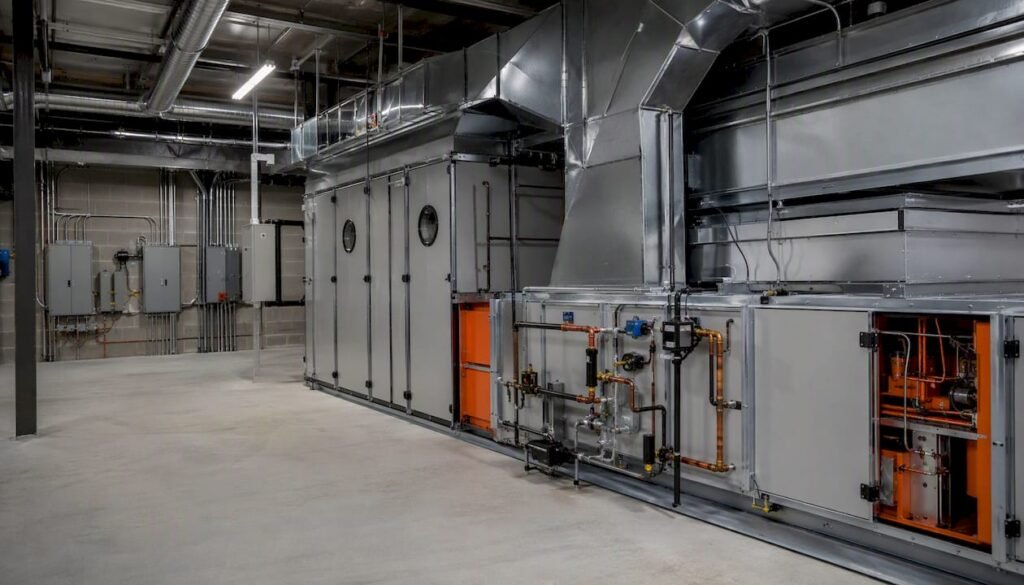
A makeup air unit (MUA) is an engineered supply fan and tempering assembly that replaces the outdoor air volume exhausted by range hoods, commercial kitchen ventilation, or large industrial exhaust systems, maintaining building pressure balance and protecting combustion appliance safety. If your project includes an exhaust device rated above approximately typical residential threshold in an airtight residential building, or any commercial or industrial exhaust system, you need an interlocked MUA before the installation passes inspection.
The core function is straightforward: when a high-capacity exhaust fan pulls air out of a building faster than infiltration can replace it, the resulting negative pressure can back-draft natural-draft combustion appliances, slam doors, and compromise indoor air quality. A dedicated makeup air system prevents that by supplying conditioned outdoor air on demand, matched in volume to the exhaust it serves.
Key thresholds and triggers in Ontario practice:
- typical residential threshold: OBC Article 9.32.3.8 requires that mechanical exhaust devices be provided with outdoor makeup air from a fan sized at not less than the exhaust capacity and not more than exhaust capacity plus 10%.
- Interlock wiring is mandatory: The makeup air fan must be wired to activate whenever the exhausting device activates — not on a separate timer or manual switch.
- Tempering requirement: Makeup air introduced to occupied spaces must be tempered to at least the minimum tempering setpoint; air introduced to unoccupied spaces may be untempered, subject to manufacturer approval for the fan operating in cold conditions.
- Commercial and industrial: OBC 6.3.2.8 extends interlock and tempering obligations to commercial and industrial exhaust facilities.
- Combustion safety: In modern airtight homes, even a high-capacity hood without makeup air can depressurize the building enough to reverse flue gases in a natural-draft furnace or water heater.
If your exhaust system exceeds the principal ventilation capacity or creates any depressurization risk, plan for an MUA and its interlock wiring before submitting for permit.
Key Takeaways
| Point | Details |
|---|---|
| OBC sizing window | MUA supply must be not less than exhaust CFM and not more than exhaust CFM plus 10%. |
| Interlock wiring is mandatory | The MUA fan must activate whenever the exhaust device activates; manual or timer control does not comply. |
| Tempering threshold | Supply air introduced to occupied spaces must reach at least the minimum tempering setpoint; unoccupied-space supply may be untempered with manufacturer approval. |
| Retrofit cost premium | Installed costs in finished residential spaces are substantially higher than new construction due to duct routing and finishing work. |
| Diffuser placement matters | Supply diffuser location affects hood capture efficiency; coordinate placement against CSA B415.1 short-circuit criteria for commercial kitchens. |
Table of Contents
- Which MUA family fits your application?
- What does a makeup air unit actually do during an exhaust event?
- Types of makeup air units and how to choose between them
- What components and controls does a complete MUA system require?
- How to size an MUA: CFM, L/s, and a worked example
- What Canadian codes and standards govern MUA installations?
- Common installation mistakes and how to avoid them
- Comparing common MUA product families available in Canada
- What does a makeup air unit cost to install in Canada?
- Routine maintenance and troubleshooting for MUA systems
- Design and compliance pitfalls in Ontario: guidance from Futuregenconsulting
- Working with Futuregenconsulting on your MUA project
- What the research on MUA design actually tells you to prioritize
- Sources
Which MUA family fits your application?
Matching the right product family to your application saves significant rework. The four primary application buckets are:
- Residential tempered packaged MUA (up to ~600 CFM): Designed for high-CFM residential range hoods in airtight homes. These units include a fan, motorized damper, electric or gas tempering, and a filter in a compact cabinet. Manufacturer families commonly available in Canada include Fantech (e.g., the MAKE-UP AIR series) and Suncourt. Fantech’s residential MUA units are widely distributed through Canadian HVAC wholesalers and are frequently specified for Ontario new-construction projects.
- Light-commercial packaged MUA (600–2,000 CFM): Suitable for small restaurants, retail food preparation, and light manufacturing exhaust. S&P (Soler & Palau) offers packaged units in this range with electric tempering options. These units typically mount indoors near the exhaust penetration or on a rooftop curb.
- Commercial kitchen packaged MUA (2,000–10,000+ CFM): Dedicated tempering with gas-fired or electric heaters, proportional controls, and VFD-driven fans. Modine manufactures direct-fired and indirect-fired commercial MUA units commonly specified for foodservice applications across Canada. These units must comply with CSA B149.1 where gas tempering is used.
- Industrial high-capacity modular MUA (10,000 CFM and above): Process exhaust, paint booths, and large manufacturing spaces require modular or custom-engineered units. Ruck supplies high-capacity industrial fans and air-handling components used in these configurations. Tempering may be direct-fired gas, indirect-fired, or steam/hot-water coil depending on the process and utility availability.
Pro Tip: Before selecting a product family, confirm the available utilities at the installation point — a gas-tempered unit requires a gas connection and CSA B149.1-compliant piping, while an electric-tempered unit may require a dedicated 240V circuit with adequate ampacity. Locking in the utility type early prevents costly redesign.
What does a makeup air unit actually do during an exhaust event?
Understanding the operating sequence clarifies why each component in the system matters and why shortcuts in specification lead to failures.
Normal idle state: The MUA’s motorized damper is closed, the supply fan is off, and the building envelope is sealed against outdoor air infiltration. No outdoor air enters through the MUA path.
Exhaust activation: When the range hood, exhaust fan, or commercial kitchen ventilation system starts, the interlock signal (typically a dry-contact relay from the exhaust fan controller) simultaneously opens the MUA’s motorized damper and starts the supply fan. Outdoor air enters through the filtered intake, passes through the tempering section (heater coil or direct-fired burner), and is distributed into the building.
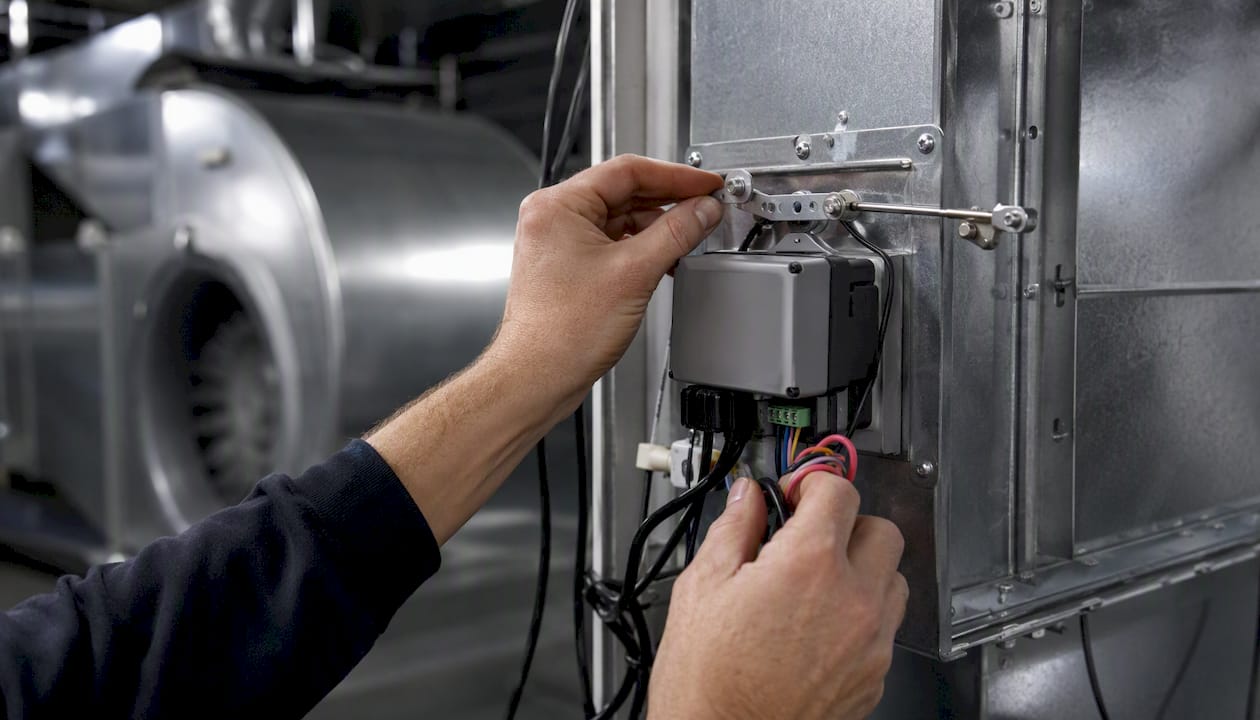
Tempering in cold climates: Ontario winters regularly reach -20°C or colder. Without tempering, introducing outdoor air directly into a kitchen or living space at those temperatures creates comfort complaints, potential condensation on cold surfaces, and — in commercial kitchens — food safety concerns. The tempering section raises supply air to a setpoint, typically 12–18°C for occupied spaces, before distribution.
Key interactions to understand:
- HRV/ERV relationship: An HRV or ERV handles continuous whole-building ventilation at low flow rates. An MUA handles the intermittent, high-volume demand from exhaust events. The two systems serve different functions and are not interchangeable. The HRAI Residential Mechanical Ventilation Manual and ASHRAE Standard 62.2 govern the continuous ventilation side; OBC 9.32.3 governs the MUA side. For a detailed comparison, see Futuregenconsulting’s guide on ERV vs HRV.
- Combustion appliance protection: Natural-draft furnaces, boilers, and water heaters rely on a slight positive or neutral building pressure to maintain proper flue draft. Negative pressure from an uncompensated high-CFM exhaust can reverse that draft, pulling combustion gases back into the living space.
- Damper sequencing: The motorized damper must be fully open before the supply fan reaches operating speed. Specify a damper end-switch interlock in the controls sequence to prevent the fan from running against a closed damper.
Pro Tip: Specify a spring-return motorized damper rather than a motor-open/motor-close type. If power fails during an exhaust event, a spring-return damper closes automatically, preventing cold air infiltration and protecting the tempering equipment from freeze damage.
Types of makeup air units and how to choose between them
The choice of MUA type drives cost, installation complexity, code compliance path, and long-term operating expense. The four primary configurations are:
Unheated (untempered) intake units
These supply outdoor air without any heating. They are only appropriate where the supply air is introduced to an unoccupied space (a mechanical room, attic plenum, or unconditioned vestibule) or where the climate permits year-round untempered supply. In Ontario, untempered units serving occupied spaces do not comply with OBC 9.32.3.8 during heating season. Manufacturer approval for fan operation at low ambient temperatures is also required.
Electric-tempered units
An electric resistance heater raises supply air temperature before distribution. These are the most common choice for residential and light-commercial applications in Ontario because they require no gas connection, have simple controls, and are straightforward to permit. The trade-off is operating cost: electric resistance heating is more expensive per unit of thermal energy than gas in most Ontario utility rate structures.
Indirect-fired gas-tempered units
A gas-fired heat exchanger (similar to a furnace heat exchanger) heats supply air without allowing combustion products to contact the airstream. These are appropriate for occupied commercial spaces and applications where introducing combustion products to the supply air is not acceptable. They require a gas connection, venting for combustion exhaust, and compliance with CSA B149.1.
Direct-fired gas-tempered units
Combustion occurs directly in the airstream, making these units highly efficient and capable of large temperature rises across compact equipment. Direct-fired units require compliance with CSA B149.1 and are typically not permitted for residential applications.
Selection criteria checklist:
- Available utilities (gas service capacity, electrical panel ampacity)
- Occupied vs. unoccupied supply zone (determines tempering obligation)
- Required CFM and delivered temperature at design conditions
- Footprint constraints (indoor cabinet vs. rooftop curb)
- Proximity to combustion appliances (affects direct-fired permissibility)
- Serviceability access for filter changes and heater inspection
What components and controls does a complete MUA system require?
A properly specified makeup air system is more than a fan and a heater. Each component has a minimum performance requirement that must appear in the project specification or RFP.
Core components:
- Supply fan: Typically a forward-curved or backward-inclined centrifugal fan. Specify fan curves at design CFM and external static pressure. A VFD allows proportional control matched to exhaust staging.
- Motorized damper: Spring-return, low-leakage (AMCA Class II or better). Specify end-switch feedback to the controls sequence.
- Tempering section: Electric resistance elements (kW rating at design CFM and temperature rise) or gas burner (BTU/h input and efficiency). Specify delivered air temperature at design CFM and at minimum ambient.
- Filtration: Minimum MERV 8 for residential and commercial applications. Specify filter pressure drop (ΔP) at rated flow to size the fan correctly and establish a change-out schedule.
- Controls and interlock: Dry-contact input from exhaust fan, damper end-switch interlock, high-limit temperature cutout, and freeze-stat protection on the intake side.
Control scenarios by application:
- Simple on/off interlock: Exhaust fan energizes → relay closes → MUA damper opens → fan starts. Adequate for single-speed residential range hoods.
- Proportional staging: Multi-speed exhaust or variable-speed hood controls signal the MUA to modulate supply CFM proportionally. Requires a 0–10V or BACnet signal from the hood controller.
- VFD-based proportional supply: A VFD on the MUA fan tracks exhaust CFM in real time, maintaining pressure balance across the full operating range. Standard for commercial kitchens with variable-speed exhaust.
- BMS integration: Large commercial and industrial installations connect the MUA to a building management system for scheduling, alarm management, and energy monitoring.
- Combustion appliance safety interlock: Where natural-draft combustion appliances are present, a pressure differential switch or flow sensor can inhibit exhaust fan operation if MUA supply fails, preventing depressurization.
Wiring and commissioning requirements:
- Interlock wiring must be documented in the electrical drawings submitted for permit.
- Commission the interlock by starting the exhaust fan and verifying the MUA activates within the specified time delay.
- Measure delivered air temperature at design CFM and at minimum outdoor ambient.
- Record static pressure at the fan inlet and outlet against the fan curve.
Pro Tip: Specify a factory-wired and factory-tested control panel from the MUA manufacturer rather than field-assembled controls. Factory testing reduces commissioning time and provides a documented baseline for troubleshooting.
How to size an MUA: CFM, L/s, and a worked example
The primary sizing rule under OBC 9.32.3.8 is direct: supply air must be not less than the exhaust CFM and not more than exhaust CFM plus 10%.
CFM to L/s conversion: 1 CFM = 0.472 L/s. For practical use: divide CFM by 2.12 to get approximate L/s, or multiply L/s by 2.12 to get CFM.
Worked example: specified professional-grade hood airflow professional range hood
- Exhaust CFM: specified professional-grade hood airflow (as rated on the hood nameplate at high speed)
- MUA supply range: specified professional-grade hood airflow minimum, 990 CFM maximum (900 × 1.10)
- L/s equivalent: specified professional-grade hood airflow ÷ 2.12 = 425 L/s; 990 CFM ÷ 2.12 = 467 L/s
- Tempering load (electric): At -20°C outdoor and 18°C supply setpoint, temperature rise = 38°C. At specified professional-grade hood airflow (0.425 m³/s), heating load ≈ 0.425 × 1.2 × 1,005 × 38 ≈ 19.4 kW. Specify a minimum 20 kW electric heater with staged elements.
- External static pressure: Account for intake louver (typically 25–50 Pa), filter at rated flow (25–75 Pa depending on MERV), supply ductwork, and diffuser. A total external static of 125–200 Pa is typical for a packaged residential/light-commercial unit. Verify the fan curve delivers rated CFM at that static.
- Short-circuit check: Per CSA B415.1-10 (R2015), supply diffuser placement must not direct air into the hood’s capture zone. Position the MUA supply diffuser at least 1.5 m from the hood face and orient discharge away from the exhaust capture zone.
What Canadian codes and standards govern MUA installations?
Compliance in Ontario draws from several overlapping documents. Understanding which is normative for permitting versus which provides performance-testing methodology prevents specification errors.
Normative code requirements (permit-binding):
- OBC Article 9.32.3.8 (Part 9 — residential): Mandates makeup air supply at not less than exhaust CFM, not more than exhaust + 10%, with mandatory interlock wiring and tempering to the minimum tempering setpoint minimum for occupied spaces. This is the primary code reference for residential MUA installations in Ontario.
- OBC Article 6.3.2.8 (Part 3 — commercial/industrial): Extends interlock and tempering requirements to commercial and industrial exhaust systems. Makeup air introduced to occupied spaces during heating season must maintain indoor design temperature.
- CSA B149.1 (Natural Gas and Propane Installation Code): Governs all gas-fired tempering equipment, including direct-fired and indirect-fired MUA heaters. Any gas-tempered MUA must be installed and commissioned in compliance with this standard.
Performance testing and design guidance (normative for testing, informative for design):
- CSA B415.1-10 (R2015): The laboratory methodology for evaluating commercial kitchen hood performance, including capture and containment metrics and short-circuit ratio measurement. Designers specifying commercial kitchen MUAs should require hood and MUA test data under this standard.
- CSA F326 and ASHRAE Standard 62.2: These govern continuous residential ventilation rates and are the technical basis for HRV/ERV requirements. ASHRAE 62.2 does not substitute for combustion air or MUA safety requirements — conflating the two is a documented source of noncompliance in Ontario residential projects.
- HRAI Residential Mechanical Ventilation Manual: Provides OBC 9.32 design guidance, duct sizing, and clarification on when an MUA versus an HRV/ERV is the appropriate solution. Available from HRAI and referenced by Ontario building officials.
Compliance checklist for Ontario MUA installations:
- Confirm whether the project falls under OBC Part 9 (residential) or Part 3 (commercial/industrial) — the applicable article differs.
- Verify that the MUA fan is sized within the OBC 9.32.3.8 window (exhaust CFM to exhaust + 10%).
- Confirm interlock wiring is shown on the electrical drawings submitted for permit.
- Confirm tempering to the minimum tempering setpoint minimum if supply air enters an occupied space.
- For gas-tempered units, confirm CSA B149.1 compliance and include gas piping design in the permit package.
- For commercial kitchens, require CSA B415.1 test data for the hood and MUA combination.
- Conduct depressurization testing where natural-draft combustion appliances are present.
Common installation mistakes and how to avoid them
The most frequent cause of failed MUA inspections in Ontario is not a defective unit — it is a correctly specified unit that was installed without proper interlock wiring, with a poorly located intake, or without commissioning verification. Ontario contractors regularly encounter failed inspections when homeowners install high-CFM hoods without budgeting for mandatory makeup air interlock and tempering.
Common mistakes:
- Short-circuiting: The MUA supply diffuser is positioned too close to the exhaust hood, feeding conditioned air directly into the capture zone. This reduces the hood’s thermal capture efficiency and can cause the exhaust system to pull in supply air before it reaches the occupant zone. Per CSA B415.1, the short-circuit ratio is a measured performance parameter — a poorly placed diffuser can fail a commercial kitchen commissioning test.
- Insufficient tempering capacity: The heater is sized for average winter conditions rather than design-day outdoor temperature. On the coldest days, delivered air temperature drops below the minimum tempering setpoint, causing comfort complaints and potential code non-compliance.
- Missing or incorrect interlock wiring: The MUA is wired to a manual switch or a separate timer rather than to the exhaust fan’s activation circuit. This is the single most common reason for failed inspections.
- Undersized ductwork: Supply ductwork sized for the fan’s rated CFM without accounting for fittings, transitions, and filter pressure drop. The result is reduced delivered CFM and a fan operating at an unfavorable point on its curve.
- Ignoring filter pressure drop: A MERV 8 filter at rated flow adds 25–75 Pa of resistance. If this is not included in the external static pressure calculation, the fan will deliver less CFM than specified.
- Intake location errors: Intake louvers placed near exhaust discharge, loading docks, parking areas, or gas meter vents introduce contaminants and can create recirculation between exhaust and supply.
Commissioning checklist:
- Verify interlock: start exhaust fan, confirm MUA activates within specified delay.
- Measure delivered air temperature at design CFM and at minimum outdoor ambient.
- Measure supply CFM against the specified value using a flow hood or pitot traverse.
- Record fan static pressure and compare to the fan curve.
- Measure filter ΔP at rated flow and record as the baseline for maintenance scheduling.
- For commercial kitchens, verify capture performance with cooking equipment operating.
Red flags during inspection:
- No interlock wiring shown on permit drawings.
- MUA supply diffuser within 1.5 m of the exhaust hood face.
- Delivered air temperature below the minimum tempering setpoint at design outdoor conditions.
- Fan operating against a closed or partially open damper.
Pro Tip: Photograph the interlock wiring connections and the damper end-switch before closing the wall or ceiling. Building officials frequently request this documentation during inspection, and having it on file eliminates delays.
Comparing common MUA product families available in Canada
The following framework reflects the key decision dimensions for screening vendor datasheets. Manufacturer families commonly available in the Canadian market include Fantech, Modine, S&P (Soler & Palau), Suncourt, and Ruck. Review manufacturer spec sheets, model-specific certifications (CSA/UL listings), and commissioning data before finalizing selection. No ranking or superiority claim is implied by the order of presentation.
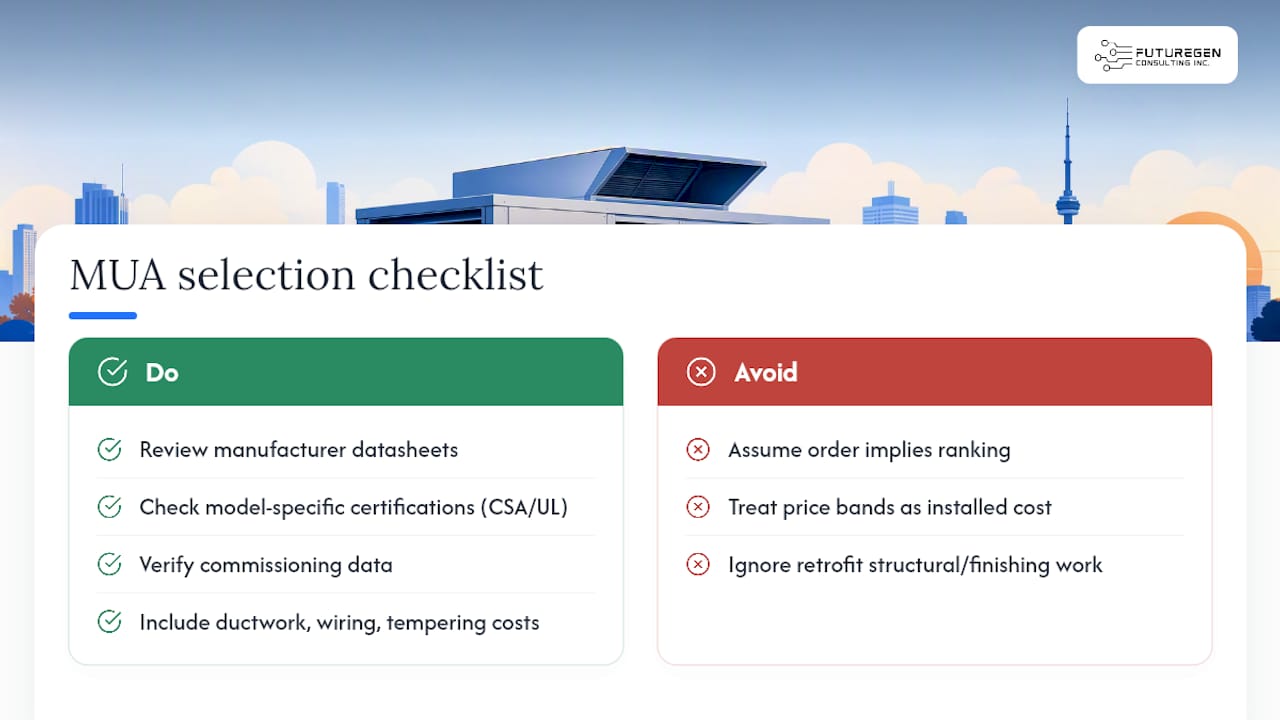
Price bands reflect equipment cost only. Installed costs include tempering utility connections, ductwork, electrical interlock wiring, commissioning, and — in retrofit scenarios — structural and finishing work.
What does a makeup air unit cost to install in Canada?
Installed costs vary substantially between new construction and retrofit scenarios, and between electric-tempered and gas-tempered configurations. The equipment price is often the smaller portion of the total project cost in a retrofit.
Typical installed cost ranges (Ontario, 2025–2026):
- Residential electric-tempered, new construction: $3,000–$6,000 installed, including the unit, ductwork, electrical interlock wiring, and commissioning. Duct routing is straightforward in new construction because walls and ceilings are open.
- Residential electric-tempered, retrofit: $5,000–$10,000 or more, depending on duct routing complexity, drywall repair, soffit work, and the need for an electrical panel upgrade to accommodate the heater circuit. Retrofit premiums are significant because routing ductwork through finished spaces requires opening walls and ceilings.
- Gas-tempered residential or light-commercial: Add $1,500–$3,500 for gas piping, venting, and CSA B149.1-compliant installation over the electric-tempered equivalent.
- Commercial kitchen packaged system: $20,000–$60,000+ installed, including rooftop curb, gas or electric tempering, VFD controls, BMS integration, and commissioning. Hood-to-MUA coordination and CSA B415.1 compliance testing add to the project cost.
Budgeting items frequently omitted from initial quotes:
- Commissioning and air balancing (typically $500–$2,000 for residential, $2,000–$8,000 for commercial)
- Electrical panel upgrade if the heater circuit exceeds available capacity
- Structural reinforcement for rooftop units
- Drywall, insulation, and finishing in retrofit duct routes
- Depressurization testing where combustion appliances are present
- Radon mitigation system interaction review where sub-slab depressurization systems are present — radon mitigation specialists can assess whether an active depressurization system affects building pressure balance and MUA sizing
Procurement advice: Request manufacturer fan curves, delivered air temperature at design CFM and minimum outdoor ambient, filter ΔP at rated flow, interlock wiring diagram, warranty documentation, and CSA/UL listing certificates with every equipment quote. Bids that omit these documents are incomplete.
Routine maintenance and troubleshooting for MUA systems
A makeup air system that is not maintained degrades in performance before it fails visibly. The most common operational problems — reduced airflow, short-circuiting, and failed tempering — all have identifiable first-line causes.
Maintenance checklist and frequency:
- Filter inspection and replacement (every 3–6 months, or when ΔP exceeds baseline by 50%): A clogged filter reduces delivered CFM and forces the fan to operate at an unfavorable point on its curve.
- Belt inspection (annually for belt-driven fans): Check tension and wear; replace at first sign of glazing or cracking.
- Electric heater element check (annually): Verify all elements energize at rated kW; a failed element reduces tempering capacity without triggering a fault in simple control systems.
- Motorized damper lubrication and travel check (annually): Confirm full open and full close travel; verify end-switch operation.
- Electrical interlock test (annually and after any exhaust fan service): Start the exhaust fan and confirm the MUA activates within the specified delay.
- Intake louver inspection (seasonally): Clear debris, bird nests, and ice accumulation that restrict airflow.
Common operational problems and first-line troubleshooting:
- Reduced airflow: Check filter ΔP first. If within normal range, check damper travel and fan belt. If the fan is direct-drive, check motor amperage against nameplate.
- Short-circuiting (hood capture complaints in commercial kitchens): Verify supply diffuser location relative to the hood face. Check for changes in kitchen layout that may have moved cooking equipment closer to the supply diffuser.
- Noisy fan: Check belt tension and bearing condition. A failing bearing produces a consistent high-frequency tone; a loose belt produces intermittent slapping.
- Failed tempering (cold supply air complaints): Check heater element continuity (electric) or burner operation (gas). Verify the freeze-stat setpoint has not tripped the heater off-line.
Call an HVAC or MEP engineer for rebalancing or redesign when: the exhaust system has been modified since original commissioning, building use has changed (e.g., a residential kitchen converted to a commercial-grade cooking space), or depressurization complaints persist after maintenance is current.
Design and compliance pitfalls in Ontario: guidance from Futuregenconsulting
Ontario projects consistently produce the same set of avoidable errors. Understanding these patterns before permit submission prevents costly remediation and re-inspection fees.
Common Ontario project pitfalls:
- Specifying a specified professional-grade hood airflow hood without budgeting for an interlocked tempered MUA: This is the most frequent residential scenario. The hood is selected for cooking performance; the MUA is treated as optional until the building official flags it at rough-in inspection. At that point, duct routing through finished framing adds $3,000–$6,000 to the project cost.
- Neglecting depressurization testing where combustion appliances are present: A new high-CFM hood in a home with a natural-draft furnace or water heater creates a measurable depressurization risk. OBC and CSA F326 both reference depressurization testing as a verification method. Skipping this test leaves the project exposed to liability if a back-drafting event occurs.
- Selecting an untempered unit for an occupied-space supply: Some contractors specify untempered units to reduce equipment cost, then route supply air into the kitchen. This does not comply with OBC 9.32.3.8 during heating season and will not pass inspection.
- Omitting the interlock wiring diagram from permit drawings: Building officials require this documentation. Submitting mechanical drawings without the electrical interlock sequence causes permit delays.
RFP and tender questions to require from contractors:
- Provide manufacturer fan curve at specified CFM and external static pressure.
- Confirm delivered air temperature at design CFM and at -20°C outdoor ambient.
- Provide filter ΔP at rated flow and recommended change interval.
- Submit interlock wiring diagram showing connection to exhaust fan activation circuit.
- Confirm CSA/UL listing for the unit and CSA B149.1 compliance for gas-tempered configurations.
- Provide commissioning report template showing CFM, temperature, and static pressure verification.
Futuregenconsulting provides permit-ready MEP engineering drawings for MUA installations, including mechanical design, electrical interlock wiring, and field review services. For projects requiring HVAC system design in Ontario — from residential range hood makeup air to commercial kitchen ventilation systems — Futuregenconsulting’s engineering team delivers stamped drawings, code compliance documentation, and commissioning oversight.
Pro Tip: For commercial kitchen projects, require the contractor to submit CSA B415.1 test data for the hood and MUA combination before final acceptance. A hood that passes capture testing with one supply diffuser configuration may fail with a different one — this is a design variable, not a manufacturing defect, and it must be resolved at the specification stage.
Working with Futuregenconsulting on your MUA project

Futuregenconsulting delivers HVAC design services for residential and commercial projects across Ontario, including permit-ready makeup air unit specifications, interlock wiring design, and field review. Whether you are specifying a tempered residential MUA for a high-CFM range hood or engineering a direct-fired commercial kitchen system, Futuregenconsulting’s MEP team provides stamped drawings, OBC/CSA compliance documentation, and commissioning oversight. For projects where MEP scope extends beyond HVAC, Futuregenconsulting also covers commercial kitchen ventilation design and full MEP coordination. Contact Futuregenconsulting to discuss your project requirements.
What the research on MUA design actually tells you to prioritize
The conventional advice on makeup air units focuses almost entirely on sizing — match the CFM, meet the minimum tempering setpoint requirement, wire the interlock. That framing is correct but incomplete, and it leads designers and contractors to treat MUA selection as a procurement exercise rather than a systems engineering problem.
The more consequential variable is supply air placement, not supply air volume. CSA B415.1 testing demonstrates that a correctly sized MUA with a poorly positioned supply diffuser can reduce a commercial kitchen hood’s capture efficiency to the point where the exhaust system fails its performance test — even though the CFM numbers on paper are compliant. The short-circuit ratio is a measured outcome of the combined hood-and-MUA system, not a property of either component in isolation. Designers who specify the MUA and the hood from separate datasheets without coordinating diffuser placement are solving half the problem.
The second underweighted issue is the retrofit cost gap. Projects that specify a 600–1,200 CFM range hood in a residential renovation without simultaneously budgeting for the MUA, its ductwork, and the electrical interlock wiring routinely encounter cost surprises at rough-in. The equipment cost of a residential MUA is modest; the installed cost in a finished home is not. Treating the MUA as a line item to be added later is the single most reliable way to exceed the project budget.
The third point worth stating plainly: ASHRAE 62.2 and the HRV/ERV requirement are not a substitute for a dedicated MUA. They address different problems. Conflating continuous whole-building ventilation with demand-based pressure compensation is a documented source of noncompliance in Ontario residential projects, and it is a distinction that building officials are increasingly enforcing at inspection.
Sources
The following documents form the normative and guidance framework for MUA design and permitting in Canada, with Ontario emphasis.
Normative (permit-binding):
- Make-Up Air Unit Ontario: When Your Home Needs an MAU, What It Costs | Get a Better Quote
- Ashrae
- The Residential Mechanical Ventilation Manual (HRAI) – OBC 9.32 guidance
Performance testing (normative for testing, informative for design):
Design guidance (informative):
Specifier note: Request manufacturer test data and commissioning reports aligned to OBC 9.32.3.8, CSA B415.1 (for commercial kitchens), and CSA B149.1 (for gas-tempered units) before accepting equipment submittals. A unit that carries a CSA/UL listing but lacks application-specific commissioning data does not constitute a complete compliance record for permit close-out.