

The six primary backflow preventer types used in Canadian plumbing systems are the Reduced Pressure Zone assembly (RPZ), Double-Check Valve Assembly (DCVA), Pressure Vacuum Breaker (PVB), Spill-Resistant Vacuum Breaker (SVB), air gap separation, and detector assemblies. Each device suits a specific hazard level and application, and selection is governed by the National Plumbing Code of Canada and the CSA B64 series of standards.
Quick-reference by device:
- RPZ (Reduced Pressure Zone): Severe hazard applications — chemical injection lines, laboratories, and industrial process connections.
- DCVA (Double-Check Valve Assembly): Moderate hazard — standard irrigation systems, commercial warehouses, and non-health-hazard services.
- PVB (Pressure Vacuum Breaker): Low-to-moderate hazard — residential and light commercial exterior irrigation where the device can be installed above the highest downstream outlet.
- SVB (Spill-Resistant Vacuum Breaker): Similar to PVB but tolerates intermittent pressure cycling; suited to indoor or sheltered irrigation control applications.
- Air gap separation: The only non-mechanical, absolute protection method; preferred wherever physical separation is practicable, regardless of hazard level.
- Detector assemblies: Fire protection systems requiring metered bypass monitoring for unauthorized water use detection.
Device selection must reference CSA B64.10 for selection and installation guidance, and provincial or municipal cross-connection control programs may impose requirements stricter than the national baseline.
Table of Contents
- What the different backflow preventer types actually mean for your system
- Device-by-device breakdown: how each assembly works and where it belongs
- How to match hazard level and application to the right device
- Canadian codes and standards that govern device selection and installation
- Testing, maintenance, and record-keeping across Canada
- Practical installation considerations that affect compliance and performance
- Engineer’s checklist for specifying a backflow preventer
- Key Takeaways
- Why backflow device selection is more consequential than most owners realize
- Futuregenconsulting: engineer-led backflow design for Alberta projects
- Useful sources and further reading
What the different backflow preventer types actually mean for your system
Backflow prevention devices fall into two fundamentally different protection strategies: non-mechanical separation and mechanical valve-based assemblies. Understanding that distinction is the starting point for any compliant design in Canada.
An air gap is the only non-mechanical method. It physically separates the supply outlet from the receiving vessel with open space, so there is no valve to fail, no seat to wear, and no test cock to maintain. The Canadian Food Inspection Agency classifies air gap separation as the gold standard for critical or severe hazard points precisely because it requires no mechanical integrity to function. The trade-off is spatial: an air gap cannot be used where a continuous pressurized connection is required, such as a fire suppression main or a closed-loop cooling system.
Mechanical devices subdivide into two families. Valve-based assemblies (RPZ and DCVA) use spring-loaded check valves and, in the case of the RPZ, a monitored relief valve zone to prevent reverse flow under both back-pressure and back-siphonage conditions. Vacuum breakers (PVB and SVB) admit atmospheric air to break a siphon but do not protect against back-pressure, which limits their application scope.
Selection principle under Canadian codes: The National Plumbing Code of Canada and CSA B64.10 require that the degree of hazard — not installer preference or cost — determines the minimum acceptable device class. A low-hazard connection may accept a DCVA; a severe-hazard connection requires an RPZ or, where practicable, an air gap. No mechanical device is interchangeable with an air gap at a severe-hazard point where air gap installation is feasible.
The practical contrast: a laboratory chemical feed line connected to a potable supply demands an RPZ because a failure of either check valve still leaves the relief valve as a third line of defense. A residential lawn irrigation system connected to a municipal main with no chemical injection typically qualifies for a DCVA or PVB, depending on whether back-pressure conditions are possible.
Device-by-device breakdown: how each assembly works and where it belongs
Reduced Pressure Zone (RPZ) assembly
An RPZ contains two independently operating spring-loaded check valves separated by a monitored relief valve chamber. When the differential pressure across the assembly drops below the design threshold — indicating a potential backflow condition or a failed check valve — the relief valve opens and discharges to atmosphere, preventing contaminated water from reaching the potable supply. This makes the RPZ the strongest mechanical protection available for severe-hazard applications.
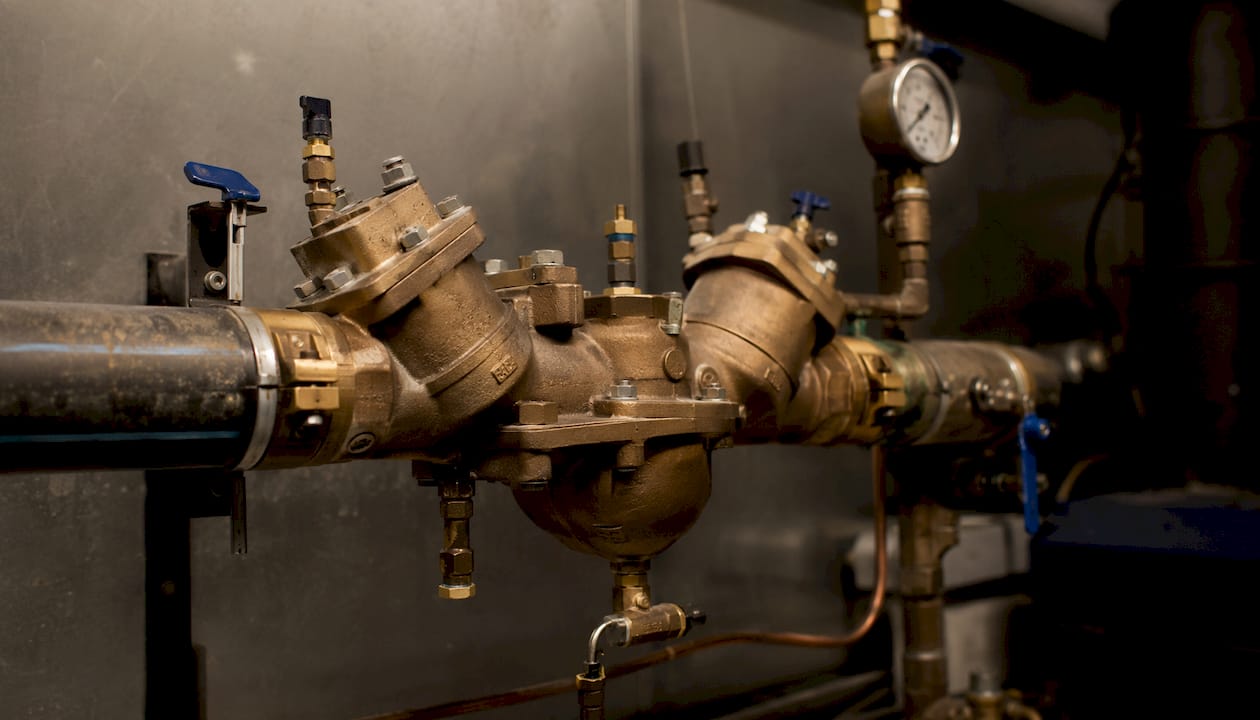
Typical applications: Chemical dosing systems, laboratories, hospitals, cooling towers with chemical treatment, and any connection where a health hazard exists if backflow occurs.
Pros:
- Protects against both back-pressure and back-siphonage.
- Relief valve provides a visible failure signal (discharge indicates a problem).
- Field-testable with standard test equipment.
Cons:
- Relief valve discharge requires piped drainage; cannot be installed in a space without an adequate floor drain or indirect waste receptor.
- Larger footprint and higher installed cost than a DCVA.
- Cannot be installed below grade or in a pit without engineered drainage provisions.
Common failure modes: Continuous relief valve discharge (worn first check valve seat), no differential pressure reading at test cocks (debris on check disc), or leaking test cock fittings after repeated testing cycles.
Double-Check Valve Assembly (DCVA)
A DCVA uses two independently operating check valves in series, each testable through dedicated test cocks. It provides protection against both back-pressure and back-siphonage but has no relief valve, so a failed check valve does not produce a visible discharge signal. The DCVA is the standard choice for moderate-hazard connections where a health hazard is not present.
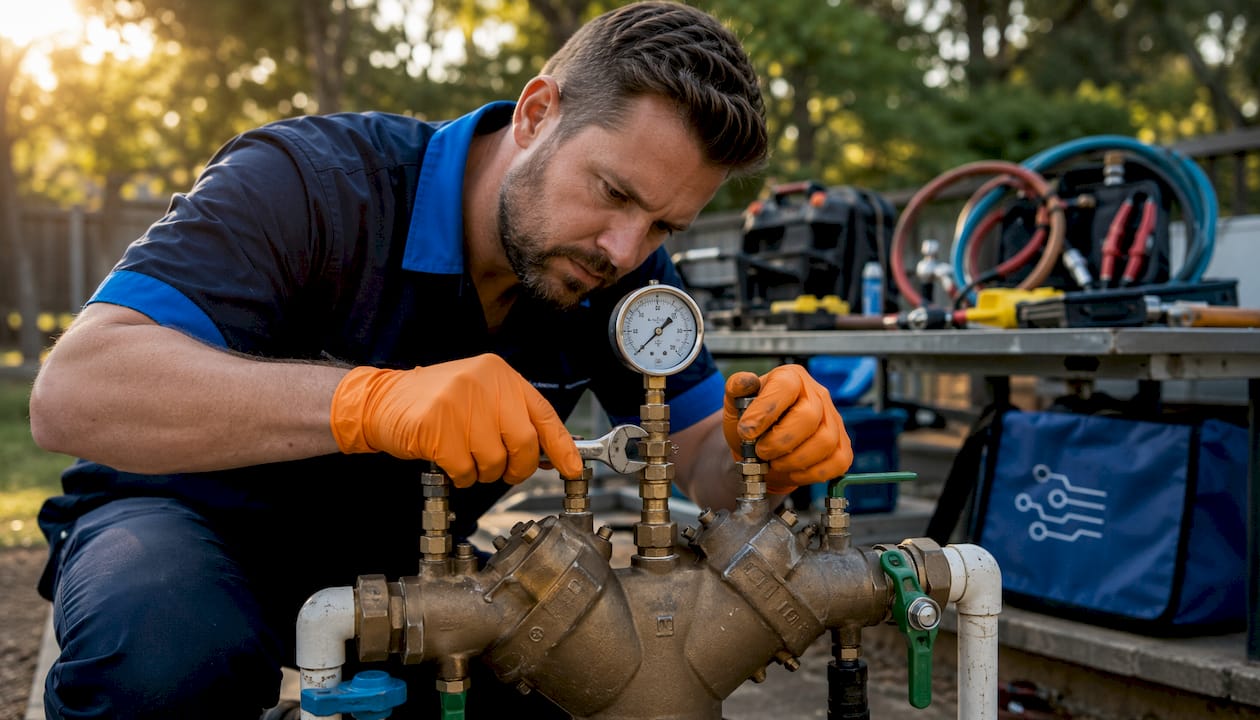
Typical applications: Residential and commercial irrigation, fire sprinkler systems in some jurisdictions (where a detector assembly is not required), commercial kitchen cold-water supplies, and warehouse plumbing.
Pros:
- Compact relative to RPZ; no drainage requirement for a relief port.
- Can be installed horizontally or vertically (per manufacturer and CSA B64 guidance).
- Lower purchase and installation cost than RPZ.
Cons:
- No visible failure signal; a failed check valve is detectable only through periodic testing.
- Not acceptable for severe-hazard or health-hazard connections.
- Requires the same annual certified testing as an RPZ in most Canadian municipalities.
Common failure modes: Debris lodged on check disc preventing full closure, worn elastomeric seats causing slow leakage, and test cock valve stems seizing from infrequent operation.
Pressure Vacuum Breaker (PVB)
A PVB contains a spring-loaded check valve and an air inlet valve that opens when upstream pressure drops to atmospheric, admitting air to break a siphon. It protects only against back-siphonage, not back-pressure, and must be installed at least 300 mm (12 inches) above the highest downstream outlet to function correctly.
Typical applications: Residential lawn irrigation systems, hose bib protection, and light commercial irrigation where no chemical injection is present.
Pros:
- Relatively low cost and simple installation.
- Effective back-siphonage protection for open-ended irrigation systems.
Cons:
- Provides no protection against back-pressure; cannot be used on closed-loop or pressurized downstream systems.
- Must be installed above the highest outlet — a constraint that limits placement options.
- Susceptible to freeze damage; requires winterization or insulated enclosure in Alberta’s climate.
Common failure modes: Air inlet valve sticking open (continuous drip), check valve fouled with debris from the irrigation line, and cracked bodies from freeze-thaw cycles.
Spill-Resistant Vacuum Breaker (SVB)
The SVB is a variant of the PVB designed to tolerate intermittent pressure cycling without spilling water through the air inlet. It uses a poppet-style air inlet that remains sealed under normal operating pressure but opens under back-siphonage conditions. This makes it suitable for indoor or sheltered locations where a PVB’s intermittent spillage would cause water damage.
Typical applications: Indoor irrigation control manifolds, chemical dispensing stations (low hazard), and applications where the device must be installed in a finished mechanical room.
Pros:
- Tolerates pressure cycling without nuisance discharge.
- Suitable for indoor installation where a PVB would create water management issues.
Cons:
- Like the PVB, provides no back-pressure protection.
- Must still be installed above the highest downstream outlet.
- Requires annual testing in most Canadian jurisdictions.
Air gap separation
An air gap is a physical, unobstructed vertical distance between the lowest point of a supply outlet and the flood-level rim of the receiving vessel. No valve, seat, or mechanical component is involved, which is why the CFIA identifies it as the only truly non-mechanical gold-standard method. Where an air gap can be maintained, it is the preferred protection for severe-hazard points.
Typical applications: Commercial dishwasher drain connections, laboratory sinks, food processing equipment, and any potable supply point where a physical break in the line is operationally feasible.
Pros:
- Absolute protection — no mechanical failure mode.
- No testing or maintenance requirement for the gap itself (though the receiving vessel and overflow must be kept clear).
- No moving parts to replace.
Cons:
- Requires a break in the pressurized line; cannot be used where a continuous pressurized connection is needed.
- Downstream pressure is lost; a pump or gravity feed must supply the downstream system.
- Physical space must be maintained — the gap cannot be bridged by hoses or fittings.
Detector assemblies
Detector assemblies are specialized backflow prevention devices used primarily on fire protection system mains. They incorporate a metered bypass line that allows small flows (such as a leaking sprinkler head or unauthorized tap) to be detected and measured, while the main line check valves prevent backflow into the potable supply. Type II bypass detector assemblies use a single check valve in the bypass and are treated as a single assembly on one test report, simplifying documentation.
Typical applications: Fire sprinkler system mains in commercial, industrial, and multi-residential buildings; any fire protection connection where unauthorized water use must be monitored.
Pros:
- Provides backflow protection and flow monitoring in a single assembly.
- Type II design reduces testing complexity by consolidating the test report.
Cons:
- More complex to test than a standard DCVA or RPZ; requires a tester familiar with fire-system protocols.
- Higher installed cost and larger footprint.
- Practitioners frequently misidentify detector assemblies as standard backflow devices, leading to incorrect test procedures and incomplete documentation.
For fire protection system design involving detector assemblies, coordination between the mechanical engineer and the fire protection contractor is required to confirm assembly sizing, bypass metering, and test-report format.
How to match hazard level and application to the right device
The decision heuristic is straightforward: identify the fluid hazard category, determine whether back-pressure or back-siphonage (or both) is possible, then select the minimum device class that addresses both conditions. CSA B64.10 formalizes this process; there is no compliant shortcut around it.
| Application | Hazard level | Backflow risk | Recommended device class |
|---|---|---|---|
| Residential lawn irrigation (no chemical injection) | Low–moderate | Back-siphonage | PVB or DCVA |
| Commercial irrigation with fertilizer injection | Moderate–severe | Back-siphonage and back-pressure | RPZ |
| Commercial kitchen cold-water supply | Moderate | Back-siphonage | DCVA |
| Cooling tower with chemical treatment | Severe | Back-pressure and back-siphonage | RPZ |
| Laboratory chemical feed line | Severe | Back-pressure | RPZ or air gap |
| Fire sprinkler system main | Moderate | Back-pressure | Detector assembly (DCVA-D or RPBA-D) |
| Car wash reclaim water connection | Severe | Back-pressure | RPZ |
| Food processing equipment drain | Severe | Back-siphonage | Air gap |
Choose an air gap over any mechanical device when the downstream system can tolerate a non-pressurized connection and the hazard is severe. Where a continuous pressurized connection is required and the hazard is severe, an RPZ is the minimum acceptable mechanical device; a DCVA is not a substitute regardless of cost considerations.
For commercial building applications, premises-isolating assemblies at the service entry are often required by municipal cross-connection control programs, and the device class at that point is determined by the highest-hazard connection within the building.
Detector assemblies apply specifically when the downstream system is a fire protection main. The bypass metering function is a fire-system requirement, not a backflow-protection upgrade; specifying a standard DCVA on a fire main where a detector assembly is required constitutes a code deficiency.
Canadian codes and standards that govern device selection and installation
The National Plumbing Code of Canada establishes the baseline definitions for backflow, back-siphonage, and backflow prevention, and sets the framework within which provinces and municipalities operate. Alberta, like other provinces, adopts the National Plumbing Code with provincial amendments; municipalities then layer cross-connection control bylaws on top of the provincial baseline. The result is that the minimum acceptable device in one Alberta municipality may differ from the minimum in an adjacent jurisdiction.
The CSA B64 series is the primary technical reference for device selection, installation, and testing in Canada. CSA B64.10 covers selection and installation guidance applicable to all device classes. Separate parts of the B64 series address specific device types: CSA B64.4 covers reduced pressure principle assemblies, CSA B64.5 covers double-check valve assemblies, CSA B64.6 covers dual-check devices, and additional parts address vacuum breakers and detector assemblies. Municipal building permit language in Alberta commonly references these CSA B64 parts directly, so specifying a device by CSA standard number on permit drawings is both accurate and expected.
Municipal variability in Alberta: Many Alberta municipalities operate formal cross-connection control programs that require premises-isolating backflow prevention at the service entry for commercial, industrial, and multi-residential buildings. Some utilities specify that an RPZ is required at the premises isolator for any building with a high-hazard connection, regardless of whether the building’s internal plumbing would otherwise qualify for a DCVA. Verify the specific utility’s cross-connection control bylaw before finalizing device selection on any commercial or industrial project.
Engineer-stamped designs are commonly required for high-hazard systems, multi-residential buildings, and commercial or industrial installations where the municipal authority having jurisdiction (AHJ) determines that the complexity of the cross-connection control system warrants professional review. Submitting permit drawings without the appropriate CSA B64 references and device specifications is a common cause of permit rejection on commercial plumbing projects.
Annual certified testing is mandated by many Canadian municipalities for all mechanical premises-isolating backflow preventers. Failure to submit test reports can result in administrative fines or water service actions.
Testing, maintenance, and record-keeping across Canada
Mechanical backflow prevention devices require periodic field testing by a certified tester; air gaps do not. Most Alberta municipalities with active cross-connection control programs require annual testing for all premises-isolating assemblies, and many require that completed test reports be submitted directly to the utility within a specified period after testing.
Standard testing checklist for a mechanical assembly:
- Pre-test visual inspection: check for physical damage, corrosion, evidence of relief valve discharge (RPZ), and accessible test cocks.
- Confirm shutoff valves upstream and downstream are operable and accessible.
- Record static supply pressure before testing begins.
- Perform differential pressure readings across each check valve using calibrated test equipment.
- For RPZ assemblies: test relief valve opening pressure and confirm discharge to an adequate drain.
- Document all readings on the authorized test report form, including assembly make, model, serial number, and test date.
- Submit the completed report to the utility or AHJ as required by the local cross-connection control program.
Record-keeping obligations vary by municipality, but retaining copies of all test reports for a minimum of three years is standard practice. Enforcement for non-compliance ranges from written notices and administrative fines to water service disconnection for persistent non-compliance.
Regarding cost: testing fees vary with device size, accessibility, and location. Larger assemblies (2-inch and above) and devices installed in confined or elevated locations typically cost more to test than standard residential-scale units. Maintenance costs increase when check valve seats or elastomeric discs require replacement, which is more frequent in systems with poor water quality or high sediment loads. Owners should budget for both annual testing and periodic parts replacement as part of their facility maintenance program.
Common installation mistakes that drive up maintenance costs include inadequate access clearances that require partial disassembly of adjacent piping to reach test cocks, and missing isolation valves that force system shutdown for routine testing.
Practical installation considerations that affect compliance and performance
Installation quality determines whether a correctly specified device actually performs as intended. Several site conditions in Alberta specifically affect long-term reliability.
Clearances and access: CSA B64.10 specifies minimum clearances around assemblies to allow certified testers to connect test equipment to all test cocks without obstruction. A minimum of 300 mm (12 inches) of clear space around the assembly body is a common baseline, though larger assemblies require more. Test cocks must face a direction that allows gauge connection without removing adjacent piping or insulation.
Freeze protection: Alberta’s climate requires that any externally mounted or unheated mechanical assembly be protected against freezing. Acceptable methods include insulated valve boxes with heat tracing, installation within heated mechanical rooms, and seasonal winterization (draining and shutoff) for irrigation-service devices. PVB and SVB assemblies are particularly vulnerable to freeze damage because their air inlet components can crack when water trapped inside freezes.
RPZ relief valve discharge: The relief valve on an RPZ must discharge to a visible, accessible indirect waste receptor or floor drain. Piping the discharge to a location where it cannot be observed defeats the primary diagnostic value of the relief valve. Routing the discharge pipe to daylight or a visible drain allows building operators to detect a continuously discharging relief valve — a signal that the first check valve has failed and the assembly requires service.
Do-not-do items:
- Do not bury test cocks or enclose them behind permanent wall finishes.
- Do not install an RPZ in a pit or vault without engineered drainage provisions for relief discharge.
- Do not omit isolation shutoff valves on both sides of the assembly; they are required for testing and servicing.
- Do not install a vacuum breaker (PVB or SVB) below the highest downstream outlet.
Pro Tip: Route the RPZ relief valve discharge pipe to a location visible from the floor — a clear sight line to the drain connection allows maintenance staff to identify a discharging relief valve during routine walkthroughs, often catching a failing check valve before a formal test is due.
Engineer’s checklist for specifying a backflow preventer
The following checklist reflects the documentation and coordination steps required for a compliant backflow preventer specification on a commercial or industrial project in Alberta. For complex or high-hazard installations, an engineer-stamped design is required by most municipal AHJs.
- Conduct a hazard assessment. Identify every cross-connection point in the system, classify each by fluid hazard category (potable, low-risk non-potable, chemical/biological hazard), and document the assessment in the project file.
- Reference applicable codes on drawings. Cite the National Plumbing Code of Canada (current edition with Alberta amendments) and the relevant CSA B64 standard (e.g., CSA B64.10 for selection/installation, CSA B64.4 for RPZ) on all permit drawings.
- Select device class per CSA B64.10. Confirm that the specified device class matches the hazard level and that no lower-rated device has been substituted for cost reasons.
- Size the assembly. Size the backflow preventer to the service pipe diameter and the system’s peak flow demand; an undersized assembly creates excessive pressure drop and accelerated wear.
- Detail pipe routing for relief and discharge. Show the RPZ relief valve discharge connection, pipe size, and termination point on the plumbing drawings. Confirm the drain receptor is adequate for the maximum relief flow rate.
- Specify access clearances. Dimension the clear space around the assembly on the drawings and confirm compliance with CSA B64.10 minimum clearances.
- Address freeze protection. Specify heat tracing, insulated enclosure, or seasonal winterization procedures for any assembly exposed to ambient temperatures below 0°C.
- Include isolation valves. Specify full-port shutoff valves upstream and downstream of every assembly; confirm they are accessible without removing the assembly.
- Document serial number tracking for detector assemblies. For fire protection mains, include the assembly serial number in the project O&M manual and specify the test-report format (Type II single-report format where applicable).
- Specify test frequency in O&M documentation. State the required testing interval (typically annual) and the name of the authority to whom test reports must be submitted.
- Coordinate with other trades. Confirm with the fire protection contractor that detector assembly sizing and bypass metering are consistent with the sprinkler system design; confirm with the HVAC contractor that cooling tower chemical treatment connections are identified and assigned the correct device class.
When an engineer-stamped design is required — high-hazard systems, multi-residential buildings, and commercial projects where the AHJ demands it — the checklist above forms the basis of the engineering submission. Incorrect installation and unauthorized device selection are the leading causes of failed inspections on these projects; a documented, code-referenced specification eliminates both risks.
Key Takeaways
Selecting the correct backflow preventer type requires matching the fluid hazard level to the device class specified in CSA B64.10, with annual certified testing and municipal report submission as non-negotiable compliance obligations across most of Alberta.
| Point | Details |
|---|---|
| Match hazard to device class | RPZ for severe hazard, DCVA for moderate, PVB/SVB for low-hazard irrigation; air gap where a non-pressurized break is feasible. |
| Air gap is the only absolute protection | No mechanical device equals an air gap at a severe-hazard point where physical separation is practicable. |
| Annual certified testing is mandatory | Most Alberta municipalities require annual field testing and test-report submission; non-compliance can result in fines or service disconnection. |
| Municipal bylaws vary across Alberta | Verify the local cross-connection control bylaw before finalizing device selection; some utilities require an RPZ at the premises isolator regardless of internal hazard classification. |
| Futuregenconsulting provides engineer-stamped designs | For complex or high-hazard installations, Futuregenconsulting delivers code-referenced MEP drawings with CSA B64 specifications and permit-ready documentation. |
Why backflow device selection is more consequential than most owners realize
The conventional framing around backflow prevention treats it as a compliance checkbox: install the device, get it tested annually, and move on. That framing misses the actual risk. The device class selected at the design stage determines whether a system failure results in a minor maintenance call or a contamination event that affects the potable supply for an entire building or premises.
What practitioners at Futuregenconsulting observe repeatedly on commercial and industrial projects is that the most consequential errors occur not during installation but during specification. A DCVA specified where an RPZ is required, a PVB installed on a system with back-pressure potential, or a standard DCVA placed on a fire main that demands a detector assembly — these are design-stage decisions that no amount of careful installation can correct. The device is either right for the hazard or it is not.
The second pattern worth noting is access. Devices installed without adequate clearance for test equipment, or with test cocks facing walls or buried under insulation, accumulate deferred testing cycles. Deferred testing means undetected check valve wear, and undetected wear means the device is providing less protection than the code assumes it is. The installation detail and the compliance outcome are directly connected.
For any project where the hazard classification is ambiguous, the municipal cross-connection bylaw is unclear, or the system complexity warrants a professional review, the appropriate step is to involve a licensed mechanical engineer before the device is specified, not after the permit is submitted.
Futuregenconsulting: engineer-led backflow design for Alberta projects
For building owners, developers, and contractors who need more than a device recommendation, Futuregenconsulting delivers complete MEP engineering services that cover backflow preventer selection, permit-ready plumbing drawings with CSA B64 references, sprinkler and fire protection coordination, and field review oversight. With over 30 years of MEP engineering experience, the firm produces engineer-stamped designs that satisfy Alberta municipal AHJ requirements and eliminate the specification errors that cause permit rejections and failed inspections.

Whether the project involves a premises-isolating RPZ on a commercial service entry, a detector assembly on a fire sprinkler main, or a multi-point cross-connection control program for an industrial facility, Futuregenconsulting provides the code-referenced documentation and engineering review that complex installations require. Contact Futuregenconsulting directly to discuss your project’s backflow prevention requirements and receive a project-specific engineering proposal.
Useful sources and further reading
| Resource | Description |
|---|---|
| National Plumbing Code of Canada 2020 | Baseline definitions, backflow preventer requirements, and the framework for provincial and municipal amendments. |
| CSA B64 Standards (CSA Group) | Full CSA B64 series covering device selection (B64.10), RPZ (B64.4), DCVA (B64.5), dual-check, vacuum breakers, and detector assemblies. |
| Preventing water backflow — Canadian Food Inspection Agency | Federal preventive control guidance on air gap separation and mechanical backflow prevention for food and potable water systems. |
| NRC Codes Canada — National Plumbing Code | Official NRC publication page for the National Plumbing Code of Canada, including amendment notices. |
| Cross-connection testing overview — Naiad Irrigation | Practical overview of municipal cross-connection testing requirements and annual certification obligations in Canada. |
| Backflow preventer types — NFPA | NFPA overview of backflow preventer device classes and fire protection system considerations. |
| Futuregenconsulting — MEP Engineering Services | Engineer-stamped MEP design services for backflow prevention, plumbing, and fire protection in Alberta and Ontario. |
This article provides general technical and regulatory information for educational purposes. Confirm current National Plumbing Code of Canada requirements, Alberta provincial amendments, and your municipality’s cross-connection control bylaw with the applicable authority having jurisdiction or a licensed professional engineer before finalizing any installation.