

For any Ontario building project requiring a three-phase service of 400 A or greater, a single-phase service of 600 A or greater, or feeders exceeding 1,000 A, power distribution design means one specific deliverable: a P.Eng.-stamped, permit-ready electrical distribution package covering service equipment, switchboards, panel schedules, feeders, transformers, emergency power systems, and EV/solar interfaces, prepared to Ontario Electrical Safety Code (OESC) standards and submitted through the ESA Electronic Plan Review (EPR) portal. Three entities appear on every compliant project:
- Electrical Safety Authority (ESA): conducts the plan review audit and issues the Authorization to Connect before any energization can occur.
- Ontario Electrical Safety Code (OESC) / O. Reg. 22/04: governs all electrical work and equipment approval at the building level.
- P.Eng.-stamped drawings: the legal design document, with firms such as Futuregenconsulting delivering permit-ready packages that satisfy both ESA and the local distribution company (LDC).
The immediate next step for any project team is to register on the ESA EPR portal and notify the local LDC, such as Hydro One, to initiate the connection assessment. Neither step can wait until construction is underway.
Table of Contents
- What a permit-ready power distribution design package includes
- Ontario approvals: who regulates what and when
- Project stages and a sample timeline from connection assessment to Authorization to Connect
- A permit-ready checklist for ESA and utility submissions
- Why hiring a P.Eng.-led Ontario electrical design firm reduces project risk
- Key Takeaways
- What experienced Ontario engineers see on projects and what actually improves outcomes
- Futuregenconsulting’s permit-ready power distribution design services
- Useful sources for Ontario power distribution design projects
What a permit-ready power distribution design package includes
A complete electrical distribution design package is not a single drawing. It is a coordinated set of stamped documents that map directly to two separate approval streams: the ESA plan review and the LDC connection design.
Core stamped deliverables for ESA submission:
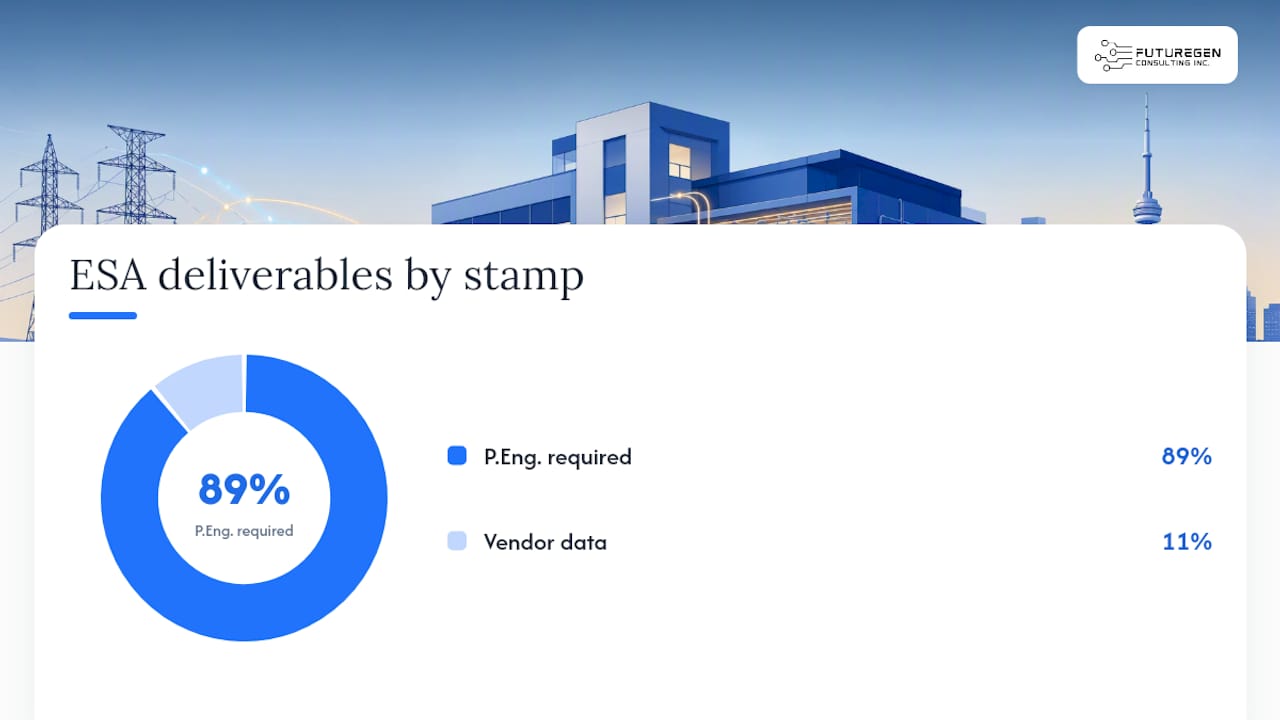
| Deliverable | Description | P.Eng. Stamp Required? |
|---|---|---|
| Single-line diagram | Shows service entrance, metering, switchgear/switchboard, feeders, and panel hierarchy | Yes |
| Load calculations | Demand load per OESC rules; basis for service and feeder sizing | Yes |
| Protection coordination study | Confirms breaker/fuse selectivity and arc-flash boundaries | Yes |
| Short-circuit study | Validates equipment interrupting ratings at each bus | Yes |
| Grounding study | Required for high-voltage station designs not otherwise exempted | Yes |
| Equipment schedules | Panel, switchboard, and transformer schedules with ratings | Yes |
| Manufacturer data / CSA marks | Confirms equipment approval per O. Reg. 22/04 and Rule 2-024 | No (vendor-supplied) |
| Life-safety generator documentation | Includes transfer switch logic, fuel capacity, and test plan | Yes |
| EVSE/ESS rating declarations | Required for EV charger and battery storage installations | Yes |
LDC/utility-specific items include primary fusing specifications, connection application forms (such as Hydro One’s NCCI process), site photographs, staking requirements, and any LDC standard design references. These documents do not go through the EPR portal; they are submitted directly to the utility as part of the connection assessment and design phase.
Equipment approval under Rule 2-024 and O. Reg. 22/04 requires that transformers, switchgear, and other major apparatus carry certification from an accredited body (CSA, UL, or equivalent NRTL mark) or undergo an accredited field evaluation. Vendor submittals must be collected before the permit package is finalized.
Ontario approvals: who regulates what and when
Understanding which body controls which gate prevents the most common scheduling errors on Ontario projects.
- OESC sets the technical rules for all electrical work inside the building, including service entrance requirements. The Ontario Building Code (OBC) explicitly excludes electrical service entrance requirements, which fall entirely under the OESC and ESA jurisdiction.
- Local Distribution Company (LDC) / Hydro One — performs the connection assessment, designs the utility-side connection, and coordinates physical energization. No construction on the utility side proceeds without LDC approval.
- EPR portal is the exclusive submission channel for all ESA plan review submissions. Paper, email, and fax submissions are not accepted. Every submission requires a completed Plan Review submittal form and a site-specific single-line diagram.
When a high-voltage station grounding design is included and not otherwise exempted, a P.Eng.-stamped Grounding Study must accompany the EPR submission using the ESA Grounding Study Submittal Form.
Project stages and a sample timeline from connection assessment to Authorization to Connect
-
Pre-application and LDC contact (weeks 1–4). The owner or developer contacts the LDC to request a connection assessment. Hydro One and other LDCs require project details including load profile, service voltage, and site address. This stage determines whether existing infrastructure can support the proposed load or whether line extensions and upgrades are needed. Responsibility: owner/developer with support from the design engineer.
-
Design and ESA plan submission (weeks 4–12). The P.Eng. prepares the full permit package: single-line diagram, load calculations, protection coordination, short-circuit study, equipment schedules, and any required grounding study. The package is submitted through the EPR portal. Plan review fees are paid at submission. Responsibility: design engineer (P.Eng.), with owner providing site data and equipment selections.
-
Utility design and permitting (weeks 8–16, overlapping with stage 2). The LDC completes its connection design, prepares cost estimates, and issues permits for utility-side work. Primary fusing specifications and staking requirements are finalized. This stage is often the critical-path item for projects requiring line extensions. Responsibility: LDC, with input from the design engineer on load and protection requirements.
-
Construction and field inspections (weeks 12–24+). Electrical contractor installs service equipment, switchboards, feeders, and associated systems per stamped drawings. ESA inspectors conduct field inspections at defined milestones. Equipment must carry the required CSA or NRTL certification marks per Rule 2-024 before installation. Responsibility: electrical contractor, with ESA inspection and design engineer field reviews.
-
Testing, commissioning, and Authorization to Connect (weeks 20–28+). Commissioning tests confirm protection settings, transfer switch operation, grounding continuity, and load balance. Test reports are submitted to ESA. The ESA issues the Authorization to Connect only after all inspections pass and required documentation is complete. The LDC then performs the physical connection and energization. Responsibility: commissioning engineer, ESA inspector, LDC.
A permit-ready checklist for ESA and utility submissions
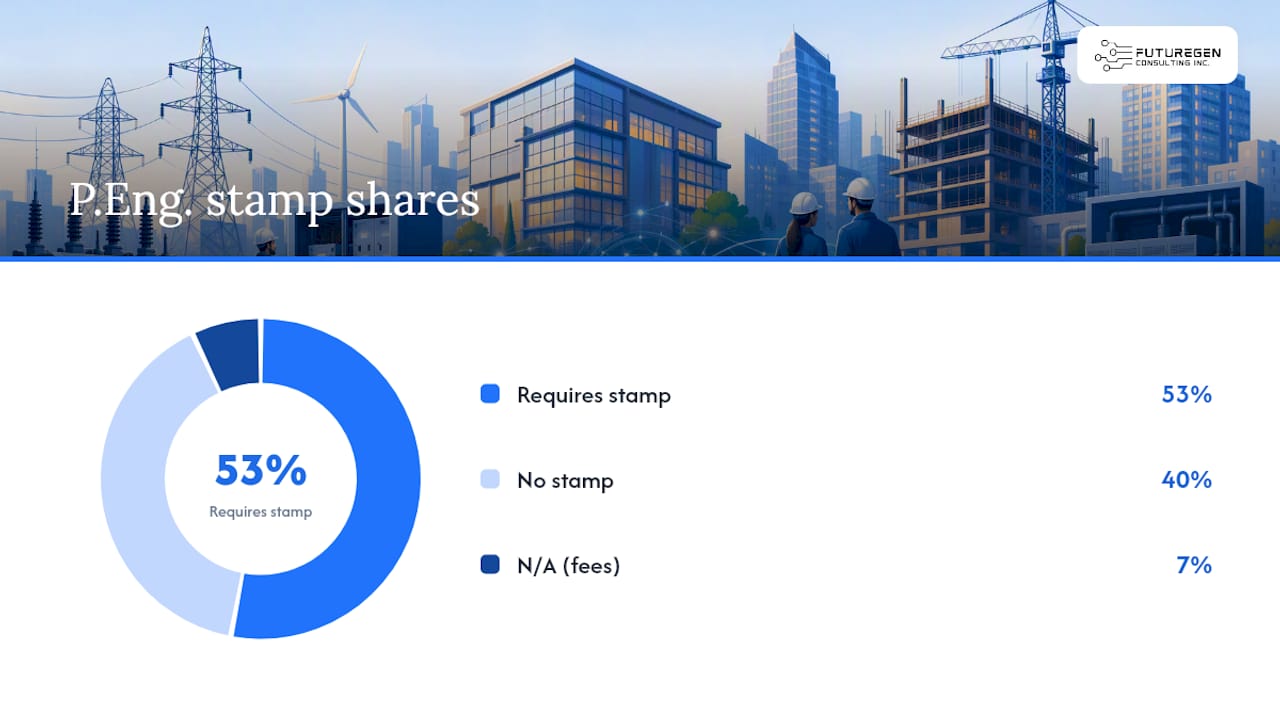
| Document | Required by | P.Eng. Stamp? |
|---|---|---|
| Plan Review submittal form (EPR) | ESA | No |
| Site-specific single-line diagram | ESA | Yes |
| Load calculations | ESA | Yes |
| Protection coordination study | ESA | Yes |
| Short-circuit study | ESA | Yes |
| Grounding Study (if required) | ESA | Yes |
| Life-safety generator documentation | ESA | Yes |
| EVSE/ESS rating declarations | ESA | Yes |
| Manufacturer data / CSA/NRTL marks | ESA | No (vendor) |
| Plan review fees | ESA | N/A |
| Primary fusing specifications | LDC | Yes |
| Connection/NCCI application form | LDC | No |
| Site photographs | LDC | No |
| Staking requirements | LDC | No |
| LDC standard design references | LDC | No |
For detailed submission requirements, the ESA plan review bulletin and the firm’s ESA plan review guide are the two most practical references for design teams preparing a first submission.
Why hiring a P.Eng.-led Ontario electrical design firm reduces project risk
The P.Eng. designation is not a formality on Ontario electrical projects. Under the Professional Engineers Act, only a licensed professional engineer may stamp and seal electrical drawings submitted for regulatory approval. ESA plan review accepts stamped designs as the basis for its compliance audit; an unstamped submission is rejected outright. Legal responsibility for the design rests with the stamping engineer, which means the P.Eng. has direct accountability for code compliance, equipment ratings, and protection coordination.
Trust signals to require from any firm:
- Current P.Eng. license in Ontario (verifiable through Professional Engineers Ontario)
- Documented ESA EPR submission history on comparable projects
- Sample single-line diagrams that reference Rule 2-024 equipment approvals and CSA marks
- Completed Authorization-to-Connect records from previous projects
- Commissioning test report templates and field review protocols
Futuregenconsulting brings P.Eng.-led teams with over 30 years of MEP engineering experience to Ontario building projects, delivering permit-ready power distribution services that include single-line diagrams, load calculations, protection coordination, grounding studies, and commissioning support — all prepared to OESC and O. Reg. 22/04 standards and submitted through the ESA EPR portal.
Key Takeaways
Permit-ready power distribution design in Ontario requires P.Eng.-stamped drawings, ESA EPR submission, LDC connection assessment, and equipment approval per Rule 2-024 before any energization can occur.
| Point | Details |
|---|---|
| Register EPR early | Submit to the ESA EPR portal at the start of design; late registration delays plan review and blocks construction. |
| Engage the LDC at pre-application | Contact Hydro One or the relevant LDC before design begins to identify line extension or upgrade requirements. |
| Require P.Eng.-stamped deliverables | Single-line diagrams, load calculations, protection studies, and grounding studies must carry a P.Eng. stamp for ESA acceptance. |
| Budget for utility-driven costs | Line extensions, transformer upgrades, and primary metering add cost and schedule that must be scoped separately from building-side design fees. |
| Futuregenconsulting | Delivers complete permit-ready power distribution packages, EPR submissions, and commissioning support for Ontario residential and commercial projects. |
What experienced Ontario engineers see on projects and what actually improves outcomes
The single pattern that consistently separates smooth projects from troubled ones is not the quality of the final drawings. It is when the design engineer is brought into the project. Projects where the P.Eng. is engaged during site selection or early schematic design consistently avoid the two most expensive surprises: discovering that the utility requires a line extension after the building design is fixed, and finding that the specified switchgear does not carry the required CSA certification mark.
The data the design team needs at project initiation is straightforward: confirmed service voltage and available fault current from the LDC, a preliminary load list that includes future EVSE and any DER, the site plan showing transformer and switchgear locations, and the life-safety system scope. With that information in hand at week one, the EPR submission can be prepared in parallel with the LDC connection assessment rather than sequentially, which typically removes four to eight weeks from the critical path.
The third cause of delay is procurement. Switchgear and transformer lead times have extended considerably in recent years. A design that specifies equipment without confirming availability and certification status forces either a redesign or a construction hold. Vendors should be engaged and their data sheets reviewed against Rule 2-024 requirements before the permit package is finalized, not after.
Futuregenconsulting’s permit-ready power distribution design services
Ontario developers, contractors, and architects working on projects that require ESA plan review have a direct path to permit-ready deliverables through Futuregenconsulting. The firm handles the full scope: P.Eng.-stamped single-line diagrams, load calculations, protection coordination and short-circuit studies, grounding studies, equipment schedules with Rule 2-024 compliance documentation, EPR portal submissions, and commissioning test plans. For projects with standby generation requirements, emergency power design is included as part of the life-safety scope.

Futuregenconsulting’s MEP engineering services cover both residential and commercial projects across Ontario, with over 30 years of experience coordinating with Hydro One and other LDCs on connection assessments, utility design reviews, and Authorization-to-Connect submissions. To start a project engagement or request a scope and fee estimate, contact the firm directly through the primary services page.
Useful sources for Ontario power distribution design projects
Required reading for plan designers:
- Distribution Connections | Hydro One
- Submit a Plan Review — ESA
- O. Reg. 22/04: ELECTRICAL DISTRIBUTION SAFETY
- 2024 OBC Volume 2 (WPL)
- Electrical Engineer in high-voltage Power Systems (occupations.ca)
Practical next steps for owners and developers:
- Futuregenconsulting ESA Plan Review Guide — practical guidance on preparing and submitting EPR packages
- Futuregenconsulting Power Distribution Services — scope of permit-ready design services available for Ontario projects