

Alberta enforces NECB 2020 for lighting compliance, governed under Part 4 of the code. Design teams must hold installed interior lighting power within NECB allowance limits, document occupancy and daylighting controls separately from power calculations, and treat any lighting trade-off as interior-only work that often needs registered professional authentication before an authority having jurisdiction (AHJ) will accept the submission.
TL;DR:
- Alberta’s NECB 2020 enforcement requires accurate fixture wattages, documented controls, and proper classification, with the compliance path decided early in design.
- Correctly applying the building-area or space-by-space method influences allowances, and outdated reference data or missing control wattage details are common review failures.
- Control documentation, including sensor placements and sequences, must be shown on drawings, and exterior lighting power and controls are also covered and require early coordination.
- The chosen compliance path—prescriptive, trade-off, performance, or tiered—directly affects supporting calculations, professional authentication, and project flexibility.
- Early consultation with a registered professional and thorough coordination of assumptions prevent costly rework during permit review.
Table of Contents
- What Are the NECB Lighting Requirements in Alberta?
- Installed Interior Lighting Power: Allowances, Calculations, and Common Pitfalls
- How Do Lighting Controls Factor Into NECB Compliance?
- Do Alberta’s NECB Rules Cover Exterior and Site Lighting?
- Which NECB Compliance Path Applies to Your Alberta Project?
- What Documentation Do Alberta AHJs Expect at Permit Submission?
- Practical Fixes From Alberta MEP Engineering Practice
- How Experienced Engineers Approach NECB Lighting Compliance
- How FutureGen Supports NECB-Compliant Lighting Design in Alberta
- Where to Verify NECB Lighting Requirements Yourself
- Sources
- FAQ
What Are the NECB Lighting Requirements in Alberta?
Getting ahead of permit delays starts with five moves at project kickoff, before a single fixture gets specified.
- Confirm the governing code edition and pick a compliance path (prescriptive, trade-off, or performance) before locking design assumptions.
- Classify every lighting space and decide between building-area or space-by-space calculation methods.
- Build a complete fixture schedule with actual input wattages, including ballasts, transformers, and control-device draw.
- Document occupancy sensors, daylighting controls, and scheduled shut-off directly on the drawing set.
- Coordinate lighting inputs with the energy model and keep every supporting calculation on file for AHJ review.
Skipping any one of these tends to surface as a review comment three to four weeks into permitting, exactly when a project can least afford the delay.
Installed Interior Lighting Power: Allowances, Calculations, and Common Pitfalls
NECB 2020 defines installed interior lighting power as the total connected wattage of all lighting equipment serving a space, and Part 4 requires that total to sit at or below the allowance drawn from the NECB 2020 tables. An LED fixture schedule by itself does not prove compliance, no matter how efficient the fixtures are. The National Energy Code of Canada for Buildings 2020 (NECB 2020) requires the actual calculated wattage to be checked against the applicable table value, and that check has to be documented, not assumed.
Two calculation methods apply, and the choice affects your allowance:
- Building-area method: applies a single lighting power density (LPD) across the whole building based on occupancy type. Faster to calculate, but less forgiving for mixed-use floor plates.
- Space-by-space method: assigns LPD values per room function, which usually yields a higher aggregate allowance for buildings with varied space types.
The most frequent mistakes on Alberta submissions: pulling LPD figures from outdated summary sheets instead of the current NECB 2020 tables, leaving control-device power out of the fixture schedule, and misclassifying semi-conditioned or sheltered spaces as fully conditioned. NECB 2020 updated lighting power densities to reflect more efficient lighting products than the 2017 edition assumed, which means older references understate what today’s allowances actually permit, or misstate them entirely.
Pro Tip: Build the fixture schedule with a dedicated column for control-device wattage from day one. Retrofitting that column after the energy model is locked is where most rework hours disappear.
How Do Lighting Controls Factor Into NECB Compliance?
Controls compliance is a separate line item from lighting power compliance, and Alberta AHJs check both independently. A building can meet its LPD allowance and still fail review if control documentation is incomplete.
- Scheduled shut-off: automatic time-based controls must switch off lighting in applicable spaces outside occupied hours, with the schedule documented on the drawings.
- Occupancy-based controls: sensors are required in specified space types, and their coverage area and mounting location need to appear on the permit set.
- Automatic daylighting controls: toplighted and sidelighted areas meeting NECB 2020 thresholds require daylight-responsive dimming or switching.
- Sequence of operation: each control type needs a written sequence, not just a symbol on a reflected ceiling plan.
The City of Edmonton’s NECB guidance specifically expects control types and sensor locations shown on drawings for both interior and exterior lighting. An AHJ reviewer who cannot locate a sensor on the plan will issue a comment, even when the control itself is specified correctly in the fixture schedule.
Do Alberta’s NECB Rules Cover Exterior and Site Lighting?
Yes. NECB Part 4 explicitly covers exterior lighting connected to the building electrical service, including parking areas, pathways, and communal outdoor spaces. This is where projects most often treat lighting as an afterthought, because site lighting gets designed late and handed to an electrical subtrade without energy-code review.
- Calculate exterior lighting power against the applicable NECB allowance and document it the same way you document interior power.
- Show exterior controls (photocell, timer, or occupancy-based) on the site electrical drawings, not buried in a spec section.
- Coordinate photometric design with dark-sky considerations and local bylaws early, since Alberta municipalities apply their own overlays on top of NECB minimums.
The City of Calgary’s NECB guidance requests exterior fixture wattage calculations and control documentation directly on prescriptive checklists, so treating site lighting as a late-stage electrical detail invites a resubmission. A site lighting plan built alongside the base building design avoids that rework entirely.
Which NECB Compliance Path Applies to Your Alberta Project?
NECB 2020 offers four paths, and the one you pick early shapes everything downstream, from modeling assumptions to who signs the submission.
- Prescriptive: meet every Part 4 lighting requirement directly, no trade-offs. Simplest documentation burden, least design flexibility.
- Prescriptive-with-trade-offs: allows lighting performance to offset other lighting requirements, but the trade-off is interior-only and cannot be balanced against envelope or HVAC performance elsewhere in the code.
- Performance path: whole-building energy modeling replaces prescriptive checks, typically demanding more upfront modeling effort but more design freedom.
- Tiered-performance path: introduced with NECB 2020, this sets progressively higher energy performance tiers above the baseline, and the NRC User’s Guide walks through how those tiers are structured.
Municipalities may require registered professional authentication on trade-off calculations, and the compliance path decision itself is the highest-leverage choice on the whole project, since it determines what the AHJ will ask for at submission. Decide before locking lighting or energy-model assumptions, not after.
What Documentation Do Alberta AHJs Expect at Permit Submission?
A permit-ready lighting package follows a consistent sequence regardless of building type.
- Confirm the governing NECB edition and pull the specific AHJ checklist, since Edmonton and Calgary format their requirements differently.
- For tenant improvements, obtain base-building energy model assumptions before finalizing fit-up lighting, so the two reconcile.
- Select building-area or space-by-space calculation and build the fixture schedule with every component wattage included.
- Provide control diagrams and sequences of operation mapped directly to the NECB control requirements they satisfy.
- Where trade-offs apply or the project falls under Part 3 scope, attach registered professional authentication and a signed schedule of interconnected involvement.
Pro Tip: Request the base-building energy model assumptions from the landlord or developer before your fit-up drawings go to 60% design. Reconciling those numbers after a lighting layout is finalized almost always triggers a redesign.
Practical Fixes From Alberta MEP Engineering Practice
The single decision that determines how much rework a project sees later is the compliance path, chosen before the lighting layout, not after. Engineers who sequence tasks well lock that path first, then build the fixture schedule and energy model against it rather than the reverse.
A handful of recurring coordination gaps account for most of the review comments we see:
- Control-device wattage left out of the luminaire schedule, which understates connected load and overstates compliance margin.
- Base-building energy assumptions never reconciled with tenant fit-up lighting, a frequent failure point on leased commercial floors.
- Exit-sign and emergency lighting miscoded against STANDATA interpretations, which can exempt photoluminescent signs from lighting power calculations under limited conditions, but only when the specific configuration matches the interpretation’s text.
- Trade-off calculations submitted without registered professional authentication, forcing a resubmission cycle on Part 3 projects.
Retaining a registered professional early, and scoping their deliverables around exactly what the AHJ requests, resolves most of these before they reach the review desk. This pairs naturally with electrical load calculation work already underway on the same project.
How Experienced Engineers Approach NECB Lighting Compliance
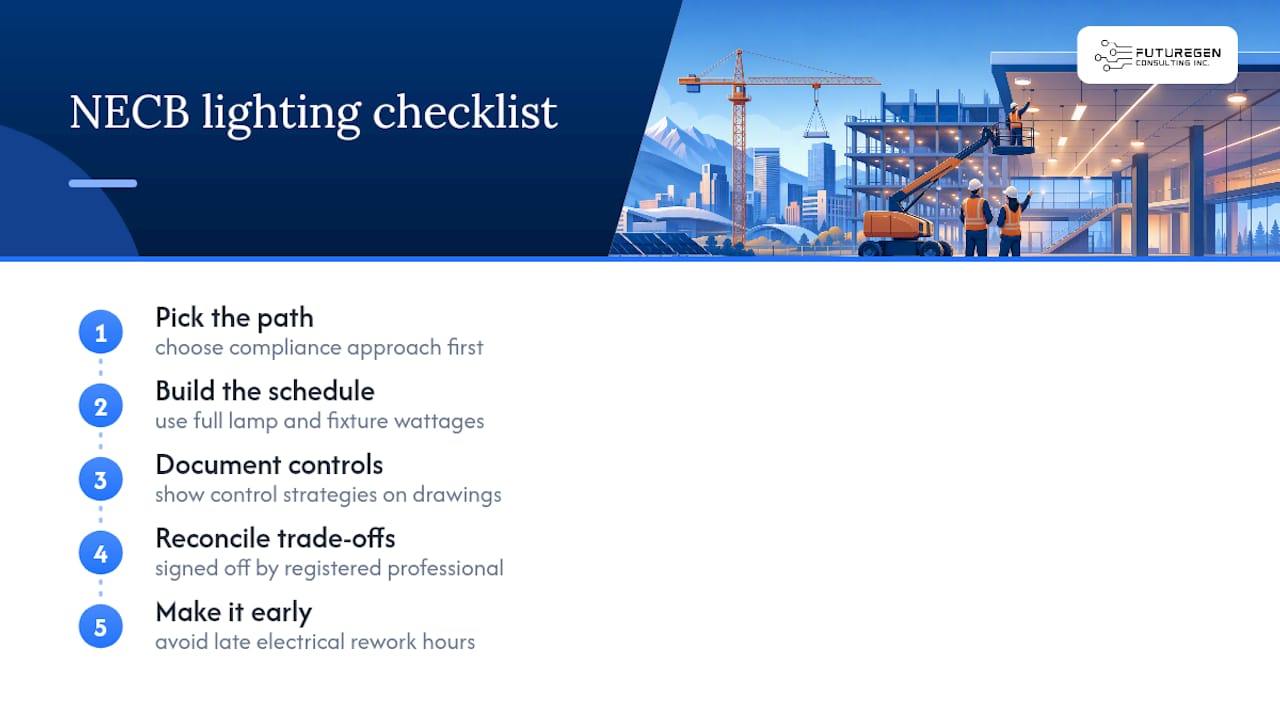
Outcomes on NECB lighting review are remarkably predictable once you follow the checklist in order: pick the path, build the schedule with full wattages, document controls on the drawings, and reconcile trade-offs with a registered professional’s stamp. The teams that struggle almost always skipped step one and tried to retrofit a compliance path onto a finished design.
The timing mistake worth naming directly: treating lighting compliance as a late electrical task instead of an early design decision costs far more hours than it saves.
— Sanjay
How FutureGen Supports NECB-Compliant Lighting Design in Alberta
Some engineering firms offer integrated lighting compliance services that deliver site lighting design, fixture schedules with full wattage accounting, energy-model coordination, and professional sign-offs as a connected package, so the compliance path is decided before the layout, not after.

Engaging FutureGen at schematic design, or at the latest before permit pre-submission, gives enough runway to reconcile base-building assumptions on tenant fit-ups and to build control documentation directly into the drawing set rather than adding it after a review comment. Our site lighting design services cover exactly this scope, from photometric layout through permit-ready, engineer-stamped drawings. If your project needs a scoped proposal for NECB lighting compliance in Alberta, reach out through our services page to start that conversation.
Where to Verify NECB Lighting Requirements Yourself
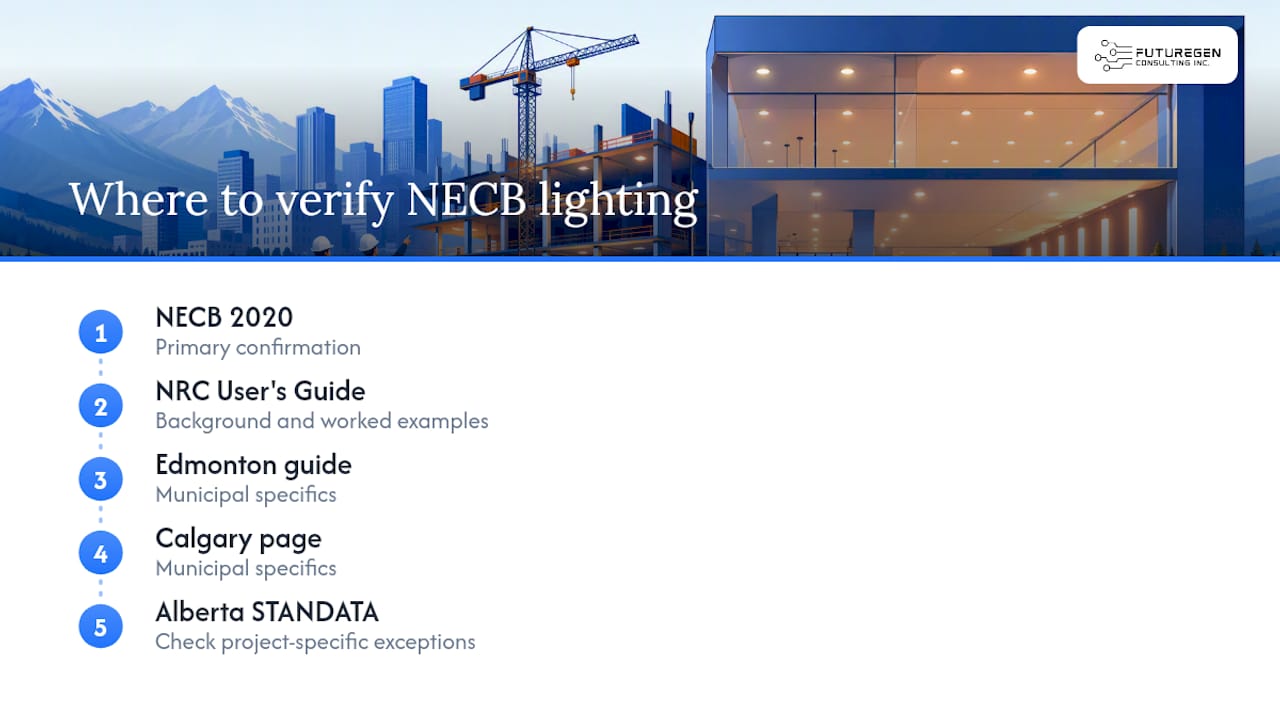
For primary confirmation, consult the NECB 2020 publication and the NRC User’s Guide for background and worked examples. Municipal specifics come from Edmonton’s NECB guide and Calgary’s NECB page, with project-specific exceptions checked against Alberta STANDATA interpretations.
Sources
- National Energy Code of Canada for Buildings 2020 (NECB 2020)
- City of Edmonton — NECB Energy Efficiency Requirements guide
- User’s Guide for the National Energy Code of Canada for Buildings 2020 — NRC
- Alberta STANDATA interpretation — example (exit sign treatment)
FAQ
What edition of the NECB applies in Alberta?
NECB 2020 is the controlling edition for lighting compliance in Alberta where adopted, replacing the 2017 edition’s lighting power density tables with updated, more current allowance values referenced in the NECB 2020 publication.
What are the key differences between the 2017 and 2020 NECB lighting rules?
NECB 2020 updated lighting power densities to reflect improvements in lighting product efficacy and introduced the tiered-performance compliance path, detailed in the NRC User’s Guide. Projects using older 2017-based summary tables risk applying incorrect allowance figures.
What is NECB Tier 1?
Tier 1 is the baseline performance level under the tiered-performance compliance path introduced in NECB 2020, with each higher tier requiring progressively better whole-building energy performance above that baseline. The NRC User’s Guide explains how the tier structure applies across compliance paths.
What is the National Energy Code of Canada for Buildings (NECB)?
The NECB is the national model code setting minimum energy efficiency requirements for building systems, including lighting, HVAC, and envelope design, published as NECB 2020. Alberta adopts it provincially, with municipalities like Edmonton and Calgary layering their own permit documentation expectations on top.
How does the NECB lighting trade-off path work in Alberta?
The lighting trade-off path allows interior lighting performance to offset other interior lighting requirements within Part 4, but it cannot be traded against envelope or HVAC performance. Municipalities may require registered professional authentication on those calculations before accepting the submission.