
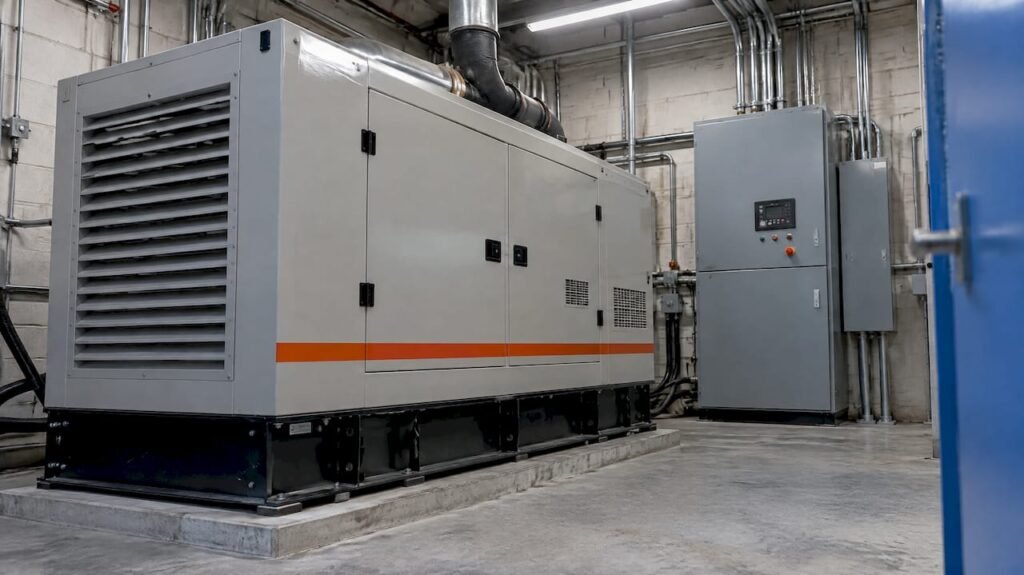
Generator load shedding is an automatic control strategy that disconnects lower-priority circuits so a standby generator keeps life-safety and essential systems running without overloading. Done well, it keeps critical loads energized, prevents overload trips, and can reduce the generator size a project needs. We design these schemes with applicable requirements in mind.
TL;DR:
- Classify circuits as life safety, support, and discretionary, then stage startup and reconnection so simultaneous motor and HVAC restarts do not overload capacity.
- Keep first tier and support loads below the generator’s continuous rating, leaving headroom for motor starts; confirm the margin with an engineer and manufacturer.
- Ontario emergency systems follow CSA C282:24, while approvals involve the local utility and ESA; where neutral switching is required, use a four pole transfer switch.
- Commissioning should test each shedding stage, confirm timed reconnection without cycling, record settings, and repeat tests after any load, setpoint, or control change.
Table of Contents
- What load shedding and load management mean for standby generators
- How load shedding works in practice: control logic, sequencing and timing
- How to select and prioritize circuits to protect essential power
- Required equipment and control components (ATS, ALMS, relays, transfer switches)
- Codes, standards and approvals that affect load-shedding design
- Testing, commissioning and maintenance steps to verify load-shedding works
- Design tips for sizing generators and avoiding overload or nuisance shedding
- Accessories and vendor-agnostic options for smarter load management
- How load shedding affects HVAC systems and keeps occupants comfortable
- Considerations for load shedding in commercial vs residential generator applications
- Real-world examples of generator load shedding implementations in Ontario projects
- A designer’s view on cost, redundancy and testing
- How we help with emergency power, load-shedding design and approvals
- FAQ
- Sources
What load shedding and load management mean for standby generators
Three terms are often used interchangeably, and they should not be. Load management is the umbrella strategy: deciding which loads the generator carries, and when. Load sequencing is the startup piece, where loads are connected in timed steps so the engine and alternator never face the full building at once. Load shedding is the ongoing piece, where non-essential circuits are dropped if demand exceeds what the generator can safely supply.
A generator has a fixed capacity, and unlike the utility it cannot absorb a sudden surge without frequency and voltage dipping. Without staged control, a large motor start or a simultaneous HVAC restart can stall the engine or trip the breaker, and then even the essential circuits go dark. Staged control keeps the generator inside its rating while the building keeps working.
How load shedding works in practice: control logic, sequencing and timing
A load management controller continuously measures generator output, typically through current transformers and a power or current setpoint. When measured demand crosses a threshold, say a set percentage of the generator’s continuous rating, the controller trips the lowest-priority stage first. If demand stays high, it moves to the next stage.
A typical sequence looks like this:
- At transfer, only first-tier essentials connect: life-safety lighting, fire pumps, controls.
- After a short delay, second-tier support loads join in timed steps, largest motors last or in separate steps.
- During operation, if output exceeds the setpoint, discretionary loads shed first, then second-tier loads if needed.
- When demand falls and stays low for a set period, shed stages reconnect one at a time.
Those delays matter. After an outage, thermostats, compressors and heaters all call for power at once, and the combined inrush (cold load pickup) can far exceed normal running demand. Spacing reconnection by seconds or minutes, and holding each stage until the previous one settles, prevents the generator from tripping on its own restart sequence. Reconnect timers also stop a marginal load from cycling on and off repeatedly, which is the classic nuisance shedding problem.
How to select and prioritize circuits to protect essential power
Start from the panel directory and sort every circuit into one of three tiers:
- First tier, essentials: life-safety and egress lighting, fire alarm and fire pumps, medical or process-critical equipment, building controls, communications and IT.
- Second tier, support loads: critical HVAC or ventilation, refrigeration, sump and sewage pumps, elevators on a controlled schedule, water heating.
- Third tier, discretionary: general receptacles, decorative lighting, EV chargers, laundry, pool equipment, non-critical comfort cooling.
Add up the running and starting demand of each tier. A practical rule is to keep the combined first-tier and expected second-tier running load below the generator’s continuous rating, leaving headroom for motor starts and avoiding sustained operation at the limit. Treat this as a design margin, not a code mandate, and confirm it against the manufacturer’s data and your engineer’s calculations.
Required equipment and control components (ATS, ALMS, relays, transfer switches)
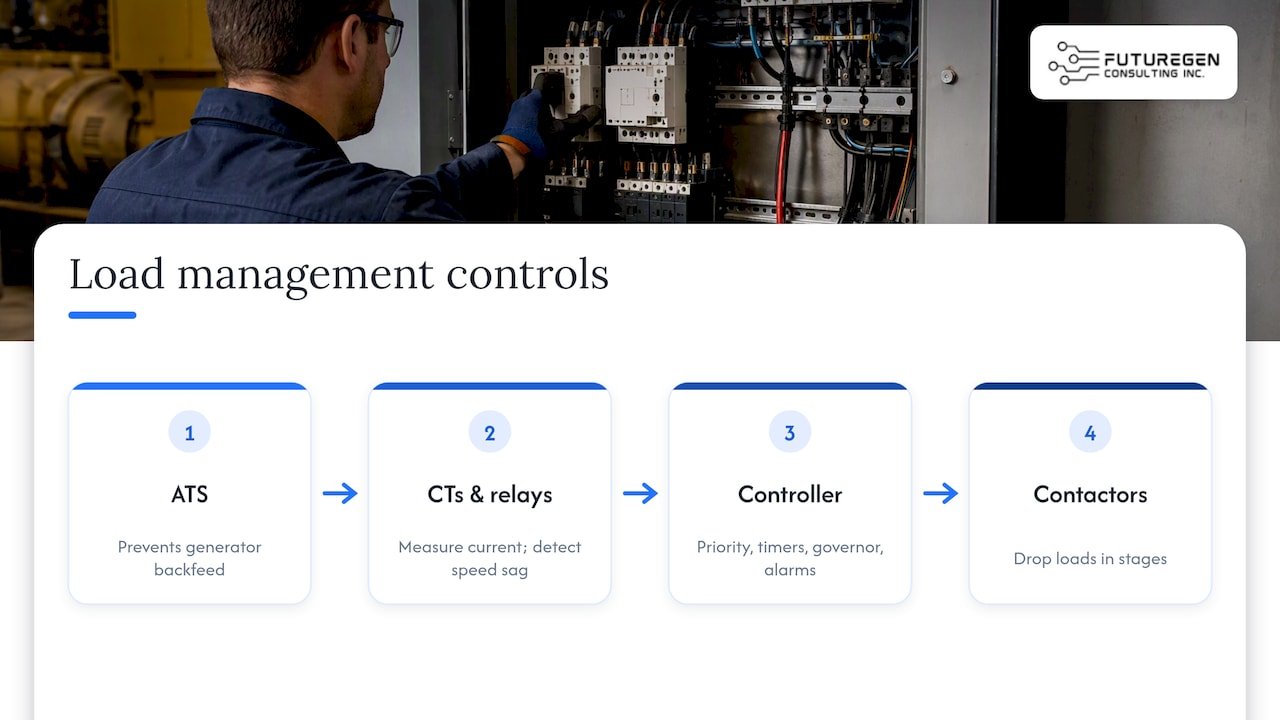
The automatic transfer switch is the foundation. It isolates the building from the utility to prevent generator backfeed. Check with your LDC about the applicable connection requirements under Ontario LDC connection rules. Where the neutral must be switched to avoid parallel ground paths, a 4-pole transfer switch is used; a 3-pole device in that situation is a common cause of inspection failures.
An automatic load management system sits downstream. In simpler installations it is a set of staged relays or contactors driven by a current sensor. In larger ones, a PLC or the generator’s own controller handles sequencing, priorities and reconnect timers. Current transformers provide the measurement, under-frequency relays can drop loads when speed sags, and the controller integrates with the generator’s governor and alarms so shedding responds before the engine is in trouble.
Codes, standards and approvals that affect load-shedding design
For emergency power in Ontario, CSA C282:24 is the reference. The 2024 edition defines an automatic load management system and adds testing requirements, including Clause 10.3.6, which matters most for multi-generator installations where essential loads must stay within available capacity.
On the grid side, IESO operating documents explain how load shedding is directed to protect grid integrity and how automatic under-frequency load shedding is administered. Separately, the Ontario restoration plan excludes priority customer loads from rotational shedding. That is grid-level shedding, which is distinct from the facility-level shedding discussed here, but your essential-circuit list should align with it.
Approvals run through your LDC and ESA. ESA’s Bulletin 2-33-0 covers transfer device rules, and LDCs require technical submissions through forms such as LDC Form B.
Testing, commissioning and maintenance steps to verify load-shedding works
A shedding scheme that has never been tested is an assumption. Commissioning should prove each stage under realistic conditions:
- Verify setpoints, timers and priority order against the approved single-line diagram.
- Run a staged load test, adding load until each shed stage operates, and confirm the correct circuits drop in the correct order.
- Confirm automatic reconnection, including timer behavior and no cycling.
- Perform a full-load test, using a load bank where building load is insufficient. We cover procedure in our generator load bank testing guide.
- Record results, setpoints and as-found conditions in the commissioning file.
Ongoing, keep inspection logs and periodic test records; our note on emergency generator rules and log requirements in Ontario outlines what inspectors expect. The pitfalls we see most often are incorrect neutral handling and relay coordination that sheds the wrong stage first. Retest after any change to loads, setpoints or generator controls.
Design tips for sizing generators and avoiding overload or nuisance shedding
Size from the worst realistic step, not the average. Motor starting current can be several times running current, so list the largest motors and decide whether they start on soft starters or variable frequency drives, or in their own timed stage. Add cold load pickup for heating and cooling after longer outages, since thermostat-driven loads all restart together.
Staged shedding is also a cost lever. Because discretionary loads drop automatically when capacity is tight, the generator only needs to cover essentials plus whatever else is likely to run together, which can mean a smaller unit than carrying the entire panel. A formal power system study is the dependable way to confirm that margin.
Where uptime matters more than first cost, consider paralleled generators. Multiple smaller sets give redundancy, and they let the load management system shed in proportion to how many units are online. Paralleled systems carry additional control and testing requirements under CSA C282, so involve your engineer early.
Accessories and vendor-agnostic options for smarter load management
Several device classes support circuit-level control without locking you into one manufacturer. Circuit-level load managers and controlled receptacles handle residential-scale shedding. Power relays and contactors, wired to a controller, handle larger staged loads. PLCs and telemetry modules add logic, event logging and remote visibility, which makes alarms, shed events and load trends visible during commissioning and maintenance. Selecting switching hardware also means reviewing switchgear options, and a switchgear product category is one starting point for comparison. Remember that accessory choices affect wiring, neutral handling and approvals, so confirm each with your engineer and the authority having jurisdiction.
How load shedding affects HVAC systems and keeps occupants comfortable
HVAC is usually the largest and most disruptive load on a generator. Compressors have high starting current, electric heat strips draw continuously, and after an outage every unit calls for conditioning at once. That is why HVAC sits in the second or third tier in most schemes, and why it is the first candidate for staged reconnection.
Practical strategies depend on what the building needs. For comfort-only spaces, shed cooling and electric heat entirely during the outage and keep ventilation fans running if they serve life-safety or air quality. For spaces with real thermal limits, such as server rooms, labs, vaccine storage or care facilities, treat dedicated cooling as a first-tier load and size the generator for it.
Between those extremes, a few design choices keep people comfortable without overloading the set. Stagger compressor restarts with timers so only one large unit starts at a time. Use fan-only or setback modes on non-critical zones during generator operation. Prefer variable-speed equipment where possible, since it starts softly and draws less inrush than fixed-speed compressors. In cold weather, protect heat sources that prevent freezing of pipes and sprinklers before comfort heating.
HVAC load behavior should be calculated, not guessed. Accurate zone loads feed both generator sizing and shedding priorities, and our HVAC design services integrate those calculations with the emergency power design so the two systems are coordinated from the start.
Considerations for load shedding in commercial vs residential generator applications
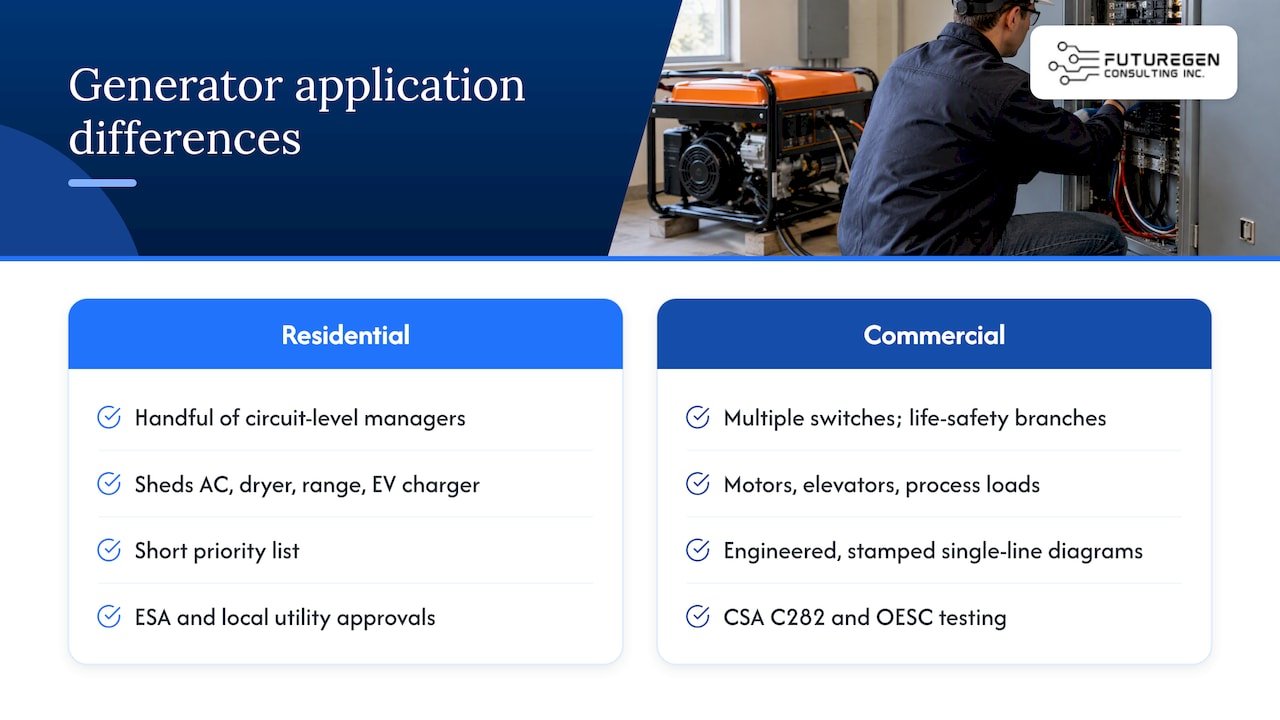
Residential systems are usually simple. A standby generator with an automatic transfer switch and a handful of circuit-level load managers or controlled relays shed an air conditioner, electric dryer, range or EV charger when the total approaches the generator rating. The priority list is short, approvals run through ESA and the local utility, and safe wiring matters most: ESA warns against homeowner modifications and stresses approved transfer devices and removal of temporary generator wiring when utility power returns.
Commercial and institutional projects are a different class of problem. They typically have multiple transfer switches, life-safety and equipment branches, motors, elevators and process loads. Load shedding is designed by an engineer, documented on stamped single-line diagrams, and tested against CSA C282 and the OESC. Where P.Eng.-stamped diagrams showing interconnection and load-management protection are expected, an incomplete submission causes construction delays and inspection failures.
Commercial projects also bring grid-side obligations. Very large facilities may need to coordinate with IESO programs: loads above 25 MW can be required to participate in under-frequency load shedding, which is far beyond typical building scale but shows how the requirements scale. For most buildings, the practical difference is documentation, testing rigor and the consequences of failure. A tripped residential generator is an inconvenience. A tripped commercial one can stop a care facility, a data room or a fire pump.
Real-world examples of generator load shedding implementations in Ontario projects
We do not publish client project data, so the following are representative scenarios drawn from the types of work we design, not named case studies.
Mid-rise residential building. The emergency generator serves life-safety loads: egress lighting, fire pump, fire alarm and an elevator for firefighter use. Rather than sizing for every elevator, the design runs elevators one at a time on a controlled sequence. The load management controller holds the second elevator until the first has parked, which keeps the generator smaller than a full-load design would require.
Small commercial building with a dedicated server room. Cooling for the server room is a first-tier load. General office HVAC and electric water heating are second and third tier, shed automatically if the generator approaches its setpoint. Commissioning showed that rooftop units were restarting together after transfer, so we added timed reconnection to stagger them.
Multi-generator institutional installation. Paralleled generator sets feed essential and equipment branches. If one unit is offline for maintenance, the load management system sheds second-tier loads automatically so the remaining unit stays within capacity. CSA C282:24’s testing requirements apply, including Clause 10.3.6, so the shedding logic is verified as part of commissioning.
These scenarios share a pattern: decide priorities early, test the staging under load, and document everything for the LDC and ESA. Our longer guide to emergency generator design in Ontario walks through the design process.
A designer’s view on cost, redundancy and testing
Every load shedding design trades three things: first cost, redundancy and the testing burden regulators impose. A smaller generator with aggressive shedding costs less to buy but demands more commissioning and leaves less margin. A larger or paralleled plant costs more but forgives mistakes. I lean toward spending on the study and the test, not on oversizing, because a coordinated single-line diagram and a P.Eng.-stamped submission prevent the LDC delays that cost far more than any equipment saving. The scheme you can prove works beats the one you hope works.
How we help with emergency power, load-shedding design and approvals
Our services cover the engineering behind a defensible load shedding scheme. Contact us to discuss your project and we will scope the work with you.

- Emergency power design, including load priority lists and shedding logic
- Power system studies to size generators and verify protection
- Permit-ready, P.Eng.-stamped drawings and single-line diagrams
- LDC and ESA coordination, plus testing and commissioning support
FAQ
What is load shedding in generators?
Load shedding is the automatic disconnection of lower-priority circuits when demand approaches a generator’s capacity. It keeps essential loads energized and prevents overload trips. Controllers use current or power setpoints to decide when each stage drops.
Is load shedding back in 2026?
Grid load shedding is directed by system operators only when needed to protect grid integrity, and IESO policies describe when and how it is applied. Facility-level generator load shedding is a separate design strategy that operates whenever a standby generator is running.
What is the 80% rule for generators?
Use this as a practical guideline, not a code requirement, and confirm it with your engineer and the manufacturer’s data.
How do you reduce reliance on load shedding?
Size the generator for the essential and likely concurrent loads, use soft starters or variable-speed drives on large motors, and stagger restarts with timers. A power system study confirms the margins before you build.
Sources
- Emergency Backup Generation Notification/Application Form
- Part 7.4: IESO-Controlled Grid Operating Policies