

What is a dry sprinkler system and why is it used?
A dry sprinkler system is a fire suppression system in which the sprinkler piping is filled with pressurized air or nitrogen rather than water. Water is held back behind a specialized dry pipe valve, located in a heated riser room, and is only released into the piping network when one or more sprinkler heads activate due to heat from a fire. This design is the standard solution for any building area where ambient temperatures cannot be reliably maintained at or above 4°C (40°F), making it particularly relevant across Alberta and other cold Canadian climates.
Key distinguishing features of dry pipe fire sprinkler systems include:
- Pressurized standby state: Compressed air or nitrogen fills the overhead piping, keeping the system free of water during normal operation.
- Dry pipe valve: A pressure-differential valve acts as the barrier between the water supply and the dry piping network, preventing water from entering until activation.
- NFPA 13 water delivery requirement: Water must discharge from the most remote test connection within 60 seconds of sprinkler activation, a standard that governs both valve trip time and water transit time.
- No standing water in exposed piping: Unlike wet pipe systems, there is no water present in any piping exposed to freezing temperatures during normal standby.
- Greater system complexity: Additional components, including air compressors, supervisory devices, and monitoring controls, are required compared to wet pipe installations.
Where wet pipe systems are the preferred choice for heated, conditioned spaces, dry systems are the code-compliant answer for unheated or intermittently heated environments throughout Canada.
Table of Contents
- How does a dry sprinkler system work? Heat transfer and system operation
- Common applications and advantages of dry sprinkler systems in Canada
- Disadvantages and maintenance considerations for dry sprinkler systems
- How dry sprinkler systems compare to wet, preaction, and other system types
- Canadian code requirements and engineering best practices for dry sprinkler systems
- Futuregenconsulting delivers code-compliant dry sprinkler system design for Canadian projects
- Key Takeaways
How does a dry sprinkler system work? Heat transfer and system operation
Understanding the operational sequence of a dry pipe fire sprinkler requires attention to both the mechanical components and the underlying heat transfer principles that govern sprinkler head activation.
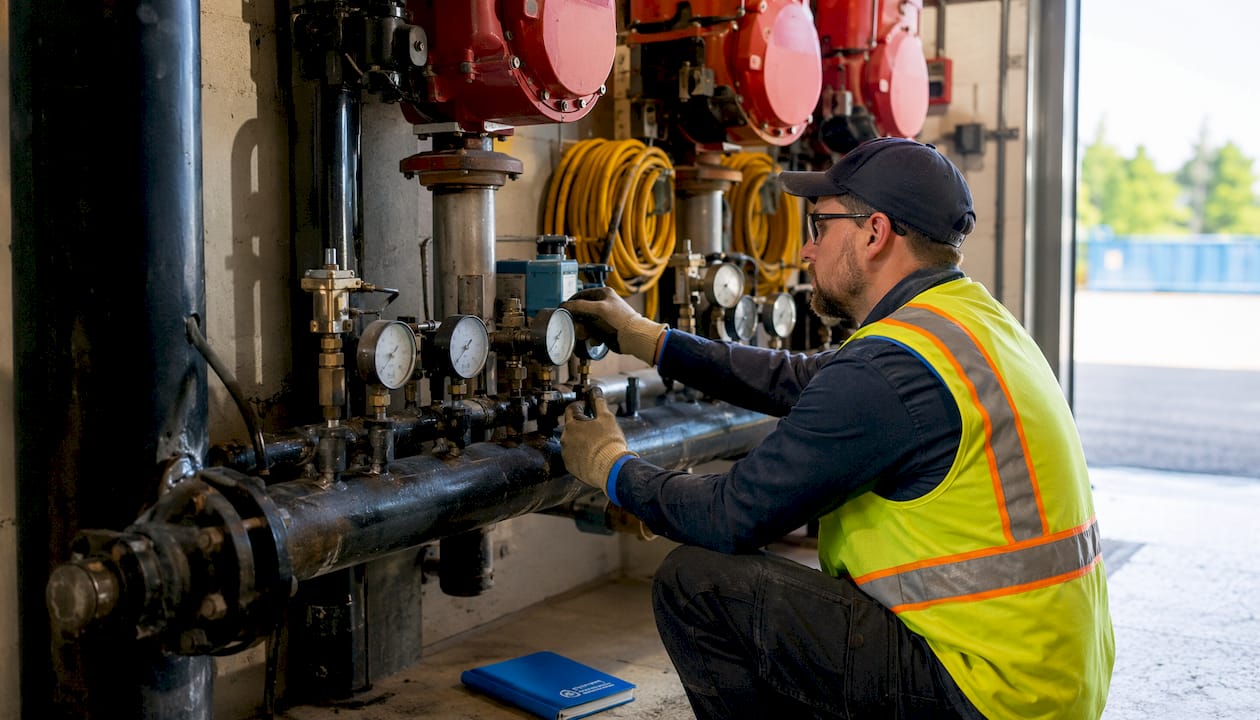
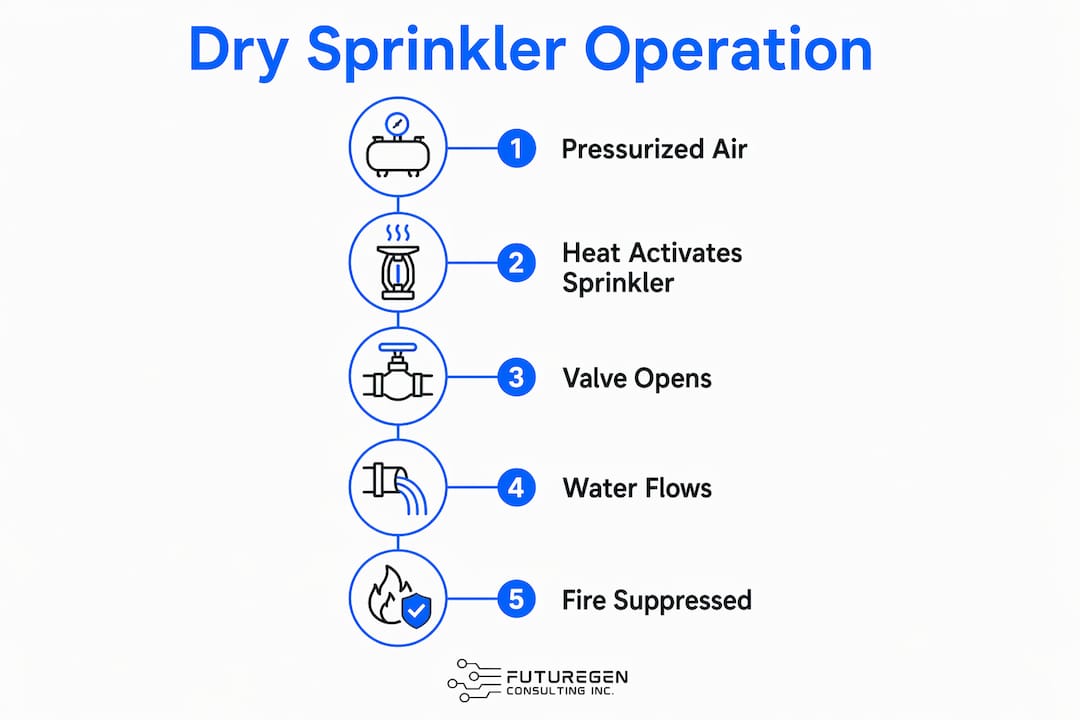
During normal standby, the piping network above the dry pipe valve is pressurized with compressed air or nitrogen. The valve itself is held closed by the pressure differential between the air side and the water supply side. When a fire develops, convective heat transfer raises the air temperature at the ceiling level. Once that temperature reaches the rated activation threshold of a sprinkler head, a heat-sensitive element (either a fusible link or a glass bulb containing a thermally expansive liquid) fails, allowing the head to open.
The sequence from that point forward proceeds as follows:
- Air or nitrogen begins escaping through the open sprinkler head, causing a rapid pressure drop in the piping network.
- The dry pipe valve detects the pressure differential change and trips open, allowing water to enter the system from the heated riser room.
- Water travels through the main feed lines and branch lines, displacing the remaining air, until it reaches and discharges from the open sprinkler head.
- Only the sprinkler head(s) directly activated by heat discharge water; adjacent heads remain closed unless their own thermal elements are triggered.
The built-in delay between sprinkler activation and water discharge is the defining operational characteristic of dry pipe systems. Because pressurized air must exhaust from the entire piping volume before water can reach the open head, response time is inherently slower than in a wet pipe system. Accelerators and quick-opening devices are installed to reduce valve trip time and partially offset this delay, but the transit time through the piping remains a function of pipe volume and layout.
System configuration, particularly the location and length of feed mains, critically affects water transit time and compliance with the NFPA 13 60-second delivery limit. Center-center feed configurations, where the water supply enters at the center of the system rather than one end, reduce the maximum distance water must travel and can shorten transit times without requiring larger pipe diameters.
Modern dry pipe valves no longer require the historically common 6:1 air-to-water pressure differential. Lower air pressure settings can accelerate valve trip times, but they require precise engineering to avoid nuisance trips or pressure instability, a detail that underscores the importance of qualified design review on every installation.
Common applications and advantages of dry sprinkler systems in Canada
Dry pipe systems are the standard fire protection solution for any building area where temperatures drop below 4°C, a threshold that applies to a significant portion of Alberta’s built environment for several months each year.
Typical applications in Canadian facilities include:
- Unheated or partially heated warehouses and distribution centers
- Parkade structures, including above-grade and underground parking garages
- Loading docks and receiving areas exposed to exterior conditions
- Attic spaces and concealed roof areas without continuous heating
- Cold storage and commercial freezer facilities
- Exterior canopies and covered walkways attached to heated buildings
- Mechanical penthouses with intermittent or no heating
Advantages of dry fire protection systems in these environments:
- Freeze protection: Water is absent from all exposed piping, eliminating the risk of frozen pipes blocking water flow or bursting under ice expansion pressure.
- Prevention of pipe bursts and structural water damage: By keeping water out of cold zones, dry pipe systems prevent the pipe failures that can cause significant structural and property damage in unheated spaces.
- Code compliance in cold climates: NFPA 13, as adopted under Canadian building codes, requires freeze protection for any area where ambient temperatures may fall below 4°C. Dry systems are the most direct method of achieving that compliance.
- Reduced accidental discharge risk: Because water is not continuously present in the exposed piping, the probability of water damage from a mechanical failure or minor impact to a sprinkler head is lower than in a wet system.
- Flexibility in mixed-occupancy buildings: Dry systems can be zoned to cover only the cold areas of a facility, while heated interior spaces use more cost-effective wet pipe protection.
A warehouse in the Edmonton area, for example, might use a wet pipe system throughout its conditioned office wing and a dry pipe system covering the unheated storage bay and loading dock. This hybrid approach is both code-compliant and cost-effective, and it is a common design pattern in Alberta’s industrial and commercial construction sector.

Disadvantages and maintenance considerations for dry sprinkler systems
The freeze protection advantages of dry systems come with real operational trade-offs. Decision makers evaluating dry sprinkler system installation should account for the following:
Operational disadvantages:
- Slower response time: The need to exhaust pressurized air before water reaches an open sprinkler head introduces a delay that does not exist in wet pipe systems. While NFPA 13 sets a maximum of 60 seconds for water delivery, even a compliant delay can affect suppression effectiveness in fast-developing fires.
- Higher installation cost: Air compressors, dry pipe valves, supervisory devices, and associated controls add significant capital cost compared to a wet pipe installation of equivalent coverage area.
- Internal pipe corrosion: Oxygen-rich compressed air and residual moisture inside the piping accelerate both electrochemical corrosion and microbiologically influenced corrosion (MIC). Over time, this can compromise pipe wall integrity and sprinkler head performance. Nitrogen is frequently specified as the supervisory gas in preference to compressed air because it significantly reduces the oxygen content inside the piping and slows corrosion rates.
- Condensation and freeze blockages: Moisture drawn into the system by air compressors accumulates at low points in the piping. In cold environments, this condensate can freeze and create blockages, potentially preventing water delivery during an actual fire event.
Dry sprinkler systems are not “set and forget” installations. Rigorous maintenance per NFPA 25 is not optional; it is the difference between a system that performs as designed and one that fails silently until a fire event exposes the deficiency.
Maintenance requirements under NFPA 25:
- Annual full trip tests, which involve opening the dry pipe valve to flood the system, measuring water transit time, draining the entire piping network, and repressurizing. This process consumes significant labor and causes system downtime.
- Annual maintenance costs for a typical 50,000 sq ft warehouse can be significant, reflecting the complexity of valve testing, compressor servicing, and drain inspections.
- Regular inspection of low-point drains to remove accumulated condensate before it freezes.
- Verification of air pressure supervisory alarms and compressor operation at each inspection interval.
- Post-trip inspection of the dry pipe valve internals to confirm proper reset and seating.
Facilities that defer or abbreviate these maintenance activities face elevated risk of false activations, valve failure to trip, or water delivery failures. Canadian insurers and authorities having jurisdiction (AHJs) increasingly scrutinize maintenance records for dry systems given these risks.
How dry sprinkler systems compare to wet, preaction, and other system types
Selecting the correct sprinkler system type requires a clear understanding of how each option performs across the variables that matter most to a given facility.
Dry pipe vs. wet pipe systems:
| Feature | Wet Pipe System | Dry Pipe System |
|---|---|---|
| Pipe contents | Water | Pressurized air or nitrogen |
| Fire response speed | Faster (immediate) | Slightly slower (air exhaust delay) |
| Installation cost | Lower | Higher |
| Maintenance complexity | Lower | Higher |
| Freeze protection | Limited (requires heated space) | Very good |
| Internal corrosion risk | Lower | Higher |
| Typical application | Heated, conditioned spaces | Unheated or freezing areas |
Wet pipe systems remain the preferred choice for any area that can be reliably maintained above 4°C. Their simpler design, lower cost, and faster response make them the default for offices, residential buildings, schools, and healthcare facilities across Canada.
Dry pipe vs. preaction systems:
Preaction systems add a secondary detection requirement before the dry pipe valve opens, meaning both a sprinkler head must activate and a separate detection device (smoke or heat detector) must signal before water enters the piping. This additional interlock makes preaction systems the preferred choice for environments where accidental water discharge would cause severe damage, such as data centers, archival storage, or museum collections. Dry pipe systems, by contrast, rely solely on sprinkler head activation and are simpler to engineer and maintain than preaction systems.
Combining system types:
Many larger Canadian facilities use both wet and dry pipe systems within the same building. NFPA 13 explicitly permits this approach, and it is common in mixed-occupancy buildings where conditioned office or retail areas use wet pipe protection while attached parkades, loading docks, or unheated storage areas use dry pipe coverage. Proper sprinkler system design at the outset determines the most cost-effective combination for each zone.
Canadian code requirements and engineering best practices for dry sprinkler systems
NFPA 13, as adopted by the National Building Code of Canada (NBC) and provincial codes including the Alberta Building Code, establishes the primary technical requirements governing dry pipe sprinkler system design and installation. Compliance with these standards is not discretionary; it is a condition of occupancy permit and insurance coverage for most commercial and industrial facilities.
Key NFPA 13 and Canadian code requirements:
- Water must discharge from the most remote test connection within 60 seconds of sprinkler activation, combining valve trip time and water transit time.
- The dry pipe valve room must be maintained at or above 4°C (40°F) at all times. In Alberta’s climate, this typically requires dedicated heating, insulation, and a supervisory thermostat with alarm capability.
- Valve room temperature control strategies such as steam tracing or battery-backed thermostats are recognized methods for maintaining system readiness and preventing dry valve freeze-ups in severe cold.
- System volume limits apply; larger systems require quick-opening devices (accelerators or exhausters) to meet the 60-second delivery requirement.
- NFPA 25 governs the inspection, testing, and maintenance frequency for all components, including annual trip tests and quarterly supervisory checks.
Engineering best practices for Alberta installations:
- Climate data verification: Design decisions for freeze protection must be based on verified lowest mean daily temperature data for the specific project location, not historical assumptions. NFPA 13 requires this verification as the basis for system type selection.
- Pipe sizing and layout: Feed main configuration directly affects water transit time. Center-center feed layouts reduce maximum transit distances and can achieve NFPA 13 compliance without upsizing pipe diameters, which is a cost-effective design strategy for large-footprint facilities.
- Nitrogen supervisory gas: Specifying nitrogen rather than compressed air reduces internal oxygen content, slowing both electrochemical and MIC corrosion and extending the service life of the piping system.
- Low-point drain placement: Proper drainage at all system low points is critical to prevent condensate accumulation and freeze blockages, particularly in Alberta’s extended cold seasons.
- Accelerator selection and sizing: Quick-opening devices must be correctly sized and positioned relative to the dry pipe valve to achieve meaningful reductions in valve trip time without creating pressure instability.
- Commissioning and acceptance testing: Full trip tests at commissioning, with documented transit time measurements, confirm that the as-built system meets NFPA 13 delivery time requirements before occupancy.
Pro Tip: Commission a full trip test with a calibrated flow meter at the most remote test connection before final acceptance. Documented transit times become the baseline for all future NFPA 25 annual tests and provide defensible evidence of code compliance if the system is ever challenged by an AHJ or insurer.
Conversion of an existing wet pipe system to a dry pipe configuration is a complex undertaking that typically requires professional evaluation of pipe sizing, water supply capacity, and alternative freeze protection options such as insulation or heating. In many cases, adding building heat or insulation to maintain temperatures above 4°C is more cost-effective than a full system conversion, and a qualified engineer should assess both paths before a decision is made.
Futuregenconsulting delivers code-compliant dry sprinkler system design for Canadian projects
Designing a dry pipe fire sprinkler system that meets NFPA 13 water delivery requirements, satisfies the Alberta Building Code, and performs reliably through decades of Alberta winters requires more than selecting the right valve. It requires engineering judgment applied to climate data, pipe layout, system volume, and maintenance planning from the first design iteration.

Futuregenconsulting provides fire protection engineering design services for commercial and industrial projects across Canada, including complete dry and wet pipe sprinkler system design, permit-ready engineer-stamped drawings, and construction review. With over 30 years of MEP engineering experience, the firm brings the technical depth to optimize pipe layout for NFPA 13 compliance, specify nitrogen supervisory systems to reduce corrosion risk, and coordinate valve room heating design with the broader HVAC scope. For developers, contractors, and facility managers working on projects where freeze protection is a code requirement, Futuregenconsulting offers a single point of accountability for the full fire and life safety design scope. Contact Futuregenconsulting through futuregenconsulting.ca to discuss your project’s fire protection requirements and receive a design scope proposal.
Key Takeaways
Dry pipe sprinkler systems are the code-mandated freeze protection solution for any Canadian building area where ambient temperatures fall below 4°C, requiring precise engineering, nitrogen supervisory gas, and rigorous NFPA 25 maintenance to perform reliably.
| Point | Details |
|---|---|
| NFPA 13 delivery time | Water must reach the most remote test connection within 60 seconds of sprinkler activation. |
| Freeze protection threshold | Dry systems are required where ambient temperatures cannot be maintained at or above 4°C (40°F). |
| Corrosion risk mitigation | Nitrogen supervisory gas reduces internal oxygen content, slowing electrochemical and MIC corrosion in piping. |
| Annual maintenance cost | NFPA 25 trip testing for a 50,000 sq ft warehouse typically costs $1,500–$4,000 per year. |
| Futuregenconsulting | Provides permit-ready dry sprinkler system design and fire protection engineering for Canadian commercial and industrial projects. |